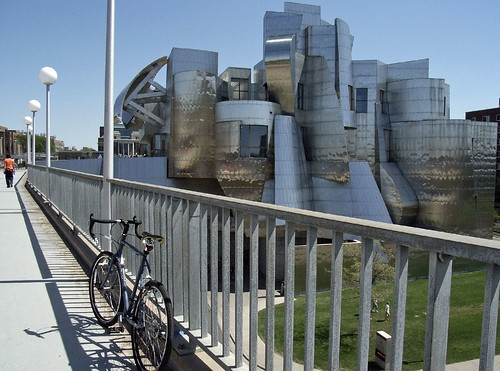
Sigh.


Sigh, or grrr. Originally uploaded by paytonc

As long as people feel that it’s socially acceptable to drive four+ ton, gas-guzzling, pedestrian-slaughtering, road-hogging tank-ettes down city streets, we’re just kidding ourselves in one big sustainability charade. Achieving true sustainability will require deep changes to social, economic, and governmental systems, going far beyond window dressing.

Oh yeah, and this “sustainable site” sits right above a ROW that’s been reserved for future transit — for thirty years now. We the taxpayers, not they the developers who stand to make a fortune off it, will probably end up building the “riverbank” (Carroll Ave.) transit line, and it’ll be decades before it ever makes it onto the capital plans.

As bad as this situation is, at least Chicago isn’t yet building “green parking garages,” as the limousine liberals in Santa Monica are. (On the bright side, I suppose, said garage cost less than $33K per space, including $1.5M in solar panels, which seems in line with costs for “unsustainable” garages elsewhere.)

Urban bites

  • You know that loft living has gone mainstream when it appears in Rocky Mount and Clayton, N.C.
  • Residential parking districts in Boulder allow 2-3 hour free parking during the day and sell parking permits to businesses and commuters — at 5X and 18X the resident price, respectively. The system still favors residents without excluding other users. (The first breach in Chicago’s obscenely underpriced RPP is the $300 citywide permit, available to people like real estate agents and home health aides.)
  • Fred Camino at MetroRiderLA diagnoses the problem with TOD as practiced in LA: parking. “Providing ample parking for vehicles orients people away from transit. But the developers don’t care because they know they won’t be able to sell their units at a ridiculously high price to the Dr. Cosmatos of the world without providing ample parking for residents and their guests. Essentially they are saying fuck transit. So Transit Oriented Developments in Los Angeles, as they stand now, are indeed bullshit and do not help reduce traffic, pollution, congestion or incease transit usage.”
  • Denver appears to be the first city to have instituted a “label match-up” law requiring motorcycles to have exhaust systems that meet EPA noise control standards. (Current laws usually rely on decibel meters, which are expensive, time consuming, and hard to use.) Motorcycle groups inevitably cried foul, citing a “double standard,” but at least one publication agrees:

    Instead of basing the requirements on the actual equipment, [legislation] tend[s] to specify sound levels, but those are hard to measure properly and require enforcement agencies to buy the necessary equipment and train personnel in its use. If legislators started by requiring exhaust system to bear the same markings found on stock pipes that show they meet EPA sound-level requirements as well as a measured noise standard, it would be easier for police to enforce. It would also give aftermarket exhaust manufacturers reason to start creating legal systems. We believe that this would be the most effective tactic… At the moment, many law-enforcement agencies find their hands tied. They cite a motorcyclists for an obviously loud exhaust, but in court they lose because the wording of laws makes the standard unclear or the measurement requirements too difficult. Art Friedman, Motorcycle Cruiser, 30 June 2003

    Apparently, Alderman Natarus asked the city to investigate “sound cameras” to issue citations based on a built-in decibel meter — another problem with enforcement is that vehicle noise is always on the move and thus hard to track. Interesting idea, although avoiding cites for emergency vehicles, etc. might be a challenge.

Megalopolis

Someone on FlyerTalk asked about “megalopolis.” An edited reply:

Actually, it was a Frenchman, Jean Gottmann, whose book “Megalopolis” was published in 1961. He originally was referring, of course, to the Eastern Seaboard, but continued metropolitan growth has led to dozens of similar situations worldwide. Gottmann said as much in “Megalopolis Revisited” in 1987.

Personally, I’ve never liked the extra syllable in there; for that matter, maybe neither did Gottman, since he used “megapolitan” instead of “megalopolitan” as the adjective form.

The Lincoln Institute of Land Policy offers a better definition, perhaps, than Wikipedia’s.

In any case, some of these regions strike me more as convenient geographic constructs than as genuine supra-metropolitan units that shape human activities. Chicago is about 400 miles from Pittsburgh, Omaha, and Kansas City; Chicago arguably has similar economic and social ties to the western cities as to Pittsburgh — so why, besides the fact that Ohio is more populous than Iowa, draw the megapolitan boundary east from Chicago? (Maybe one useful and easily obtained measure might be intercity passenger and freight flows.)

Mid-May miscellany

Quick links! The new site isn’t ready, and CNU XV is next week. Wow!

1. “Everyone should bike to work for a week, if for no other reason than the people who complain about bikers breaking the law would shut the hell up…. Bicyclists disobey traffic regulations is very predictable and self preserving ways.” — BrodyV at DCist

2. A new bike’s on its way! Looks like this — a Surly Long Haul Trucker, 52cm, which I test rode at Hub Bike Co-op in Minneapolis recently but have ordered from Boulevard.* The thought process behind that particular frame was similar to this guy’s: a solid road bike, eminently practical and comfy on short or long rides. Although everyone says I should go for a faster, lighter cross bike — like, say, the Cross Check. On my test rides the Cross-Check wasn’t any more responsive or sprightly (a tad squirrelier, maybe), although it did corner ever so slightly better. Oh, and touring bikes are trendy in a retro-’70s way, unlike, say:

“In the last few years, however, track bikes have won over a decidedly nontough, unathletic batch of acolytes: hipsters. Grab a latte on any random corner in the Haight, Castro, Mission, etc., and you’ll be treated to a veritable parade of carefully coiffed thin mints trucking along on bikes like me. Zut alors!” — Ephraim the Track Bike (SF Weekly)

However, I’m still leery of touring, if only because I find American countryside to be supremely boring. French countryside, though — Paris-Brest wouldn’t be my first choice, but it *is* awfully famous.

Update, 4 July: Photos of the bike. After the little Wisconsin journey, I’m looking into Amtrak supported tours along the Allegheny Passage from Pittsburgh, Lake Champlain from Burlington, and the Niagara region from Buffalo. Hmm — funny how a different perspective changes everything.

* Update, 9 May 2008: Boulevard now has a few Surly models built-up and in stock, so future purchasers can stay on this side of the Mississippi. North Central Cyclery in DeKalb always keeps some in stock, but (as with much else in exurban Illinois) it’s honestly easier for me to go to Minnesota.

3. Design your own street.

4. Unlike here in Illinois, state legislators in Pennsylvania are paying attention to transit funding solutions. An editorial in the Morning Call by Rep. Douglas Reichley (R-Emmaus) calls for integrated regional transit funding:

[W]e should look seriously at the model for mass transit in New York City, where bridge and tunnel tolls subsidize fares for buses and subways. We should determine if the same kind of system could be implemented in individual cities, such as Philadelphia, or even on a regional basis.

A Lehigh Valley transit authority consisting of the parking bureaus from the three major Valley cities, the Lehigh Valley International Airport, and the Lehigh and Northampton Transit Authority (LANTA) could set up a system of fees and excise taxes to help LANTA stand on its own feet financially.

Such a transition would help to end the annual plea from mass transit systems for taxpayer bailouts, and relieve the financial drain of mass transit systems on the state budget.
Urban lesson plan

Otis White is wrapping up his run of Governing’s “Urban Notebook”:http://governing.com/notebook.htm, among the first (and still among the best) urban blogs — it seems to have predated blogging software, in fact. He leaves with seven lessons:

Lesson 1: Innovate, save money, throw the bums out and use good sense.
Lesson 2: Protect the order of public spaces.
Lesson 3: Get dense: It’s how you make residents and housing affordable.
Lesson 4: Save the property tax.
Lesson 5: Tie transportation to land use.
Lesson 6: Don’t act helpless: why local leadership is important.
Lesson 7: Have fun: Cities are funny, funny places.

For further explanation, see his concise “Best of Urban Notebook”:http://governing.com/notebest.htm roundup.

His final print column includes this:

bq. Suburbs are looking more like cities did 30 years ago: commercial, crowded, ethnically diverse, hectic, poverty-pocked and unsafe in places. Suburbs are no longer the refuges we once considered them. Meanwhile, cities are getting safer, turning into gentrified magnets for empty-nesters and young singles… [H]ere’s the vision that might help metro areas […]: the complete community. Cities that have neighborhoods with suburban [bourgeois?] sensibilities, suburbs with areas of hipness, density and transit, and places in both for all income levels.

This focus on regionalism is a refreshing change from the tired city vs. suburban tirades that certain libertarian writers keep falling into. In cities all over the country, I see exciting New Urbanism being built in both city and suburb.

Chris Swope, their best (and dishiest) writer on city governance, takes over for Otis next month.

NW sightseeing

Seeing as I’m leaving for there in a few hours, thought it would be useful to post something I wrote in July in response to a request for a sightseeing itinerary along the Cascadian coast.

All three cities have new “instant neighborhoods,” light-industrial areas near downtown that are rapidly becoming mixed commercial-residential. It’s quite interesting to compare the varying approaches between and within the cities. Here’s an interesting “Seattle Times article”:http://seattletimes.nwsource.com/pacificnw/2003/0202/cover.html
on the three.

* Portland downtown, generally (what districts or buildings?)
* Orenco Station

A light rail tour of Portland is quite doable. A quick overview of what’s “around the east-west MAX stations”:http://world.nycsubway.org/us/portland/max-blue.html and a “quick restaurant guide”:http://www.extramsg.com/uploaded_misc/portland_tipsheet.html are both online.

Most of the new neighborhoods surrounding downtown can be covered using “the Portland Streetcar”:http://www.portlandstreetcar.org/map.php. Several gentrifying neighborhoods (like Hawthorne on the east side) aren’t on either line, but are easily reached using the “Frequent Bus”:http://www.trimet.org/bus/frequentservice.htm network. (I prefer MSP’s name: [Say Hi to] “Hi Frequency Service”:http://www.metrotransit.org/serviceInfo/hi-frequency.asp)

* Vancouver, downtown, residential towers

Vancouver’s downtown peninsula is very small and incredibly walkable. Most of the new towers are on or toward the waterfront, particularly along the downtown peninsula’s south edge (facing False Creek). There’s a bike rental place on Marinaside Crescent; I’d suggest renting a bicycle and taking it for a trip around the entire peninsula. Just inland is Yaletown, with some of the newest towers and (in fact) new mid-rises. Another, less successful clump of new high-rises is around Coal Harbour, on the northwest corner of downtown right by Stanley Park. Many of the suburban municipalities have also encouraged similar development around their transit nodes, so it’s worth taking SkyTrain, SeaBus, and the B-Line rapid buses out to sites like Metrotown, Lonsdale Quay, and Richmond Centre to see how other jurisdictions have done things differently. (Richmond Centre is also more like Hong Kong than Hong Kong, which is amusing.)

South of False Creek are a set of neighborhoods also worth investigating. Granville Slopes, on the south bank of False Creek, was state of the art in the 1980s — feels like a leafy suburban PUD — and shows what would’ve happened to the rest of downtown Vancouver had the city not discovered New Urbanism. Kitsilano is a yuppie area to the southwest; around Arbutus & 11th is a new low- and mid-rise, mixed-use neighborhood built on a former brewery site in the ’90s. Granville Island is a kitschy but still interesting take on a festival marketplace — less tourist-focused than the usual US version.

The city has a helpful set of publications outlining areas they view as “urban design achievements”:http://vancouver.ca/commsvcs/currentplanning/urbandesign .

In Seattle, the hot new urban neighborhoods are Belltown (between Pike Place and Seattle Center) and South Lake Union (up Westlake from downtown). There’s interesting stuff, but as the Seattle Times article makes clear, the story’s much bigger in Portland and Vancouver.

Denver

I think I’m getting better about “uploading trip photos in a timely manner”:http://flickr.com/photos/paytonc/sets/72157594419601104, although more will certainly trickle in over the next year. Some things I noticed in Denver:

* Street-runing LRT along Welton Street is resulting in gentrification of a historically Black main street, with surprisingly good retail occupancy. Not many intact Black main streets are left out there, so it’d be a shame to see this disappear.
* South Broadway has what looks like a Motor Row, also threatened by development.
* What is up with the giant arched atria in every 1980s building? Wells Fargo has by far the most ostentatious of the bunch, even more so than the performing arts center, but sheesh. Was it city policy at the time?
* Stapleton, slightly to my surprise, is in the metro’s unfavored sector (northeast; “MARC”:http://www.metroresearch.org/projects/national_report_region.asp?region=9 has favored/unfavored sector maps). In fact, to get there from downtown you take “Martin Luther King, Jr. Boulevard”:http://www.sallygreene.org/mlk.htm. Apparently, it’s not a big challenge for retail leasing — there’s little competing new retail along the corridor, and a large population base — but they’ve done an admirable job with addressing the “schools issue”:http://www.sellstapleton.com/schools.php through choices like charter schools.
* Add Boulder to the short list of places where driving has declined considerably. Mode split of downtown commuters, 1999 to 2005: drive alone 59% to 36% (-39%), transit 14% to 34% (+143%). Walk/bike accounted for 14% in 2005, carpooling for 9%.

Big plans

Mayor Bloomberg recently announced PLANYC2030, a — yes — comprehensive plan and sustainability plan for New York City rolled into one.

The clearly stated goals for 2030 include
* reducing GHG emissions 30%+ (considering the age of the building stock, this is bigger than the 2030 Challenge’s goal of carbon-neutral new buildings by 2030)
* cleaning all contaminated land
* making 90% of waterways safe for recreation
* build one million new homes

Again, a few Chicago departments have shown that they’re capable of setting quantifiable long-term targets with real-world significance (e.g., families helped instead of dollars spent), reporting on their progress, and achieving them — Housing and Bicycle, for example. Yet where’s the climate change planning effort?

Exaggerated?

bq. the City of Berkeley… will lose one of the best opportunities anywhere for leading the world into a sane and healthy 21st Century… Why would I say something as extravagant as claiming the opportunity is one of the best in the world? Because the world is facing the largest crisis in 65 million years and if the right thing is built there, that particular development would constitute a major and early part in the solution to that crisis.

This sort of self-obsessed hyperbole [from “EcoCity Builders”:http://www.ecocitybuilders.org/about.html%5D, asserting that two acres in California are somehow vastly more crucial towards solving all the world’s problems than the 99.9999999946% of the earth’s land area around it, is one reason why I can’t see myself working in the Bay Area anytime soon. One can easily say that the Berkeley community deserves and demands an environmentally superior solution, that the world faces multiple environmental crises and that new development can help to start to address these crises, etc. However, asserting that you (and/or your pet project) are singularly tasked with changing the future of the world says more about your ego than anything else.