Drowning? We’ll build you a bridge

Jacob Hacker has a great analogy for “the ownership society” in TNR:
The conservative response to rising insecurity is equivalent to tossing a lead weight to a drowning man on the assumption that, now, he will really have an incentive to swim.
It’s all about incentives, right?

From DC’s truth-stranger-than-fiction department, the new “highway bill” contains, of course, a record number of earmarks — since Congressmen, not planners, of course, know what’s best for America’s transportation needs. Riiiight. Rep. Don Young (R-AK) proudly says he “stuffed” TEA-LU — the “Legacy for Users” an excuse to put his wife’s name into his true pride and joy — “like a turkey,” particularly with one project so incredibly useless that its folly could only be paralleled in a land ruled by a feebleminded (if sharply dressed) despot:

$231 million for a bridge that will connect Anchorage to Port MacKenzie, a rural area that has exactly one resident.

The same amount of cash invested in, say, the Mid-City Transitway could buy a transit line with 30,000 passengers a day. But… no. This is how the Republicans describe “smaller government.” Maybe I should write a check to the Alaskan Independence Party to help them secede from the Union and stop wasting our tax dollars.

Edit 18 August: Garrison Keillor writes in his syndicated column: “Had Minnesota voted Republican, as Alaska wisely did, we might have gotten a canal connecting the Mississippi to Lake Superior and a high-speed rail link between Bemidji and Roseau and maybe a 10,000-foot runway at the Waseca (pop. 8,389) International Airport.” He also suggests that English majors band together to demand $223 million libraries from the feds, “equipped with leather sofas and an espresso bar and librarians who are trained in pressure-point massage. Greek columns would be nice, and a pair of stone lions, and a rare book collection and a three-story lobby with marble floors so your footsteps echo as if you were in an Edith Wharton novel. And a statue of Minerva.”

Car kabob


Car kabob

Originally uploaded by paytonc.

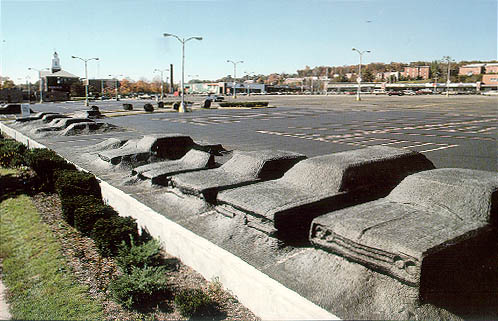
Last weekend, the Perimeter Ride took its second annual detour to see “Spindle,” a 1989 commission by Dustin Shuler in the parking lot of the aging Berwyn Plaza. (A Service Merchandise there has sat empty since its bankruptcy in 1999; the parking lot is crumbling, some of the artworks have deteriorated, and the town around it has changed considerably, to say the least.)

While googling the artist to locate his other works in California, I found several mentions of other artworks placed at strip malls by developer David Bermant–notably at Hamden Plaza outside New Haven. However, it turns out that a lot of the whimsical strip-mall conceptual art of the 1970s and 1980s has disappeared. Commercial priorities of new owners has subsumed much of the early work by James Wines at SITE, including Ghost Parking Lot (photo) and eight of the nine weird Best Products showrooms. (“Forest” in Henrico, Va., is the lone survivor; it’s now a peacefully wooded setting for a church.) Even the Spindle has been threatened: 69% of Berwynites voted to remove it in a primary-election referendum just a year after its installation, and other works (including SITE’s Floating McDonald’s, replaced by a standard outlet) have disappeared from Berwyn Plaza.

What the wacky, anti-consumerist artists were doing installing pieces in shopping malls in the first place isn’t quite the point; it’s that, once installed, I would have assumed that suburbanites’ inherently conservative tendencies would have left the works standing. However, the forces of commerce and progress are perhaps too strong to remain provoked, even in what are now decaying inner-ring ‘burbs.

Illinois the disturbed

An interesting map in Sunday’s NYT shows that, by the standards of the Wildlife Conservation Society, Illinois is perhaps the nation’s least “wild” state — almost all of its terrain has seen substantial human disturbance. Unlike other states, no inhospitable slopes or deserts stubbornly resisted settlement; the settlers planted their stakes across the Prairie State with ease, showing perhaps that this state was uniquely suited for human settlement.

Wal*Mart dreams


What Wal*Mart dreams of

Originally uploaded by paytonc.

Neighbors gathering in the street… gabled houses and picket fences sheltered by trees… striped awnings shading corner stores… this was life before Wal*Mart paved it all over for a 50-acre Supercenter, right? Oddly enough, this mistily maudlin illustration of idyllic small-town bliss appeared in a propaganda advertisement placed by Wal*Mart in the New York Review of Books in April.

80% of Americans would probably never allow their children to walk the dog in the street out of a well-founded fear of traffic, but Brobdignagian corporations like Wal*Mart continue to use the visual vocabulary of walkable American neighborhoods (a way of life that said corporations bulldozed decades ago en route to greater profit) to cloak themselves in a comfortably gauzy veneer of Pax Americana. Yet Wal*Mart is the exemplar of the economy that has “progressed” and “expanded” to the point where the friendliness and comfort of this scene have been deemed insufficiently enticing of consumer desire, and therefore un-American. After all, where in this scene could one find a GM Hummer H3, or 20-pound box of America’s Value Choice from Sam’s Club fish sticks, or a $3,000 Weber grill? Disgusting.

Pride of second city hit again

Sandra Jones in Crain’s points out, and Sandra Guy in the Sun-Times insinuates, that Federated’s decision not to terminate Lord & Taylor’s 54 stores puts the writing on the wall for Marshall Field’s 60 stores. Simply put, Federated’s goal above all else is to make Macy’s the national department store, a feat never before accomplished in a marketplace where local names once held tremendous sway. Field’s three principal markets–Chicago, Detroit, and the Twin Cities — are too important to that strategy, and if L&T stands in those markets, then Macy’s only entr�e will be to replace Field’s. Both are boutique operations compared with what will soon be 730 Macy’s, and Federated clearly thinks that Macy’s can trade at the same upper-middle level as Field’s.

And thus, within the span of a few years, Federated will have killed off maybe 1,600 years of American retailing history, wiping out the pride and joy of the gentries of a score of cities. All replaced, of course, by a trio of names from the self-proclaimed Capital of the World.

The list of store closings will open up a few choice mall opportunities (UTC in San Diego, King of Prussia, Burlington and Natick near Boston, and a bunch of those dual Robinsons-Mays in Southern California) but oddly doesn’t affect any of the half-dozen downtowns (e.g., Boston or Los Angeles or St. Louis, where Famous-Barr does almost no trade) which might have feared store closings.

Bring home the bacon

Surprising find in the list of Illinois earmarks inserted into the House version of SAFETEA: $4 million for the Eisenhower cap in Oak Park. Also interesting: Cermak BRT, not Ogden Transitway, was singled out for cash — maybe Lipinski, Jr. has different priorities?

Not so surprising: the Hastert Highway. Sigh.

Not at all surprising: only 12.6% of the $215.5M in earmarks will be spent in a city with 23% of the state’s population. (Granted, the city might do better in getting allocations from awarded, non-pork funds.)

Great route planning resource

One really neat new Google Maps add-on, for others who plan route maps (e.g., walking tours): Pedometer, a tool that allows you not only to create connect-the-dots route outlines (just click on the intersections) but also gives distances and perhaps even calories burned, and gives a one-click TinyURL to the finished result. Way cool, and really damn easy.

Flying Squirrel

Years ago, I joked with a biology student that his long hours in the lab were spent breeding aggression into the local squirrels, who seemed a little too acclimated to people. Eventually, this escalated into an imaginary project to create Flying Attack Squirrels. (I guess you had to be there to see the hilarity.) Little did we know that just a few blocks away was a playground so rife with flying squirrels that it was named Flying Squirrel Playlot Park, apparently because flying squirrels’ range once extended this far west.

Traffic Management Authority must go

This new Traffic Management Authority is now officially way, way out of hand. Fran Spielman and Lisa Donovan of the Sun-Times report that the authority has stolen 26% of the crossing time from pedestrians at State & Washington, one of the city’s flagship pedestrian intersections — and given that time to right-turning cars.

We’re moving completely in the wrong direction here. Other cities like New York and San Francisco are embracing signal timing solutions that benefit pedestrians: scramble signals (all traffic stops, all pedestrians go), Leading Pedestrian Intervals, and, in New York, “thru streets” where all turns are banned to improve pedestrian flow. In fact, Washington Street is designated in the zoning ordinance as a “mobility street,” where new development should “promote safe and efficient pedestrian flows” (sec. 17-4-0604). And here city officials are stepping in to demote safe and efficient pedestrian flows — all in the name of adding a little bit of convenience to THREE drivers per light cycle. Three!

I would be willing to bet that people in private cars are no more than 20% of the PEOPLE who move down State Street every day. Cars on State Street are vastly outnumbered by people walking, riding buses or trains, or on bicycles.

IIRC, the city received a substantial CMAQ grant a few years back to coordinate the pedestrian signals downtown — someone walking at a brisk pace across the Loop can make all green lights. Reducing pedestrian timing would mess up this existing system, frustrating pedestrians — although that seems to be the point here.

The gauntlet has been set. Gridlockers, let’s meet at the Campaign for a Free & Clear Lakefront’s “God Save the Queen’s Landing” rally tomorrow (4pm, Buckingham Fountain) and strategize for how to defeat the “slay those pesky pedestrians, all hail almighty car” attitude of this new Traffic Authority. The “traffic problem” downtown is entirely the fault of there being too many cars — not because of pedestrians or buses or trains or bicycles. Downtown would thrive with fewer cars; it would die with fewer pedestrians, but the blind bureaucrats don’t understand that. They’d rather demolish everything and just pave it over: then we’d have no traffic because there’d be nowhere to go to! How amazing!

High gas prices draining metro economies

The 2005 edition of Driven to Spend, just released by STPP and CNT, finds that households spent 52% of their 2003 income on housing and transportation, a figure that’s undoubtedly higher today thanks to a run-up in both. Indeed, both have been rising substantially; despite higher incomes overall, housing and transport expenditures have both doubled as a share of household expenses over the past 40 years — e.g., they’ve grown twice as fast as incomes! American auto dependence has gotten to the point where 11% of the world’s crude oil goes into American gas tanks.

More importantly, cities with extensive public transit already save their residents billions of dollars in personal expenditures each year — a figure that will grow as higher gas prices further raise the cost of driving. “[R]egions with transit are losing less per household from the increase in gas prices… [I]nvestments by… government in more efficient transportation systems, effectively lower[s]… transportation expenditures and convert[s] transportation dollars that would otherwise leave the region in the form of higher payments for gasoline to dollars that help pay for local transportation services plus other household expenses.”

A one-cent increase in gas prices mean that the Big Oil companies and despots who control most of the world’s oil (nearly 2/3 of American oil is imported) get to suck an additional $1.4 billion out of the pockets of American consumers — money that could otherwise be invested or spent in America, for Americans. The toll is especially high for regions that have no local oil industry and therefore see little economic gain from Big Oil: higher gas prices in 2004 took nearly $800 million from metro Chicago and nearly $500 million from both metro Detroit and metro Washington. Interestingly, the New York metro lost $20 million less to Big Oil than Chicago, even though New York has 17% more households — principally because New Yorkers use transit more and drive less. The state of Florida lost $2.3 billion to Big Oil, again more than more-populous New York state due to the former’s auto dependence.

Just think what our metropolitan economies could do with billions of extra dollars. Or, imagine if someone (ahem) had raised gas TAXES earlier, thereby making sure that those billions go back to us Americans instead of building submarine sandcastles in the Persian Gulf for oil sheiks to play in.

Admiring the view


Admiring the mountain view

Originally uploaded by paytonc.

A cyclist pauses to, well, ignore the view. Montr�al, Vancouver, and Portland all share the same glory: a T1 forested mountain butting up against T6 downtown, with the skyscrapers and mountain offering fantastic views of one another. Montr�al has the added good sense to cap the buildings’ heights to keep the two in dialogue with one another.