Cycling Rantzausgade


Cycling Rantzausgade

Originally uploaded by Payton Chung

Click on the link for a video of a retail street in the Nørrebro area in western Copenhagen. About one block behind is a chokepoint (as it crosses a greenway) which doesn’t allow cars or motorcycles past — only buses and cyclists can go through — but the shops still do fine with just local traffic circulation. The video stops at the intersection with Aboulevard, the main artery into Copenhagen from the west: it’s not a freeway, it has separated bike lanes, and during my quick observation about 25% of the vehicles even there were bikes.

This is what I mean by cycling there being an "effortless revelation."

What I’m reading today

[This started short and got quite lengthy. Maybe I’ll break off parts later.]

1. Citywide bike sharing arrives in the Midwest this week when Nice Ride launches in Minneapolis, using Bixi technology. (I had hoped to be there for the launch, but it looks like I’ll be there in July instead.) Interesting: (1) BCBS is the lead sponsor and (2) the city is not resting on its laurels (the article finds that the communitarian Minnesota culture is the key factor); the bikeway network is due to grow by 30% this year.

2. Jeff Speck in Architect uses the same taxonomy of New Urbanist critics — which he calls Lib[ertarian], Mod[ernist], and Saint — that I incompletely delineated in an earlier study of “Additional Myths About New Urbanism.” I used right, avant-garde, and left, but the themes are the same. Nice point in his final paragraph, addressing the Saints: new urbanism is a reform movement, not a revolutionary movement. We can’t fix everything all at once since we don’t aim to; it’s incremental change, not an entirely new world order.

Which reminds me: an offhand remark by Andres Duany about how crowds of suburban teenagers can “love the city to death” — suffocating the diversity of uses and people in the Sunbelt’s few-and-far-between urban oases — has drawn a storm of the same old Saint/Mod criticisms (only this time some bloggers are taking it personally!) about NU being exclusionary, authoritarian, static, hopelessly middle-class and middle-aged and middle-brow.

The answer to such critics is the same. Reform takes time, places evolve, and diversity must be managed as it’s actually not the natural order of human ecology. The same critics enthralled with “emergent, incremental, accretive” urbanism haven’t the patience to let Kentlands’ trees grow in, don’t understand that New Urbanists seek not to take away great places but to create new places that will, in time, evolve into great ones. Or, as I’ve said before, “today’s Old Urbanism was yesteryear’s New Urbanism, and therefore that today’s New Urbanism, in due time, will be tomorrow’s Old Urbanism… time is the most necessary ingredient to create the ‘authentic urbanism’ that many critics of New Urbanism cite in false opposition to NU.” In other words, give us a hundred years.

Of course, Duany doesn’t speak for the entire movement, and his admiration for civil libertarian’s bugaboo of Singapore — which actually does a better job than the USA of guaranteeing its citizens human rights like health, housing, education, and safety, not to mention protection from rights violations — is not exactly a plea for tyranny. I disagree with Duany about democracy’s utility: not a surfeit of democracy per se, but rather a fake populism that empowers a vocal [small-c] conservative minority, has impeded urban evolution.

3. Speaking of history and democracy, Charles Siegel writes about “Unplanning” over at Planetizen, arguing to some extent that planners caused the auto domination of American cities — whereas politicians should have kept them in check. While that may be true around the margins — different cities on the same continent have chosen rather different paths towards relative auto domination, as Patrick Condon (links to PDF) points out — my own reading of history (relying on Peter Norton here) says otherwise. Auto domination was a conscious political choice made in the 1920s, before the era of professional planning (or rather, traffic engineering), by political elites who sided with affluent auto drivers in their fight to claim road space from working-class pedestrians and middle-class transit riders. Indeed, overt attempts to politically legislate exactly the slow-traffic conditions that he outlines failed miserably: a 1923 initiative in Cincinnati (placed on the ballot with 42,000 petition signatures) that would have mechanically prohibited autos from going faster than 25MPH went down to defeat after a furious campaign by the Auto Club and newspapers.

4. More history: an oral history documentation project of LA Chinatown during my grandfather’s era.

5. From The Atlantic‘s special city issue, a reminder by Benjamin Schwarz that “Manhattan never was what we think it was” — or what Village writers like Sorkin and Zukin think it was. The bohemian, deindustrializing Lower Manhattan (itself hardly static) that so many exhibit a false nostalgia for was “pretty much limited to the years of the LaGuardia administration,” and itself was quite an exception within a vast urban “agglomeration of mostly self-sufficient, inward-looking, lower-middle-class communities.” Yes, Jane Jacobs wrote convincingly about how that city worked, because she lived in it. Yet many take the wrong message away from Jacobs: the look and feel of the industrial city were just the backdrop; her principles say nothing about post-industrial gentrification. Jacobs loved watching systems emerge and evolve from market interactions; heavy-handed intervention was most certainly not her style.

Yet the paralyzed political climate that has resulted from empowered neighborhood “activists” (see #2 above) has stunted urban evolution — always driven by markets’ creative destruction — in the name of this faux “authenticity.” These “activists” don’t realize that the problem they seek to solve isn’t with architects or planners or even with developers, it’s with “all that is solid melts into air” capitalism itself. There are ways around this, and I’m excited to see that authors like Matt Hern get this and are doing something about this: shutting down streets and setting up collectives to reclaim space, not just a setting, for society. The planners, cops, and Tories he antagonizes turn out to be mostly reasonable people, doing pretty good work within a flawed system larger than all of them. Sure, he has his share of “can’t we all just get along” platitudes, but even those are grounded in a sense of possibility and progress. Perhaps it’s due to his base outside the Greenwich Village snowglobe, in a peripheral city simultaneously tossed about by globalization, blessed with a surprising degree of autonomy, and relatively unweighted by hidebound tradition. It’s a much fresher take on “finding real place” than I found in either Zukin or Sorkin’s books.

6. More authenticity: Hong Kong, which made an interesting decision to conserve and rehabilitate one of its original public housing blocks, will now preserve Wing Lee street. It gained notoriety principally for being an actual movie set, the only place where directors could recreate a feel of 1950s tenement life.

7. Just nudging urbanism along in California could cut CO2 emissions in half — and by 75% over a business as usual scenario, according to new research by Peter Calthorpe. The household savings angle is an interesting one to push: the less people spend on cars and oil, the more they’ll have to spend on houses — preserving the property values which are so incredibly paramount to California politics. Jarvis League, are you listening?

8. “You want to know who Sarah Palin is? She’s the False Maria in Metropolis! That’s who she is.” — Peter Trachtenberg

9. The world’s thirst for oil has outpaced humans’ capacity to “safely” (if we ever could) drill for (and burn) it. Sickening pollution is intrinsic to oil; the act of driving is drilling. And as we’re finding out, drilling technology has advanced faster than spill-cleanup technology. Boycotting one company won’t help; they all have tar and blood on their hands. Alexandra Paul at HuffPo:

There is a story about a scorpion asking a frog to carry him across a river. The frog is afraid of being stung, but the scorpion reassures him that if he stung the frog, the scorpion would drown as well. So the frog agrees to be carried on the scorpion’s back across the river. Mid-river, the scorpion stings the frog, dooming the two of them. As they are sinking, the scorpion explains, “I’m a scorpion; stinging is my nature.”

Ocean drilling is the nature of oil companies. It is what they do, even if it dooms us all. We can be angry about how they are ineffectively dealing with their mess, but in the end, BP is drilling for oil in environmentally sensitive areas for one reason only: we need the oil they provide.

Oh, please.


Oh, please. Originally uploaded by Payton Chung

What purpose does this stop sign serve? There is no cross traffic to stop for at School & Clifton in Lakeview.

This stop sign, and thousands more throughout Chicago, exist not to promote traffic flow but to make drivers obey the speed limit and yield to pedestrians. Instead of creating more and useless rules (which do have consequences — like impacting the way bikes move through the city), how about honoring and enforcing the ones that we already have?

As a cyclist who respects safety and order, I resent being obligated to constantly break the law in order to stay safe. I find it unconscionable that regulations have turned cautious road users into outlaws, while rewarding dangerous behavior (like zooming between stop signs, something today’s cars do with ease). Street regulations — like laws about, say, marriage — should change to accommodate harmless and socially accepted behavior.

Fads

“The most ass-backwards renewal gimmicks yet, shrinkage and farming simply restate the formula for racially driven sprawl that wrecked Detroit, only this time in the jargon of environmentalism and, God help us, urbanism.” Will Boisvert, “Motor City Elegy,” in The Baffler vol 2 no 1, pg 102

Breaking News

This was emailed to Break the Gridlock yesterday:

NASCAR To Terminate All Auto Races Following Gulf Oil Spill

By JENNA FRYER
AP Auto Racing  Writer

Ashamed and appalled at the devastation of British Petroleum’s Gulf of Mexico Oil spill, NASCAR Board Chairman Brian France announced today the end of NASCAR’s car and auto racing empire. “The impact on thousands of NASCAR Fans in the Deep South is clear,” He said, “NASCAR will be reorganizing as NACHAR, the National Association of Chariot Racing.” “Chariot Racing is a true Man’s Sport,” quipped NASCAR’s Jimmie Johnson, while overseeing the design of his first NACHAR Chariot, to be named the Ben Hur. Dale Earnhardt, Jr. endorsed the move, adding “I confess, our critics have had one thing right for years: NASCAR Drivers are not athletes, Chariot Racing will give them the opportunity to really impress the waitresses at Hooters.”

NACHAR’s target date for  the Chariot Rollout is July 4th. The depavement of raceways, and replacement with packed red clay for the Chariot Races is already underway at several racetracks. Parking lots are being downsized and converted for Horse and bicycle parking. Limited automobile parking will still be available for people with mobility issues. Plans are to depave about 90% of the parking lots, and replace them with demonstration permaculture gardens, the produce to be promoted and sold as a healthier alternative to former NASCAR fans. Company Vice President James France cited private studies by the National Institutes of Health commissioned by NASCAR, confirming a threefold incidence of obesity and heart disease among NASCAR fans as motivation for the change. “This is change NASCAR Fans can believe in,” He said, “We want our fans to be around in their Golden Years, so they can enjoy Chariot Racing with their Grandchildren.”

Executive Vice President Lesa Kennedy was enthusiastic about the move, and added the that NASCAR is boycotting all British Petroleum products and terminated BP’s sponsorship for the final week of NASCAR events. “My Daytona Beach neighbors have expressed sheer excitement about the changes,” gushed Ms. Kennedy. A surprise lineup of Celebrities and Racehorses is planned for the July 4th Daytona Beach NACHAR Races. The NACHAR.com website rollout is scheduled for May 27th.

Livable streets: a platform for national political success

In the USA, talk of implementing livable streets policies at the national level has ignited the usual rural-urban standoff, wherein rural areas accustomed to receiving generous road subsidies are sniping at the idea that new rules might reward metropolitan areas for being more productive and efficient.

Yet in Colombia, the picture looks quite different: on Sunday, the country may well elect Antanas Mockus as the world’s first Green Party head of state; he’s a former Bogotá mayor who championed that city’s numerous public space initiatives. And, of course, South Korea’s president Lee Myung-bak — “the bulldozer” — won his reputation as mayor of Seoul by fulfilling a campaign promise to demolish the freeway covering the Cheonggyecheon river.

No open space in my backyard (2)

An open letter sent to CROP, regarding a proposed orchard nearby. BTW, the title refers to another fight over what to do with another backyard I had.

I live [south of Logan Square, near the] city-owned vacant parcel that has been identified as “future community open space.” I recently heard about a plan being advanced to develop that parcel as a fruit orchard, rather than the market plaza promised by the Logan Square Open Space Plan. This proposal puzzles and concerns me, since this location strikes me as a particularly poor location for agriculture.

I have spent my career advocating for smart neighborhood and city planning, including longtime volunteer service on local planning in the West Town and Logan Square community areas. I also spent years as a community gardener at Greenhouse Garden in Ukrainian Village, which houses a number of espaliered heirloom fruit trees.

When I participated in the Logan Square Open Space Plan public outreach process, the conversation about this parcel centered around creating a space filled with human activity. That makes sense given that this is one of Logan Square’s busiest corners, with thriving businesses opening up all around. Pedestrian-oriented retail districts like this need a critical mass of activity to thrive, and that activity should be reinforced whenever possible. That the retail is growing despite nearby parking lots, blank walls, empty storefronts, and high-speed thoroughfares is heartening, but we cannot take further growth for granted. A market plaza would bring more people and more commerce to this corner, helping all of the nearby businesses thrive…

An orchard, closed and gated to the public for all but a few days each year (I know from experience that otherwise fruit and/or trees would be lost to theft or vandalism), would do nothing to reinforce this hub of activity. Creating a “walled garden” (lasting at least several, if not a hundred, years) at the key junction of the Logan-Milwaukee business district will freeze this budding area’s growth and prevent it from coalescing into something greater. In addition, I know from having dug in my own yard that the soil underneath this site does not lend itself to trees: construction of the subway portal and trench required extensive excavation which was backfilled with gravel aggregate, which lurks just a foot beneath the ground.

Scores of vacant lots exist elsewhere in Logan Square, Humboldt Park, and Garfield Park, including high-visibility sites along the boulevard system or near the future Bloomingdale Trail. In fact, the Logan Square Open Space Plan identified several lots that would be ideal for community gardens, provided a group (like yours) was willing to step up and organize management of the site. Many of these would make for suitable locations for quiet agricultural uses, reinforcing the areas’ quiet residential or industrial character.

I wish your organization luck on finding a great site for your worthy project.

Tidbits, 11 May

  • In a classic case of Manhattan myopia, Ed Glaeser makes an oversimplified argument that high-rises can spur economic diversity in Economix. Two crucial shortcomings to the argument: (1) high-rises have inordinately high construction costs per unit, due to expensive steel/concrete structures and elevators; and (2) their highly standardized units and interiors, and high ratio of communal-but-not-common space, resist any efforts to meaningfully mix price points within.
  • “The Deepwater Horizon spill illustrates that every gallon of gas is a gallon of risks — risks of spills in production and transport, of worker deaths, of asthma-inducing air pollution and of climate change, to name a few. We should print these risks on every gasoline receipt, just as we label smoking’s risks on cigarette packs. And we should throw our newfound political will behind a sweeping commitment to use less gas — build cars that use less oil (or none at all) and figure out better ways to transport Americans.” — Lisa Margonelli in the NYT (h/t Ryan Avent)
  • Brookings (via TNR) unveiled an interesting new metro-area cluster typology. Larger growing regions can be low-education “border growth,” better educated and whiter “New Heartland” (Charlotte, Columbus, KC, MSP, SLC), or diverse and highly educated “Next Frontier” (they bet on Albuquerque, Austin, DC, Denver, DFW, Houston, Sacramento, Seattle, and Tucson). The “rust belt” divides into stable, better educated “Skilled Anchor” (Hartford, Milwaukee, Pittsburgh) and declining, less educated “Industrial Core” cities (Memphis, New Orleans, Toledo).
  • Seems like I’m not the only one who’s disappointed by the New United Airlines’ adoption of Continental’s whiffleball clip-art logo. It offers some peculiarly ugly typography — notably the stem on the uppercase U, which appears to be, in a sad twist on the false small caps of UA’s 90s look, an inverted and enlarged n. Contrast that with the “Helvetica on fast forward” look of the current wordmark, so clean and detailed that it draws attention to the angles snipped into the T. What also worries me is that the new company seems, so far, to be taking its design cues from Continental’s graphically blunt advertising, which features all-caps headlines, underlines (more appropriate for emphasis on typewriters than in digital media), high contrast colors, and predictable visuals — quite different from UA’s almost too elegant, soft-sell approach of spare watercolor illustration, in greys and pastels, set against lots of whitespace. In fact, Continental’s ad agency deliberately says about its strategy: “forgo the flowery imagery and messaging of typical airline ads and focus on what really matters to business travelers: getting basic needs met with consistency. Our campaign… talks to travelers in a simple, straightforward style and voice…” The visual contrast is nowhere more evident than in comparing their recent TV spots; particularly the parting shot that introduces the logo:


    (Interestingly, in choosing blue as the new airline color, it appears that US aviation is joining other duopoly markets that have coalesced around red vs. blue. Coke-Pepsi, Colgate-Crest, Labour-Tory, Republican-Democrat, TWA-Pan Am, and now Delta-United.) [originally posted to FT]

  • A recent article on “Chinglish” in the NYT reveals that the Shanghai government has been cracking down on poor English translations. That might explain why the amusing picture book cited in the article was one of the few English-language books widely available at most bookshops, gift shops, and the like — having it everywhere sure seemed strange given China’s strong aversion to embarrassment.

Rising and ebbing

An interesting way of visualizing the changing fortunes of American cities is at this graph of metropolitan population ranks over time, compiled by Greg Slayden. Some notable trends:
– The most “turbulent” periods appear to be the western settlement in 1820-1860 and the rise of the Sunbelt in 1970-1990
– Dramatic movements appear just as often as stable oscillations, particularly when cities appear or disappear from the list
– The only city that appears on the Top 20 list, disappears, then makes a comeback appears to be Seattle

Might be interesting to group the cities — say, regionally, to see the rise of different parts of the country.

Forevermore 2: “authenticity”


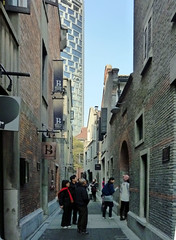
Xintiandi Originally uploaded by Payton Chung

Xintiandi is a fantastically successful upmarket shopping center in central Shanghai that combines restored lilong (townhouses along narrow interior lanes) with new construction buildings, squares, and passages. Large new buildings with a cinema, enclosed mall, high-rise hotels, and fantastically expensive apartments have been arranged around its edges.

Its popularity with foreigners (and subsequent priciness) proves a bit vexing. I’d love to think that it’s a model for adaptively reusing historic buildings elsewhere in Shanghai — they won’t know the value of what they’re destroying until it’s long gone — but its popularity with expats (and American architect, and American awards) might actually reinforce the local perception that urban placemaking is for other people to play in, not for something actually worth living in.

Not that I don’t run into similar feelings in the States — as when trying to sell the idea of walkable downtowns to suburbanites by showing examples from posh railroad suburbs, gentrified city neighborhoods, or plush suburban lifestyle centers. "Yes, well that works for those fancy people. We like our strip malls just fine." Yet in the States, at least you can blame that on cultural amnesia: people have plumb forgotten what city/town life means. In China, though, there’s no excuse other than their willful obsession with novelty (even when they’ve a ca. 1955 idea of tomorrow). It also takes a lot more skill and careful consideration to get a Xintiandi right than a Portman Ritz right — the rewards are richer and more durable, but the go-go attitude in China favors quick, shiny, and slapdash. I’m all for letting people learn from their own mistakes, but it’s still painful to watch.

The whole experience, and knowing that these buildings represent not "Chinese history" but "Western imperialist history" to the locals, really continues to confound my expectations about authenticity. It’s like space, place, and use have nothing to do with one another — and in someplace as crowded (and thus alive with market potential) as China, where use traditionally has never been regulated, maybe they don’t.

(I expect to write a bit more about authenticity in a little book review soon.)

Melting away


Melting away Originally uploaded by Payton Chung

A sign inside the Shanghai Urban Planning Exhibition Hall notes that, over the past 20 years, nearly 1M households have been relocated from 42.81M m^2 (466.2 million square feet) of demolished “shabby and dilapidated houses.”

Now, imagine if all the office space in the entire Washington-Baltimore region — or all those in NYC, Long Island, and southwest Connecticut — were swept away, beginning with the inauguration of G. H. W. Bush. That’s the scale of change underway.

Of course, the scale is entirely necessary due to a metro population growing at nearly one million people a year. My interest in urban issues began with realizing that the city around me would add a million people during my childhood — a stupendous pace for America, but downright leisurely in the context of urban China. With population growth on that scale, I can’t blame decision-makers in Shanghai for deciding to demolish lower-scale neighborhoods in favor of high-rise developments. Where else would people go: the suburbs?