A glance at Hong Kong MTR’s retail results

Mall entrance

An attempt to answer a recent Twitter exchange ran over the 140 characters, so here it is. I have another post underway about MTR’s unusual value-capture business model and its implication on stations, so this is useful background research.

Per analysis of MTR’s 2012 annual report, the typical MTR mall is ~100KSF (median 85KSF, avg 130KSF), which is certainly a neighborhood or community scale retail center. The report lists 19 held investment properties in retail use, accounting for 79.6% of the investment properties’ area; another 15.3% is in office. The “Property and Other” business unit also includes property management, Octopus, etc.

Three malls qualify as regional retail, with over 300,000 sq. ft. of leasable area (a typical million-foot regional mall in the USA will have about 300,000 leasable, with the rest tied up in various owned parcels like department stores): Maritime Square at 316,779, Telford Plaza at 640,245, and Elements at 498,762. Most serve a local market, as evidenced by the Chinese-language-only MTR Malls directory, but with Hong Kong’s density that market can be surprisingly deep. Elements, atop the airport express rail station and adjacent to the new high-speed rail terminal, certainly aspires to a higher-end audience with its Madison Avenue-caliber roster of haute couture — and English-first website.

55.4% of MTR’s total 2012 profits stemmed from property and in-station commerce: 36.1% from rents and management income and 19.3% in for-sale development. Profit margins on the property businesses are certainly healthy: 81.6% on investment property and 89.2% on in-station commercial, vs. 46.1% on Hong Kong transport and just 4.7% on the emerging international transport businesses. A near-90% margin practically qualifies as minting money. (In fact, it’s much better than minting money: the U.S. Mint cleared only 21% seigniorage on circulating currency in 2012.)

Note that in-station commercial offers the richest margins; over half of this business unit’s revenues come from in-station retail, with the rest from advertising and telecom fees within stations. MTR collected US$276.4 million on 608,729 square feet of in-station retail, for an unbelievable-for-the-US (but not for HK) average rental rate of $454/foot, well over twice the rents garnered per foot of investment property above the stations. Averaged across MTR’s 84 heavy-rail stations, that’s 7,247 square feet of retail per station.

A few facts that surprised me:
1. Retail accounts for most of ongoing income; office is just a sideline, and rental residential miniscule.
2. In-station retail rents for substantially more than the flashier malls above.
3. Aside from a few properties (of leviathan scale: Telford Gardens has almost 5,000 apartments; Elements is the retail portion of a Canary Wharf-sized, 12-million-foot mixed-use complex), the scale of station retail centers is usually fairly modest, although admittedly Hong Kong makes very good use of every available square foot.
4. Residential activities are almost all for-sale, unusual in a city that’s about evenly split between owner-occupiers and renters. However, its government owners probably want to focus housing development within HKHA/HKHS.
5. Margins on the core transit business are much stronger than I expected, particularly relative to the industry average.
6. Operating margins on the property business are generous, but comparable to REITs Stateside. Although net operating income (NOI) and operating margins aren’t GAAP measures, since different companies allocate costs like general operations or capex very differently, a quick review of three retail REIT financials (FRT, GGP, HHC) show the best with net operating margins in the low 80%s. The in-station retail’s 89% doesn’t sound much higher, but it implies operating costs half as high on a percentage basis, perhaps explained by the combination of higher rents, lower wages, lower taxes, and division of expenses between the property and transit businesses.

Openings: retail possibilities at Union Station, Metro Center

Two recent retail news items in downtown DC reported by Jonathan O’Connell in the Post:

Union Station, East Hall

B. Smith’s, the restaurant inside the former State Reception Room (Presidential suite) at the east end of Union Station, has announced its imminent departure.

The managers of Union Station have done well re-merchandising the West Hall with popular quick-casual restaurants in recent years: its current tenants include Chipotle, Chop’t, Potbelly, Roti, Yo Sushi, and now Shake Shack (perhaps in the vacant America! restaurant space). It’s true that the West Hall offers a superior location astride the path between the Metro entrance and the Great Hall, whereas the East Hall (pictured above with its jewelry kiosks) was always a cul-de-sac — for obvious security reasons, the State Reception Room was secluded. The odd thing is, the West Hall was historically just a ticket lobby (see old floor plan here or current floor plan here); the East Hall that was purpose-built for foodservice:

Union Station Dining Room

(This and other great vintage postcard views of the various rooms inside Union Station are featured in this Streets of Washington post.)

Imagine how well the space would function if the present-day retail uses were flipped: the East Hall returned to dining, anchored by a new fine-dining restaurant in the State Reception Room and perhaps another within the old Lunch Room (now the Columbus Club on the mezzanine, and Lost City Art on the main level), the West Hall for high-traffic retailers, and an anchor tenant filling the vacant theater and the eastern half of the food court. (Current plans for adding escalators indicate that there’s at least 40,000 square feet available downstairs, between the vacant 32,000-foot theater and 8,000 feet where the existing food court widens to the south.) As it stands, though, I have a hard time imagining a new merchandising plan for the East Hall.

Elsewhere in downtown, Target has considered opening a CityTarget location at 555 12th, the former ESPN Zone space. Having never been inside, I wasn’t aware of how vast the site is, but broker CBRE has a great diagram: there’s 59,000 sq. ft. vacant (12,000′ on the ground floor + 47,000′ on two basement levels). CBRE is also soft-marketing the 32,000′ that Barnes & Noble rents on the ground & second floors; as great as it is to still have a bookstore downtown, B&N’s upstairs is pretty woefully underused these days, and their lease expires soon. The office market in downtown DC has historically been so strong that retail spaces of this size (e.g., Woodie’s and Hecht’s) have usually been converted, leaving few suitably large retail spaces available.

Still, it’s going to be a squeeze. The smallest CityTarget today is 75,000 sq. ft. in San Francisco, although on a recent earnings call (h/t Thomas Lee at the Strib) CEO Gregg Steinhafel noted that “we have the ability to reduce space even more, allowing us to further shrink the size.” Then there’s the verticality: OK for a restaurant or a bookstore, but 4 floors may push the practical limits for shopping carts: cart escalators eat both time and square footage. (Target operates many 2-floor locations and a few converted 3-floor department stores in Southern California.)

July shorts: aimless bicyclists, green roofs

Pearl St.
Do the French have a term for aimlessly bicycling around towns?

Cleaning out the fridge, so to speak, with several links & quotes:

1. Flaneur, randonneur: just wandering about, whether on foot in the city or on bike in the countryside, is a long-established practice in French but just doesn’t translate to English.

There’s no direct translation for randonnée (pronounced ran-don-NAY) — it can mean a long outing or trip, or a ramble in the countryside. For its practitioners, called randonneurs, it’s easier to define the event by what it isn’t: a race. There are time limits, which means riders can’t go too slowly — but they also can’t go too quickly.

2. Mayor Bloomberg speaking about the myth of the scofflaw cyclist at Citibike’s launch:

I’m sure there will be people who will, just like they are today, take their bicycles and do things that break the law. This will shock you but there are even people in automobiles who do the same thing. When you take a look at the number of people killed in automobiles, it sort of dwarfs everything put together on the road.

3. The world is filled with ironic NIMBYs, but this story still takes the cake: a retired Concorde pilot complaining about the noise from a playground.

4. Nate Berg sounded an appropriate note of skepticism over green roof cheerleading. It always really irked me that Mayor Daley would take credit for putting green roofs on big box stores in Chicago, even though the ratio of blacktop parking lot to green roof built by said stores is easily 3:1. A garden built on the ground, within a depaved parking lot, can offer more environmental benefits than a monocultural, thin green roof, and at a much lower cost. Oh, sure, someone might lose their parking space, but discouraging driving is yet another environmental benefit!

5. During the years I bike commuted through the South Side, it always fascinated me that Chicago’s ghettos were often bereft of any commerce whatsoever: for the most part, there weren’t even fast-food joints along the way, even though plenty of people lived nearby. Other U.S. cities (much less thriving Canadian inner cities) didn’t seem quite as derelict: witness the busy, if run-down, retail streets of Spike Lee’s Brooklyn. Whet Moser uncovers research by Marco Luis Small that quantifies this: “In some cases, the difference is stark. Chicago has 82% fewer small restaurants, 95% fewer small banks, and 72% fewer small convenience stores than a black poor ghetto in the average city.”

What Fundrise can and can’t offer

Starting to look like a grocery store
Crowdfunding built this little store.

A few years ago, during the darkest days of the financial crisis, I was the finance director for the Dill Pickle Food Co-op, launching the crowdfunding campaign that ultimately raised enough capital to open what’s now a thriving local institution. I’ve also worked in commercial real estate finance, closely examined how economics and ownership structures affect gentrification, and deeply interested in how to use capital to build authentic places. So I was obviously very interested in what Fundrise was starting here in Washington, D.C., and ultimately chose to invest in their latest project on H St. Their approach has been extensively covered in the media, for instance by Emily Badger in Atlantic Cities and David Lepeska in Next City.

Jonathan O’Connell in the Post offers a different critique: financial advisors who reviewed the offering’s legal documents had strong reservations about its merit as an investment.

My reading of the offering docs concurs with the advisers: The developers, and the large-dollar investors, get preferred classes of stock (and hence voting control, first dibs on returns, and priority in the event of liquidation), plus a guaranteed return via management fees. “The crowd” gets Class C common stock. We small shareholders, in return for our small contributions, ultimately receive no vested control over the project, stand last in line for returns, and stand first in line to be wiped out in bankruptcy.

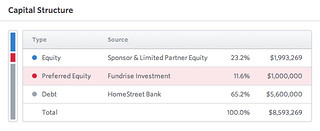
Illustrative Fundrise capital stack

One Fundrise investment‘s capital stack, showing Fundrise’s “preferred equity” (mezzanine) position.

[Update May 2015: As of this time, the majority of Fundrise offerings are currently for “preferred equity.” First, Fundrise itself purchases an equity stake with a stated return, paid either during the investment term or at the end of the term. Then, investors purchase debt backed by that stake — accounting and tax compliance are much easier for debt than for equity. Their offerings also now include a clearer illustration of the capital stack.

The short of it: as is typical with preferred equity, Fundrise investors receive no control, stand second in line for returns (with promised, but not guaranteed, returns), and stand second in line in bankruptcy (with no secured guarantees). In the capital stack illustration, control rests at the top end, risk is highest at the top end, and returns are paid first from the bottom end — debt gets paid first, then preferred equity, then equity gets what’s left over.]

Matt Yglesias in Slate points out that Fundrise can involve its “small-business silent partners” under an SEC regulation “whose main use in the recent past was financing Broadway shows” — and, indeed, I’m reminded of how little control the little-old-lady investors have over Max Bialystock in “The Producers.”

So now that expectations have been suitably lowered, what’s in it for both the developers and the community? Why did I still think this was an experiment worthy of watching from the inside?

A. Cheaper, slower money.

Think about a typical real estate situation: a homeowner with a house. When that house is sold, people get paid in this chain:
1. First mortgage
2. Second mortgage (in commercial real estate, this is a “mezzanine loan”)
3. Homeowner (“equity”)
Risk increases down the chain, but so do rewards and control.

What Class C shares do is to create an equity class with higher risk, lower returns, and no control. This equity isn’t sufficient to forego debt altogether — there’s still a mortgage on the property — but it’s enough to displace high-rate mezzanine financing, and therefore move the preferred equity investors up the chain. Since these loans are generally the highest-cost financing that a developer receives, and usually written with very brief loan terms, they create the greatest incentive to quickly lease the space to a “credit” (i.e., boring) tenant. Common stock is more patient: in fact, we Class C shareholders are so patient that we’re investing without any expectation about when, or even if, we get our money back. In short, it’s similar to a co-op’s membership equity: maybe your money will be there at the end, and maybe you’ll get paid along the way if we choose to declare a dividend, but we don’t guarantee anything and it’s probably easier to think about your equity as a donation.

The reduced cost and reduced “velocity” of capital reduces the developers’ incentive to quickly flip the property, and certainly eases longer-term thinking about the investment. Real estate has an intrinsic susceptibility to wide value swings: construction introduces an inherent delay that prevents supply from quickly aligning with demand, resulting in severe market imbalances throughout the business cycle. Patient capital that can wait out these swings is best poised to profit from true placemaking — hence the family-controlled real estate dynasties that control so much of central New York, London, and Hong Kong.

Yet in this instance, the managers might not take full advantage of their capital’s patience. The offering documents clearly state that the developer plans to sell or refinance the property after a few years, and may well cash out the Class C shareholders at that time. While this may provide Class C shareholders with a conveniently timed liquidity event, five years isn’t exactly a long-term investment in the community.

B. Participation and trust.

Perhaps a bigger — if unquantifiable — benefit for developers is that crowdfunding quite literally demonstrates community buy-in. As Yglesias writes, “A huge network of small-time, commercial real-estate shareholders could provide a much-needed counterweight to the plague of NIMBYs strangling America’s cities.”

Fundrise knows this power, which is why they’ve just floated a project on Florida Avenue that they don’t yet have control over — and even though the terms of the RFP appear to give the edge to another, conventionally financed project team. By letting residents “vote with their dollars,” Fundrise thinks that they can level the playing field between the big, bad developer and the little community. They also benefit from a broad shift in whom we trust: Americans have declining trust in institutions (government, developers, banks) and a technology-mediated concomitant increase in trust between individuals (e.g., Kiva for loans, Lyft for hitchhiking). Instead of just complaining, a well-capitalized community can act on the mantra to “be the change you wish to see in the world.”

In the context of gentrifying Washington, D.C., this strategy might not engender unlimited goodwill: the crowd looks too much like both Matt Yglesias and me: quite heavy on the “myopic little twits” of local lore: young, petit-bourgeois, tech-savvy guys with vanishingly little street cred. In a uniformly gentrified neighborhood like Cleveland Park or Brooklyn Heights or Uptown Minneapolis, “one dollar, one vote” might not be such a big deal, and community finance can definitely tap into the “silent majority” that might desire reinvestment vs. stasis. However, those locales are hardly underserved by conventional finance strategies. Instead, Fundrise is operating in more stratified urban neighborhoods, where banks are still wary of lending against more-speculative land values — and where even a modest capital requirement prevents the venture from truly reaching across the economic divide.

Even the completely community-based Dill Pickle (and other coops like it) encountered resistance by those who viewed it as an agent of gentrification. Not enough resistance to derail the project, to be sure, but plenty of grumbles nonetheless.

C. An opening for even better investment vehicles.

These two reasons — and the idea that, in terms of diversifying my portfolio exposure to real estate, H St. NE is as good a location as any for a 3-5 year speculative play — were reason enough for me to decide that Fundrise was worth a gander. I doubt that it’s really going to take off in a big way: even if its practice is standardized and the market becomes more liquid, crowdfunding still seems like a lot of legwork to raise a relatively small sum, especially given the amount of capital necessary for large-scale urban real estate development.

Fundrise is certainly a great idea, but the lack of community control limits its ability to establish trust in the community development enterprise. Yet it’s an important part of a broader conversation that’s just beginning around using crowdfunding innovations to improve communities. We can try many other tools — some new, some tried-and-true — to give communities greater control and input over their character and future. Cooperative businesses, like the one I founded, are growing all across America, and they play a key role in affordably housing thousands of Washingtonians (including myself). Financial co-ops, better known as credit unions, are quickly growing in the USA — and in some states, they have branched out past basic consumer lending and increasingly lend to or buy equity stakes in small businesses, even at the venture stage. Canadian banking law gives credit unions much wider scope, which allows them to do more for their communities: Vancouver’s Vancity isn’t just a carbon-neutral, living-wage, triple-bottom-line company, it also has $16 billion in deposits (enough to make it the largest or second-largest bank in the context of a similarly sized metro area like Denver or Pittsburgh). Over in Toronto, the Centre for Social Innovation has raised millions of dollars for community-development and clean energy projects through its community bonds. Since they’re bonds, not equity, they can be issued without prospectuses, and can even be held through RRSPs (Canada’s version of an IRA).

Edited to reflect that all Fundrise equity is “pari passu,” and has equal claim in the event of default.

Malls: the long goodbye

Second Floor, Owings Mills Mall

The slow contraction of the market for enclosed suburban shopping malls is part of a long-term trend, exacerbated by the credit crunch. I found a 2005 report from the International Council of Shopping Centers (hardly an anti-mall bunch!) that included a very noisy graph of shopping mall openings over the years. I chose to smooth the curve by (arbitrarily) calculating three-year moving averages instead, rounded to the nearest whole #:


1987-1989: 10
1990-1992: 15
1993-1995: 6
1996-1998: 6
1999-2001: 5
2002-2004: 4


The steep decline from the early ’90s occurred despite bubbly, credit-happy economies in the late ’90s and mid ’00s. Also, keep in mind that malls take several years to finance and build, so arguably developers quietly began aborting mall proposals around 1990, when the power center began its meteoric rise (and subsequent decline; Emerging Trends 2013 ranks them as the worst property type to invest in). The numbers since then (also from ICSC and from press reports) have been just dismal, both before and after the 2008 crisis:


2005: 2
2006: 1
2007: 0
2008: 0
2009: 0
2010: 0
2011: 0
2012: 1*


Even in a recent article trumpeting “Return of the Mall!,” Retail Traffic magazine admitted that “there is little, if any, room for new enclosed regional mall development… Even prior to the current downturn, the U.S. mall market was near the point of saturation. During the 1970s, the heyday of the mall, U.S. developers delivered a total of 375 million square feet of new space. By contrast, in the 2000s, new mall deliveries fell 62 percent, to 144 million square feet, according to research from CoStar.” The best that the article can muster is that trophy malls are still prospering, and that other shopping-center categories have been hit by bigger sales declines. Personally, I don’t know if that’s saying much; I’ve always thought that power centers were most vulnerable to online shopping — out-competed on price and selection (the only selling points of big box) — and we’ve seen that with the recent collapse of many big-box chains.

 
Given the number of malls that have closed — over 40% of enclosed malls built even in the DC region have shuttered — malls have been trending in reverse for almost 20 years now. They were sputtering in the mid/late 1990s, and over the 2000s I’d bet that many more have closed than opened. This isn’t some short-lived, newfangled fad, this is a seriously big shift in how Americans shop (and, in a consumer society, live).
 
Retail may have been the first property sector to see a huge momentum shift away from Edge Cities. Now that momentum in the residential and office markets** has shifted away from the suburbs, it’s hard to argue that drivable suburbia is still what Americans demand.

* City Creek Center in downtown Salt Lake City replaced two enclosed malls that had failed. Net mall count was still reduced by one.
** Emerging Trends ranked “severely handicapped” suburban office the second-worst investment. Just as with malls, this trend is a long time coming: nationally, suburban office vacancy rates used to track downtown office vacancies, but decoupled in 1998 and have stubbornly remained about 5% higher through peaks and troughs ever since. Similarly, the best housing investments were ranked as infill/intown, senior, student, and affordable, with golf course communities and master-planned resorts ranking a shade above “abysmal” as the absolute worst property subsectors to be in.

Metro DC’s not that rich (for the most part)

Western Avenue
Western at Wisconsin in Friendship Heights: not Madison Ave. by a long stretch

Nate Cohn in the New Republic addresses a factoid that really bugs me: metropolitan Washington is not the wealthiest region in the country, because sums, means, and medians are all quite different things. Rather, the surprisingly high median household incomes posted by many suburban jurisdictions here reflect a large upper middle class of dual-income white-collar families, rather than the very spiky (higher average, lower median) incomes that one finds in New York City or Chicago (or, perhaps even more strikingly, metro Chicago).

Compare, for instance, the Gini coefficients for income (derived from 5-year ACS):
Central jurisdictions
New York County (Manhattan): 0.60
District of Columbia: 0.53
Suburban jurisdictions
Fairfield County, Conn.: 0.53
Hudson County, N.J.: 0.48
Prince George’s County, Md.: 0.38
Loudoun County, Va.: 0.36

For the suburban jurisdictions, that’s the difference between Brazil or Zimbabwe-level inequality in NYC suburbs vs. Japan-level inequality in the Washington suburbs. Despite the District having worse income inequality than any state,* the region as a whole ranks 82nd among top-100 metro areas in income inequality.

This broad equality also contributes to the region’s general good performance on other economic metrics. Despite the extortionate cost of housing locally, proportionately high incomes for the middle class mean that the cost of living is about as reasonable as in Des Moines. A preponderance of well-paid jobs makes the area the most productive in the USA, as the returns on labor are pretty broadly distributed here.

This particular factoid is a favorite of those who trot out the tired “Boomtown DC, growing fat on your tax dollars” GOP talking point. That would have been a correct storyline back when Virginia defense contractors were getting rich off of Presidents Reagan & Bush(es), but it doesn’t quite hold today for various reasons. Besides, those complaining might take a closer look at how wealth elsewhere ultimately stems from federally directed subsidies from “the rest of us”: boomtown Houston flourishes only through vast implicit subsidies to untaxed, unregulated carbon pollution, and booming NYC (with more cranes building more flats for the superrich than anywhere else in the USA) is fed by a federally bankrolled financial industry.

Incidentally, anyone who is looking for the super-rich around here shouldn’t look along the Red Line. Wisconsin Ave. may have “Gucci Gulch,” but besides its relative lack of ostentation (a clue that the real money in America is elsewhere), it’s not nearly as exclusive as the sensitive watershed to its south. Stephen Higley locates the real gold coast along the Potomac gorge: the storied Embassy Row — so named because many of its Gilded Age mansions now house chanceries — of Massachusetts Ave. and its Maryland extension, River Road, plus their Virginia counterpart of Georgetown Pike.

* Typical disclaimer: D.C., as a wholly urbanized place, is not comparable to any state. Urban areas usually have higher inequality, since the very wealthy generally earn their living only within metropolitan economies.

Retail = restaurants in 2013

axis
Findlay Market in Cincinnati, always a great place to buy food

It’s not just you: nationwide, what’s opening on Main Street is pretty much only restaurants. To quantify this hunch, retail consultancy Terranomics compiled expansion plans from numerous chains and found:

40% of new retail unit openings will be restaurants… there really are not an enormous number of options out there for landlords looking to backfill smaller shop spaces… There is only one segment of the market where we are seeing aggressive growth plans from inline users and that is the restaurant sector… As e-commerce increasingly competes with the bricks-and-mortar retail landscape, shopping centers will find themselves insulated against those technology driven shifts by beefing up dining and entertaining options that do not compete with the internet.

Yes, we’d all love to be able to walk to the corner and buy some bolts from a corner hardware store, or socks from an apparel shop, but let’s face it: not enough of us do that often enough to sustain very many such businesses, particularly in areas that don’t have enough foot traffic to guarantee significant cross-shopping. Such uses will increasingly congregate within metropolitan subcenters — probably focused on today’s fortress malls or midtown destinations — so there will be winners and losers among retail nodes. At least everyone will have someplace to eat, though.

(BTW, connectivity to those subcenters will be necessary from ever-wider catchment areas. This will require rapid transit, not just walk accelerators like streetcars or bikeshare, in order to connect neighborhoods to retail focal points.)

What will those centers look like? A new ULI report by Leanne Lachman and Deborah Brett (complete with a cover image of a yarn-happy hipster using Square to buy a single-speed cruiser bike) suggests the following tenant mix to keep a lifestyle center — a format designed around Boomer women — relevant to Millennials. I’ll stifle my giggles.

  • a broader choice of eateries;
  • apparel brands favored by Gen Y (such as J. Crew, Old Navy, Forever 21,
    H&M, Zara);
  • a gym;
  • hair/blow-dry salons;
  • Trader Joe’s and green grocers;
  • a bike shop;
  • a pet store and/or a dog run; or
  • uniquely local offerings.

Third places are surprisingly important, with restaurants nearly rivaling homes as gathering locations:

Favorite places to get together with friends (pick three)
At home—my place or theirs 66%
At a restaurant 59%
At a bar 30%
At a shopping center 28%
At a coffee shop 22%
At a park/the beach 20%

(There’s also this amusing mental image: “Hispanics’ propensity to go out for weekend brunch is especially notable. Brunch is also more popular in the South, where 20 percent go weekly, and among downtown residents, with one-third saying they go for brunch each weekend.”)

Campaigning on stale tax policy

I was a bit crestfallen earlier this week when Obama came out swinging in favor of extending Bush’s ill-conceived (and 13-year-old) tax policy. There’s been enough time since the last time the tax code changed; if it’s not going to get past the House anyways, why not instead suggest replacing the whole shebang with something new? This had been broadly hinted at during the debt-ceiling debacle last year.

The very words “tax reform” are music to the ears of good-government liberals like me—and Barack Obama. They bear the hope of bipartisan compromise and grand bargains in which everyone wins. Conservatives get lower rates, liberals get a fairer tax code with more revenues for social programs, and fewer giveaways to favored industries.

via Mark Schmitt in the New Republic.

On debt

I have little more to contribute to the discourse over the debt-ceiling debacle — part of the never-ending 2011 budget cutting season (partly a result of this Congress’ record low productivity and thus inability to pass even the most routine of budgetary measures) — so here’s a few quotes I’ve relished from this most recent debate between prudence and insanity:

Perhaps best of all, David Brooks:

If the Republican Party were a normal party, it would take advantage of this amazing moment. It is being offered the deal of the century: trillions of dollars in spending cuts in exchange for a few hundred billion dollars of revenue increases… This, as I say, is the mother of all no-brainers.

But we can have no confidence that the Republicans will seize this opportunity. That’s because the Republican Party may no longer be a normal party. Over the past few years, it has been infected by a faction that is more of a psychological protest than a practical, governing alternative.

The members of this movement do not accept the logic of compromise, no matter how sweet the terms. If you ask them to raise taxes by an inch in order to cut government by a foot, they will say no. If you ask them to raise taxes by an inch to cut government by a yard, they will still say no.

The members of this movement do not accept the legitimacy of scholars and intellectual authorities. A thousand impartial experts may tell them that a default on the debt would have calamitous effects, far worse than raising tax revenues a bit. But the members of this movement refuse to believe it.

The members of this movement have no sense of moral decency. A nation makes a sacred pledge to pay the money back when it borrows money. But the members of this movement talk blandly of default and are willing to stain their nation’s honor.

The members of this movement have no economic theory worthy of the name. Economists have identified many factors that contribute to economic growth, ranging from the productivity of the work force to the share of private savings that is available for private investment. Tax levels matter, but they are far from the only or even the most important factor.

But to members of this movement, tax levels are everything. Members of this tendency have taken a small piece of economic policy and turned it into a sacred fixation. They are willing to cut education and research to preserve tax expenditures…

Dana Milbank, WaPo:

But while Reagan nostalgia endures, a number of Republicans have begun to admit the obvious: The Gipper would no longer be welcome on the GOP team. Most recently, Rep. Duncan Hunter Jr. (Calif.) called Reagan a “moderate former liberal . . . who would never be elected today in my opinion.” This spring, Mike Huckabee judged that “Ronald Reagan would have a very difficult, if not impossible time being nominated in this atmosphere,” pointing out that Reagan “raises taxes as governor, he made deals with Democrats, he compromised on things in order to move the ball down the field.”

The Economist‘s editorial:

Now, however, the Republicans are pushing things too far… The sticking-point is not on the spending side. It is because the vast majority of Republicans, driven on by the wilder-eyed members of their party and the cacophony of conservative media, are clinging to the position that not a single cent of deficit reduction must come from a higher tax take. This is economically illiterate and disgracefully cynical…

America’s tax take is at its lowest level for decades: even Ronald Reagan raised taxes when he needed to do so. And the closer you look, the more unprincipled the Republicans look…

Adam Levitin, a bankruptcy attorney in California, foresees a disaster in the newly rewritten Balanced Budget Amendment (and correctly wonders just how enforceable the amendment could be):

Here’s the true lunacy of the bill, it would require a 2/3s majority (by rollcall vote) in both houses for any bill to increase revenue. Let me repeat that again: any tax increase would have to be approved by a 2/3 majority in both houses. That’s a federal version of Proposition 13, the state Constitutional amendment that destroyed California by requiring supermajorities for tax increases. It effectively gives a selfish minority the ability to stymie actions that benefit the whole.

Robert Bixby, executive director of the original deficit hawks at the Concord Coalition, echoes the sentiment:

The whole point of a balanced budget amendment is to ensure that future generations are free to make their own fiscal decisions. It is inconsistent with that freedom to forever mandate a particular level of spending or to permanently favor spending cuts over revenue increases as the manner of managing these decisions.

GOP turns its back on its past and future

The other day, I mentioned the Republican Party’s role in pioneering huge federal subsidies for national infrastructure investments, spurring centuries of enduring economic growth — and how it’s turned its back on that heritage, now attacking the mere notion of federal investment as “socialistic.”

Take a moment to closely consider the Pacific Railway Act ad the contrast to today’s small-bore politics gets even sharper. 1862’s Republican-dominated Congress wasn’t just preoccupied with a handful of terrorists on the other side of the world; it faced an enemy that had just stolen half the country and was just a few months into battling (and, at that point, winning!) an unfathomably costly and bloody war. That Congress allocated precious federal resources to literally lay the groundwork for a greater future for America — even at a time when it was unclear whether America even had a future.

Moreover, those first Republicans chose to create a giant federal entitlement scheme for snooty higher education — the Morril Land Grant Act — at a time when few Americans could possibly have comprehended widespread college enrollment. That investment, reinforced over the years by state appropriations, now spins off almost incalculable economic gains for the nation. They financed all this federal largesse with, naturally, new income taxes on the rich.

Later, in the Reconstruction years, the transcontinental railroad was lauded for creating publicly funded, make-work jobs for veterans — a noble cause which today’s Republicans denigrate as “buying jobs with borrowed money.” Yet that was never the point of the railroad: those employed veterans were building useful, lasting infrastructure, not ditches. Today, that same infrastructure continues to spin off billions of dollars in value, and continues to create private-sector jobs in ways that its builders could not have foreseen: the fiber-optic backbone paralleling the tracks makes possible companies like Amazon and Qwest, its sheer intermodal shipping capacity underlies UPS’s world-renowned logistics, the diesel-engine business was the basis for GE’s leading position in gas-fired electric turbines. Infrastructure investments don’t pay off next week, and they might not even pay off next year, but they ideally leave lasting benefits for the next generation. However, today’s GOP has made it clear that their vision for government is one that pays off their base now, while damning future generations (of taxpayers, of Medicare beneficiaries) to a nasty, brutish, and short life.

The affluent society starving investment

As the Economist points out this week, capital spending on transportation & water infrastructure in the USA has declined by two-thirds since its Kennedy (and Pat Brown) era heyday. As that era crested, John Kenneth Galbraith wrote “The Affluent Society,” a vision of an America characterized by private affluence amidst public poverty. That vision has come to pass: the World Economic Forum ranks 23rd for overall infrastructure quality, between Spain and Chile. At a metropolitan level, I would hazard that Spanish and Chilean metropolitan commuters appear to enjoy more extensive and efficient mass transit and toll highways than their American counterparts.

As if this precipitous decline in investment just were not enough, Jonathan Cohn points out that the Ryan/House GOP budget would reduce federal spending on infrastructure by roughly half.* That the Republicans are leading this charge would surely disappoint that party’s founding fathers, who (as highlighted at GOP.com) “Established the Transcontinental Railroad” with lavish sums of federal “funny money” (land grants).

The GOP is broadly fighting a war against the future — attacking any investment in the future, choosing instead to distribute those false savings as tax cuts to foster present-day private consumption. The Ryan budget also cuts federal investment in human infrastructure — education — by over half. At the state level in North Carolina, N&O political columnist Rob Christensen frames the “two competing narratives” of low taxes and private consumption today vs. broader public gains tomorrow within the context of Richard Burr, a Republican of the old (pre-paleo-nihilist), truly pro-business variety:

[Gov. Perdue and the Democrats] have argued that North Carolina has been a leader in the South for the past several generations precisely because it has invested more than its sister states in creating a nationally respected university system, a noted community college system, and has historically been a leader in roads and the arts. That North Carolina — unlike other parts of the South — has not engaged in a race to have the lowest taxes in the South, the Democrats argue, has allowed the state to develop a more sophisticated industrial policy that has resulted in such success stories as the Research Triangle Park…

[Republican U.S. Senator Richard Burr:] “We are the highest-tax state in the Southeast. And we still win. We win more than our neighboring states.” The main reason, Burr said, is because of North Carolina’s education system, particularly its university and community college system. “When an employer looks at an investment in North Carolina, they are not looking at the return next year,” Burr said. “They are looking at the return 30 years from now. They need a future workforce that has the skills and knowledge.”

* Note differing metrics (% of GDP spent by all levels of government vs. just federal spending per capita). I’d estimate the Ryan trendline on that graph slightly downward, based on stable or declining state/local spending, which seems likely given budget pressures, and GDP growth modestly outpacing population growth.

Speaking of smoothly functioning societies, Fukuyama confirms Kierkegaard’s theory that history ends in modern Copenhagen. We’re all “getting to Denmark,” it would seem.

Are they really “relocated Yankees”?

For an assignment last year, I crunched some numbers about migration to Wake County –as of this year, North Carolina’s most populous county thanks to plentiful in-migration. Three interesting findings:
1. Contrary to common perception, just under half of movers to Wake County are “Yankees” (moving from states north of the Mason-Dixon). Most out-state movers arrive from other largely suburban counties.
2. The largest sending counties to Wake are nearby rural or mill-town counties (consistent with “migration potential” theory), since the South in general is still rapidly urbanizing. North Carolina was still majority-rural until the 1970s. (Urban/rural population from 1900-1990 and 1990-2000 [xls], or 1970-2010 [html]. Note that North Carolina in 2000 was as urbanized as Illinois in 1910.)
3. Within the Triangle, the metropolitan migration dynamic (larger households flow to the periphery, smaller households towards the center) appears to place Durham & Orange at the center, Wake at both center and periphery, and the exurbs at the periphery.

Full presentation (1MB PDF)