The affluent society starving investment

As the Economist points out this week, capital spending on transportation & water infrastructure in the USA has declined by two-thirds since its Kennedy (and Pat Brown) era heyday. As that era crested, John Kenneth Galbraith wrote “The Affluent Society,” a vision of an America characterized by private affluence amidst public poverty. That vision has come to pass: the World Economic Forum ranks 23rd for overall infrastructure quality, between Spain and Chile. At a metropolitan level, I would hazard that Spanish and Chilean metropolitan commuters appear to enjoy more extensive and efficient mass transit and toll highways than their American counterparts.

As if this precipitous decline in investment just were not enough, Jonathan Cohn points out that the Ryan/House GOP budget would reduce federal spending on infrastructure by roughly half.* That the Republicans are leading this charge would surely disappoint that party’s founding fathers, who (as highlighted at GOP.com) “Established the Transcontinental Railroad” with lavish sums of federal “funny money” (land grants).

The GOP is broadly fighting a war against the future — attacking any investment in the future, choosing instead to distribute those false savings as tax cuts to foster present-day private consumption. The Ryan budget also cuts federal investment in human infrastructure — education — by over half. At the state level in North Carolina, N&O political columnist Rob Christensen frames the “two competing narratives” of low taxes and private consumption today vs. broader public gains tomorrow within the context of Richard Burr, a Republican of the old (pre-paleo-nihilist), truly pro-business variety:

[Gov. Perdue and the Democrats] have argued that North Carolina has been a leader in the South for the past several generations precisely because it has invested more than its sister states in creating a nationally respected university system, a noted community college system, and has historically been a leader in roads and the arts. That North Carolina — unlike other parts of the South — has not engaged in a race to have the lowest taxes in the South, the Democrats argue, has allowed the state to develop a more sophisticated industrial policy that has resulted in such success stories as the Research Triangle Park…

[Republican U.S. Senator Richard Burr:] “We are the highest-tax state in the Southeast. And we still win. We win more than our neighboring states.” The main reason, Burr said, is because of North Carolina’s education system, particularly its university and community college system. “When an employer looks at an investment in North Carolina, they are not looking at the return next year,” Burr said. “They are looking at the return 30 years from now. They need a future workforce that has the skills and knowledge.”

* Note differing metrics (% of GDP spent by all levels of government vs. just federal spending per capita). I’d estimate the Ryan trendline on that graph slightly downward, based on stable or declining state/local spending, which seems likely given budget pressures, and GDP growth modestly outpacing population growth.

Speaking of smoothly functioning societies, Fukuyama confirms Kierkegaard’s theory that history ends in modern Copenhagen. We’re all “getting to Denmark,” it would seem.

City limits blur up close


Three decades of retail Originally uploaded by Payton Chung

Chris Leinberger refers to how the 2010 Census tract-level data dump has inevitably led to self-congratulatory crowing by the pavement-lobby-funded sprawl-triumphalist brigade:

“Unfortunately, the census shines the light on the terms ‘city’ and ‘suburb’ –neither of which are the keys to understanding today’s built environment.”

Friendship Heights, Maryland shows a particularly striking illustration of how it’s dangerous to strictly rely on Census geography to define terms like “city” and “suburb.” (As if categorizing Fresno as a city and Newark as a suburb weren’t quite enough.) On the right, the Mazza Gallerie enclosed mall walls itself off from the “central city” streets, whereas on the left, the mixed-use, high-rise, street-facing Wisconsin Place is in the “suburbs.” To further muddle the vagaries of local Census geography, the four-block, 34-acre Census Designated Place (and incorporated tax district) of Friendship Heights Village is right behind Wisconsin Place. Since it’s just a cluster of mostly residential high rises, it’s the single most densely populated “place” in the entire country, with 79,556 residents per square mile. Even Manhattan only clocks in at 69,468 per square mile.

On the broader point: the triumphalists still refuse to recognize that population growth is just one, and not even a particularly good, metric of success. Global and national population growth is slowing, household sizes are declining, and housing space consumption per capita has grown considerably (although this trend is declining in suburbs, it probably still has a way to go in cities). All of these trends, plus the by-definition relative lack of cheap developable land in cities, means that cities will lag in population growth — but that most have turned the corner and are no longer places that people are fleeing when given the choice. I described Chicago’s turnaround as not one where the population is growing, but as one where it is ceasing to shrink as quickly (a turnaround in the second derivative of population growth). To the extent that hasn’t been borne out, it’s also a definitional problem — the city’s core is still growing, but outlying, low-density neighborhoods are emptying out as they undergo a different, more painful part of a demographic cycle. That doesn’t change the fact that something remarkably novel and different is happening to the core, though.

Demographics shorts

1. Bill Frey from Brookings on how America is already transitioning to a multiracial society:

Over the last decade, the U.S. population under age 18 grew by less than 3 percent. But the 2010 Census also reveals an absolute decline of white young people over this period, as well a somewhat smaller decline of black youths. Hispanics, Asians, and to a lesser degree multiracial children, accounted for all of the net growth the nation’s under-18 population.

This, however, has troubling consequences with regard to the ever greater divide (see #6) between older, whiter, conservative voters and younger, browner, liberal constituents — in short, between America’s past and America’s future, except that the former is generally going to be in charge.

2. Speaking of America growing apart, an interesting way to look at Brookings Metro’s newest online datasets — showing that metro areas dominate many states in population, employment, and particularly in economic output — is to compare cities that lead vs. lag in GDP per capita within their respective states. For instance, right next door:
Durham-Chapel Hill, N.C.: 47% higher GRP/capita than state average
Burlington, N.C.: 25% lower GRP/capita than state average

Within the nation as a whole, the wide gap between the most and least productive regions is sharply growing: DC earns 5X as much as Mississippi, and that gap has grown 18% since 1990. By 2015, at PPP, Shanghai province will have a higher per capita income than Mississippi.

3. Wikipedia has some interesting bits on linguistics. For instance, the extra R in “char siu bao” (it’s pronounced “cha seew bow”) comes, of course, from the non-rhotic Englishmen who settled in Hong Kong. Also, something that I’ve noticed in England and New England alike — particularly in terms like street names — is a tendency towards plainer terminology, disposing of many of the euphemisms that American English has imported from French. This tendency has a term, since of course it was tied to the tension between upper and middle class Britons — “U and non-U.”

Shorts

1. No, we cyclists don’t approve of how stupid riding, either:

The above video adheres to the bicycle messenger video style manual, which mandates that any video must include messengers talking about how dangerous their job is while simultaneously including footage of them doing their job in the most idiotically dangerous way possible…. I’d like to see a video from the IBEW in which electricians talk about how dangerous their job is, intercut with footage of them randomly stabbing at wall outlets with forks. – BSNYC

2. On the eve of the government shutdown:

Rep. Mike Pence (R-IN) drew cheers by saying, “If liberals in the Senate would rather play political games and shut down the government instead of making a small down payment on fiscal discipline and reform, I say, ‘Shut it down.’” – reported by John Avlon, Daily Beast

I’d like to see these Ayn Rand-worshipping teabagger extremists survive a true government shutdown. End Social Security and Medicare payments, garrison the forts, abandon the airports and ports and border crossings, freeze defense contractors’ payments, stand down the poultry inspectors, turn off MedLine, rope off the Interstates. See how your constituents feel after a few days of living in the Stone Age. Those taxes we pay are (h/t Oliver Wendell Holmes) the price of civilization, and without them we’ll descend into anarchy — which ain’t pretty.

3. David Roberts says of a nifty LLNL flowchart of America’s energy consumption: “Holy sh*t we waste a lot of energy! Well over half of the raw energy that enters our economy goes to waste.” Less than 1/3 of the fuel going into electric plants actually ends up as used energy; generator losses and line loss accounts for much of the rest. (Smart grids and better transmission lines should go a ways to solving that.) Yet the huge waste is in transportation: just as much energy is wasted in transportation as is provided by coal. Only 1/4 of the energy going into the transportation sector actually gets used. Increasing fuel economy will surely help matters a great deal, but surely a great deal of that inefficiency stems from America’s overreliance on the 20%-efficiency internal combustion engine for almost all of its transportation needs.

4. DCentric’s Elahe Izadi reveals how (in DC as in Chicago, although less dramatically since gentrification led to net gains in DC vs. net losses in Chicago) suburbanization rather than gentrification actually explains much of the decline in both cities’ Black populations.

Yesterday we spoke with demographer Roderick J. Harrison, a senior fellow at the Joint Center and a Howard University associate professor, to get a better understanding of the city’s shifting demographics. He framed D.C.’s loss of 39,000 black residents in this light: gentrification wasn’t the major driving force in Wards 7 and 8, where population losses were the greatest. Rather, it was by-and-large classic suburbanization in which people left the city’s poorest wards “that are often considered the worst neighborhoods,” Harrison said.

“The force behind it probably is seen as a positive force. These are people who are some way or another, they are upwardly mobile, they are improving their housing and neighborhood conditions, they are making personal decisions that they see, on the whole, as an improvement,” he said.

5. I’ve previously despaired over whether Continental Airlines’ marketing strategy might win out over United Airlines’ — and yes, it seems that CO’s Kaplan Thaler is behind the new company’s branding. As Lewis Lazare wrote in the Sun-Times:

A golden age in the annals of airline advertising officially ended Tuesday when the merged United Airlines unveiled its first ad campaign from Kaplan Thaler/New York ad agency… does away with the elegant, illustration-centric print ads and television commercials that for the past four years were a hallmark of the United advertising created by the Minneapolis boutique shop Barrie, D’Rozario Murphy. Those print ads and story-driven commercials were always smart and sophisticated — the finest examples of airline advertising since the landmark ‘World’s Favorite Airline’ campaigns for British Airways from Saatchi & Saatchi/London in the late 1980’s… United’s ads from BDM helped elevate the carrier’s image even as the airline was struggling to right itself after a difficult bankruptcy filing… The new United advertising just now breaking incorporates much of the imagery associated with previous Continental campaigns, which have been handled for many years by Kaplan Thaler. It is certainly a functional campaign, if not hugely creative.

However, what worked for Continental might not work for the new United: the two competed in very different market spaces. Continental faced very little competition for its “hub captive” travelers, and has been able to profit immensely from that. That’s highlighted in Nate Silver’s recent analysis of airports with “unfair fares.” Legacy Continental’s hubs are , , and #6 on his list of most overpriced large airports, with megahubs IAH and EWR taking the top slots. Of United’s hubs, IAD and ORD are and , but United’s other three hubs are apparently at least fairly priced — and United has at times been to American at ORD.

Shorts


Densest towns in NC Originally uploaded by Payton Chung

1. Carrboro, the ex-milltown turned grad-student ghetto that was Chapel Hill’s proletarian neighbor for many years, has been dethroned as North Carolina’s densest town. Instead, the new TND of Lake Park in Union County has the state’s highest population density. (Chart from USA Today’s online Census 2010 tool.)

2. “The telephone has a very rude propensity to interrupt people.” – Miss Manners, quoted by Pamela Paul in the NYT Magazine

3. Wicker Park may be one of the few places ever where an organic vegan quick-service restaurant replaced a drive-through Burger King. Perhaps it’s not really destined to be just a western extension of bro-tastic Lincoln Park. (Via Spyguy at SSC.)

Technology choices & the importance of phasing

I’ll take a little step into the bus vs. rail rapid transit debate, spurred by recent articles in GGW, by attending the 2011 Sustainable Transport Award ceremony, and by Jarrett Walker‘s “Field Guide to Transit Quarrels.”

Generally speaking, I like to think of myself as relatively mode-agnostic. I have a slight sentimental attachment to rail, but recognize that BRT offers several intrinsic benefits over rail. Instead of making a blanket generalization, though, the relative costs of different underlying inputs might explain why BRT has found such success in Latin America, while rail makes more sense for Europe (and perhaps Asia). BRT requires more labor and more fuel (petroleum) than rail, but less capital (in both guideway and rolling stock). Labor and petroleum are relatively cheap and locally sourced in Latin America — whereas interest rates are high (significantly raising the cost of capital), electricity is comparatively expensive, and currencies are cheap, raising the price of imported railcars (there’s no local rail industry) and making locally-made buses comparatively cheaper. Cultural preferences might also come into play; only Argentina ever built an extensive rail network during the fin-de-siecle railroad boom; that also increases ROW acquisition costs, since (unlike parts of the USA) there isn’t an extensive rail network awaiting reuse. Europe faces an almost exactly opposed scenario.

Bing aerial Reston Town Center

Reston Town Center as built: small blocks allowed the project to be phased over the past 20 years. (Bing Maps)

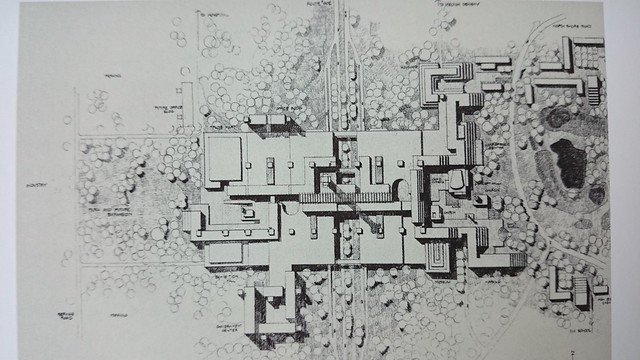
Reston Town Center early plans

Earlier proposals (e.g., 1974) centered on a giant mall bridging roadways, but since it would have had to be built all at once it proved cost-prohibitive.

Another point of Walker’s that I’ll echo, and one in which BRT has a leg up: rapid transit projects need a clear phasing strategy; each step has to stand on its own. Indeed, I’ll draw an ease-of-phasing analogy with New Urbanism: several successful NU developments were once proposed as conventional projects, but later downsized into their current, much more profitable, NU formats. Reston Town Center and Battery Park City were originally intended to be the sort of gargantuan, self contained, internally oriented mixed use complexes that were quite popular in the 1970-80s, whether regional malls in the suburbs or John Portman developments downtown. A small chunk of that was even built at BPC before that project stalled amidst New York City’s 1970s financial collapse.

Both projects were redesigned and downsized; it turns out that streets and blocks made for obvious phases that were easier to build and finance incrementally by different parties, and required much less upfront investment in expensive infrastructure. (At sites like Illinois Center in downtown Chicago, such costs bankrupted the developer, leaving half-built overpasses to nowhere. Also, bear in mind that interest rates were much higher then.) And the results have been a phenomenal success from an investor’s standpoint — even more so when contrasted with the megaprojects that did get built, many of which are now undergoing costly, comprehensive redevelopment or renovation because they cannot incrementally change.

And three other points I’ll briefly echo:
– NIMBYism is about protecting home, and animals can be fiercely territorial.
– Project opponents can be characterized as “stuck in the present” (most common) or, at other times, “stuck in the future” (less common, but just as intransigent).
– Airline networks might be a good contrast between frequent connections (a strategy Walker prefers) vs. point-to-point milk runs.

Five quotables

1. My comment on Felix Salmon’s rebuttal to John Cassidy in the New Yorker on bike lanes, echoing some previous comments about externalities and vicious/virtuous cycles in transportation:

Cars are unique among all common modes of *urban* transportation in that their sheer size — particularly in cities, which by definition have limited, expensive ground area for a large population to share — leads to a competitive, vicious circle of congestion when they’re overused. When more people drive, congestion gets worse for everyone, potentially destroying the positive economic effects of agglomeration, and as such the state has a vested interest in reducing congestion by discouraging driving.

Cycling, walking, and transit use are so much more space-efficient that, at typical urban densities, they are subject to a cooperative, virtuous circle of congestion that reinforces the positive externalities of urban agglomeration. More cyclists make for safer cycling conditions [P.L. Jacobsen, Inj Prev 2003;9:205-209], more foot traffic leads to lower crime rates, more transit riders creates demand for more frequent service. Looked at another way, each of these modes is subject to much higher thresholds where the virtuous circle turns vicious. The space occupied by three cars can easily fit 30 bicycles, one bus with 70 passengers, or hundreds of pedestrians.

Drivers tend to blindly bring their competitive outlook to all urban transportation, which is why Cassidy and others end up with such inane arguments.

[Commenter Olaf Storbeck puts it this way: “parking is a private good which the free market can easily provide… To a certain degree bike lanes are public goods,” since they are non-exclusive and non-excludable.]

2. Nick Kristof remarks on how Japan’s remarkable social solidarity helps it cope in times of trial:

Uncomplaining, collective resilience is steeped into the Japanese soul. We sent our eldest son to Japanese school briefly, and I’ll never forget seeing all the little kids having to go to school in shorts even in the dead of winter. The idea was that it built character. I thought it just gave kids colds. But it was one more effort to instill “gaman.” And it’s “gaman” that helped Japan recovered from World War II and tolerated the “lost decade” after the bubble economy burst in about 1990. Indeed, it might be better if Japanese complained a bit more – perhaps then their politicians would be more responsive… [after the Kobe earthquake] Japan’s social fabric never tore. Barely even creased.

Timothy Egan after a California earthquake last year, with a reminder that mountains and water, that most scenic of landscape combinations, erase one another, and the two cannot coexist peacefully:

“It is precisely because of these earthquakes that the most nervy ground is also the most sublime. The mountains, the deep harbors, the valleys and vistas we love are products of the same turbulence that can deal a mortal blow to a city.”

3. “Upski” now sounds like a Brookings metropolitan white paper.

4. Jeremy Anwyl, CEO of car site Edmunds, raises the idea that the certainty of a “gas price stabilizer” could be almost as good as a federal loan guarantee — and thus better smooth out the ups & downs of car market:

Taxing gas an additional $0.15 is a missed opportunity. We have seen that to move demand, gas prices need to climb much higher. Raising the price by $2 per gallon seems about right.

5. Select quotes from the 2011 issue of Emerging Trends:

For the first time since the early 1950s, no regional malls are under construction in the United States. “That’s stunning!”

[S]chools will con- tinue to be drivers in parent decisions of where to raise families. “But where are schools heading?” Will it matter as much where you are in the future? Will kids join classes from remote locations…? “It won’t necessarily be the same.” Some cities make strides in improving public schools and providing charter-school alternatives, while certain suburban districts falter under shrinking tax bases…

“Younger professionals want walkable centers where they don’t have to get into a car to have lunch or do errands,” says a Sunbelt developer… “I can’t imagine why anyone would want to own a suburban office building… It used to be back offices went to the suburbs. Now they go to India, Guatemala, Warsaw, or wherever.” These “easy-to-build assets” turn into a “trading commodity.”

It’s not kind to Chicago, where, once again, feelings of emptiness are rising in suburbs. (Perhaps my favorite Trib headline of all time.)

“Tomorrow has come to the suburbs,” where vacancies, including shadow space, “approach 30 percent.” […] Locals, meanwhile, find the condition of “state and municipal finances hugely troubling,” weighing down the market with the likelihood of higher taxes and fewer services.

This is honestly the nicest it’s ever been to Pennsylvania, describing it as “Not that Bad, Really.” I remember that years ago, when I worked for a subconsultant on ET, Philadelphia’s economic development authorities wooed us with a constant stream of good news about Center City — hoping that it would upgrade them to being a 24-hour city. It didn’t work then.

“We’re going to see a lot more places end up like Pittsburgh, if they’re lucky,” says a senior investment executive. “Here’s a city that used to be a major manufacturing center with many corporate headquarters. Now it’s cleaned up, the high-paying factory jobs have diminished dramatically, and a high ratio of workers have government or quasi-government jobs in education and medical fields.” Forbes magazine ranked it as America’s most livable city in 2010. However, “Property values and rents have essentially been flat and development has been sporadic.” […]

Interviewees lament how [Philadelphia] “suffers from its proximity to New York,” but others hope for gains from positioning as “a cheaper alternative.” […] If only high-speed rail—traveling 150 miles per hour—could be developed to link with Manhattan, the city might get a major boost… But institutional investors never muster much enthusiasm for the overall scene.

And finally, private sector investors are indeed griping about a lack of government investment in infrastructure, but somehow the politicians would rather care

Infrastructure Neglect. Economic travail and government deficits distract attention from dealing with the nation’s archaic and deteriorating infrastructure. Twentieth-century interstates and in sufficient mass-transit systems can no longer support population growth and commerce in many increasingly clogged metropolitan areas. Newer Sunbelt cities, developed through road and highway grids, strangle in congestion while older 24-hour metro areas desperately need to replace crumbling bridges, overpasses, and tunnels… Financing a makeover will cost trillions of dollars over the next three decades—money the country does not have or does not want to spend… Eventual decisions and costs related to infrastructure could force monumental changes in where people choose to live and work.

Thar be danger on the roads


for blog Originally uploaded by Payton Chung

This graph comes from the Pew Center on Global Climate Change’s recent report (by researchers at Argonne) on greenhouse gas emissions from the transportation sector. More powerful engines and heavier cars both increase fuel consumption and therefore auto-related emissions.

Yet this also demonstrates that cars today are much more dangerous weapons than they used to be. Faster, heavier cars have more momentum, and when they hit someone who isn’t armored (a pedestrian, a cyclist), they’re more likely to kill or seriously injure that person.

Shorts

1. Commenter Future Bus Riders Union Member over at Human Transit points out that the recent installation of a cyclist Green Wave on Valencia St — San Francisco’s Hipster Highway — doesn’t just save cyclists energy, but it also reduces potential conflicts with buses:

“I suspect this is probably the best way to reduce the problem of bikes and buses continually overtaking each other. While bikes and buses often travel at roughly the same average speed, they don’t have the same acceleration profile. When you set traffic lights at the same speed you tend to ameliorate the jockeying for position problem.”

Speaking of green waves, something I hadn’t really noticed until last week: Chicago, probably due to its Midwestern scale and density, sometimes doesn’t have that many stop lights. I rode 3 miles down side streets from Ukrainian Village to Logan Square and encountered only one red light. As much as I like 11th St NW to take me downtown from Columbia Heights, the lights are always against me — and they’re every two blocks, well outside downtown. (Particularly frustrating is the light at Florida, at the base of the 100′ ridge; I very rarely have managed to not have that turn red as I’m going downhill.)

2. Blair Kamin writes about how public space and virtual space have reinforced one another in the Mideastern revolutions — and, ironically, that the incident that started it all involved an internet cafe, that rare space which stands at the border of both:

“There was a time when some viewed the Internet and social media as the enemies of public space. These critics had nightmarish visions of a world where people lived in lonely isolation, lured away from the public square by the seduction of Internet chatrooms. The picture was of people sitting in the dark, in the basement, staring at the computer screen, always by themselves.

“But if Friday’s resignation of Egyptian President Hosni Mubarak proves nothing else, it is that social media and public space can be complementary, rather than in conflict. The social bonds built in the virtual world can spill over into the physical world–and with such seismic force that they can topple an autocrat.

“The revolt is Egypt is said to have begun with the killing of Khaled Said, a 28-year-old Egyptian businessman who was hauled out of an Internet cafe by plainclothes policemen last June and beaten to death. As the New York Times reported last week, a graphic Facebook page tribute to Said provided an outlet for people’s rage.”

3. One possible bright side to Chicago’s steep population decline: people largely seem to have moved away from several hypersegregated neighborhoods, from gentrifying neighborhoods, and from the formerly racially homogenous Bungalow Belt. (See this tract-level map, from the Tribune.) The net result is that segregation on the south & southwest sides may have declined from its former levels.

4. Like Donna Dubinsky, writing in the Times recently, I recently had a discouraging experience securing an individual health insurance policy:

“how broken the market for health insurance is, even for those who are healthy and who are willing and able to pay for it… I have no doubt that the system is broken and reform is absolutely essential. If we are not going to have universal coverage but are going to rely on employer plans, then we must offer individuals, self-employed people and small businesses a place to purchase insurance at a reasonable price.”

I’ve always suspected that at least part of the reason why Canadian cities are filled with small businesses while American cities are “food deserts” (besides their superior, investment- and entrepreneur- oriented immigration policies) is because universal health insurance unleashes their entrepreneurial potential; Americans are tied to their big-company jobs by health insurance. If even successful, hundred-millionaire Silicon Valley entrepreneurs find that going it alone proves perplexing, then how can we expect others to navigate the system?

5. Speaking of socialized medicine, socialism sure seems to work in the imperfect market of HIV transmission, where treatment is prevention. Vancouver gets headlines for its supervised injection sites, but the other half of its successful anti-HIV strategy (infections have fallen by over half, yielding incalculable long term cost savings for everyone) is to eliminate free riders through widespread testing and treatment, as Donald McNeil Jr. reports:

By offering clean needles and aggressively testing and treating those who may be infected with H.I.V., Vancouver is offering proof that an idea that was once controversial actually works: Widespread treatment, while expensive, protects not just individuals but the whole community.

6. The myopic cut-spending-at-all-costs agenda being pushed by Congressional Republicans now reminds me of the intergenerational warfare that typifies issues like school funding in Florida or Arizona. There, largely White homeowning seniors systematically veto taxes that would pay for schools educating a largely Latino student population — starving the future to feed the present. Of course, though, this is the natural result of a GOP that’s beholden to old white voters:

It is difficult, for example, to fulfill your promises to balance the budget and reduce the national debt without enacting substantive reforms to Medicare and Social Security, and it’s almost impossible to reform Medicare and Social Security if your most important constituents are the people who benefit the most from those programs. The result is a lot of hypocrisy—like Republicans resisting precisely the kind of Medicare cuts they’ve advocated for decades—and a potential split between spending-obsessed Tea Partiers and the establishment conservatives who know they owe their jobs to seniors.

This hysterical hue and cry of Republican stupidity drowns out any number of more reasonable proposals to reduce the deficit. The GOP is blind to the 800-pound gorillas in the room; they’re slurping up buckets of cash for seniors’ transfer payments and cushy security contracts. Extracting all of their spending cuts from the remainder of the budget is like a lobbyist fat on steakhouse dinner trying to diet by foregoing side salads.

Those transfer payments are so huge that Ezra Klein writes: “the business of the American government is insurance. Literally. If you look at how the federal government spends our money, it’s an insurance conglomerate protected by a large, standing army.” I guess it’s only appropriate that we own AIG, right?

(Seems like that “insurance” line was first used by Peter Fisher.)

One bipartisan panel has already advanced nearly $100 billion in cuts (that somehow magical figure that needs to be gutted out of existing discretionary programs) just to the Department of Defense, with appreciably no impact on Americans’ daily lives or long-term security. Instead, it stops the age-old practice of giving the Pentagon toys that it didn’t want. Obvious to me, but evidently many Americans don’t think that’s a folly.

The “cut & invest,” feed-the-future tone that Obama’s budget puts forth — one similar to what NYT columnists like Tom Friedman have been advocating — certainly sounds more promising to this young voter. It inspired me to try that NYT budget exercise again; my latest plan gets the spending cuts : tax ratio up to 77 : 23 — and still notably including a fully refunded carbon tax. (Or, of course, a fraction of that could be set aside for investment in market-tested decarbonization.)

On the cheap?


Metro Originally uploaded by Payton Chung

Deep, multi-level subway stations like these aren’t cheap, particularly when outfitted with capital-intensive fully automated trains. Yet pretty much the only bargain I found in a week in Copenhagen? The entirely new, 17-station, 15.5km, dual deep bore tunnel ring line will cost just $3 billion to build. That wouldn’t even pay for the 3.5-station first phase of NYC’s Second Avenue Subway, and only somewhat surpasses the 5-station elevated first phase cost of Dulles Metrorail. It’s not as if safety or accessibility standards, or construction labor, or materials, are any cheaper in Denmark. Never mind that the operating cost of the Copenhagen metro looks negligible compared to US systems; there are no retired drivers drawing lifetime medical benefits, since retiree benefits are the state’s problem and, well, there are no drivers.

Maybe I can gather some hints at TRB this week.

(Yes, I mentioned this briefly recently.)