Enviro action at home made simple

Well, simple to understand, but the spirit of Gar Smith’s 50 Difficult Things You Can Do to Save the Earth lives on. Umbra over at Grist gives a quick, peer-reviewed overview of highly effective environmental choices. Topping the list, naturally: “buy the most fuel-efficient vehicle possible, and use it as little as possible,” followed by home energy efficiency (lightbulbs, appliances, windows) and citizen action (letter writing, joining groups). The Consumption Manifesto puts it all a bit more elegantly:

  1. Reduce, Reuse, Recycle.
  2. Stay close to home.
  3. Internal combustion engines are polluting and their use should be minimized.
  4. Watch what you eat.
  5. Private industries have very little incentive to improve their environmental practices.
  6. Support thoughtful innovations in manufacturing and production.
  7. Prioritize. Think hardest when buying large objects.
  8. Vote.
  9. Don’t feel guilty. It only makes you sad.
  10. Enjoy what you have — the things that are yours alone, and the things that belong to none of us.

This comes to mind partly because someone on the Critical Mass list keeps retreading some tired PETA numbers about how meat is worse for the environment than driving. Um, nope; that’s specious even on the weight principle: even if the average American goes through hundreds of pounds of meat each year, that’s nothing compared to the collectively thousands of pounds of car and car-related products (principally gas & oil), and the environmental impact of the latter per pound vastly exceeds the impact of the former. Sure, we should all curb meat consumption and eat lower on the food chain, but I’m not about to be guilt-tripped into changing my well-considered, mostly-local, low-meat, high-organic diet anytime soon.

Study: Calif. fiscal zoning just silly

Sharon Simonson in the Silicon Valley Business Journal reports on a newly done study showing that someone’s finally discovered the obvious: the fiscal zoning that has most California municipalities afraid to build any housing has little basis in reality.

“Generally speaking, if a home is of high-enough value and it houses a higher-income family in it, there is a tipping point at which” it becomes a financial benefit to the city to allow it to be built, Mr. [Darin] Smith [of Economic & Planning Systems] says. He does not know what exactly that price point is, he says.

Since Proposition 13 exempts new property sales, cities get to claim full property tax revenue from any new housing. Back in Cary (ten years ago, albeit with pretty rich services), I remember hearing that houses worth over $250,000 or so paid enough in property taxes to more than pay for the city services they demanded. Any new housing in California almost certainly will sell for multiples of that break-even figure — which makes cities like San Jose look stupid when they reject new housing in favor of even more auto malls or office parks, just to boost the jobs-per-household figure (and presumably download the households onto some other poor schmuck.)

Incidentally, the study was done to advocate a faster development timetable at Coyote Valley; a scheme for developing the valley with offices and housing won a CNU Charter Award this year.

Prosperous

Another weird multiculti twist: the US mint is cashing in (literally) on “8” mania with its Prosperity Collection of collectibles. All feature dollar bills with serial numbers prominently featuring the number “8” (sourced from Fed #8, in St. Louis) and generous splashes of red. Puts a new spin on “lucky money,” I suppose.

If they were really smart, they’d market these through Chinese-owned banks as well — red envelopes of lucky money are particularly popular at New Year but also given throughout the year as token gifts.

Internet Archive: Trixie elections!

Thank goodness for the Internet Wayback Machine, which has the results from the Lincoln Park Trixie Society’s 2000 board member elections, complete with candidate photos. Sadly, though, the detailed platform of Kate Sheridan (“Will launch the “Center for Necessary Transportation” (CNT) and the “Starbucks Efficient Mortgage” (SEM) for Trixies living in the village”) has been lost to history.

Food tours

One idle idea of mine has been a bike tour of food factories — a throwback to those kindergarten tours, but this time much cooler because adults ask better questions. We all know that Vienna Beef doesn’t do factory tours (I wonder why), but Eli’s Cheesecake certainly does. In particular, four great specialty food manufacturers operate on the near west side: Goose Island Brewery, Intelligentsia Coffee, Red Hen Bread, and Vosges Haut-Chocolat. Intelligentsia does public tours, but the rest?

Electioneers’ designs

A good election poster conveys a simple but warm message with bold graphics, bright colors, and clear type. Examples from the current German election:

The only distinctively German thing about these examples appears to be the typography: at first glance, several of the fonts appear to be from FontShop, which carries many clean-but-humanist Dutch and German fonts.

Contrast these to American electoral posters, with their poor typography, utter lack of message (besides candidate names), and the same old tired stars, stripes, red, white, and blue motif — or to US electoral sites, most of which suffer from overload: small print, poor contrast, and busy graphics. Curiously, neither major party has either an official color or logo, both essential components of any branding campaign. Maybe some of this has to do with how Americans reach voters — via television in private homes — versus how European parties, with smaller budgets and more public spaces for walk-by outdoor advertising.

Stop that yelling

Today’s random find: in 1901, residents of East Garfield Park were riled up over the noise problem in the 13th Ward. Most disconcertingly, they wanted a proposed roller coaster (“centrifugal railroad,” for how centrifugal force would keep it on the tracks in a loop) stopped, as “they dreaded the yelling this novelty would produce.”

It’s hard to even imagine a time when (a) roller coasters were so close to houses that they could be heard from there, as amusement parks now have to locate out in the exurbs to get the needed quantities of parking; and (b) yelling was a primary concern of voters.

Drowning? We’ll build you a bridge

Jacob Hacker has a great analogy for “the ownership society” in TNR:
The conservative response to rising insecurity is equivalent to tossing a lead weight to a drowning man on the assumption that, now, he will really have an incentive to swim.
It’s all about incentives, right?

From DC’s truth-stranger-than-fiction department, the new “highway bill” contains, of course, a record number of earmarks — since Congressmen, not planners, of course, know what’s best for America’s transportation needs. Riiiight. Rep. Don Young (R-AK) proudly says he “stuffed” TEA-LU — the “Legacy for Users” an excuse to put his wife’s name into his true pride and joy — “like a turkey,” particularly with one project so incredibly useless that its folly could only be paralleled in a land ruled by a feebleminded (if sharply dressed) despot:

$231 million for a bridge that will connect Anchorage to Port MacKenzie, a rural area that has exactly one resident.

The same amount of cash invested in, say, the Mid-City Transitway could buy a transit line with 30,000 passengers a day. But… no. This is how the Republicans describe “smaller government.” Maybe I should write a check to the Alaskan Independence Party to help them secede from the Union and stop wasting our tax dollars.

Edit 18 August: Garrison Keillor writes in his syndicated column: “Had Minnesota voted Republican, as Alaska wisely did, we might have gotten a canal connecting the Mississippi to Lake Superior and a high-speed rail link between Bemidji and Roseau and maybe a 10,000-foot runway at the Waseca (pop. 8,389) International Airport.” He also suggests that English majors band together to demand $223 million libraries from the feds, “equipped with leather sofas and an espresso bar and librarians who are trained in pressure-point massage. Greek columns would be nice, and a pair of stone lions, and a rare book collection and a three-story lobby with marble floors so your footsteps echo as if you were in an Edith Wharton novel. And a statue of Minerva.”

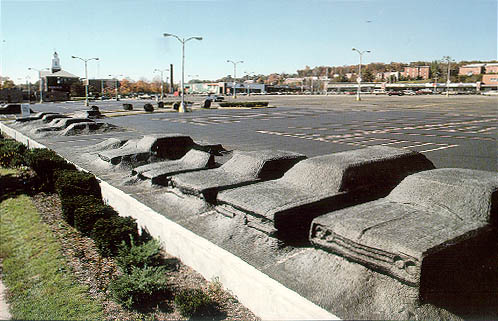
Car kabob


Car kabob

Originally uploaded by paytonc.

Last weekend, the Perimeter Ride took its second annual detour to see “Spindle,” a 1989 commission by Dustin Shuler in the parking lot of the aging Berwyn Plaza. (A Service Merchandise there has sat empty since its bankruptcy in 1999; the parking lot is crumbling, some of the artworks have deteriorated, and the town around it has changed considerably, to say the least.)

While googling the artist to locate his other works in California, I found several mentions of other artworks placed at strip malls by developer David Bermant–notably at Hamden Plaza outside New Haven. However, it turns out that a lot of the whimsical strip-mall conceptual art of the 1970s and 1980s has disappeared. Commercial priorities of new owners has subsumed much of the early work by James Wines at SITE, including Ghost Parking Lot (photo) and eight of the nine weird Best Products showrooms. (“Forest” in Henrico, Va., is the lone survivor; it’s now a peacefully wooded setting for a church.) Even the Spindle has been threatened: 69% of Berwynites voted to remove it in a primary-election referendum just a year after its installation, and other works (including SITE’s Floating McDonald’s, replaced by a standard outlet) have disappeared from Berwyn Plaza.

What the wacky, anti-consumerist artists were doing installing pieces in shopping malls in the first place isn’t quite the point; it’s that, once installed, I would have assumed that suburbanites’ inherently conservative tendencies would have left the works standing. However, the forces of commerce and progress are perhaps too strong to remain provoked, even in what are now decaying inner-ring ‘burbs.

Illinois the disturbed

An interesting map in Sunday’s NYT shows that, by the standards of the Wildlife Conservation Society, Illinois is perhaps the nation’s least “wild” state — almost all of its terrain has seen substantial human disturbance. Unlike other states, no inhospitable slopes or deserts stubbornly resisted settlement; the settlers planted their stakes across the Prairie State with ease, showing perhaps that this state was uniquely suited for human settlement.