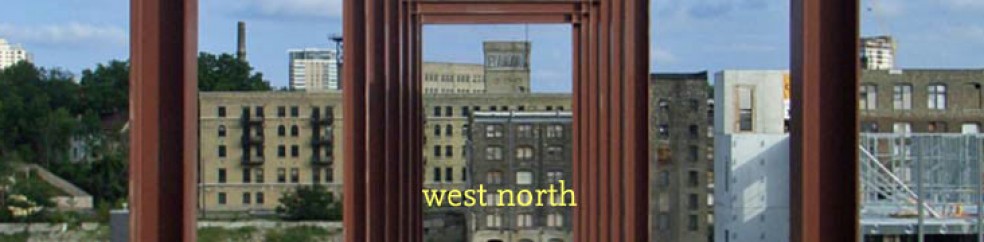
Every section-line corner of Chicago, in photos.
Mama Bear
as described by Faulkner, or at least someone who writes much like him:
MAMA BEAR. Fecundfertile primoprogenitive matriarch of the clan, who each day carelessly and without ratiocination made the beds and prepared the bowls of liquefied cereal, forgetting in her imbecility that not only her husband and child but she herself, and indeed all others of her species, were carnivores.
More about 32nd
A November article by Russ Stewart gives more background on the 32nd ward.
32nd ward race over
The race for 32nd Ward Democratic committeeman apparently is over before it began. From an email sent to volunteers for candidate John Fritchey today:
“I am very pleased to inform you that the discussions [“between myself and elected officials at every level of City and State government”] yielded results that simply would not have been obtained without us showing just how serious we are about obtaining significant improvements in our area. In general terms, the outcome of the discussions is as follows: 1) I have been given commitments that there will be no consolidation of the committeeman’s office with that of any other local elected officeholder; 2) I have received what I consider to be credible assurances that the needs of 32nd Ward constituents are going to be given a heightened and continued priority beginning immediately and continuing on a going forward basis.”
County clerk filing data shows that both Alderman Matlak and Fritchey have withdrawn their filings, leaving incumbent Terry Gabinski as the sole candidate. Many locals had pinned their hopes on this race, and specifically Fritchey, to sink the old Rostenkowski machine that has held the 32nd since the Depression. Gabinski was Rosty’s chief deputy, and Matlak was Gabinski’s protege. Indeed, the aldermen’s office adjoins the Democratic committee’s office, and title to both is still held by none other than Dan Rostenkowski. Essentially, whether or not Matlak or Gabinski holds the committeeman’s chair doesn’t matter; the effect is that the committeeman’s office is consolidated with the alderman’s office.
Historically, aldermen in Chicago have controlled both their position and the chair of the ward Regular Democratic Organization — thus solidifying both their power in City Hall and in the RDO machine. However, some have recently alleged that the role split between Alderman Matlak and Committeeman Gabinski has improved on that centralization of authority: tales abound of developers paying off Gabinski, who then calls the favor into Matlak’s office — thus maintaining the appearance of propriety, since contributions to the RDO aren’t watched as closely as contributions to the alderman’s campaign fund.
That both Matlak and Gabinski filed for the upcoming race led some to wonder whether the machine had fractured. Independent constituents were lining up behind Fritchey, who’s well known in the ward’s northern reaches as the State Senator for much of the north lakefront yuppie belt — but who has less name recognition in west-side Bucktown and Ukrainian Village, which gentrified more recently and thus maintain Latino representatives in Springfield and Washington. Fritchey’s name recognition and unrest within the community over development would have provided a substantial base for a challenge.
This announcement ends a race which could have been interesting: the yuppies who now dominate the 32nd have little need for the traditional “ward services” (e.g., patronage jobs) disbursed by the RDO to newly arrived immigrants. For instance, the Hispanic Democratic Organization has had great success marketing The Machine to Mexican immigrants in areas like Back of the Yards (12th ward), Cragin (30th ward), and Southeast Chicago (10th ward). The RDO’s victory in the 44th last year — tossing its support behind Tom Tunney in Lakeview, thus endearing itself to that neighborhood’s assimilationist gays with a candidate who also had independent credentials — proved that its marketing muscle is still unmatched. Some speculated then that the proto-yuppie “lakefront liberals” who opposed Richard J. have been placated by Richard M. and his flowerbeds.
Since many yuppies are technocrats, they would seem to demand technocratic (transparent, efficient) government — the antithesis of the old ward system, where all city services were cloaked behind the alderman’s office in order to extract favors from seekers of said services. Perhaps the overall political apathy of the day has dimmed this group’s drive for good government.
Furthermore, a decade under the tyranny of Richard Daley the Second has led to increased unrest on City Council and in city politics. An political axis has formed between Mu�oz, Colon, and Flores, the three non-HDO affiliated Latinos on City Council, and the progressive organization surrounding Toni Preckwinkle in Hyde Park — creating an interesting, progressive foil for the Daley machine, committed to transparency and a progressive social agenda.
Also, the election for Democratic committeeman was to have coincided with the hotly contested primary election for U.S. Senate and president (although the latter will likely be over long before March), thus raising voter turnout above dismal municipal-election levels. There could have been something interesting to report in March, but there won’t be.
Bush in 30 Seconds
Voting for Bush in 30 Seconds, the political ad contest sponsored by MoveOn Voter Fund, ends in two days. The particular voting algorithm used is playing the more popular (and hopefully more effective) ads more often as the voting deadline nears, so last-minute voters are likely to get a taste of some of the best ads.
Greenhouse Garden
Instead of keeping a separate blog on the Greenhouse Garden, the community garden that I (through the Wicker Park Greens) help to maintain, I think I’ll just toss my posts in here. So, the “food & garden” subject heading will function as a mini-blog of my gardening and eating (and, perchance, drinking) life — along with the usual musings or links about slow food.
I mention this because the first garden catalog of the season has arrived (from Burpee, a consistently excellent seed supplier). I’m looking forward to an early start in the garden, before the bugs and heat of August come by and knock everything out. Several plants worked really well this year, including bok choy, mustard greens, collard greens, beets, arugula, and (finally) sorrel. The asparagus rooted well, and maybe I’ll be able to get a few stalks this year.
Possibilities for this year:
beans (none this year): edamame and French beans
edible flowers: mums, squash, and violas
fruiting: long eggplant, bell peppers (which we forgot this year), honeydew (Charentais), yellow squash, tomatillo, black beefsteak tomatoes
greens/roots: arugula, beets, bok choy, broccoli raab, carrots, yellow chard, leek, mustard, Napa cabbage, red garlic, tetragonia
herbs: Thai basil, bergamot, chamomile, chives, verbena
bush versions: delicata squash, sunflower, zucchini (much larger versions of these took over the garden last year)
Too bad my apartment’s porch is too dim for most anything to grow. I might try placing some perennial herbs in the courtyard immediately below the porch; as long as they look like they fit in, the landscapers won’t bother them. Plus, it’s sunnier down there than it is under the porch.
Even more movies?
Landmark Theaters has reportedly signed a lease with Holsten to build a art-house multiplex in the Wilson Yard redevelopment, at Broadway and Wilson in Uptown. Although certainly movies are an appropriate use in what was one of Chicago’s premier entertainment districts, the opening of the Landmark Century Center (and art houses in Evanston and Highland Park, keeping North Shore moviegoers closer to home) has cut into ticket sales at the Music Box. The new theater site is similarly near the Music Box, but offers even better access to the Red Line than any existing north side theater.
Talk about signing a theater chain for subterranean space at Block 37 (to complement the Siskel, but perhaps too close to the new River East megaplex) has gone nowhere. Similarly, plans for screening revivals at old moviehouses in out-of-the-way Portage Park and Bridgeport have stalled despite overflow crowds at the annual Outdoor Film Festival in Grant Park. It seems there won’t be enough indy or foreign films to fill the screens (and my dreams of ever seeing a movie on the west side — besides the City North and Lawndale multiplexes — seem all the more distant now); revivals and niche ethnic markets seem like long shots as well.
Merry…
The local forecast is for a white Christmas, which makes the notion of a Bike Winter Xmas even more appealing.
Reinventing Stateway’s schools
Some public housing redevelopment schemes will need an extra push to get started. Reinventing the local public schools sounds like a good idea, but the results of school reform are famously slow to arrive — and may not arrive quickly enough to put a happy new face onto a notorious neighborhood.
SUVs twice as deadly
A recent assessment of pedestrian crash data (reported by New Scientist and Transportation Alternatives) finds that large SUVs and vans are two to three times more likely to kill a pedestrian or cyclist upon impact than regular cars. Another paper estimates pedestrian fatality rates two to three times as high for light trucks as for cars.
Most of this increased risk is due to the vehicles’ bulk and high, aggressive front end designs (QT video and discussion — from a car reviewer, no less). The high, square front end hits higher on a pedestrian’s body, not only inflicting damage directly onto vital organs but also increasing the risk of a pedestrian going under, and therefore getting run over by, the car. Simply put, an SUV with bull bars is about the deadliest design possible for a car (short of arming the car).
The European Union and Australia have adopted safety tests and regulations to ensure that car designs aren’t unnecessarily deadly for pedestrians. Regulators in the U.S. estimate that simple changes in vehicle design — changes already in place on new Volvo and VW vehicles, for instance — could save at least 300 pedestrian lives every year. Yet, under the first Bush administration (updated link, #9), the NHTSA decided that pedestrians’ lives were expendable and not worth the effort. In the years since, thousands of pedestrians have died needlessly.
Meanwhile, the automakers’ recent voluntary initiative to improve SUV safety does nothing to protect pedestrians and cyclists. Blocker (Bradsher) bars prevent trucks from riding above cars by engaging the cars’ steel safety cages, but do nothing to prevent a pedestrian from going under; similarly, side curtain air bags should have been required safety equipment anyhow. Insofar as the Bush administration was marginally involved in raising the question, I suppose it’s a good thing.
From the New Scientist article: …The UK Department of Transport says new rules coming into force in Europe in October 2005 will force makers of “cars and car-derived vans” to meet strict new pedestrian protection standards. “They will have to use new materials to soften up some of the areas around the bonnet so they deform controllably in an impact,” says a DoT spokesperson…
Continue reading
SUV toll mounts
The social cost of SUV proliferation is finally showing up in higher auto insurance premiums, brought on by the increasingly violent, increasingly deadly crashes that these things cause.
The article notes in passing that a pedestrian or cyclist is 82% more likely to die when hit by an SUV than by a car. That factor increases immeasurably with the installation of “bull bars,” which turn a three-ton battering ram into a three-ton steel-edged battering ram.
It’s appalling that almost all discussions of SUV safety are couched in language about drivers alone — namely, their danger to other drivers (or, from the SUV advocate perspective, the other drivers’ danger to themselves for not choosing the “safer” trucks). Pedestrians account for 13% of traffic deaths, and cyclists another 2%. It is unquestionably true that a world of all SUVs would be more dangerous for pedestrians and cyclists; even if it were marginally safer for drivers, the total number of traffic deaths will undoubtedly increase as weaker road users are killed off.
Up and running!
After a two-day DNS delay, I can now view the site. Now I can post archives and fix the stylesheets.

