“[T]he real cost of oil, is not just what you pay at the pump,” says Press. “It’s what we’re paying in Iraq. That’s the true cost.” — Jim Press, Chief Operating Officer, Toyota, as reported by Brendan Koerner in Wired
Monthly Archives: August 2005
Drowning? We’ll build you a bridge
Jacob Hacker has a great analogy for “the ownership society” in TNR:
The conservative response to rising insecurity is equivalent to tossing a lead weight to a drowning man on the assumption that, now, he will really have an incentive to swim.
It’s all about incentives, right?
From DC’s truth-stranger-than-fiction department, the new “highway bill” contains, of course, a record number of earmarks — since Congressmen, not planners, of course, know what’s best for America’s transportation needs. Riiiight. Rep. Don Young (R-AK) proudly says he “stuffed” TEA-LU — the “Legacy for Users” an excuse to put his wife’s name into his true pride and joy — “like a turkey,” particularly with one project so incredibly useless that its folly could only be paralleled in a land ruled by a feebleminded (if sharply dressed) despot:
$231 million for a bridge that will connect Anchorage to Port MacKenzie, a rural area that has exactly one resident.
The same amount of cash invested in, say, the Mid-City Transitway could buy a transit line with 30,000 passengers a day. But… no. This is how the Republicans describe “smaller government.” Maybe I should write a check to the Alaskan Independence Party to help them secede from the Union and stop wasting our tax dollars.
Edit 18 August: Garrison Keillor writes in his syndicated column: “Had Minnesota voted Republican, as Alaska wisely did, we might have gotten a canal connecting the Mississippi to Lake Superior and a high-speed rail link between Bemidji and Roseau and maybe a 10,000-foot runway at the Waseca (pop. 8,389) International Airport.” He also suggests that English majors band together to demand $223 million libraries from the feds, “equipped with leather sofas and an espresso bar and librarians who are trained in pressure-point massage. Greek columns would be nice, and a pair of stone lions, and a rare book collection and a three-story lobby with marble floors so your footsteps echo as if you were in an Edith Wharton novel. And a statue of Minerva.”
Car kabob

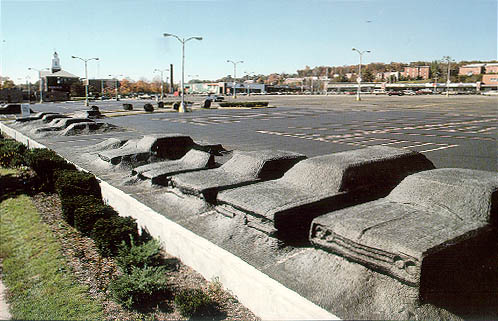
Last weekend, the Perimeter Ride took its second annual detour to see “Spindle,” a 1989 commission by Dustin Shuler in the parking lot of the aging Berwyn Plaza. (A Service Merchandise there has sat empty since its bankruptcy in 1999; the parking lot is crumbling, some of the artworks have deteriorated, and the town around it has changed considerably, to say the least.)
While googling the artist to locate his other works in California, I found several mentions of other artworks placed at strip malls by developer David Bermant–notably at Hamden Plaza outside New Haven. However, it turns out that a lot of the whimsical strip-mall conceptual art of the 1970s and 1980s has disappeared. Commercial priorities of new owners has subsumed much of the early work by James Wines at SITE, including Ghost Parking Lot (photo) and eight of the nine weird Best Products showrooms. (“Forest” in Henrico, Va., is the lone survivor; it’s now a peacefully wooded setting for a church.) Even the Spindle has been threatened: 69% of Berwynites voted to remove it in a primary-election referendum just a year after its installation, and other works (including SITE’s Floating McDonald’s, replaced by a standard outlet) have disappeared from Berwyn Plaza.
What the wacky, anti-consumerist artists were doing installing pieces in shopping malls in the first place isn’t quite the point; it’s that, once installed, I would have assumed that suburbanites’ inherently conservative tendencies would have left the works standing. However, the forces of commerce and progress are perhaps too strong to remain provoked, even in what are now decaying inner-ring ‘burbs.
Illinois the disturbed
An interesting map in Sunday’s NYT shows that, by the standards of the Wildlife Conservation Society, Illinois is perhaps the nation’s least “wild” state — almost all of its terrain has seen substantial human disturbance. Unlike other states, no inhospitable slopes or deserts stubbornly resisted settlement; the settlers planted their stakes across the Prairie State with ease, showing perhaps that this state was uniquely suited for human settlement.
Wal*Mart dreams

Neighbors gathering in the street… gabled houses and picket fences sheltered by trees… striped awnings shading corner stores… this was life before Wal*Mart paved it all over for a 50-acre Supercenter, right? Oddly enough, this mistily maudlin illustration of idyllic small-town bliss appeared in a propaganda advertisement placed by Wal*Mart in the New York Review of Books in April.
80% of Americans would probably never allow their children to walk the dog in the street out of a well-founded fear of traffic, but Brobdignagian corporations like Wal*Mart continue to use the visual vocabulary of walkable American neighborhoods (a way of life that said corporations bulldozed decades ago en route to greater profit) to cloak themselves in a comfortably gauzy veneer of Pax Americana. Yet Wal*Mart is the exemplar of the economy that has “progressed” and “expanded” to the point where the friendliness and comfort of this scene have been deemed insufficiently enticing of consumer desire, and therefore un-American. After all, where in this scene could one find a GM Hummer H3, or 20-pound box of America’s Value Choice from Sam’s Club fish sticks, or a $3,000 Weber grill? Disgusting.
 west north