Flat fare falls flat

“Metro should have a flat fare.” I’ve seen this mind-boggling argument all over the place, much to my consternation. This scheme prizes mind-numbing simplicity over all else — economy, equity, efficiency, environment, everything.

Such a move would penalize DC & Arlington residents who take transit, rather than road-clogging and pollution-spewing cars, to make their trips around town — while giving a huge and highly regressive gift to some of the country’s wealthiest, sprawliest suburbs. Within DC & Arlington, Metro charges a $1.70 base fare: actually one of the cheapest for a subway in North America. Bus fares here are even lower: $1 for Circulator, $1.60 for Metrobus. You’ll pay almost twice our subway fare (C$3) just for a mile-long bus ride in poorer Toronto. The vast majority of people paying that short-distance fare are indeed actually residents, not tourists, and many of those people are transit-dependent and lower-income. The suburban commuters who would overwhelmingly benefit from a flat fare are people who can easily just drive to the grocery store or to visit grandma three miles away; that’s not an option for the transit-dependent.

Distance-based and time-based pricing recognizes that:
– it’s more expensive to provide longer trips in lower-density suburban areas.
– conversely, that trips within the core present a low marginal cost (so much so that cities like Pittsburgh, Portland, and Seattle have “fareless squares” where all downtown service is free): besides their short distance, the trains have to run through the core anyways just to distribute their suburban passengers. (If Alice is going 1-2-3 and Brenda is going 2-3-4, the marginal cost for the train to carry Charlie from 2-3 is $0, as no additional trains or drivers are needed.)
– more frequent rush hour service costs more to provide (since it requires purchasing more trains and paying more drivers).
– people are willing to pay more for longer trips at peak hours. This is especially true since many local employees, including most federal workers, have access to some kind of flex time.
– make more frequent transit trips, best customers who are traveling within the most congested areas and thus should be encouraged to ride space-efficient transit
– hundreds of thousands of suburbanites demonstrate every day that they’re willing to pay the higher fares charged to them, so cutting their fares leaves money on the table.

Therefore, if it costs more and the customers will pay more, then charge more. M arket economies use the price mechanism as the primary way in which consumers and producers match incentives, and transit is not an exception. We never question why the New Jersey Turnpike or American Airlines factors distance into pricing, so why is it bad for transit? We tacitly understand that hotels cost more during conventions, and restaurants cost more at dinner than at lunch, so why whine incessantly about how peak fares “confuse” the world’s most over-educated city?

Confused tourists do not merit a new fare system, they merit a better way of presenting the information at fare machines. Presenting a map instead of a table of fares might work: I could quickly figure out ticket prices in Japan that way, even at stations where nothing was in English. Selling 1/2/3-day passes and round-trip tickets would certainly simplify matters, and fare vending machines should have larger, more informative displays with more helpful prompts.

It’s telling that very few new subway systems use flat-rate pricing, and in fact some newer, all-electronic transit systems have even more bewildering pricing schemes: Singapore changes road tolls every five minutes, Capital Bikeshare has four price bands ($0/$1.50/$3/$6). Those transit systems that have flat-rate prices are usually older systems with antiquated, token-based fare collection systems, and as a result are hobbled by path dependence. We live in the 21st century, so let’s use the technology that we have to make things smarter and better. Stored-value smart cards like SmarTrip only increases the incentive for transit systems to have more complex, Metrorail-like fare structures. A huge percentage of fares are paid by regular commuters who either use passes or have auto-reloading cards and thus don’t have to count out the fares they’re paying — so why not optimize the fare structure with rush-hour surcharges, zones, and the like?

Also, people complaining about high fares should be throttled. $3.85 from Bethesda to Capitol Hill? So what? A 10-mile trip on New Jersey Transit commuter rail is $5; on MBTA commuter rail $4.75; on a NYC Transit express bus $5.50 (and with slower, less frequent service). Per AAA, driving a 10-mile trip is $7.40 even before paying for parking — or for the $5.25 in tolls that a 10-mile rush-hour commute on the Dulles Greenway, or for the wages foregone by having you drive yourself. Typical Bethesda families can spare that change; their median income of $170K would pay for 60 roundtrips every day. Atypical Bethesda families can save money by traveling off-peak, or riding buses or bikes instead. Indeed, typical Metrorail riders are considerably more affluent and educated than Americans as a whole. 80% of Metrorail riders and 59% of Metrobus riders have college degrees — compared to 27.5% nationally and 47.5% in DC (all 2007; the best-educated state is Massachusetts at a mere 37.9% college grad). And get this: over half of Metrorail riders earn six figures.

Perhaps a 10-mile trip is cheaper in Tokyo or Hong Kong or NYC, but the cost of providing transit service falls dramatically with such high densities — Hong Kong crams 10X more population density into its urban core and 80% more passengers onto every single subway car (which are of surprisingly similar dimensions).

[Themes developed in comments posted at WeLoveDC, GGW]

Take a tour, any tour

A few months ago, I started working on a few bike tour routes reaching into D.C.’s suburbs, towards points of interest in urban planning history or just boozy destinations (and, even better, places with both). I’ll try to continue updating this map, but here are the completed and under-construction routes (the latter marked with POIs, but not connected yet):

  • Wine, spirits, and beer in Alexandria & Mount Vernon
  • Route 1 in Maryland: streetcar suburbs (Brookland, Hyattsville, Riverdale Park, College Park) and Greenbelt
  • Montgomery County Agricultural Preserve to Purcellville distillery (back on W&OD)
  • National Capital Streetcar Museum via Rock Creek trails
  • Falls Church, Merrifield, old & new Reston via W&OD
  • South Arlington redevelopment sites
  • Columbia & Ellicott City
  • Rockville & Gaithersburg

I’m aiming to present a few of these as guided tours, depending on whether I can find good tour guides at the POIs. Let me know if you can help.

Peak Car presentation

Taking to the street

I gave a brief Pecha Kucha presentation last night at CNU-DC‘s bimonthly 20×20 series. My topic was “Peak Car: nothing to fear here,” in a weak attempt to fit into the month’s Halloween theme. Peak Car doesn’t mean Apocalypse Now — cars will continue to be an important way for millions of people to get around — but it means that a whole series of assumptions around having to always increase pavement supply need to end, and a new set of assumptions around sharing urban spaces among many modes (and methods of interaction) needs to begin.

PK presentations don’t lend themselves to extensive quotes or footnotes, so here are three bonus items:
1. Mark Halper’s article at SmartPlanet provided background on the cost of alternative automotive fuels. Takeaway: $4+ “gas” is here to stay, regardless of whether it’s actually gasoline or something else. Joel Garreau made this point in Edge City (p. 126) back in 1991, and despite all the technological advances since then, it still holds true.
2. Christine MacDonald wrote in CityPaper about Joe Mamo, who holds a near-monopoly on DC’s gasoline supply — but not because the gas business is lucrative (it’s in a long term decline, as even oil industry CEOs admit), but because they’re an opportunistic real estate play: “The market is changing. A lot of properties are being used for best and highest use, as the properties become more expensive. So the chances are less and less gas stations in the future.”
3. The takeaway: car access to a location will slowly mean less and less in the future. Non-car access to a location will increase in importance. There are great tools out there, like Mapnificent, which can help us visualize these relative differences.

Stay tuned for a February follow-up about how America can love its streets once again.

Ethnoburbs: why not?

James Frank Dy Zarsadiaz in The Atlantic Cities writes about his ethnographic research into Asian immigrants in Diamond Bar, Calif. (where my cousin lives and works):

While scholars and researchers rightfully problematize political economies, migration patterns, and social dynamics between different racial and class groups in the contemporary ethnoburb, oftentimes post-1965 Asian immigrants moved to these neighborhoods for tangible and banal reasons. Interviewees provided various mundane and frank motives as to why the east Valley sold them twenty or thirty years ago: inexpensive new housing, reputable school districts, easy access to work, distance from urban crime and racial “others,” and by the late 1980s and 1990s, conveniences to ethnic commodities.

As banal as the reasons for moving to suburbia are, though, Asian Americans have reshaped suburbia in some interesting ways. The San Gabriel Valley’s population shift has been accompanied by an influx of a few things that conventional sprawl didn’t accommodate well — like extended families and myriad small businesses — and the towns there have started to extensively retrofit their built environment to accommodate them. By organically adding mixed uses and a wider range of housing types, they’re perhaps well out in front of suburbs elsewhere in America that are seeking to improve their resilience.

Last year, I presented as part of a “Cultural Urbanism” panel at the Next Generation of the New Urbanism which explored additional implications for urbanism that might arise as American metropolitan areas become more multi-ethnic — and assimilate different metropolitan values from the world’s cities.

My bonus slide’s call to action: Great urbanism exists outside of Europe. Before pointing to European cities in your presentations, keep in mind that the next generation of Americans looks quite different. Urban America is already majority minority, and soon America’s children will be as well.

Africa, Asia, Latin America, and even North America are filled with great examples of wonderful urbanism, in contexts no more “foreign” than Europe — so find them, and use them. Want to talk about bike infrastructure? Show off Bogota and Montreal. Transit oriented development? Curitiba and Hong Kong. Mass re-housing under capitalism? Santiago and Singapore. Organic, medieval street networks? You’ll find none more enchanting than Casablanca or Kyoto.

Help bring CaBi to DCA!


CaBi missing Originally uploaded by Payton Chung

Want to bring Capital Bikeshare to National Airport? “Like” one of the suggested Capital Bikeshare station locations at DCA on the Capital Bikeshare Crowdsourcing Map. (Hint: you’ll have to zoom into the airport to see the pins.) The map is maintained by Arlington County, which is in charge of adding new locations within Arlington. I hear that they’ve already met with MWAA about siting CaBi on airport grounds, and a whole bunch of votes could be what it takes to make sure that DCA is included in the next station expansion round.

Bike sharing at DCA would be:
– quick: just 10 minutes to Crystal City & Pentagon City, or 30 minutes to DC, and unlike shuttles is available on demand
– convenient: bike sharing is available 24 hours a day, unlike other transit services; the bikes can hold small carry-ons, which suffices for many business travelers, airline employees, and airport employees
– safe: DCA already has a completely grade-separated connection to a popular Class 1 trail, eliminating traffic conflicts; providing bike sharing could eliminate dangerous jaywalking behavior; over 3 million riders have enjoyed CaBi with an excellent safety record
– healthful: promotes a happy, healthful choice for stressed travelers and employees
– cost-effective: adds mobility at a low cost, unlike expensive remote parking options
– enjoyable: a great way for the region to show travelers the beautiful Mount Vernon Trail and the convenience of East Arlington’s neighborhoods
– economical (for MWAA): airport concessions are the only F&B outlet directly along 7.5 miles of the Mount Vernon Trail (between Rosslyn and Old Town Alexandria)

(BTW, I suggested the locations north of the terminal and west of the parking garage. These are near bike parking locations 1 and 6 on MWAA’s bike access map, and even though they’re not next to the terminal, they’re next to the trail and would keep bikes off the high-speed access roads.)

Southwest Washington: introduction

This school year, I’m working on a series of projects relating to my neighborhood of Southwest Waterfront. Since this semester’s work is with a team of other students less familiar with the neighborhood, I’ll be posting resources about the neighborhood on a periodic basis, which you can easily find using the swdc tag.

Walk through Southwest Waterfront

A few months ago, I gave a short presentation to CNU-DC based on a summertime walk around the neighborhood. Note that this covers only the Waterfront residential neighborhood, not the Southwest Rectangle (Federal Center & L’Enfant Plaza) office precinct north of I-395. You can download the PowerPoint or take a look at the photos on Flickr.

There are also a lot of great, easy-to-use online resources. I particularly like:

An extensive collection of original documents related to urban renewal in Washington can be found at the Washingtoniana Collection, on the third floor of the MLK Library at Gallery Place.

An etymology of “parking”

18:26

Ever wonder how “parking” came to mean two very diametrically opposed things — dead pavement and living green space? Historian Kirk Savage offers an explanation in his book Monument Wars:

In the nineteenth century, to park meant to plant a tree or spread a patch of turf or flowers–to create a little patch of parkland. In Washington, the Parking Commission was a group of respected horticulturalists who supervised street-tree planting. On the city’s wide streets, parking places typically referred to strips of grass, flowers, or trees plated alongside the pavement, or in the larger squares or circles. These strips of parking* not only cooled the streets but made them more manageable by reducing their great width and the amount of paving they required. By the turn of the century, such parking areas were sometimes used to hold horse-drawn carriages on special occasions; these were temporary intrusions that did not threaten the parkland itself. When automobiles started to overrun cities in the early twentieth century, parking areas were given over to car storage and the word began to refer to the cars themselves rather than the trees and grass they were replacing. The new meaning of the word intertwined with the old in strange ways. In 1924, for example, the park in front of Centre Market, “one of the few spots of green along Pennsylvania Avenue,” was converted into a “parking space” for cars over the opposition of the city’s “superintendent of trees and parkings,” who lamented that “the oil and gasoline from the parked automobiles will quickly kill whatever trees are left standing.” In early 1927, the District commissioners, acting on citizen complaints, appointed a committee to try to stop “the practice of parking automobiles on the grass-sown parkings between sidewalks and curbs.” At the same time, however, city officials were also beginning to cut down street trees throughout downtown Washington and widen pavements to make room for automobile traffic and parking (in the new sense). Literally and metaphorically, the new parking conquered the old.

skewed National Mall

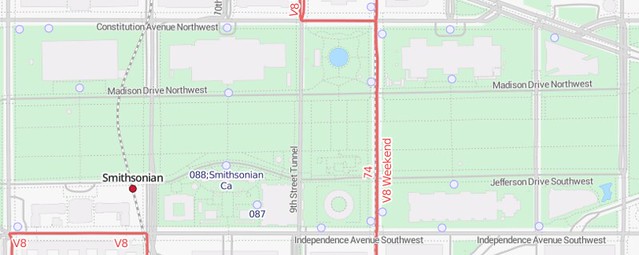
Another fun fact from the book: the axis of the National Mall was tilted about 1.5° south so that the Capitol and Washington Monument appear to line up. Since the Monument was built off-axis, it doesn’t line up anything in the L’Enfant Plan, and that’s still subtly visible in some views. Now that I know this, I can’t un-see its crookedness on any map of the city.

* In Chicago, the local dialect persists in calling areas like the planting zone between sidewalk and street “the parkway.”