Hong Kong’s revolution is in the streets, not the skyways

Even in “the city without ground,” #UmbrellaRevolution has taken not to the ersatz quasi-public spaces floating above Central, but instead to the ground — or at least to the traffic-sewer highways that fill what little is left of the ground:
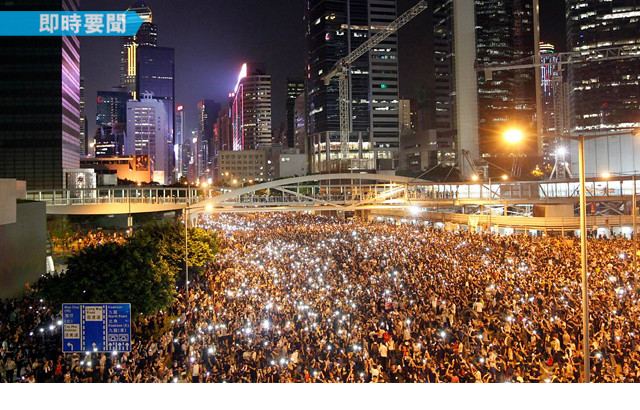
(c)2014 NextMedia

It’s an interesting contrast with Occupy Wall Street, which happened to fill privately owned public space even though New York has comparatively more truly public spaces.

Trevor Boddy’s essay about North American “skyway” systems in Variations on a Theme Park seems prescient:

Heretofore streets functioned as periodic reminders and enforcers of the civic domain; the new patterns of city building remove even this remaining vestige of public life, replacing them with an analogue, a surrogate.

Precisely because downtown streets are the last preserve of something approaching a mixing of all sectors of society, their replacement by the sealed realm overhead and underground has enormous implications for all aspects of political life. Constitutional guarantees of free speech and of freedom of association and assembly mean much less if there is literally no peopled public space to serve as a forum in which to act out these rights…

[Protest] activities have been displaced over the past decade from the square and main street to the windswept emptiness of City Hall Mall or Federal Building Plaza. To encounter a ragtag mob of protestors in such places today renders them even more pathetic, their marginality enforced by a physical displacement into so unimportant, uninhabited, and unloved a civic location.

Only a full-scale revolt, involving hundreds of thousands, can be taken seriously under these conditions.

Not that a U.S. Supreme Court case matters much in this context, but Thurgood Marshall’s concurring opinion in the Pruneyard Shopping Center case is also worth remembering (emphasis added):

[S]hopping center owners had opened their centers to the public at large, effectively replacing the State with respect to such traditional First Amendment forums as streets, sidewalks, and parks…. Rights of free expression become illusory when a State has operated in such a way as to shut off effective channels of communication.

(Image of Occupy Central on Monday, 29 September 2014 from Apple Daily/NextMedia.)

My five days on the GAP + C&O trails

GAP ride

Overlook just east of the continental divide.

Three general observations after a week on the Great Allegheny Passage and C&O Canal towpath:

  • Six days would be perfect; the five-day schedule offered insufficient recovery/slack time and left me feeling rushed, despite good stretches at 15+ MPH. In my case, a rainy morning and the Fallingwater side trip ended up taking up a good chunk of day two, which left me with almost a century to accomplish on day three. Plus, the towns were more interesting than I expected.
  • For the most part, you actually might not want to stay overnight in the most interesting towns (IMO: Ohiopyle, Cumberland, Harpers Ferry). Their attractions are mostly open during the day, whereas for an overnight location you mostly just want to eat dinner and crash. Specifically, I’d recommend stopping at Harpers Ferry during the day when the historic park’s attractions are open, then overnighting at Lockhouse 28, and then a leisurely reintroduction to metropolitan civilization the next day.
  • The C&O’s surface varies tremendously. Some of the sections are, like the parts closest to DC, very rocky and tough to take at speed, but others are much smoother (and often muddier). I did appreciate taking breaks from it, though.

The daily itinerary, as it played out:

  1. Pittsburgh to Ohiopyle, Penna. 77 mi. slightly uphill via McKeesport, West Newton, Connellsville. Stopped at Target in Homestead to buy a $30 tent, which did in fact pay off. Some of the Steel Valley towns would have been worth a side trip, but the main goal was to get out of town. Highlight: Appalachian Juice Company in Connellsville.
  2. Ohiopyle to Meyersdale, Penna. 42 mi. uphill via Confluence, Rockwood. The morning trip to Fallingwater was very steep: it’s 780′ of vertical over less than five miles. By comparison, the GAP’s first hundred miles rise by about the same amount. I’d planned to make it over the divide to Frostburg, but had to stop 15 miles short once night fell — it’s really, truly dark. That said, Fallingwater is truly transcendent.
  3. Meyersdale to Hancock, Md. 93 mi. mostly downhill via eastern continental divide, Cumberland, Paw Paw. Detour onto Western Maryland Rail-Trail. Highlight: dinner at Buddy Lou’s in Hancock.
  4. Hancock to Sandy Hook, Md. (Harpers Ferry) 48 mi. flat via Williamsport, Sharpsburg. Detoured over land from Williamsport through Antietam Battlefield. This cut out about 16 miles by keeping us away from a particularly windy stretch of the Potomac; plus, the main uphill was from the valley up to Williamsport, where we were stopping for lunch anyways. Highlights: lunch at Desert Rose Cafe in Williamsport and Nutter’s Ice Cream in Sharpsburg. However, we did end up bypassing Shepherdstown, W.V., a town that other riders commended.
  5. Sandy Hook to Reston, Va. 45 mi. via Leesburg, switching to W&OD via White’s Ferry. Took the Silver Line to Washington Union Station from there. Highlight: ultra-smooth cold-brewed Hopscotch Coffee. Although this was the only day that passed by any breweries (Crooked Run, Old Ox, Lost Rhino, Mad Fox, Bluejacket, etc.), we were in too much of a hurry for any stops.

Update, 1 June 2015, for benefit of whoever landed here searching for a five-day itinerary: Finished another trip last week. This itinerary was more balanced miles-wise, owing to an evening rather than midday ending on Day 5. Three nights of camping also helped keep the itinerary more flexible:

  1. Pittsburgh > Braddock > West Newton > Connellsville 59 mi. Camped behind a supermarket (24-hour!) at the edge of town in Connellsville, which was convenient if not scenic.
  2. Connellsville > Ohiopyle > Confluence > Rockwood 47 mi. Lunch at Ohiopyle was a perfect “last stop in civilization.” The surroundings get very rural past there, but Rockwood did at least have pizza and campsites.
  3. Rockwood > Frostburg > Cumberland > Lock 62 campsite (past Paw Paw) 72 mi. Frostburg is empty after the college lets out. Stocked up on supplies in Cumberland ahead of the only night of primitive camping.
  4. Lock 62 > Hancock > Williamsport > Sharpsburg > Shepherdstown 74 mi. Shepherdstown was a better overnight stop than HF, with better nightlife even when school’s not in session.
  5. Shepherdstown > Leesburg > Herndon 55 mi. Spent a while lingering around Harpers Ferry during the day. Took the 5A from Herndon-Monroe rather than the Silver Line because it was rush hour, and got a warning from the bus driver about our front racks not fitting — but we were fine.

Update 2025: Anyone planning <50 mile days on the C&O should note that there are no towns and few accommodations on the C&O trail between Brunswick (mile 55) and Georgetown DC (mile 1). The C&O National Historical Park sits within a canyon through this stretch, and strict suburban zoning prevents so much as a B&B along the way. Indeed, the only food along the trail is at Whites Ferry (MP 35.5) or Great Falls Tavern (MP 14.4). The only accommodations along the trail are the NPS campgrounds (none closer than MP 16.6) and the six “Canal Quarters” houses (each of which can only be booked by one group).

The W&OD in Virginia is a paved suburban rail-trail with many more services, but getting there now requires an on-road detour. My preferred scenic and direct route: exit the C&O at Point of Rocks and cross the Potomac River on US 15; traffic is heavy but slow. Turn right immediately after the river and climb (unpaved) Furnace Mountain Road; the total climb is around 200 feet. Take this to the village of Taylorstown: turn right at Taylorstown Road (VA 668), then almost immediately left on Loyalty Road (VA 665). Continue south past Waterford village; it becomes Clarkes Gap Road (VA 662). This ends at Paeonian Springs and VA 9; cross and continue south on Simpson Circle to the W&OD trail.

Parallel trends: bigger houses, tinier apartments

size of new houses

It’s lately become very fashionable to contrast the concurrent trend towards ever-larger new houses and ever-smaller new apartments. Recently, Richard Florida,* Kaid Benfield, and even the Streetsblog podcast have all mentioned this peculiar contradiction.

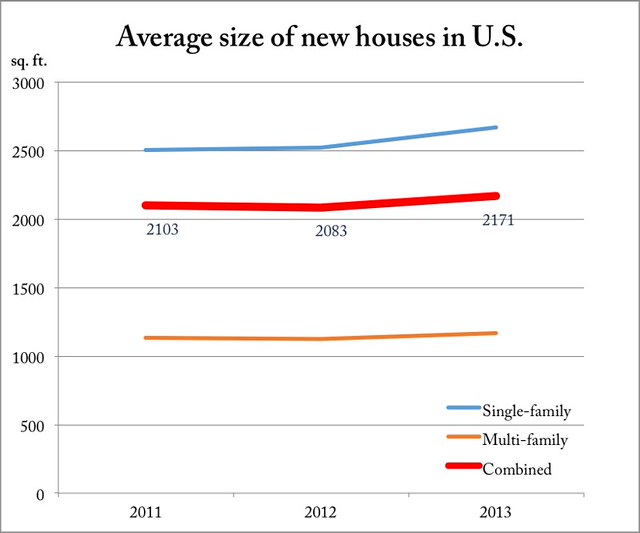
But scratch a little bit at the surface and you’ll find that it’s an artifact of the Great Recession, not an existential conundrum. Consider that the Census’ Survey of Construction, the source of said statistic, only measures a universe consisting of new single family (usually for-sale) houses. However, these share of total new housing construction that is in single-family houses continues to fall. Just from 2011 to 2013, multi-family houses went from 29% to 33% of all new housing completions. Meanwhile, their size hasn’t budged: it’s consistently been around 1,100 square feet (+/- 50) since 1999.

The chart above also comes from Census data, and tells a more complete story. The average size of new houses built in the USA, both single- and multi-family, declined from 2011 to 2012, then ticked up to a record in 2013. It hasn’t been on an upward march forever. Another reason why this data point isn’t quite as important as it might seem at first glance: many fewer Americans are in new houses, period.

houses creeping back up

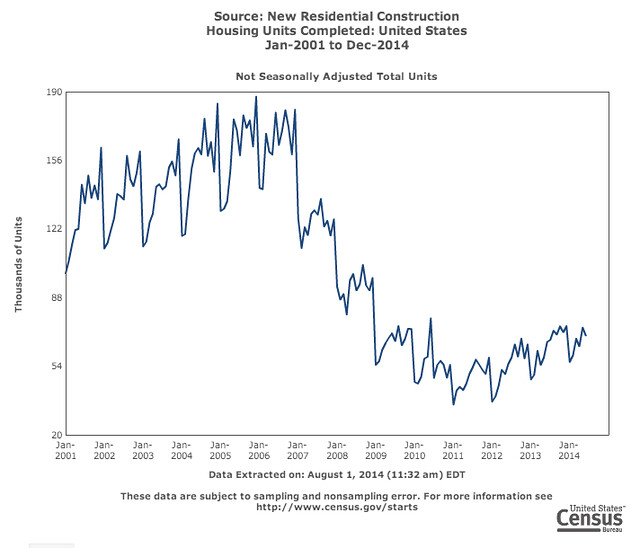
Construction may be up slightly, but it’s still well below its peak. Completions fell 70% from the 2004-2006 rate, and now we’re back up to 60% below that (completely unsustainable) rate. From builders I’ve heard at ULI panels and the like, new move-up product is still selling in the suburbs, but first-time buyers are staying in rentals longer, largely due to tighter financing. Hence, fewer small homes are getting built, as younger households stay in existing stock for much longer, and the average home size is increasing. (Oh, and remember: we’re talking about fewer smaller single-family houses. The number of multi-family houses, small and medium-sized, is increasing.)

Thus, the real story is that the for-sale single-family starter home, as a product type, is dying off. For example, when my brother recently purchased his first new house (at 35, considerably older than the 28-year-old median buyer at, say, Park Forest), he didn’t get a starter home. He went directly from an existing multi-family unit to a move-up sized house.

* Making the additional methodological error of taking the definition of “central cities” seriously.