Two presentations given at YIMBYtown 2025:
- Expanding Infill Affordable Homeownership Pathways
2. Who killed Missing Middle Housing – and how?
Two presentations given at YIMBYtown 2025:
2. Who killed Missing Middle Housing – and how?
Seeing a photograph of streetlights on during the day in Pittsburgh prompted me to investigate how bad air pollution really was back then. Voila: a 1979 journal article by Cliff Davidson notes that typical Total Suspended Particulates (a now-deprecated measure) in Chicago in 1913 were 0.3-2.0 mg/m3, with a maximum of 9.3. Cleveland in 1915 reported an average of 14.3 mg/m3, and Pittsburgh was estimated at <7 mg/m3. All of those are many, many times higher than the current EU limit, which is 0.15 mg/m3 – about 99% lower than Cleveland a century ago.
The Baltimore Museum of Art currently has an interesting exhibit of art from the turn of the last century, with a bit of added context: how gosh-darn smoke-filled the skies were back then. “Smog was visually stimulating and helped Monet see his urban environment in new ways.” It translates hazy scenes of London and Paris into air quality scores that would be nightmarish for present-day Americans, or challenging even for current residents of developing-world cities.
Presentation given at the Smart Growth America Equity Summit, March 2025.
Wee Japanese fire trucks, as some Stateside auto enthusiasts have discovered, are adorably, I-wanna-pinch-your-cheeks tiny. Here’s one on the streets of Onomichi:
Of course, something this different doesn’t exist in isolation; there are systemic differences between Japanese and American fire response that allow and even require smaller trucks.
There are more, but smaller, trucks. Japan has smaller, specialized fire and rescue trucks, whereas America chooses to have larger, generalist trucks. Nagata Shozo, a disaster mitigation administration professor at Kansai University, says in a recent NHK documentary (see ~5m in): “In other countries, you may see a single vehicle that combines firefighting and rescue equipment… in Japan, we have a tradition of specialization… We improve the vehicles’ specific uses and capabilities, and when it comes to dealing with emergency, vehicles with different special features are used in combination to tackle the situation.”
At many fire stations I saw vehicles parked nose-to-tail, with garage doors on both sides of the building. A peek inside the Mukojima Fire Station in eastern Tokyo shows a second set of doors behind perhaps a dozen vehicles, including conventional trucks and van-sized ambulances. That is much larger than my brand-new local fire station (Engine #13, Truck #10, Ambulance #13), which has just five bays.
Equally capable equipment is smaller. A ladder truck inside the Shiba Fire Station is about the size of a typical US fire truck. This station is surrounded by new high-rises along the waterfront just south of the Imperial Palace.
Compare that to a ladder truck in DC, whose service area only has buildings up to 130′ tall (40m). [Or, check out this short video of a Japanese truck visiting a downtown DC fire station.]
A NACTO/Volpe report from 2018 calls out ladder trucks in particular as being peculiarly over-sized: “Aerial ladder fire trucks used in major European and Asian cities can reach just as high, despite being only two-thirds as long and having only half of the turn radius as common American models.”
By the way, the Shiba station was huge, with eight ranks of vehicles and garage doors in front and back.
There are even smaller vehicles. Note the rescue motorcycle at the right edge of the garage at the Arakawa Fire Department, Otonashigawa Branch. There were even cargo bicycles parked behind it. These can reach medical situations quickly even in pedestrian zones, or after earthquakes when roads may not be clear. (Mukojima above also had motorcycles.)
Fire stations are more numerous, and often mixed-use. Shinjuku-gyoen and Shiba are 3 miles apart, and there are five other fire stations in between them – meaning about one station every half-mile. Central Tokyo is dense, but not absurdly so; these areas have the population density of Brooklyn or the Bronx, not Manhattan.
A downside of having so many fire stations is that the land footprint is extensive, but that’s mitigated by combining fire stations into mixed-use buildings. None of the urban fire stations I saw were single-story structures.
This isn’t just in urban areas; it also means putting fire trucks in remote areas, like this one stationed at the Enryaku-ji temple complex atop Mount Hiei east of Kyoto:
The small trucks respond to historically narrow streets – and enable narrow streets into the future. These tiny fire trucks can fight fires and respond to medical emergencies even though Japanese streets are famously narrow (often 4m, sometimes narrower), and just as importantly they allow new streets to be narrow as well. Contrast that with the absolute narrowest street I can build in Raleigh, which is 6.7m wide (34% wider) and requires a 40′ long fire truck turnaround.
Whatever they’re doing, it works. Japan’s fire death rate is substantially below America’s, which is notable given that its cities have historically been even more fire-prone than US cities. America’s “era of great urban fires” was over a century ago; by then, Tokyo alone had seen 49 large-scale urban fires in the preceding two centuries.
More importantly, given that the death rate for car crashes in the US (128 per million) is about ten times higher than the fire death rate (13 per million), the narrow streets and slower speeds found in Japan contribute to a traffic death rate that’s 3/4 lower per capita and 2/3 lower per vehicle.
Further reading:
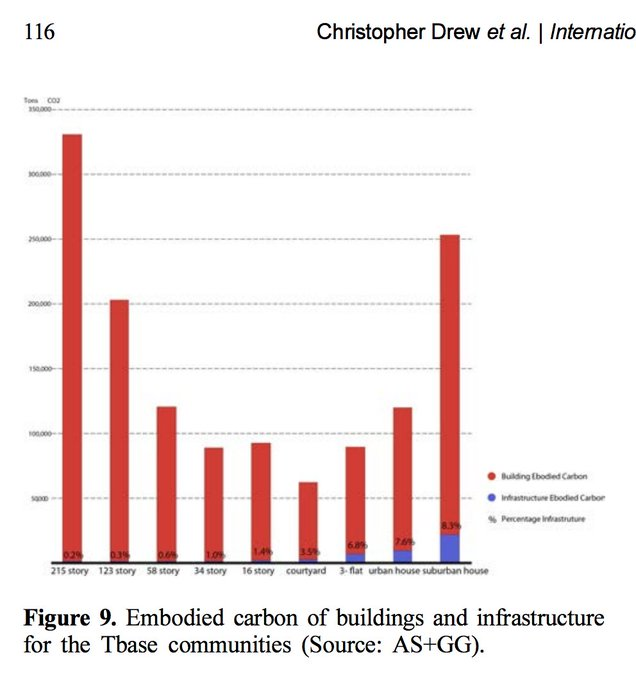
Earlier, I’ve written about how high-rise residential buildings have higher construction costs, land costs, floorplan efficiency, and maintenance costs than low-rise buildings. But leave it to some supertall skyscraper architects to make the ecological case for low-rise multifamily, with the book Residensity. The Chicago-based architects ran analyses on nine different arrangements for 2,000 residential units, from detached suburban houses to 215-story skyscrapers, and found that the optimal type was the humble courtyard apartment.
This housing type, typical of medium-density lakefront neighborhoods in Chicago (see Moss Design), is a low-rise version of a European perimeter block. Multiple apartment entrances are arrayed around a courtyard, each reaching up to six flats (one on either side, for three floors). The deep courtyard evolved (see Ultra Local Geography) from the practice of putting apartment entrances along both streets on corner lots, and a clever response to Chicago’s relatively deep lots. They’re not quite single stair point-access blocks, though: each apartment technically also accesses a second stair — an exterior fire escape, usually built as a sociable rear porch. (21st-century building codes do not count this as a legal egress.) Courtyard apartments also allow for shallower, more usable interior floor plans; unlike mid-century “garden apartments” they structure open space into urbane settings.
The Smith/Gill team found that courtyard apartments had:

In some sense, this shouldn’t be surprising: the high construction costs and operating costs for high-rises are, in large part, paying for large quantities of carbon-intensive materials and energy to go into their construction and operation. The high operating energy demand reflects the large building surface areas that tall buildings have, as well as inefficient floor plans with extensive interior spaces. In a skyscraper, everyone on floor 150 has to travel indoors past everyone on floors 1-149 to get to anything outside the building; in a courtyard apartment building, most of that travel is outdoors.

Most striking to me is the density effect: high-rises aren’t incredibly more land efficient (shown by the green bars) than low-rise multifamily. For the same population, three-story apartments use 87.1% less land than suburban houses, courtyard apartments use 94.2% less, and high-rises uses 97-99% less land. Thus, low-rise apartments offer 90-97% of the land savings that high-rises do.
This paper also didn’t consider CO2 emissions from transportation: almost 1/3 of all US CO2. (The US accounts for 45% of the whole world’s transport CO2!) The greatest potential for transport CO2 reductions is to raise low densities to moderate, not high to higher: “the relationship between density and emissions is nonlinear,” says Grist about a PNAS journal article by Conor Gately — echoing Newman & Kenworthy’s finding from 1999.
Here’s a Google-translated ad for new houses for sale in suburban Hiroshima; just this one small advertisement for new houses required a lot of research and explaining to make sense!
Building and zoning codes reference link: www.iibh.org/kijun/japan.htm
Brookings Institute overview www.brookings.edu/articles/japan-rental-housing-markets/
English blog on Japanese housing: catforehead.com/
If those are the prices for suburbia, how about infill? Here’s an ad for new high-rise condos in the downtown area of Yokosuka, a seaside southern suburb of Yokohama that’s home to a large US Navy base. It’s half an hour to Yokohama by train and one hour to southern Tokyo, and one-bedroom units begin at ¥27M, or US$177K today.
This ad was for a Keikyu condo, near a Keikyu station, and seen on a Keikyu train. Land development is how American streetcar systems made their fortunes, and it’s still a legitimate business model across Asia today.
A short presentation with an overview of commercial real estate (specifically housing construction) development finance, illustrated with examples drawn from ULI case studies. Created this at YIMBYtown in 2018 by request; do note that dollar figures are outdated as a result of severe construction cost inflation.
Want a car-free day-trip escape one of these last few weekends of summer? I wrote about four county fairs and eight transit museums you can get to from DC.
Read originals at Greater Greater Washington:
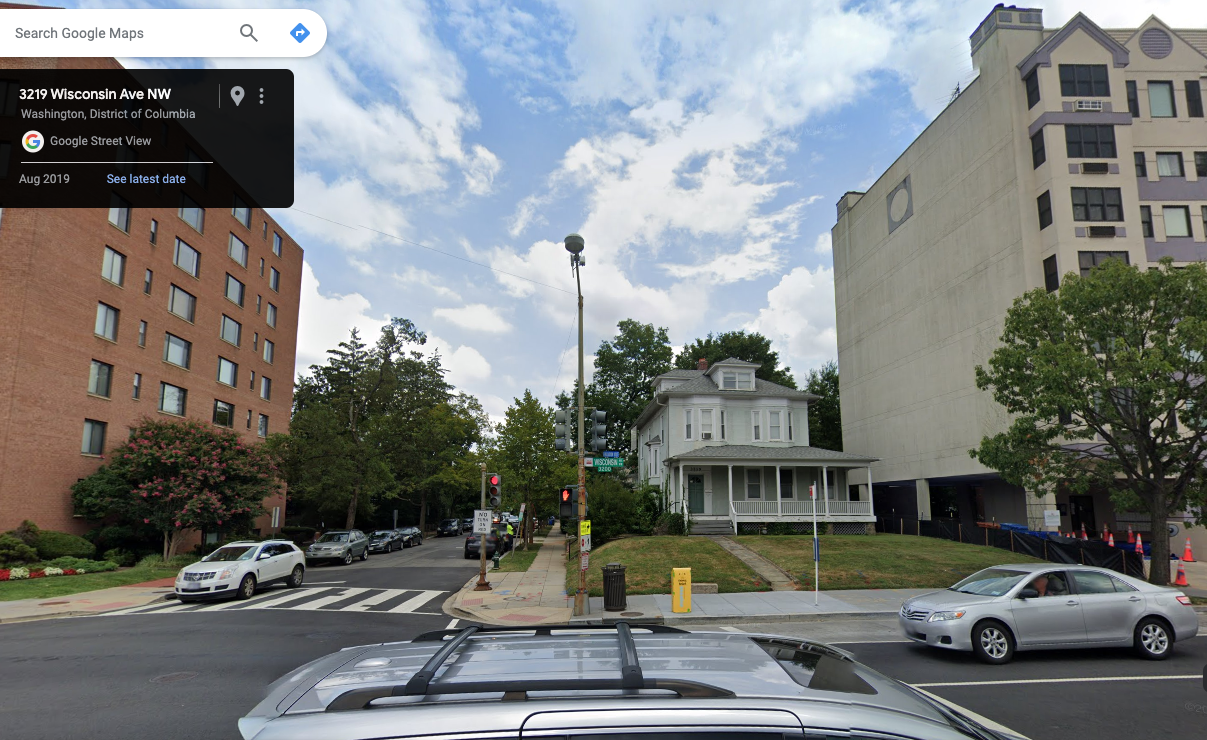
This house on Wisconsin Ave. NW was demolished by greedy high-rise developers — no, wait, it was merely moved around the corner to face Macomb St. The high-rise is actual infill, in that it fills in what had been a square of grass. Keeping the house (which might have been part of a bargain with the neighborhood) can help to recoup most of the land acquisition cost.


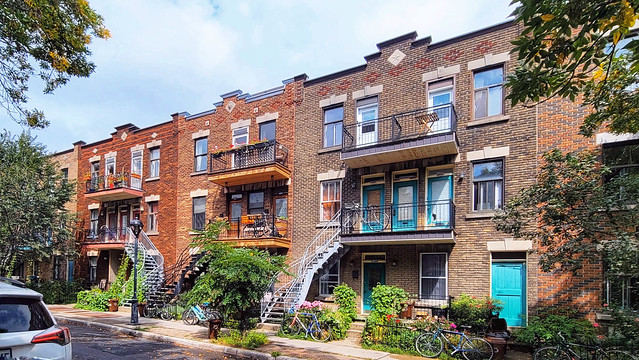
Infill, rather than demolition, was pretty typical of how “missing middle housing” was originally built in its early 20th-century, pre-zoning heyday. It’s also how middle housing development generally pencils in the present day: “the best way to make an infill project work is to avoid demolition.”
Even though houses in locations like Upper NW DC are expensive, houses’ yard space is some of the lowest-valued land in cities. Moving a house on its lot is a way to buy just the yard while leaving the use value of the house intact.
I had hoped to take a similar approach with my Redgrove project by building new houses just within the backyard and calling the entire site a “cottage court.” Alas, I couldn’t get zoning permission to call it a cottage court. Raleigh allows “flag lots” (a site that wraps around an existing house) but only for one or two units, not 10. The only legal way to get more than a few units (indeed, up to 41 units!) was with only townhouses or multifamily on site, and so the original house will be demolished soon. Inflexible planning rules (minimum lot sizes, frontage requirements) don’t allow this sort of mix-and-match development.
(Edit 2025. Glad to see my strategy and experience validated in a Portland city report about middle housing: “cottage clusters… can sometimes preserve existing structures that are well positioned on the original lot to allow building on the remainder of the site… a challenge [arises] because preservation necessarily means the builder has less site area, flexibility, and fewer new structures… These realities mean sites where preservation is an option (or financial necessity) aren’t as workable as they could be.”)
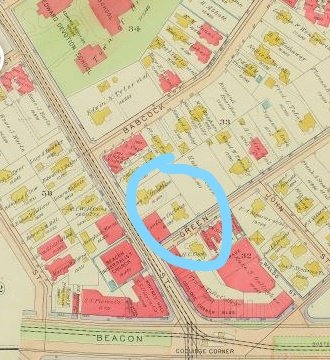
A century-old example is the Coolidge Corner section of Brookline, Massachusetts, where my grandparents once bought a triple-decker and where John F. Kennedy grew up. The NPS website for the JFK house includes this Sanborn insurance map slider, which shows how Coolidge Corner’s building stock changed between 1907 and 1919 — including both the Kennedy’s house and my grandfather’s triple-decker.
The maps shows that flats (shown on the fire insurance maps in red, as they were built out of fireproof brick) were usually built on vacant, but already subdivided, house lots. Sometimes, a wooden house (shown in yellow) would be moved on its lot to make room for flats–e.g., the two circled houses at the corner of Harvard and Green Streets were rotated away from Harvard St. to make room for shops on the same lot. A ~1919 photo shows Jack and Joe Kennedy Jr. standing amidst a half-built suburban subdivision. Few houses were demolished entirely to build just flats — though some were for larger buildings, like the mixed-use complex in the obtuse corner.


People like Rose Kennedy, who moved into a new-ish wooden house in Coolidge Corner in 1914, did not approve. In 1973, just after my family arrived, she called the area “built up now… congested and drab” (pg. 33). Keep in mind that Joseph Kennedy Sr. moved there as a bank president. Single lots and detached houses in Coolidge Corner in the 1910s were already a luxury, perhaps because restrictive covenants required a minimum house value.
Despite those covenants, this pre-zoning suburb was demographically mixed—because nuclear-family SFH-owners like the Kennedys were the exception, while extended families & renters were the norm. The 1920 Census found the Kennedys’ block was 68% renters and had 47 unrelated boarders! Roomers and live-in servants were surprisingly common in many urban and suburban neighborhoods into the early 20th century, until early zoning advocates forced them out. In that sense, my grandfather bringing his multigenerational family (and renters) to the area wasn’t anything new, even in a rich suburb like Brookline. Also, every neighborhood has always been changing forever and always will, the end.
Allowing single-stair multifamily buildings has the potential to get more people into safer buildings, by allowing better alternatives to less-safe townhouses and existing houses. Read more in Greater Greater Washington: https://ggwash.org/view/93257/how-single-stair-apartments-can-improve-fire-safety
Single-stair reforms now spreading across the US will let local developers build flats that better meet retirees’ needs — which frees up millions of existing houses, too. This addresses a common conundrum for suburban retirees: ‘They have started shopping for “a nice two-bedroom condo with a little den, all on one floor.” But they can’t find one. Local developers are putting up four-level townhouses with even more stairs. The few suitable one-floor homes available get instantly snapped up… “We can’t free [our house] up, because where would we go?” ‘
What I’m reading lately:
1. Lee Anne Ferrell, “Residents Against Housing” suggests an “insurance plan” that pays vulnerable tenants in gentrifying areas if their rent rises, despite welcoming new construction. This seems plausible in some limited scenarios, but I could imagine one where a neighborhood plan that envisions substantial residential growth is being implemented by a local taxing authority (e.g., a TIF, or a suburban town), and where payouts are indexed to regional rent inflation.
This is reminiscent of an insurance-based solution for the opposite urban succession situation: home equity insurance, intended to assuage homeowners worried about house value decline caused by neighborhood demographic shifts.
2. Adie Tomer and Caroline George for Brookings Institute, “Building for Proximity“. The amount that Americans travel is truly bonkers: miles traveled per capita per day doubled from 19.5 1969 to 40 in 2017, distances that are impossible to achieve without a car. “Americans simply travel too far, using cars too often. National trip distances easily exceed global economic peers.” Americans travel further for no good reason, besides the fact that we’ve been doing it this way for decades.
Even Americans living near activity centers travel a lot: almost 24,000 miles (the distance around the globe) per household per year. But those living far (10+ miles) from metro activities travel an extra 17,000 miles, or 2/3 of the way around the globe!
“While individuals have little control over manufacturing processes or electricity generation, where one chooses to live and travel is their most significant environmental decision.” The same goes for communities, and yet trip distances reduction figures into few local government climate action plans.
The graphs in the report show a somewhat logarithmic relationship between proximity and VMT. Too many transit-oriented development plans have hewed too closely to overly narrow radiuses (e.g., 1/4 mile to transit) which don’t have substantial basis in scientific literature. TOD effects are strongest closest to transit, but that doesn’t mean that areas 0.26 miles from transit are automatically “too far” and should be reserved for very low density detached houses. Yet that’s how generations of planners zoned “TOD,” with sharp density distinctions.
3. Lida Weinstock for Congressional Research Service, “U.S. Housing Supply: Recent Trends and Policy Considerations” (July 2023). “New housing units… have trended downwards in recent decades.”
“Relatively low housing supply, especially when demand for housing is strong, can cause undesirable frictions in the housing market. One of the main results of low supply has been decreasing affordability.”
“[E]ven if there are technically enough units to house the population, that may not be true at certain price points or in certain locations,” a point misunderstood by “vacancy truthers.”
4. Richard Kahlenberg, “A Way Forward on Housing“. Ritchie Torres: “Exclusionary zoning produces and perpetuates housing segregation by race and class, which in turn produces and perpetuates school segregation by race and class.”
Contrast that to Patricia McCloskey speaking to Donald Trump’s Republican National Convention, warning that ending “single family home zoning” would bring “crime, lawlessness, and low-quality apartments into now-thriving suburban neighborhoods.” [Or, I’d add, Ben Carson and Donald Trump’s co-signed WSJ editorial: “a relentless push for more high-density housing in single-family residential neighborhoods, has become the mainstream goal of the left.”
“Large developers… may actually benefit from a more complicated regulatory structure that prices out smaller operations.” This is attributed to “Boston University researchers,” but fits into the Bruce Yandle-inspired “bootlegger and Baptist coalition” model of how big developers and NIMBYs both benefit from restricted growth.