“The most ass-backwards renewal gimmicks yet, shrinkage and farming simply restate the formula for racially driven sprawl that wrecked Detroit, only this time in the jargon of environmentalism and, God help us, urbanism.” Will Boisvert, “Motor City Elegy,” in The Baffler vol 2 no 1, pg 102
Breaking News
This was emailed to Break the Gridlock yesterday:
NASCAR To Terminate All Auto Races Following Gulf Oil Spill
By JENNA FRYER
AP Auto Racing Writer
Ashamed and appalled at the devastation of British Petroleum’s Gulf of Mexico Oil spill, NASCAR Board Chairman Brian France announced today the end of NASCAR’s car and auto racing empire. “The impact on thousands of NASCAR Fans in the Deep South is clear,” He said, “NASCAR will be reorganizing as NACHAR, the National Association of Chariot Racing.” “Chariot Racing is a true Man’s Sport,” quipped NASCAR’s Jimmie Johnson, while overseeing the design of his first NACHAR Chariot, to be named the Ben Hur. Dale Earnhardt, Jr. endorsed the move, adding “I confess, our critics have had one thing right for years: NASCAR Drivers are not athletes, Chariot Racing will give them the opportunity to really impress the waitresses at Hooters.”
NACHAR’s target date for the Chariot Rollout is July 4th. The depavement of raceways, and replacement with packed red clay for the Chariot Races is already underway at several racetracks. Parking lots are being downsized and converted for Horse and bicycle parking. Limited automobile parking will still be available for people with mobility issues. Plans are to depave about 90% of the parking lots, and replace them with demonstration permaculture gardens, the produce to be promoted and sold as a healthier alternative to former NASCAR fans. Company Vice President James France cited private studies by the National Institutes of Health commissioned by NASCAR, confirming a threefold incidence of obesity and heart disease among NASCAR fans as motivation for the change. “This is change NASCAR Fans can believe in,” He said, “We want our fans to be around in their Golden Years, so they can enjoy Chariot Racing with their Grandchildren.”
Executive Vice President Lesa Kennedy was enthusiastic about the move, and added the that NASCAR is boycotting all British Petroleum products and terminated BP’s sponsorship for the final week of NASCAR events. “My Daytona Beach neighbors have expressed sheer excitement about the changes,” gushed Ms. Kennedy. A surprise lineup of Celebrities and Racehorses is planned for the July 4th Daytona Beach NACHAR Races. The NACHAR.com website rollout is scheduled for May 27th.
Livable streets: a platform for national political success
In the USA, talk of implementing livable streets policies at the national level has ignited the usual rural-urban standoff, wherein rural areas accustomed to receiving generous road subsidies are sniping at the idea that new rules might reward metropolitan areas for being more productive and efficient.
Yet in Colombia, the picture looks quite different: on Sunday, the country may well elect Antanas Mockus as the world’s first Green Party head of state; he’s a former Bogotá mayor who championed that city’s numerous public space initiatives. And, of course, South Korea’s president Lee Myung-bak — “the bulldozer” — won his reputation as mayor of Seoul by fulfilling a campaign promise to demolish the freeway covering the Cheonggyecheon river.
No open space in my backyard (2)
An open letter sent to CROP, regarding a proposed orchard nearby. BTW, the title refers to another fight over what to do with another backyard I had.
I live [south of Logan Square, near the] city-owned vacant parcel that has been identified as “future community open space.” I recently heard about a plan being advanced to develop that parcel as a fruit orchard, rather than the market plaza promised by the Logan Square Open Space Plan. This proposal puzzles and concerns me, since this location strikes me as a particularly poor location for agriculture.
I have spent my career advocating for smart neighborhood and city planning, including longtime volunteer service on local planning in the West Town and Logan Square community areas. I also spent years as a community gardener at Greenhouse Garden in Ukrainian Village, which houses a number of espaliered heirloom fruit trees.
When I participated in the Logan Square Open Space Plan public outreach process, the conversation about this parcel centered around creating a space filled with human activity. That makes sense given that this is one of Logan Square’s busiest corners, with thriving businesses opening up all around. Pedestrian-oriented retail districts like this need a critical mass of activity to thrive, and that activity should be reinforced whenever possible. That the retail is growing despite nearby parking lots, blank walls, empty storefronts, and high-speed thoroughfares is heartening, but we cannot take further growth for granted. A market plaza would bring more people and more commerce to this corner, helping all of the nearby businesses thrive…
An orchard, closed and gated to the public for all but a few days each year (I know from experience that otherwise fruit and/or trees would be lost to theft or vandalism), would do nothing to reinforce this hub of activity. Creating a “walled garden” (lasting at least several, if not a hundred, years) at the key junction of the Logan-Milwaukee business district will freeze this budding area’s growth and prevent it from coalescing into something greater. In addition, I know from having dug in my own yard that the soil underneath this site does not lend itself to trees: construction of the subway portal and trench required extensive excavation which was backfilled with gravel aggregate, which lurks just a foot beneath the ground.
Scores of vacant lots exist elsewhere in Logan Square, Humboldt Park, and Garfield Park, including high-visibility sites along the boulevard system or near the future Bloomingdale Trail. In fact, the Logan Square Open Space Plan identified several lots that would be ideal for community gardens, provided a group (like yours) was willing to step up and organize management of the site. Many of these would make for suitable locations for quiet agricultural uses, reinforcing the areas’ quiet residential or industrial character.
I wish your organization luck on finding a great site for your worthy project.
Tidbits, 11 May
- In a classic case of Manhattan myopia, Ed Glaeser makes an oversimplified argument that high-rises can spur economic diversity in Economix. Two crucial shortcomings to the argument: (1) high-rises have inordinately high construction costs per unit, due to expensive steel/concrete structures and elevators; and (2) their highly standardized units and interiors, and high ratio of communal-but-not-common space, resist any efforts to meaningfully mix price points within.
- “The Deepwater Horizon spill illustrates that every gallon of gas is a gallon of risks — risks of spills in production and transport, of worker deaths, of asthma-inducing air pollution and of climate change, to name a few. We should print these risks on every gasoline receipt, just as we label smoking’s risks on cigarette packs. And we should throw our newfound political will behind a sweeping commitment to use less gas — build cars that use less oil (or none at all) and figure out better ways to transport Americans.” — Lisa Margonelli in the NYT (h/t Ryan Avent)
- Brookings (via TNR) unveiled an interesting new metro-area cluster typology. Larger growing regions can be low-education “border growth,” better educated and whiter “New Heartland” (Charlotte, Columbus, KC, MSP, SLC), or diverse and highly educated “Next Frontier” (they bet on Albuquerque, Austin, DC, Denver, DFW, Houston, Sacramento, Seattle, and Tucson). The “rust belt” divides into stable, better educated “Skilled Anchor” (Hartford, Milwaukee, Pittsburgh) and declining, less educated “Industrial Core” cities (Memphis, New Orleans, Toledo).
- Seems like I’m not the only one who’s disappointed by the New United Airlines’ adoption of Continental’s whiffleball clip-art logo. It offers some peculiarly ugly typography — notably the stem on the uppercase U, which appears to be, in a sad twist on the false small caps of UA’s 90s look, an inverted and enlarged n. Contrast that with the “Helvetica on fast forward” look of the current wordmark, so clean and detailed that it draws attention to the angles snipped into the T. What also worries me is that the new company seems, so far, to be taking its design cues from Continental’s graphically blunt advertising, which features all-caps headlines, underlines (more appropriate for emphasis on typewriters than in digital media), high contrast colors, and predictable visuals — quite different from UA’s almost too elegant, soft-sell approach of spare watercolor illustration, in greys and pastels, set against lots of whitespace. In fact, Continental’s ad agency deliberately says about its strategy: “forgo the flowery imagery and messaging of typical airline ads and focus on what really matters to business travelers: getting basic needs met with consistency. Our campaign… talks to travelers in a simple, straightforward style and voice…” The visual contrast is nowhere more evident than in comparing their recent TV spots; particularly the parting shot that introduces the logo:
(Interestingly, in choosing blue as the new airline color, it appears that US aviation is joining other duopoly markets that have coalesced around red vs. blue. Coke-Pepsi, Colgate-Crest, Labour-Tory, Republican-Democrat, TWA-Pan Am, and now Delta-United.) [originally posted to FT]
- A recent article on “Chinglish” in the NYT reveals that the Shanghai government has been cracking down on poor English translations. That might explain why the amusing picture book cited in the article was one of the few English-language books widely available at most bookshops, gift shops, and the like — having it everywhere sure seemed strange given China’s strong aversion to embarrassment.
Rising and ebbing
An interesting way of visualizing the changing fortunes of American cities is at this graph of metropolitan population ranks over time, compiled by Greg Slayden. Some notable trends:
– The most “turbulent” periods appear to be the western settlement in 1820-1860 and the rise of the Sunbelt in 1970-1990
– Dramatic movements appear just as often as stable oscillations, particularly when cities appear or disappear from the list
– The only city that appears on the Top 20 list, disappears, then makes a comeback appears to be Seattle
Might be interesting to group the cities — say, regionally, to see the rise of different parts of the country.
Forevermore 2: “authenticity”
Xintiandi is a fantastically successful upmarket shopping center in central Shanghai that combines restored lilong (townhouses along narrow interior lanes) with new construction buildings, squares, and passages. Large new buildings with a cinema, enclosed mall, high-rise hotels, and fantastically expensive apartments have been arranged around its edges.
Its popularity with foreigners (and subsequent priciness) proves a bit vexing. I’d love to think that it’s a model for adaptively reusing historic buildings elsewhere in Shanghai — they won’t know the value of what they’re destroying until it’s long gone — but its popularity with expats (and American architect, and American awards) might actually reinforce the local perception that urban placemaking is for other people to play in, not for something actually worth living in.
Not that I don’t run into similar feelings in the States — as when trying to sell the idea of walkable downtowns to suburbanites by showing examples from posh railroad suburbs, gentrified city neighborhoods, or plush suburban lifestyle centers. "Yes, well that works for those fancy people. We like our strip malls just fine." Yet in the States, at least you can blame that on cultural amnesia: people have plumb forgotten what city/town life means. In China, though, there’s no excuse other than their willful obsession with novelty (even when they’ve a ca. 1955 idea of tomorrow). It also takes a lot more skill and careful consideration to get a Xintiandi right than a Portman Ritz right — the rewards are richer and more durable, but the go-go attitude in China favors quick, shiny, and slapdash. I’m all for letting people learn from their own mistakes, but it’s still painful to watch.
The whole experience, and knowing that these buildings represent not "Chinese history" but "Western imperialist history" to the locals, really continues to confound my expectations about authenticity. It’s like space, place, and use have nothing to do with one another — and in someplace as crowded (and thus alive with market potential) as China, where use traditionally has never been regulated, maybe they don’t.
(I expect to write a bit more about authenticity in a little book review soon.)
Melting away
A sign inside the Shanghai Urban Planning Exhibition Hall notes that, over the past 20 years, nearly 1M households have been relocated from 42.81M m^2 (466.2 million square feet) of demolished “shabby and dilapidated houses.”
Now, imagine if all the office space in the entire Washington-Baltimore region — or all those in NYC, Long Island, and southwest Connecticut — were swept away, beginning with the inauguration of G. H. W. Bush. That’s the scale of change underway.
Of course, the scale is entirely necessary due to a metro population growing at nearly one million people a year. My interest in urban issues began with realizing that the city around me would add a million people during my childhood — a stupendous pace for America, but downright leisurely in the context of urban China. With population growth on that scale, I can’t blame decision-makers in Shanghai for deciding to demolish lower-scale neighborhoods in favor of high-rise developments. Where else would people go: the suburbs?
Walking maps
WPB has had great success with our Time Out neighborhood guide partnership, now in its second year. However, my original vision for the map was to have it installed permanently around the neighborhood. Seems that SSA #27 up in west Lakeview has beaten us to the punch on that, with these informational community kiosks, complete with block by block maps of local businesses.
Chokepoint
I’ve been even more vexed lately by the lack of adequate east-west connections across the chasm introduced between the North Branch of the Chicago River and the Kennedy Expressway. (Webster doesn’t work to/from Logan Square, since there’s no way out of the Bermuda Triangle of one-ways between Western, Fullerton, and Milwaukee.)
In particular, the recommended route that most people take — Logan Boulevard to Diversey Parkway — keeps thwarting me, particularly headed westbound. I’ve highlighted all the conflict points where I’ve been nearly sideswiped over the past few attempts to use this route.
Luckily, I don’t have much reason to go to Lincoln Park or Lakeview these days. To get to the near or far north side, I can use one of the more reasonable, more frequent river crossings north or south of me:
Kinzie 400N: A-
Grand 510N: C+
Chicago 800N: C-
Division 1200N: C-
North 1600N: D
Cortland 1900N: B+
Webster 2200N: B-
Fullerton 2400N: F
Diversey 2800N: C
Belmont 3200N: C+
Addison 3600N: D
Irving Park 4000N: F
Montrose 4400N: B-
Wilson 4600N: A
Lawrence 4800N: B-
Argyle 5000N: A
Foster 5200N: F
[A = relaxing, C = woah watch out, F = suicidal; includes quality of approaches on either side]
Quick links
- Recently attended a presentation about the Sustainable Sites Initiative and I-LAST, two new attempts at green rating schemes developed largely by (respectively) ASLA and Illinois highway engineers. Ultimately, I’m certainly glad to see that other groups are paying attention to the need for sustainable practices, and appreciate the challenges that many areas face in taking just the first step in that direction. However, I can’t help but feel that these efforts will result in unfortunate greenwashing, at the expense of more rigorous systems like LEED-ND. SSI awards more points for native plant use than for infill and transit-oriented locations; I-LAST allows project managers to skip over sustainable practices (even basics like complying with local comp plans or doing perfunctory public involvement) that “aren’t applicable” without even trying. FHWA is rumored to be creating its own sustainability rating scheme; let’s hope that it not only sets a rigorous standard but also can make or break a project’s funding decisions.
- “Farmers in Northern Illinois who only a few years ago were making plans to move their operations Downstate or closer to Iowa now have a rare opportunity to reclaim land sold to developers, at a fraction of the price the homebuilders paid… With a resumption of exurban homebuilding years away, corn and soybean farms will continue to dot the outer fringes of metro Chicago, making the woes of homebuilders and banks a source of opportunity for local farmers who want to bulk up and cheering critics of suburban sprawl.” [Steve Daniels in Crain’s]
- “Holiday Inn… commissioned less than a dozen of these circular high-rise hotels in the 1960s.” [Jefferson City, Missouri – Landmarks] Strange, I could have sworn there were more — or maybe they just figure prominently in my memory, owing to what’s now the Clarion Hotel in downtown Raleigh.
- Alan Durning notes in “the parable of the electric bike” that a transformative electric vehicle boom has been underway — only it involves bicycles in China, not cars in the USA. (Indeed, you really have to be careful to look both ways when crossing either road or footpath in China, since electric bikes will quickly and silently whip out of nowhere.) Citing Chi-Jen Yang at Duke, he notes that this phenomenon was a market reaction to a policy stick: a crackdown on motorcycle pollution displaced demand over to e-bikes. Systems don’t change, markets don’t adapt to gentle pressure. New inventions for urban mobility won’t change the way we get around overnight, unless there are equally huge changes in how we build the places we get around. (He also makes a good point that we cyclists shouldn’t turn up our noses at e-bikes in our quest to human-power everything; we’re just falling for the same “our vehicles, ourselves” trap that makes drivers thumb their noses at cyclists.)
Once and forevermore
[From Flickr]
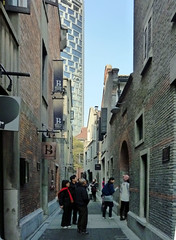
This street was lined with herbalist shops: both the older buildings at right and, strangely, the entire ground floor of the new building at left as well. Eventually, the block on the right will get redeveloped, the shops will come back like hermit crabs, and the market will continue as it has for another 100 years — with no physical memory of what it once was. Just like mini-malls in Southern California, where a generic envelope contains gosh knows what. Pragmatic, perhaps, since the existing buildings probably aren’t that rooted in their place, either — yet still disappointing.
Jane Jacobs highlights “the need for aged buildings” as a generator of diversity and vibrancy; in the U.S., the developers of the new building would seek to fill their retail spaces with high-rent “credit” (i.e., chain) tenants. Not so in China. (One could argue whether block after block of tiny shops all selling the same herbs really constitutes diversity, though.)