Pass it now
I was sufficiently alarmed by word that my Congresscritter planned to vote no on health insurance reform that I wrote the below letter and dropped it off at his office (conveniently, about a block away). Within a few hours, though, the news changed, and he announced his intention to vote yes: colleague Jose Serrano pointed out the obvious (as I did): “I’ve been a legislator for 35 years… Once you have a law on the books, you can amend it as time goes on.”
(Oh, and I’ve been quite amused to see how the current bill compares with the Nixon and Chaffee-Dole plans from 1974 and 1993, respectively. As usual, today’s Republicans have drifted far over into what was the lunatic fringe.)
Dear Mr. Gutierrez:
As your constituent, I was upset to find out that you plan to vote against the health care reform package advancing through the House this week. I find it absolutely incredible that you can show such disregard for the needs of the nearly one-third of your district (the 15th highest in the country!) which lacks health insurance, and the thousands of Fourth District residents (like me) who have health insurance but fear for it every day — here in a state where thousands have their health insurance policies disappear every year due to unfair industry practices like recession.
I am particularly insulted, as the son of immigrants, to find that you plan to use your vote on this crucial matter in order to complain to the President about the separate matter of immigration. Surely you understand how our political process works: that in order to pass legislation on crucial matters of national importance like health care reform requires that we sometimes put aside differences in the interest of the nation. I have my own reservations about this bill, and differences with the President on where priorities should be set — but would not wish for these differences to stop absolutely necessary reforms to our country’s ruinous health insurance system. Great tasks like health insurance or immigration reform cannot be accomplished alone; we Democrats need to work together to accomplish them.
I plead with you: be reasonable. Consider the interests of your constituents, your district (72% of whom are U.S. citizens and will directly benefit from this bill), and your nation, and please vote for health care reform.
Pass go
Several techniques have been used to address the dual market for transit service to the airport, separating air travelers (time sensitive but price insensitive) from airport employees. In St. Louis, San Francisco, and Newark, cash fares to/from the airport station are high but monthly passes are accepted. In Indianapolis and Hong Kong, completely separate, premium-fare express routes run alongside local routes with standard pricing.
Now Montreal comes by with an added innovation, incorporating the ridership gains associated with selling day passes to visitors: the STM’s new airport express bus will only accept passes. The base cash fare of $7 is the same price as a day pass, and includes a day pass. Even if the pass goes unused, it’s still a bargain for the air traveler — it’s half the cost of the current private-franchise shuttle bus, and 80% cheaper than a cab.
Axis of warmth
At a seminar this weekend, I heard from political consultant John Neffinger that “charisma = strength + warmth.” Warmth is the dimension that separates Dick Cheney from Bill Clinton — or, as I was thinking, Robert Moses from arch-nemesis Jane Jacobs. That’s the juxtaposition that makes “Boozy,” wherein Jacobs snarls and Moses tap-dances his way to success, such a brilliant inversion of history.
Anyhow, another key takeaway is that true charisma wears a peculiar expression: angrily-lidded eyes with a broad smile. (My attempt at constructing such a face sent a room into peals of laughter.)
“No recipe for urban funk”
Common Ground in a Liquid City: Essays in Defense of an Urban Future by Matt Hern
This book offers a rare viewpoint: a thoughtful inner-city leftist who understands both New Urbanism and capitalism (and apportions the blame correctly), Vancouver and the world, direct action and policy prescriptions. A useful tool for focusing my own thoughts on density and diversity, and how they combine to create interesting, humane places. (Some, like architect Neal Payton*, add a third D of design, but sometimes I think that enough of the first two can counterbalance even the worst design.)
* Not my namesake, even though by strange coincidence I was named in LA, where he lives. His last name was anglicized generations ago.
Hearing things
I spent a good part of Saturday whistling “Somewhere,” a melancholy note for lovely spring day thanks to the R142 subway trains rolling over Queens Boulevard. It turns out that even Tony Kushner enjoys this bit of coincidence, although his mechanical explanation is mistaken: it’s the electrical inverters, not the brakes, that make the sound.
I’d always been told that the distinctive (and rather more triumphal) tune on a certain generation of Montréal Metro cars (which turn up as the opening to “Il Fait Beau Dans le Metro“) were made by the air brakes, but it turns out that they, too, are made by the electrical equipment.
The CTA’s new AC-propulsion trains, although also built (like the R142 series) by Bombardier, don’t have a distinctive sound as they leave the station.
Remembering an inspiration
Jan Metzger, my neighbor and colleague on the WPB commission, died yesterday after a long struggle with cancer. Gin and Michael have shared some of their thoughts on their blog.
I’m proud that we, as commissioners of WPB, created a lasting legacy. We walked into a deeply divided room — which she walked out of as chair! She had faith in planning, urging me along to get the planning process rolling even while other commissioners were skeptical of the whole idea. When it came time to do the major public involvement for our then-in-process WPB plan, I almost felt afraid that whatever we came up with wouldn’t pass muster with her. After all, her passion for community engagement is legendary, and admittedly I sometimes prefer no-muss technocracy to the oft-dirty business of democracy. Yet her experience with leavening planning guided our successful approach.
From that rocky beginning, WPB now has lots of momentum behind numerous aspects of our plan, regardless of the personnel (commissioners, aldermen). Soon I’ll be proud to fulfill my last promise to Jan: to have one of our volunteers go to her favorite city, New Orleans, to accept an award for excellence in public involvement.
Misallocation of capital
Joe Stiglitz on Worldview just now: “financial sector innovation” sucked up capital; that had an opportunity cost, in that “boring industries” with lower returns were starved of capital. (Echoes of Tom Geoghegan writing about unlimited interest in Harper’s last year. Somehow, I didn’t trust him then, but it makes more sense now.)
If our banks had been boring, like the Canadian banks, maybe we’d actually be in a better place right now. And what did all of this capital thunder towards? A huge volume of it poured into fundamentally unproductive (even counter-productive) suburban sprawl. Way to go.
As Kunstler said, “our suburbs… represent the greatest misallocation of resources in the history of the world.”
High school officially a waste of time
Just as I suspected, high school graduation requirements are all about keeping seats warm, not about actually teaching students anything. That will soon change in eight states, according to Sam Dillon in the NYT; as Kentucky education commissioner Terry Holliday says, “We’ve been tied to seat time for 100 years. This would allow an approach [to graduation] based… around move-on-when-ready.”
Those states will allow 10th-graders who pass a battery of subject examinations to proceed directly to postsecondary education — vaguely recalling the entrance examinations that Robert Hutchins’ administration applied to 16-year-olds applying to the University of Chicago in the 1940s.
I faced similar stupidity when I left high school after three years: at the time, North Carolina required four years of English credits. English classes from the local state university weren’t acceptable, either. A deal was struck wherein my high school would pre-print a diploma and hold it until I provided a transcript showing that I’d completed a year at university. (As far as I can remember, I never did pick up that diploma.) It appears that N.C. has lightened up and now allows students to complete English in four semesters, since it’s now a national leader in early college high schools.
Ped malls have it backwards
Mongkok 1 Originally uploaded by █ Slices of Light █▀ ▀ ▀
[sent to NextGen list, responding to Lydon]
Prime downtown shopping streets rarely work as ped-exclusive streets. 3rd Street or Lincoln Road are exceptional places on many levels: most of America is not Santa Monica or South Beach (nor Boulder, Aspen, Burlington, nor Times Square). Instead, why not focus on smaller streets with an entertainment focused tenant mix? East 4th in Cleveland (official site) actually seems to work okay (a single owner is a huge advantage), especially relative to its surroundings. Even in Europe or Asia, grand retail corridors aren’t pedestrianised (Stroget
being the exception rather than the rule); it’s the side streets, where cars always felt like a huge intrusion anyways.
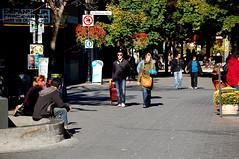
Shown here is Sai Yeung Choi Street in Kowloon’s Mong Kok district, which is car-free from 4pm-midnight every night — a switch only undertaken in the past few years. As you can see, a pedestrian street is not defined by the absence of cars: it’s about the abundance of pedestrians.
Kowloon’s main spine, Nathan Road, continues apace a block west, and alleys (really, just wide enough to push a cart down) are on either side should deliveries still be necessary. Of course, the other side streets are just as choked with pedestrians — often browsing at retail stalls, as on Tung Choi Street just east, and often sharing the space with the few cars who dare to brave the streets.
Of course, having stupendously high densities helps to sustain retail on both the arterials and the side streets, and the American tendency to have fewer but larger shops certainly doesn’t help.
Insisting that shoppers will materialize out of thin air just to see a place that’s interestingly designed, but inconvenient to get to — an “if you build it, they will come” approach — is backwards. Instead, retail is all about making things easy for customers, and the converse is true: “if they come, then you build it” (a nice echo of the aphorism that “retail follows rooftops”).
This strategy kind of mirrors the suburban lifestyle center approach: the arterial is still there to handle circulation, but the inviting environment is off to the side.
montreal-prince-arthur_0053 Originally uploaded by Spacing Magazine
A similar approach here in North America was taken on Rue Prince-Arthur in Montreal’s lively Plateau neighborhood, a pedestrian street that links two parallel main streets (St. Laurent and St. Denis).
Chinatowns gentrifying even across the Pacific
I’ve written earlier on gentrification in U.S. Chinatowns (as with everything else, Manhattan gets more than its share of attention). Yet this is something new: gentrification (including, apparently, a shift to a whiter population) has occurred even in cities with large Asian majorities, like Honolulu, Vancouver, or even Singapore.
The broader context matters little: in these cities, Chinatown is the original ethnic neighborhood, offering vintage architecture (and, in both instances, unusually well-preserved) adjacent to the CBD. Just as in Los Angeles (where gentrification’s further along in Little Tokyo than in Chinatown), that proves an unbeatable combination for boutiquey businesses appealing to hip travelers or expats — who might find most local neighborhoods, with their preponderance of concrete apartments and enclosed malls, insufficiently “exotic” for their tastes.
Nuances of housing density
[h/t Kaid and Irwin Dawid/Planetizen for the video of Dan Zack’s density game]
Of course housing density is something that we must properly understand, and it’s a necessary (but insufficient) precondition for so much of what makes a great city — particularly the sustainability of services like retail and transit. However, there’s a danger in making it an end rather than a mean. So many other factors, like unit size, household size, parking ratios, landscaping, and occupancy rates (a high percentage of high-rise units are second homes) can have a huge effect on how density “lives” once it’s built.
For instance, the Cabrini-Green building shown is being replaced with three-story walkups that might have:
– the same DUA density
– higher occupancy rates
– higher impervious surface cover
– more living space per capita
– lower population density (much smaller households)
– higher income density (much higher household incomes)
Lower population density might mean lower transit ridership, but higher incomes mean that more retail space is needed.