Retail courts lost and found

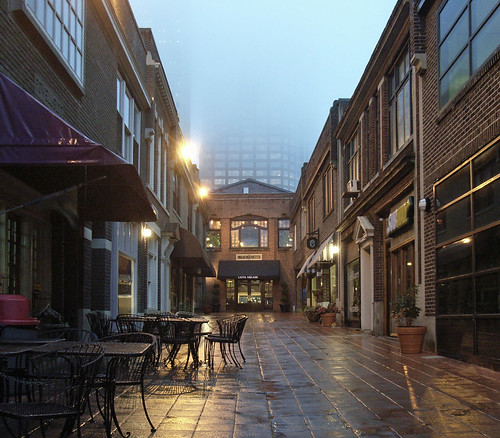
I stumbled across this delightfully human-scaled space in the middle of the variously anonymous and flashy bank towers of uptown Charlotte:

Brevard Court and Latta Arcade together provide homes for dozens of tiny businesses — Latta is divided into miniature, 500 sq. ft. bays — along a through-block passage off Tryon Street, Charlotte’s main drag. A preservation easement over the site protects it in perpetuity, even if the current tenanting plan seems a little uninspired. (Most everything was shut at 5 PM, and a few forgettable fast food chains visually dominate the space.)

Closer to home, in supposedly preservation-obsessed Oak Park, a place similar in size and scale to Latta — Westgate, a picturesque (“storybook style”) parking-court ensemble of two-story Tudor facades just half a block behind the main drag of Lake Street — is about to get summarily wiped away after 75 years. A series of insensitive developments gradually walled Westgate off from the rest of downtown: the 1950s filling in of an open-air arcade to Lake Street (the building in yellow, Tudor on the back and Deco in the front), and the botched 1990s tilt-up retail complex that “revitalized” Harlem at the expense of the town around it.

Here it is today, still mostly intact.

Of course, the same quest that led to the Harlem buildings getting wiped away in favor of hopelessly bland chain retailers in forgettable strip-mall brick boxes has come back with a vengeance. Vince Michaels has an overview of the process that led — even after an official commission heard from several professionals who urged its salvation — to the village’s announcement of an RFP to bulldoze half of what remains at Westgate and replace it with what’s optimistically termed “transit oriented mixed-use infill.” The village’s RFP only said “encouraged” teams to “investigate” saving “some of the facades.” This week, the only RFP responses selected to proceed all declined this “encouragement” in favor of teardown.

6. Historic Preservation: The Oak Park Historic Preservation Commission has indicated a preference for saving some of the facades of the Westgate buildings on the RFQ parcels and integrating them into the design of a redevelopment project. Teams are encouraged to investigate this possibility as part of their preliminary plan submittal — especially if it helps with the LEED Certification Process…

And here’s an overview of the RFP parcels (in red).

Now, I’m no reflexive NIMBY — I got excommunicated by my neighborhood association for speaking in favor of a giant condo literally in my backyard, and I’m also obviously a fan of human-scale hotels and big box retailers (what the proposals, well, propose) — but really. When you have something this exquisitely human scaled, sitting in an enviable location next to a major transit hub in an upscale area, and surrounded by underutilized land, you can make it work — by demolishing the throwaway retail boxes and parking lots at the heavily trafficked edges of the block, not the historic ensemble in the center.

Socialist baseball

Hooray! A local group, For Fans Sake, is attempting to socialize the Cubs. Well, not really, but they’re offering shares in a company that would replicate the community ownership model behind the Green Bay Packers, instead of selling the franchise to some random egomaniac billionaire. From their FAQ:

How much money can I make on this?

None.

Un-American!

EDIT: Okay, when I wrote that, I was thinking “social ownership of the means of production,” not “welfare state,” as in “corporate welfare subsidiaries to benefit billionaires” — like the wastrel governor maneuvering to buy the stadium, thereby removing a potential liability from the team’s balance sheet as its ownership shifts from one billionaire’s pocket to another.

Every step of the tomato’s way

Andrew Martin in the New York Times notices a new study that adds a few wrinkles to the locavores’ “local is better” equation with food. As with any simple equation that attempts to summarize an endlessly complex system, it has nuances.

Gail Feenstra, a food system analyst at the [University of California at] Davis campus, says her group hopes the research will help consumers decide if buying local is better than buying organic food that has traveled hundreds of miles. “Maybe you can buy organic within a certain geographic range, and outside of that the trade-offs won’t work anymore,” Ms. Feenstra said.

At some point, the ethical maze can make you dizzy. But there was one line of inquiry from the California researchers that hit particularly close to home: the carbon impact of shoppers themselves.

Some people walk or take the subway to buy their groceries and then compost what they don’t use. But, let’s face it, most of us drive and toss the leftovers into the garbage disposal or the garbage can. In doing so, we may be contributing nearly a quarter of the greenhouse gases associated with our food, research has shown.

Here’s why: Instead of going to the grocery store once a week and stocking up, many consumers are driving for groceries several times a week, if not every day, to all sorts of different stores.

(BTW, UC Davis makes olive oil from street trees on campus. How cool is that?)

Pick up and go [updated]

[I’ll be traveling for the latter half of December, perhaps without benefit of computer or phone! The horrors!]

A few assorted things from the past few weeks of being away:

* “If I lived 17.5 miles from work, I wouldn’t bike to work, either — I’d move. Remember, location and locomotion are two halves of an equation where neither is constant.” [posted at updated metrorider link]

Todd Litman calculates that every nonmotorized (active) trip displaces about seven vehicle miles traveled — not because active trips are seven miles long, but because they’re associated with smarter patterns of development.

“Not every walking or cycling trip causes seven miles of reduced driving. The lower vehicle mileage in cities with relatively high nonmotorized mode split reflects various land use and transport system factors, such as density, mix, street design, parking supply, and pricing which affect the relative attractiveness of motorized and nonmotorized travel. But programs that increase nonmotorized travel tend to create such communities, which is to say that smart growth supports nonmotorized travel and nonmotorized travel supports smart growth.”

* The Pacific Northwest spends more on oil and gas — 100% of which is imported — than on public K-12 education in 2006 or hospital care, and more than 3.5 times total spending on prescription drugs. [Sightline Institute] All that goes “up in smoke,” as they say. Interestingly, Idaho is separated on that counter — an interesting point of comparison, since as many people live within 10 miles of my house than in all of Idaho.

* An interesting “List of Privilege Lists” — ways of “unpacking the invisible knapsack” that accompany those of us with unspoken social privileges, whether racial, sexual, class, religious, gendered, or ability.

* Jay Mouawad in the Times notices that the oil producers fear the geo-green agenda:

“What we are worried about is for industrialized countries to use climate policy as a pretext to discriminate against oil,” [said Mohammad al-Sabban, a senior Saudi government adviser on climate change].

Over in the UK, $100/bbl oil has led gasoline across the magic 1.00 line: one pound per litre. That translates to about $9.50 a gallon, so really, quit whining about gas prices in America already.

* While in Toronto, I picked up a brochure distributed by Alphabet City — not the Chicago Humanities Festival, not an academic symposium, but rather something in between — outlining a program of events around local food in the Toronto area. (Ongoing online discussion hosted by the Walrus.) It opened up first to a manifesto (er, open letter) that posits food distribution as another problem of internalized profits and socialized costs, principally because “healthier, tastier” food is not necessarily more profitable. Indeed, it’s often less so. As such, it calls for market intervention and political action:

Ontario’s working landscapes, farms, rural communities, and cities are linked in a web of complex exchanges. But our food policies to date have usually ignored that web, dividing rather than connecting. If we are going to build a healthy and sustainable village, we have to make the connections… [W]e believe that food is connected to every major problem being raised in the current provincial election campaign—rising medical costs, poverty and hunger, declining farm incomes, the paving-over of farmland, wildlife protection, urban sprawl, youth unemployment, and communities at risk.

These problems will only be solved when we connect the dots.

Local farmers markets, community and school gardens, food co-ops, urban gardens, food access centres—all of these emerging possibilities support healthier, tastier food for all villagers. As this happens, everyone benefits and communities become stronger and more inclusive.

Streets everywhere, but no strolls in sight

Chris Leinberger’s new Footloose and Fancy Free “Field Survey of Walkable Urban Places” study isn’t exactly of the highest scientific caliber: I won’t begin listing his omissions, since that’d be tiring; and I personally prize a “streetcar urbanism” of continuously enjoyable expanses of urban fabric rather than periodic episodes of frenzied activity focused around rapid-transit nodes. However, it does try to put some background behind one curious observation about LA: “there are 10 million people who have, between them, maybe five places to go for a Sunday walk.” Therefore, those five places (now up to 15, by Leinberger’s rather more lenient definition) are absolutely thronged with crowds (1.13 million Southern Californians apiece, by his calculation).

His most interesting conclusion:

If the bottom 10 metropolitan areas developed as many walkable urban places on a per capita basis as the top 10 have done to date, there would be approximately 40 additional walkable urban places developed in these metro areas, probably representing tens of billions of dollars of real estate development.

Some worry that such developments appeal only to a small slice of the population — and that the market for retail of this variety is especially thin — and therefore that cannibalization will inevitably occur when new developments attempt to create walkable places. However, the demand is apparently quite a bit deeper than skeptics suspect; if demand warrants at least one walkable place per 500,000 residents (and the D.C. area apparently supports twice that level), then, say, the Twin Cities could support six or seven such places — far above the three in existence today.

Post-collegiate in extremis


young and restless Originally uploaded by Payton Chung

The first set of charts, graphs, and illustrations has come back from the planners examining Wicker Park & Bucktown on behalf of we, the people of WP-B (or at least our special service area). The most astonishing finding, in my view, is here: our neighborhood’s people are defined by a stunning — indeed, almost statistically improbable — self-segregation of young people.

Nearly 52% of the population is between 20-39, compared to just 29% nationally. 45.4% even fall within that most marketer-coveted of all age groups, the 18-35s. Maybe we could make a lot of money selling sidewalk billboards.

Perhaps even more quizzically, young men significantly outnumber young women in most age brackets: 9.4% (nearly one in ten!) neighborhood residents are (like me) men in their late 20s, nearly three times the share in the American populace. It’s not even an appreciably gay neighborhood, either.

Almost all other age groups are underrepresented (relative to their national shares) in the neighborhood by about 30-50% — except for preschool aged children. Sure enough, the kids leave at school age — although not nearly to the “total” extent that is sometimes claimed by alarmists. Why, there are about as many grade-schoolers living here as 60-somethings.

(Produced by Interface Studio for Wicker Park Bucktown Special Service Area #33)

Share the road

Okay, it’s official. If God (well, the Pontifical Council for the Pastoral Care of Migrants and Itinerant People) says so, it must be true. A new statement, “Guidelines for the Pastoral Care of the Road,” issued by the Vatican on 19 June:

V. The Christian virtue of drivers and their “Ten Commandments”

49. Back in 1956 Pope Pius XII exhorted motorists: “Do not forget to respect other road users, be courteous and fair with other drivers and pedestrians and show them your obliging nature. Pride yourselves in being able to master an often natural impatience, in sometimes sacrificing a little of your sense of honour so that the courteousness that is a sign of true charity may prevail. Not only will you thus be able to avoid unpleasant accidents, but you will also help to make the car a more useful tool for yourselves and others that is capable of giving you a more genuine pleasure” […]

61. In any case, with the request for motorists to exercise virtue, we
have drawn up a special “decalogue” for them, in analogy with the
Lord’s Ten Commandments. These are stated here below, as indications,
considering that they may also be formulated differently.

I. You shall not kill.
II. The road shall be for you a means of communion between people and
not of mortal harm.
III. Courtesy, uprightness and prudence will help you deal with
unforeseen events.
IV Be charitable and help your neighbour in need, especially victims
of accidents.
V. Cars shall not be for you an expression of power and domination,
and an occasion of sin.
VI. Charitably convince the young and not so young not to drive when
they are not in a fitting condition to do so.
VII. Support the families of accident victims.
VIII. Bring guilty motorists and their victims together, at the
appropriate time, so that they can undergo the liberating experience
of forgiveness.
IX. On the road, protect the more vulnerable party.
X. Feel responsible towards others.

Draining

Today’s award for best acronym goes to SWIM: Storm Water Infrastructure Matters, a group advocating natural approaches to water management in New York. Stormwater on its own is a little too esoteric, but swimming — most people can get behind that.

It comes to mind because this month’s Landscape Architecture magazine has three great articles on stormwater, about integrating natural drainage into the layered history of Minneapolis’ Grand Rounds necklace; restoration trial and error along a mostly buried, slag-lined stream in Pittsburgh’s East End, and a call by longtime smart growth advocate Lisa Nisenson for municipalities and regions to think globally, not site-specifically, about stormwater. The new stormwater regs popping up, while well intentioned, have already started adding yet another layer of regulatory discrimination against infill projects — which must be stopped before they proliferate much further.

Locally, I’m pretty confident in the efforts of MWRD board member Debra Shore’s ability to work with CNT to bring this research into Cook County’s future regulations — and maybe eventually transition to the bold “eco-boulevards” concept that would finally heal Chicago’s breach in the Great Lakes watershed.

Town and country


goat coat Originally uploaded by Payton Chung

I took a tour of Prairie Crossing last weekend [a few more photos]; here’s a photo of livestock with some houses behind. (I wasn’t aware that some people kept livestock alongside the co-op horse barn.) Not that interesting unless you know that the farmland is permanently protected, I suppose.

Some interesting figures: one homeowner estimated that his front "lawn" might have 100+ species. Compared to the site’s previous incarnation as a cornfield, the development has created an interesting human habitat (~1,000 residents, school, a few shops) while increasing biodiversity tenfold (example: 110 bird species on site vs. "10-15" before) and reducing water runoff 50-80%. Lake Aldo Leopold, a.k.a. “stormwater detention basin A,” is among the cleanest lakes in Illinois, with water clarity of 20-30 ft. The Sand Hill organic vegetable/flower/fruit farm grosses $18,000 per acre from sales via CSA and farmers markets, vs. $1,700 per acre in even the current overheated market for corn.

Hubs and links


Top 10 US air markets Originally uploaded by Payton Chung

I’d read before that NYC-CHI was the nation’s busiest air route, but here’s some proof in that pudding courtesy BTS. What always depresses me about flying this route (and I account for 0.0003% of that bar) is that there’s no adequate ground alternative. The only direct Amtrak service pulls into Penn Station around 7 PM, necessitating an extra night’s stay in NYC (over and above the night spent aboard the train). Not very effective, especially when average hotel rates in Manhattan are over $300/night.

Even more depressing? Back in 1938, trains made the NYC-CHI run in 16 hours, not the 21 hours it takes today. That’s right, it takes 31% more time to travel in the 21st century than it did during the Great Depression. (Oh, and the trains then? “[S]plendiferous… a speak-easy style midsection with side-seat nooks… like an intimate cocktail room.”) That “intimate cocktail room” (the Pennsy’s Broadway Limited) arrived at the old Penn Station at a much more reasonable hour: 8:30 AM. My, how our nation has declined, although I suppose we have more gizmos now.

The other thing this graph illuminates is the business logic underlying recent gossip about a merger between United and Delta. Currently, three of these top 10 routes connect two UA hubs: IAD-ORD, LAX-ORD, and DEN-ORD. Just ATL-JFK connects two DL hubs; ATL-MCO runs between a hub and a focus city. The respective carriers dominate 40-60% of the market on those routes, since they have strong local customer bases at both ends and high frequencies between.

However, three more connect UA and DL hubs: JFK-ORD, ATL-IAD, and IAD-JFK. That gives a combined carrier load-balanced, hub-to-hub frequencies on eight of the ten busiest air routes in the country, with the other two (NYC-FLL and CHI-LAS, both leisure routes rife with discounters) at least originating in one of the hubs. Even Pan Am (whose international route network, minus the Latin American routes that United tossed away, would be rejoined) never had this kind of a domestic network.

The strengths that Delta brings domestically are its Atlanta fortress, JFK gateway, and focus cities in competitive Boston and Orlando. If this merger takes place, Delta’s hubs at Salt Lake City and Cincinnati will go: Denver serves twice the population and 2.5X the passengers as SLC, and CVG accounts for just 4% of DL’s mainline boardings, just 29% of which is local traffic. JFK and IAD can work side by side: UA enplanes nearly twice as many mainline passengers at IAD as DL does at JFK, and IAD has growth potential which “intensely dungeonlike” JFK lacks.

Of course, all this dances around the real business logic behind putting UAL on the auction block, as described in the Motley Fool:

Upon a change of control in the airline, however, United’s latest proxy statement says that [UA’s CEO Glenn] Tilton’s stock options would immediately vest, entitling Tilton to $24 million in compensation. If he was forced out of the executive suite within two years of the merger’s completion, he’d also receive an additional $12 million.

Leadership (and trailership)

The most amazing thing I read last week was mayor Michael Bloomberg’s speech to a USCM meeting on climate change. Emphasis added:

Leadership is not waiting for others to act, or bowing to special interests, or making policy by polling or political calculus. And it’s not hoping that technology will rescue us down the road or forcing our children to foot the bill. Leadership is about facing facts, making hard decisions and having the independence and courage to do the right thing, even when it’s not easy or popular. We’ve all heard people say, “It’s a great idea, but for the politics.” And let me give you just one example from New York.

Last spring, as part of our PlaNYC initiative, we proposed a system of congestion pricing based on successful programs in London, Stockholm and Singapore. The plan would charge drivers $8 to enter Manhattan on weekdays from 6 a.m. to 6 p.m., which would help us reduce the congestion that is choking our economy, the pollution that has helped produce asthma rates that are twice the national average, and the carbon dioxide that is fueling global warming.

Now, the question is not whether we want to pay, but how do we want to pay. With an increased asthma rate? With more greenhouse gases? Wasted time? Lost business? Higher prices? Or do we charge a modest fee to encourage more people to take mass transit and use that money to expand mass transit service? When you look at it that way, the idea makes a lot of sense, but for the politics, because no one likes the idea of paying more. But being up front and honest about the costs and benefits, we’ve been able to build a coalition of supporters that includes conservatives and liberals, labor unions and businesses, and community leaders throughout the city.

There is no problem that can’t be solved if we have the courage to confront it head-on — and put progress above politics. Mayors around the country are doing it — and those in Washington can, too.

Just a few days later in Seattle, the transportation bond proposal that I referenced earlier failed — possibly because it wasn’t pro-transit enough. Chris McGann reporting in the P-I:

Though voters rejected Proposition 1, an extensive poll commissioned by the Sierra Club showed that if the transit element of the measure had appeared on the ballot alone, it would have passed.

The Sierra Club joined forces with the anti-transit crowd and campaigned against Proposition 1, believing the measure included too much freeway expansion, relied on general taxes, including the sales tax, and did not address global warming.

According to the poll, 52 percent of voters say they would have voted for the transit portion had it been presented alone… “The single largest reason [a group of voters who we would describe as pro-transit defectors] gave (for voting no) was environmental impacts like global warming,” [pollster Thomas Riehle from RT Strategies] said… 20% [of No voters] objected to Prop 1’s impact on the environment.

Meanwhile, back here under the clouds in Planet Illinois, the Tribune‘s Jon Hilkevitch notes that CTA’s facilities are falling apart.

Rail passengers aren’t spared from the ills of ancient infrastructure either. They must endure longer commutes each year as trains crawl as slowly as 5 m.p.h. through numerous “slow zones” caused by crumbling viaducts or deteriorated tracks.

In fact, the slow-zones cover about 50 miles of track, more than one-fifth of its rail network, according to the CTA.

The neglect of the rail system has also led to derailments, including one in July 2006 in which a Blue Line subway train jumped tracks held barely in place by rusted screw spikes and fastening clips…

The cost of repairing and maintaining the old buses is soaring. The CTA said it spends $16 million a year to keep the old buses in running order, more than five-fold the $3 million cost for upkeep on newer models.

Despite the clearly inefficient use of public money, the failure to renew transit infrastructure has received much less attention among politicians and other decision-makers than the prospect of hundreds of thousands of commuters losing their bus routes to service cuts.

Even if the current transit operating crisis were resolved, the system would remain under siege until a funding stream is established to overhaul and replace aging equipment, transit officials said…

Increasing amounts of the CTA’s capital budget — more than a combined $150 million since 2003 — have been diverted to operations to help balance annual budgets and reduce the threatened service cuts and fare increases under the CTA’s doomsday plans…

Without the state launching a successor to Illinois FIRST, non-federal capital funding to the CTA during the next five years is projected at one-tenth the level in 2002, according to CTA budget documents.

Shoring up, modernizing and expanding the mass transit system in the six-county Chicago metropolitan area comes with a breathtaking price tag that exceeds $10 billion during the next five years for CTA, Metra and Pace combined, according to the Regional Transportation Authority…

“My concern is Springfield passing the kind of capital bill they are talking about — totaling only $425 million for all three transit agencies — and that there won’t be discussions about another capital bill for years,” [CTA chair Carole] Brown said. “It would just put us in such a difficult position.”

Of course, the city’s half-billion dollar annual take from TIF revenue — the same buzz-worthyvalue capture” revenue stream that’s building new rail systems in Atlanta, Portland, and NoVa — would be an ideal source of funds to seed the system renewal that CTA so badly needs. After all, improving transit is an almost sure-fire way to raise property values. (I’d point out that many of the exceptions listed there, as in Miami, San Jose, and San Diego, placed rail through low-value industrial corridors in the interest of reducing ROW acquisition costs.)

Yet it’s going to take a whole lot more money to get this done. NYC Transit spent nearly $20 billion in the 1980s on renewing its capital stock, about $40 billion in today’s dollars; upgrading the signals to allow automated operations just on the L line cost nearly $300 million. And yet — the governor, and even more shockingly Emil Jones, would rather pick the pockets of Chicago’s math-challenged to gold-plate a bunch of empty Downstate roads.