Mid-May miscellany

Quick links! The new site isn’t ready, and CNU XV is next week. Wow!

1. “Everyone should bike to work for a week, if for no other reason than the people who complain about bikers breaking the law would shut the hell up…. Bicyclists disobey traffic regulations is very predictable and self preserving ways.” — BrodyV at DCist

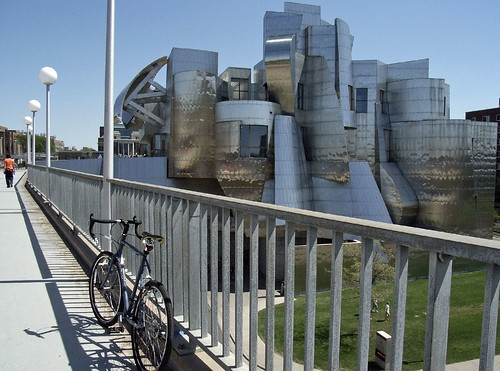
2. A new bike’s on its way! Looks like this — a Surly Long Haul Trucker, 52cm, which I test rode at Hub Bike Co-op in Minneapolis recently but have ordered from Boulevard.* The thought process behind that particular frame was similar to this guy’s: a solid road bike, eminently practical and comfy on short or long rides. Although everyone says I should go for a faster, lighter cross bike — like, say, the Cross Check. On my test rides the Cross-Check wasn’t any more responsive or sprightly (a tad squirrelier, maybe), although it did corner ever so slightly better. Oh, and touring bikes are trendy in a retro-’70s way, unlike, say:

“In the last few years, however, track bikes have won over a decidedly nontough, unathletic batch of acolytes: hipsters. Grab a latte on any random corner in the Haight, Castro, Mission, etc., and you’ll be treated to a veritable parade of carefully coiffed thin mints trucking along on bikes like me. Zut alors!” — Ephraim the Track Bike (SF Weekly)

However, I’m still leery of touring, if only because I find American countryside to be supremely boring. French countryside, though — Paris-Brest wouldn’t be my first choice, but it *is* awfully famous.

Update, 4 July: Photos of the bike. After the little Wisconsin journey, I’m looking into Amtrak supported tours along the Allegheny Passage from Pittsburgh, Lake Champlain from Burlington, and the Niagara region from Buffalo. Hmm — funny how a different perspective changes everything.

* Update, 9 May 2008: Boulevard now has a few Surly models built-up and in stock, so future purchasers can stay on this side of the Mississippi. North Central Cyclery in DeKalb always keeps some in stock, but (as with much else in exurban Illinois) it’s honestly easier for me to go to Minnesota.

3. Design your own street.

4. Unlike here in Illinois, state legislators in Pennsylvania are paying attention to transit funding solutions. An editorial in the Morning Call by Rep. Douglas Reichley (R-Emmaus) calls for integrated regional transit funding:

[W]e should look seriously at the model for mass transit in New York City, where bridge and tunnel tolls subsidize fares for buses and subways. We should determine if the same kind of system could be implemented in individual cities, such as Philadelphia, or even on a regional basis.

A Lehigh Valley transit authority consisting of the parking bureaus from the three major Valley cities, the Lehigh Valley International Airport, and the Lehigh and Northampton Transit Authority (LANTA) could set up a system of fees and excise taxes to help LANTA stand on its own feet financially.

Such a transition would help to end the annual plea from mass transit systems for taxpayer bailouts, and relieve the financial drain of mass transit systems on the state budget.

Ald. Preckwinkle, urban designer

Fran Spielman reports that Ald. Preckwinkle is now about as well trained an urban designer as you’ll probably find in Chicago:

[The alderman’s] demands [for the Olympic Village] include: Connections to the Bronzeville community to the west so the village doesn’t become an “isolated little spur of McCormick Place”; a “street grid instead of superblocks,” with streets that “go through like a real neighborhood”; a street wall “built to the lot lines” instead of the “unusual curved buildings” now proposed; and ground floor retail “so there’s some life on the street.”

“I want it to be like a neighborhood. [What they’ve proposed] is sort of architectural egotism as opposed to a real neighborhood,” Preckwinkle said of the alternating series of eight- and 16-story condo towers.

“They’ve proposed curved buildings sort of plunked there. I don’t think that contributes to having a neighborhood. The buildings are self-contained, as opposed to part of a larger community. They proposed a connection at 31st Street. That’s not good enough. There have to be intervening streets.”

Preckwinkle noted that superblocks are being eliminated in the $1.6 billion Plan for Transformation now replacing CHA high-rises with mixed income communities.

“One of the things we’ve done is put the streets back in. If you want a real neighborhood, it doesn’t work to have superblocks,” she said.

Moving… moved

I got a sudden note that my web host is shutting down at the end of this month. Therefore, there will be some weirdness with the site as I move to a new host. Expect the photo galleries to finally migrate to Flickr, for instance.

Update: we’re now at WordPress.com, more or less, after wrestling with numerous export and import scripts (you’d think WordPress could handle this simply, no?). Some posts are still missing, the lack of Textile formatting here makes some posts look strange, and I’ve trashed some of the old static content, but most importantly everything’s safely backed up. Might also give TextPattern a try.

Disappointment


Disappointment

Originally uploaded by paytonc.

Catesby Leigh, “California Dreaming” in Princeton Alumni Weekly, 15 Sep 2004:

Another disappointment for Moule, Polyzoides, and other New Urbanists is the Playa Vista project in Los Angeles’ Westside section. In 1989, the couple was invited to join the project by Duany and Plater-Zyberk, whom Polyzoides had encountered as a teaching assistant at Princeton’s architecture school. Moule and Polyzoides wound up leading a team of high-profile architectural firms in the design of a new community on this 1,087-acre site fronting on the Pacific Ocean. Their models were cities like Beverly Hills and Pasadena.
Playa Vista was intended to relieve the acute housing shortage in Westside, known for its concentration of high-end, high-tech industries and services. Though the design produced by the architects assumed restoration and preservation of 300 acres of wetlands on the previously industrial site, environmentalists resisted any development at all, a contributing factor in the developer’s loss of the property. The project has gone forward under new management, and the amount of land set aside for conservation has been doubled. But while Playa Vista’s mixed-use character has been retained, Moule and Polyzoides express bitter disappointment with the project’s quality. “It’s unrecognizable to me,” Polyzoides says sadly of the portion constructed to date. “It’s absolutely unlike anything we ever imagined.” Unfortunately, New Urbanist knockoffs are not an uncommon phenomenon.

One of the rare project with participation from four CNU founders, unrecognizably dumbed down by a new developer.

Stuck at O’Hare?

My answers to some questions frequently asked by FlyerTalkers about Chicago. Since I usually fly United, answers focus on O’Hare’s Terminal 1; since I don’t drive, I’m assuming you won’t, either. Incidentally, my first visit to Chicago — and, in fact, only visit before I decided to move here — was a night spent at ORD due to a weather cancellation on a LAX-ORD-RDU trip on AA many years ago. Updated on a regular basis in response to new questions and/or inbound search inquiries. Continue reading

Getting from Me to We

A friend sent along these recent Gallup Poll results, from a poll taken Mar. 23-25:

Steps the Government Can Take to Reduce Global Warming (by party identification):
|Dem. | Ind. | Rep. | (percentage saying “should be doing”)|
|72 | 64 | 58 | Starting major research effort to develop new energy sources|
|72 | 60 | 47 | Requiring government office buildings to use renewable energy sources|
|59 | 43 | 36 | Requiring surcharge on utility bills when energy use limits exceeded |
|59 | 44 | 26 | Banning vehicles that do not average at least 30 miles per gallon |
|47 | 35 | 26 | Setting land-use policies to discourage suburban sprawl |
|46 | 40 | 28 | Imposing tough restrictions on U.S. industries and utilities |

While Americans, especially Democrats and Independents, were quite enthusiastic about taking individual steps to combat global warming (over 75%, and over 80% of Dems and Inds, said they should be “spending thousands of dollars to make [my] home energy efficient” and “riding mass transit whenever possible”), they’re much cooler towards government (“We the People”) “making these choices for them.” Not even a majority of Democrats want to discourage sprawl, and Independents seem quite wary of government intervention.

The Dem vs. Ind gap is especially strange given that another Gallup poll found that just under half of both Dems and Inds think that “Immediate, drastic action [is] needed to address environmental problems.” So, what kind of “immediate, drastic” action is palatable to those elusive centrist independent swing voters? Or is this impossible until civil society is restored from its current sad state? (Sorry, but we can’t wait for that.)

Perhaps we should focus on teaching people that urbanism means higher quality of life, wiser investment of scarce resources, and greater choices — while saving the world, of course.

The urban snowball

I earlier mentioned the positive feedback loops for “people-friendly” transportation modes, like walking and transit; in short, more people = better performance. Cars, on the other hand, have a negative feedback loop: one car makes life convenient, many result in congestion which inconveniences all.

Sometime-developer, sometime-think tank-er Chris Leinberger’s forthcoming book The Option of Urbanism extends this analogy to the built environment surrounding each mode:

[A]s you build more drivable sub-urban development, you get less quality of life, In other words, _more is less_. The more that is built, the more the very qualities that attract the households to suburbia are degraded or destroyed, setting the stage for further development on the ever-expanding fringe. The American Dream, based upon drivable sub-urbanism, is elusive if growth is assumed to continue; the more you build, the more the promise is denied…

He goes on to point out that this treadmill implicitly devalues existing suburbia, and that this “disposable cities” approach to growth lays to waste vast sums of capital tied up in the existing built environment.

In walkable urban places, when more development and activities are added into the stew, more people are attracted onto the street, thereby increasing safety with numbers. The restaurants are more crowded, encouraging more restaurants and other retail, increasing rents, making buildings more valuable, raising property taxes and on and on and on. In walkable urban places, more is better. Adding more density and uses makes life better and real estate values climb higher. It is an upward spiral of value creation. If a new housing development is built, this self-re-enforcing spiral creates value for the entire district.

Two completely different paradigms of urban development — but shifting from the NIMBY former to the YIMBY latter (and avoiding the equally extremist “skyscraper fan” position of BEAN: Build Everything, Anywhere, Now) seems either difficult or impossible.

Summer driving

(slightly less edited version sent to Gristmill)

Gasoline supplies right now are plumbing historic lows, just as May and the “summer driving season” are about to roll around. This fact has the industry types at the WSJ’s Energy Roundup abuzz with predictions of $4/gallon gasoline, should the inevitable disruption (refinery fire, hurricane, Iran war) occur. As in years past, areas with higher cost gasoline, mostly the blue states along the oceans and Great Lakes, will see the highest prices.

Some hope that record margins (known as “crack spread,” heh heh) will lead refineries to crank up gas production, but in any case, there’s perilously little slack in America’s already-taut gasoline supply chain. Blogger Robert Rapier points out that gasoline supplies right now are lower than they’ve ever been (at least since current records began, in 1991), besides a few Labor Day weekends when supplies are drawn down after all that summer driving.

I never quite understood the concept of a “summer driving season,” anyways. Why waste a glorious summer day cooped up inside a car stuck in traffic? This summer, let’s all escape gloomy gas prices (and the inevitable media moaning about such) and have a Summer Walking Season instead.

Olympian sports welfare

A rant on the Olympics, written as a blog comment for nowhere in particular.

hey folks, cynicism and negativity have nothing to do with why I oppose an Olympic bid. (personally, I don’t usually read blog comments for fear of all the whiny, sourpuss snark.) I have worked professionally as an advocate and activist in this city for a decade now, even getting unceremoniously thrown out of a community group for offering constructive dialogue rather than the knee-jerk reaction preferred by its leaders. so, here’s my constructive solution: drop the Games bid and instead think creatively about how we can work here to fix our problems today.

if we want to invest billions of dollars for transit or housing or parks, we could raise it ourselves instead of wishing upon Washington’s or the IOC’s stars. and trust me, a billion dollars spent on better moving Chicagoans around will have a much greater long-term economic impact than even two billion spent on moving Olympian hordes around — and, mind you, the feds only paid half of SLC’s and Atlanta’s bills, so we’d probably be looking at a billion dollar bill anyways. want to raise a billion dollars?

besides, repairing our existing transit system (for starters) will result in greater economic impact than building new. for instance, a 2003 study estimated that $X spent on road repair will create 21% more jobs than $X spent on new road construction. “fix it first” — leveraging and enhancing prior generations’ investment in infrastructure — is fundamentally more cost effective than building new from scratch, just like renovating an existing house is cheaper than knocking it down and building new.

to sum it up in a bumper sticker: NO sports welfare!

John King on “Instant urbanism”

John King, the Chronicle’s urban design critic, recently wrote “a two-part series”:http://sfgate.com/cgi-bin/article.cgi?f=/chronicle/a/2007/04/09/MNGPBP56AD1.DTL on New Urbanist suburban infill in/around Denver and the Bay Area — pointing out that Denver is far further along than self-congratulatory San Francisco in creating good urban fabric in suburbia. He has this response to the elite critics of NU:

A cynic would look at projects like these and dismiss the lot. They’re not Paris in the 1920s, or North Beach in 1950s, or SoHo in the 1970s. Cue up the intellectual scorn.

But the fact is that American expectations are being redefined — and the suburban landscape where most people live is following suit. This is, after all, a world where people want what they want when they want: music on their iPod, old movies or television shows on their DVD player, newspapers via the Internet.

Why shouldn’t urbanism be available on demand as well?

The thing is, there’s a difference between buildings and megabytes. One is ephemeral, the other isn’t. You can watch a grainy snippet on YouTube and move on, but a poorly designed building stays right where it is, looking more faded and false by the day.

The suburbia of the future will be more dense than today, with a more varied set of options. And that’s a good thing: There’s a limit to how far a region’s population should sprawl, or how much land should be consumed. Fighting change is absurd. Sneering at it is equally absurd.

On my long-term projects list is an effort to catalog today’s “historic, gritty” urban neighborhoods when they, too, were brand spanking new — with shiny new buildings and tiny trees, they, too, looked pretty silly.

How we got here

Some old Break the Gridlock policy statements (most of which I wrote, all PDFs) that I found in the stacks, linked here so that they’re indexed:
* “Response to initial draft of city’s new zoning”:https://westnorth.com/freelance/BTGonZoning.pdf
* “Central Area Plan response letter”:https://westnorth.com/freelance/btgCAPltr.pdf
* Zoning for Transportation Equity Coalition’s “City in a Garden or a Parking Lot?, latest version without cover art”:https://westnorth.com/freelance/CityInGarden8NC.pdf
* ZTEC’s “one-page factsheet”:https://westnorth.com/freelance/zfactsheeta.pdf

ZTEC was largely responsible for getting the city to back down on a proposed increase in parking ratios during the 2002-2004 code rewrite. I don’t think that my letter on the Central Area Plan ever had an impact, but I still like it anyways:

bq. The people-friendly modes that we advocate are space efficient, thereby conserving the Central Area’s most scarce resource; create street-level vitality, enhancing the key to the Central Area’s unique character; and, best of all, are self-reinforcing. Busy sidewalks are safer and more pleasant to walk down; busy bus lines have more frequent, reliable service. Busy roads, on the other hand, merely create traffic congestion that maddens everyone. If total traffic is to grow, should that growth improve or paralyze the surface transportation network?

In short, walking, cycling, and riding transit create positive feedback loops: an increase in traffic yields better conditions (safer, livelier streets with better transit service). Driving creates a negative feedback loop: an increase in traffic degrades conditions for *everyone*, drivers, walkers, cyclists, and transit riders alike.