
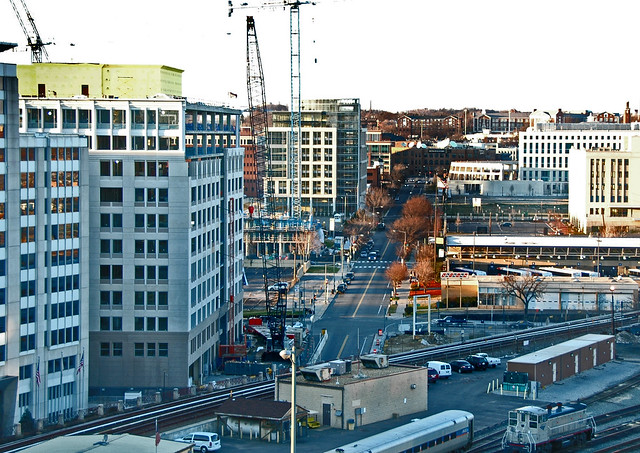
Why NoMa, not your neighborhood, got $50 million for parks

Looking north on 1st St NE

As with other new parks in general, there seems to be a lot of confusion out there about the $50 million that was recently allocated within DC’s capital budget for parks in NoMa.

First, it’s conventional wisdom at this point that upzoning NoMa without requiring any dedications of open space was “flawed.” That said, it probably seemed like a reasonable decision at the time. Nobody expected the area to develop quite as quickly as it did, or with as many residents as it did. (Office workers only require residual park space.) Besides, DC was land rich and cash poor, and thus didn’t have the capital to purchase even what seems now to be relatively cheap land; now, we’re relatively cash rich and land poor. Regret’s easy in hindsight.

Now, where did this $50 million come from? Yes, it’s now been set aside in DC’s capital plan, to be paid out over several years, and those capital funds come from general taxation. But, in another sense, it’s a thank-you to NoMa for the plentiful — and lucrative — new development that it’s brought to the District.

Way back in 2011, the NoMa BID and city councilmembers proposed a tax increment financing (TIF) district for NoMa. The TIF would have captured $50 million from the property taxes that NoMa properties paid, diverting it from the general fund to a BID-administered fund to pay for local parks. That’s a lot of money, sure, but consider that, by 2012, NoMa was paying $49 million each year in additional property taxes (over 2006 levels). Under a TIF, only NoMa taxes would pay for NoMa parks — although it’s true that government spending is theoretically fungible.

DC’s CFO had concerns about the TIF, which they outlined in this testimony to the Council. Their two key complaints centered on accountability of the BID-administered funds, and an odd feature of DC’s governance: its self-imposed debt cap. By diverting general property tax revenues, the CFO argued, the proposed TIF could jeopardize the way DC’s debt-to-income ratio is calculated, and push the District past that magic (and, again, self-imposed) line.

(Note that by borrowing from future tax revenues, a TIF is a nifty way to solve that “land rich, cash poor” conundrum I mentioned above. DC doesn’t have very many TIFs, compared to other cities.)

With that in mind, the Council declined to pass the proposed NoMa TIF legislation, and the NoMa BID instead pushed to include the parks within the city’s general capital budget. Mayor Gray did exactly that in 2013, adding the $50 million to his FY 2014 budget. Subsequently, the Council adopted the 2014 budget.

So, yes, NoMa did get $50 million in tax revenue to pay for parks. However, it did so by paying the city far more than that in advance, and by threatening to withhold future tax revenues. Until your neighborhood can raise similar funds from its own development projects — as the Yards and the Wharf have done, for example, or as Georgetown Waterfront did from the neighborhood’s deep pockets — you can’t necessarily expect the same outcome for your neighborhood.

One more note about local parks: it appears that NPS (which isn’t funded through local value capture) is aware of local trails’ safety shortcomings, including the “Peter’s Point” junction I’ve previously complained about.

It’s not just a phase: urban population dynamics have changed

National Park Seminary new EYA townhouses

EYA townhouses in Forest Glen, Md.

Ben Adler from Grist wrote about a recent NYT trend piece about how suburbia is hollowing out, with few young families to replace the empty nesters. He puts too much emphasis on gross migration and population change, without drilling into how those components have been changing:

A handful of coastal and upper Midwestern cities are attracting more young professionals than before and are retaining them for longer… Even where gentrifiers are moving in at a pace sufficient to reverse outmigration, they’re barely making in a dent in reversing the tide.

Migration population losses from cities paint an unnecessarily dire view of urban prospects. There is a good reason why large metros would tend to lose people to domestic migration — and, for the 20th century, pretty much always did. A statistically significant group of young people move to large cities, get married there, have kids, and then move away in search of more appropriate housing. Two people move in, three move out: presto, population “loss,” even though the same number of people moved in and out. Similarly, for decades a steady flow of retirees southward, away from large cities, was a good thing for society — an indicator that healthier seniors were physically able to move, rather than remaining house-bound.

Yet long-established movements like these (plus shrinking household sizes, plunging overcrowding, the twin crises of deindustrialization and crime, and employment displacing relatively dense central-city residential), may have largely run their course.

Yes, this does indicate that “the school problem” remains,* but indications are that cities are attracting more young people, and retaining them for more years. This is occurring both before and after the critical life milestone of marriage: new households are overwhelmingly singles, couples, and unrelated persons. Whereas many of the 1950s pioneers who settled what are now inner-ring suburbs were young families headed by 20-somethings, or maybe 30-somethings, today many married couples (without kids, or with young children) stay in the city for longer.

Here in DC (where the city’s small size and overwhelmingly post-industrial nature makes the demographic transition especially sharp), Carol Morello from the Post observes:

the number of children younger than 5 has grown by almost 20 percent, from 33,000 to 39,000, according to census figures. In the same time span, the number of children ages 5 to 13 rose 7 percent. But there were fewer children 14 and older, suggesting that many parents still choose to leave the city when their children reach high school.

This also shows up anecdotally, as in the NYT’s quote of a Westchester County official (“Parents used to be 35ish, now they’re 45ish. What we’re seeing is not so much an exodus as a later arrival”) and this observation (at a recent ULI conference) by the biggest developer of townhouses inside the Beltway:

Within the DC region, the geographically compact core (about 3% of the region’s area) accounts for a huge share of net growth of 25-34s. (Drawn from 2010-2012 ACS.)

A larger share of households spending more years living in the city is a marginal boon to cities’ residential market share. Few Americans live in one place for life, anyways, but imagine the implication for apartment owners as their tenant pool both grows in size and stays longer.

Meanwhile, population decline hasn’t hurt some urban areas (like my old neighborhood of Bucktown, where densities on some blocks have fallen 90% since their WW1 peaks, and continued falling in recent years). These can feel more lively and active than ever, even with much-reduced populations, because incomes are way up. More disposable income can substitute for a smaller population; retailers look for underserved pockets of spending power, not necessarily people.

Yes, at the end of the day, cities need to provide homes for a growing global population and so should welcome growing populations. However, gross population shifts need to be disaggregated and viewed cautiously.

On another note entirely, I’d like to honor the recent passing of Donald Bogue, 1918-2014, who taught me much of what I know about demographic processes. (My “Relocated Yankees” paper was done as a final project for his class.) Even though he was well into his eighties when I took his class, his approach was the best of UChicago: thoughtful, broadly read, engaging, and kindly critical, and he helped to tie together a lot of loose ends that I’d thought about for many years. He leaves behind a tremendous published legacy — scores of publications in the Library of Congress, for instance — and his work on topics like Skid Row still has strong resonance in planning today, for example in understanding the historical intersections between homelessness and place.

* Don’t look at me for any answers; this isn’t a school policy blog.

Lumpiness: in cities’ property values, and in metro structure

Two only tangentially related thoughts on lumpy growth:

1. Richard Florida in The Atlantic Cities was one of the few major outlets to cover a report from the Demand Institute (a collaboration between Nielsen and The Conference Board) called “A Tale of 2000 Cities.”

The top 10% of American cities account for more housing wealth than the next 90%. The gains in the 2000s were tilted towards the already wealthiest communities.

The report includes an extensive look at a typology identifying nine types of American communities primarily by the strength of their local housing markets, post-recession. In keeping with the name, the results show a striking divergence, with a select handful of healthy markets sweeping up much of the gains — and leaving half of American cities and towns “currently facing fundamental economic pressure.” The report’s summary says: “In today’s global economy, nothing is more important than the strength and sustainability of the local labor market, regardless of whether employers are serving customers in Chicago, Chile, or China.”

If anything, today’s telecom-centric, information economy has resulted in the geography of opportunity getting lumpier, not more diffuse (a prediction going back to Toffler’s “electronic cottages” in 1980) — “reports of the ‘death of distance’ have been much exaggerated.” We telecommuters haven’t all decamped to mountaintops. The most valuable places are becoming even more so: they account for not only an outsized share of wealth but also the gains of recent years.

The underlying economic reality, that human capital is what drives most prosperity today, is why I differ from my colleagues who believe that “investment ready places” can thrive based on previous investments in capital goods like housing. Jane Jacobs agrees: “Many attractive looking little cities stagnate or dwindle; Scranton, where I grew up, is an instance. The determining factors, rather, are economic opportunities.”

(I’ll have more thoughts in a later post about how macroeconomic changes, and in particular greater economic inequality, have left their mark on “gateway cities.” In the meantime, I highly recommend Ryan Avent’s ‘The Spectre Haunting San Francisco,’ which ties in man-of-the-moment Thomas Piketty as well.)

(April 2018 update: Florida points to a 2016 paper by Albouy and Zabek showing that housing value inequality, which was suppressed from 1940 to 1980, is back at levels last seen in 1990 and 1930. Furthermore, this increase is primarily due to inequality within metro areas [e.g., run-ups in favored-quarter prices], which has increased fairly steadily since 1970, rather than between metros.)

On another note, the report also has a good omen for suburban retrofits in “favored quarter” suburbs, in the form of an interesting but familiar disconnect between housing supply and demand in “Affluent Metroburbs.” 58% of housing stock in these communities is detached, “but fewer than half [of those seeking to move] say they are seeking a detached single-family home, compared with a national average of 60 percent.”

Among residents of “historic skyline cities,” a broad category that includes both healthy and less-healthy cities, there isn’t exactly a stampede to the exits. 54% of those who intend to move still “intend to stay in an urban area,” and “nearly one in five” wants to move for better schools (hardly the unanimity some cry about).

2. Alon Levy has a great post about how, on a macro scale, the gridded West has a suburban layout that fosters high-coverage bus networks, whereas more organically settled Eastern suburbs have a dendritic, hub-and-spoke layout that lends itself to commuter rail. (Yes, he points out that Johnny-come-lately Washington has, through Metro, grown into the latter pattern.)

This might go some way towards explaining “the Western Paradox” in Brookings’ findings regarding transit access to jobs. In short, Western cities (particularly in the desert southwest) had a strange spread: many jobs were technically accessible by transit, but low transit-to-work mode shares. The highest mode shares were found in older eastern cities, where a large fraction of suburban service jobs are inaccessible by transit.

A rising Potomac: oh, dam it

30m sea level rise along the Potomac

30 meters of sea level rise would wipe out most of the L’Enfant City, put the White House underwater, and leave the Capitol on a little island — but it could still be managed by damming the Potomac River at key locations, like Quantico or Mason Neck.

Of the world’s major coastal-plain cities, Washington, Rio, and London are among the few that could conceivably be saved by damming estuaries, although I’m sure the Japanese will still try. (Or maybe Houston.)

The same can’t be said for Philadelphia, where the Delaware has a very broad valley, or even New York, where dams at Verrazano Narrows and Arthur Kill will have to be supplemented by very extensive construction to block Long Island Sound. Boston either becomes an archipelago or a polder at a mere 7m of SLR. Even Montreal faces serious property loss over 20m; at 30m Beijing becomes coastal and tides could reach Lake Champlain and the Caspian sea.

Much more than 30m, like the 60m these guys have in mind, and most everything on the east coast below the fall line would be gone. Even dams at the Golden Gate and St. John’s would no longer protect San Francisco or Portland. That’s when inland real estate might become rather more valuable.

Surprisingly, my river-view apartment should be okay up to +10m or so even without a downstream barrier.

Generated using flood.firetree.net/

[Posted to Flickr on 12 June 2012, but today’s Antarctic ice sheet news reminded me that I never cross-posted it here.]