Modest proposal: depave Foggy Bottom’s riverfront, but leave I-66

Neil Flanagan recently wrote about current and past proposals to heal the urban-renewal scars that separate the Kennedy Center — which should be a terrific urban amenity — from the city around it.
Erasing RCP by the Kennedy Center

The KenCen, along with the Watergate complex and what’s now the Saudi embassy, stands in a tiny island isolated from both the city and the river by two parallel highways. Neil’s post focuses on a long history of proposals to bridge the chasm of I-66, built alongside this island as part of the grand urban renewal scheme that obliterated Foggy Bottom’s industrial heritage.

Yet the 1920s-era Rock Creek Parkway that runs on the riverfront through this stretch is perhaps a greater urban offense. It’s a limited-access highway that squeezes strolling pedestrians and cyclists into a narrow riverfront strip. It intervenes between the bike path and the river at one point, creating a particularly confusing, and dangerous, joint in the otherwise admirably complete trail network along the region’s waterways, and pretty much completely interrupting any pedestrian flow between the Mall and the waterfront. (Speaking of harrowing junctions, its at-grade intersection with I-66 creates a terrifying two-stage left turn at the end of I-66’s Independence Avenue ramp.)

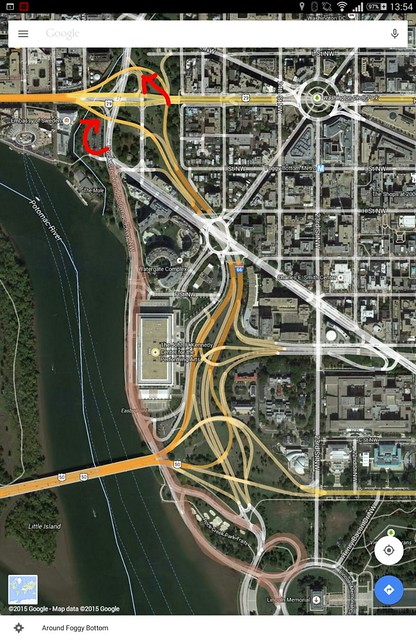
And it could be eliminated with just two ramps — the ones shown in red in the map, linking the existing and underused ramps that link I-66 Extension to the Whitehurst Freeway, to Rock Creek Parkway. Adding these two ramps would enable cars that currently use Rock Creek Parkway to use the woefully empty I-66 that runs just two blocks east — and thus permit depaving Rock Creek Parkway (in pink), south of Virginia Avenue and north of the Lincoln Memorial.*

(A 1998 FHWA study also proposed the same ramp at the northeast quadrant of the interchange, but instead of a loop suggested a signal and a left exit. It also proposed to leave RCP, and grade-separated the Ohio/RCP intersection.)

Creating a linear park along the river between the Thompson Boat Center and the Lincoln Memorial would more clearly link three great linear open spaces — the Mall, Rock Creek Park, and Georgetown Waterfront Park and the upstream parks. (A clearer, perhaps grade-separated walkway behind the Lincoln Memorial would still be needed.) It would finally connect the KenCen and Watergate to the water, and break apart the asphalt chains that encircle the old Watergate Steps. It would also attach this little urban island to the city (well, Georgetown).

It would accomplish these aims at a cost far lower than decking over I-66, a proposal that has failed several times for want of funding. The surrounding renewal-era fabric would require retrofitting if such a deck were built, since most of it was built with high walls that ignore I-66.

Yes, direct access between Memorial Bridge and Rock Creek Parkway would be eliminated. Drivers would instead have access to the Roosevelt Bridge, which is currently denied, and could use Virginia and 23rd to reach Lincoln Circle and thus Memorial Bridge.

A similar concept was floated on POP in 2012 and roundly criticized in the comments, although it seems most of the commenters misunderstood which segment of RCP was being referred to.

* On second glance, the north Lincoln Memorial loop may be needed to allow Independence Avenue traffic to flow onto Memorial Bridge.

Downzoning R4: Zoning Commission testimony

Price per square foot premium

My name is Payton Chung, I live in yes, an apartment in Ward 6, and I am testifying with regard to Case 14-11.

This rezoning amounts to a severe reduction in the potential number of housing units within the District. This action seems incongruous with the Office of Planning’s recent arguments that the District is adding a thousand residents each month, which will result in exhausting its “zoned capacity” for new development within 25 years — and perhaps sooner, if ambitious plans like the Sustainable DC plan bear fruit.

OP has suggested that existing single-family neighborhoods should accommodate some of that growth, through accessory dwelling units and corner stores. Yet now OP has reversed course, shutting the window on secondary units in one-third of the central city, and in some regards (like with height) making R4 more restrictive than the lower-density R1, R2, and R3.

The supposed principal rationale that OP offers, that further restricting an already severely constrained supply of housing will somehow make housing more affordable to a select class of households, is spurious and discriminatory towards smaller households like mine. As former OP director Harriet Tregoning once said, “Part of the challenge is to right-size our housing stock so we can have the type of housing that matches the needs of our residents.”

Tregoning pointed out then that larger housing units are already amply supplied within the District. Today, there are 2.4 large housing units in DC for every one household that needs one. More specifically, 33.5% of our housing units have three or more bedrooms, but 13.9% of our households have four or more residents.

This imbalance results in the market awarding a substantial discount to large units. On a per square foot basis, three-bedroom units sell for 15% less than the citywide average, while zero and one bedroom units pay a 15% premium. And yet OP wishes to exacerbate this crisis by further constraining the supply of small housing units, with no guarantee that larger units will be at all affordable.

I happen to enjoy living in a high-rise apartment building, but it is neither feasible nor desirable to shoehorn all residential growth solely into the rapidly diminishing areas available for high-rises — which are, of course, subject to the Height Act. High-rises have intrinsically high costs due to their fireproof construction, elevators, and interior corridors.

It’s no accident that most of North America’s great urban neighborhoods, from Boston to Brooklyn to Chicago to San Francisco, are comprised of small, low-rise buildings with 2-4 units apiece. Such buildings are affordable to build and maintain, yet create just enough density to keep eyes on the street and shops within walking distance. In fact, Milwaukee reveres two-unit pop-ups as the city’s characteristic housing type — former mayor John Norquist described its so-called “Polish flats”  as a housing type “specifically designed both to accommodate and to accelerate the economic improvement of the family.”

Almost 40% of Boston households live in 2-4 unit buildings, and so do nearly one-fourth of households in New York City and San Francisco. Yet here in DC, scarcely one in nine of our households do.

This text amendment certainly has a number of supporters, but in the end we must also consider its inadvertent result: to deny thousands of people the option to live in neighborhoods like Columbia Heights, Mount Pleasant, Park View, Trinidad, and Capitol Hill; to further diminish the prospect of more walkable retail within these neighborhoods; to sharply limit investment in some of the region’s most centrally located areas; to make Washington even less affordable to the young strivers who are, more than ever, its lifeblood.

Thank you for your time.

Shorts: Critical Masses

Critical Mass I Ching

A few short topics for January, all around the theme of achieving critical mass in three very different markets for metropolitan services.

1. Nathan Donato-Weinstein, reporting for the Silicon Valley Business Journal about Google’s October purchase of buildings along San Francisco Bay:

Google — which like many expanding tech companies is focused on reducing its car and shuttle trips as traffic worsens during the current boom — may be eyeing transit options beyond freeways. Pacific Shores is a half mile from the Port of Redwood City, where a Google pilot project earlier this year tested running ferries from San Francisco and Alameda to the port. The Water Emergency Transportation Authority, which administers the San Francisco Bay Ferry routes, has studied regular public ferry service to Redwood City, with a potential public terminal practically next door to Pacific Shores.
“I know they really liked the ferry and the concept. Their challenge was getting people off a boat and putting them on a bus to Mountain View, and that was taking 25 minutes,” said Kevin Connolly, director of planning and development for WETA. “This might be one way to address it.” […]
A Redwood City terminal would cost about $15 million. But the county doesn’t have ongoing operational funding, Connolly said.
A major built-in user such as Google could help make service pencil out, he said.

I’ve written critically about the peculiar geometries (and thus poor economics) of water taxi transit before. Having high-density development built on landfill immediately adjacent to a deep-water port certainly solves some of those problems — but a ferry does need at least two ports. However, most other Bay Area jurisdictions have incredibly restrictive development policies along their waterfronts, and many of the Bay Area’s most desirable residential areas are well inland (and atop hills, in fact).

Perhaps last-mile bus service would supplement a 101-bypassing ferry on one or both ends. That adds in the time and hassle of a transfer; when combined with a lower peak speed (around 40 MPH) and increased susceptibility to inclement weather, it’s tough to see how it would be a faster, more reliable, or more fuel-efficient option. (2008 figures submitted to FTA, as reported by Wayne Cottrell in Energies, indicate that ferry operators in the USA have a median fuel economy of about 10 seat-miles per gallon of fuel.)

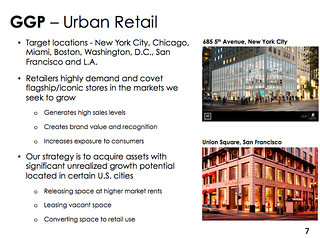
2. General Growth Properties plans a $2 billion investment in street retail, ultimately aiming to have 15% of its portfolio invested on high streets in the principal gateway cities of NYC, Chicago, Miami, Boston, DC, SF, and LA. Even in these high-rent areas, GGP sees “assets with significant unrealized growth potential,” with below-market rents and under-used vertical space.

General Growth Properties investor presentation slide

Many office REITs have focused on CBD office, but these properties have historically been neglected by large retail REITs. Adjacencies matter much more with retail than with office, which creates a “commons” problem that undermines streets with fragmented ownership.

GGP has hinted at two approaches to circumvent this. Like Acadia Realty Trust (an exceptional retail REIT that has redefined itself as a high-street owner), it might hope to aggregate enough properties to create its own mall-like ecosystem, and thus internalize the external benefits of its investment. GGP’s first big investment, an equity stake in the Miami Design District, certainly has that advantage. However, the DD is a singular example unlikely to be replicated elsewhere, so it appears that GGP will instead have to rely upon its high-rent neighbors to similarly aggressively upgrade their properties.

This could be a long waiting game, though, since a lot of urban property isn’t owned by others who need the same quick upside that a REIT does. Micah Maidenberg quotes a skeptic in Crain’s:

“The street-retail business, just like luxury hotels and other sorts of high-end projects, tend not to be a quarter-to-quarter-growth kind of business. It’s more of a long-term hold,” says Jeffrey Donnelly, a managing director at Wells Fargo Securities in Boston.

3. Two few weeks ago, I was visiting my parents in North Carolina and feeling under the weather. While looking up my out-of-area health care options, I came across an instructive article in Milbank Quarterly (by Daniel Gitterman, Bryan Weiner, Marisa Elena Domino, Aaron McKethan, and Alain Enthoven) about why Kaiser Permanente’s integrated group medical practice failed in the Triangle — where I’d previously been a satisfied customer.

My main takeaway from the case study was that, while “prepaid group practices” like Kaiser or GHC in Seattle (not to mention vertically integrated government systems like the VA) do offer tremendous cost efficiencies, they also rely on economies of scale that are difficult to set up from scratch.

The article estimates that KP’s break-even point is around 100,000 members in a metro area. That figure would have been a huge ask, given that the Triangle’s population was well below a million at that time, and spread out across a broad area. KP needs that kind of scale to build bargaining power, both:
– on the cost side, when bringing services in-house (the essential feature of their cost-containment model) or bargaining with hospitals and specialists; and
– on the revenue side, when selling their product to employers and employees who have to be sold on a choice that (a) most would find less convenient and (b) involves disrupting the “stay with my doctor” inertia many customers have.

It’s not a coincidence that prepaid group practices are best established in markets where either government employees or unionized employees bulk-purchase healthcare services. But HMOs are beginning to re-emerge now that the Triangle is bigger and denser, the ACA exchange has made the health insurance market less fragmented, and more doctors have organized into group practices linked to specialists via electronic health records. One new option in this year’s ACA marketplace for North Carolina (and especially valued, since last year only NC Blue Cross participated in the marketplace) is Coventry’s CareLink HMO, which uses Duke Medicine’s primary care network as the in-house practice.