Back to school

This somehow passed me by (although CBF did report on it): Saint Xavier University, on the southwest side, will launch a campus bike sharing scheme this fall.

“Over the summer, the University will install the SXU Green Bike Program, providing 65 European pedal bikes that can be automatically checked out 24 hours a day, seven days a week with a Cougar card and returned to any of several computerized docking stations around campus. The first 15 minutes between docking stations will be free, and patrons can use cell phone technology to more easily arrange for a bike.”

I’ll see how it works on an upcoming visit to London, where “OYBikes” are available throughout the west end. The procedure sounds a bit fiddly — check online for available bikes (stands only house three), push some buttons, call in, enter two randomly generated codes, tug on the lock — but the price is right (£10 initial deposit, first half-hour free, £8/day). One interesting bit: they’re shaft-driven (and thus chainless).

OYBike also sites bikes at many train stations run by French utilities group Veolia, which in turn has introduced its own sharing scheme.

Edit 1 October: the Sears Tower has started a free bike share scheme, with tenants reserving time online for three bikes — or two shared I-Go cars.

Edit 20 October: there are 75 campus bike-sharing/bike-lending programs nationally, according to the AASHE (protected link; Google cache here), but St. Xavier’s is the first such “smart” scheme. Most others rely on cheap student labor with manned check-out desks, which seriously impede spur-of-the-moment and short-trip use but which might be appropriate for occasional weekend use.)

And the capital bill gets worse

Of course the capital bill from hell (or at least deepest, darkest Southern Illinois — close enough) has morphed into an even worse beast. We have Governor Goofy in charge; what else was I expecting?

The old $34 billion capital bill [pdf] lavished $16.4 billion on IDOT’s Pave All Illinois program, and an additional $1 billion for local governments to sign right on over to the paving companies. Because, you know, drivers are driving less, so we need even more roads to entice them to drive more again, or something like that. The bill also allocated $5.3 billion into transit and rail, which is about half of the money needed just to bring Northeastern Illinois’ transit system back into adequate condition.

The new, improved, 26.5%-smaller capital bill [pdf] might address some of the equity concerns that I had by removing the Chicago-money-suck (er, casino) from the funding plan, but now the funding levels are $14.4 for his pals the asphalters and $3.4 billion for transit and rail. For those keeping score at home, that’s a 12.2% cut in cement — and a 35.8% cut in rail and transit. The funding ratio went from a dreary 3:1 to a dismal 4.2:1.

Yeah, thanks a lot for nothing, G-Rod. Keep it coming.

Of course, there’s a lot that’s fundamentally wrong about the pavement emphasis in the bill: roads are simply the wrong answer. Roads are the wrong emphasis for a bill that G-Ro(a)d ostensibly keeps rah-rahing as a way to create jobs; mass transit generates many more jobs per dollar. Further, IDOT has infamously assumed that the nonstop VMT growth of the past 50 years will continue forever in a straight-line fashion, and thus that the demand for roads will insatiably grow into perpetuity — long after everyone is spending 24 hours a day driving. Of course, they’re wrong; VMT growth hit a wall several years ago and recently went into sharp reverse.

vmt growth has hit a wall

(Courtesy Joseph Romm/Climate Progress/Gristmill)

Not fair!

State Sen. Gary Forby and State Rep. Brandon Phelps make it absolutely clear in a Southern editorial whom Blago’s “Illinois Works” would benefit:

The capital bill would have yielded $1,763 per person to Southern Illinois and only $645 per person for Chicago. Did Glenn let us down? We think not.

And just where will this magical windfall of money come from? Oh, duh. Not from Southern Illinois: instead, we’ll just steal the money from Chicago, just like we always have! After all, it would be unfair to just let those Chicago scoundrels keep the money from their businesses, leaving us free-loaders with nothing.

Under this bill, gambling would only be expanded in Chicago, and we believe it eventually will be anyway, with these new revenues now only benefitting Chicago, leaving Southern Illinois with nothing.

And just why do Southern Illinoisans deserve 273% more money than we Chicagoans, even though our votes theoretically count the same? Do I count as just one-third of a citizen of Illinois? After all, Chicago has bike lanes which serve more people than entire Interstates downstate. We deserve our fair share, and it’s obscene that the state’s leaders (like Blago and Jones, both of whom seem to spend an awful lot of taxpayer money to access Chicago’s transportation infrastructure) would allow such an unbalanced program (which threatens Chicago’s, and thus the state’s, future prosperity) to get this far.

Your ideas for WPB

Over the course of three WPB Community Open House weekends, 88 people gave us their Big Ideas on what Wicker Park & Bucktown need. Take a look at what people wanted during Week 1 [try the extra-fun slideshow], Week 2 [slideshow], and Week 3 [slideshow]. (You’ll see me a few times on Week 3.) And attention, entrepreneurs: there appear to be a lot of unserved market niches!

Have your own idea? Take a few moments to tell us via a Virtual Postcard From WPB’s Future.

Look into the future of Wicker Park & Bucktown: Mar 29-Apr 5

kitty

You’ve got ideas on how to make Wicker Park & Bucktown better. WPB is listening. Tell us your stories, show us your local hangouts, gaze into our crystal ball, see our neighborhood in new ways, meet our neighbors — even spend our money and eat our food.

Come and shape our neighborhoods’ future at WPB’s Open House: Saturdays, March 29, April 5, April 12, 10AM-4PM, at 1275 N. Milwaukee. We’ll even have door prizes and cool coupons. Check it out.

For more info, visit http://wickerparkbucktownssa.org/?p=242. If you can’t attend, send us a Postcard From WPB’s Future!

Wait and see (updated)

The bids for privatizing about 36,000 parking meters citywide were due yesterday. I talked with someone who feels that a private operator might be more flexible and open to working with neighborhoods, but personally I suspect that a private operator will be even more willing to jack rates and run with the money. There was a brief moment when neighborhoods realized the upside potential of underpriced street parking, but now the city’s caught on and wants to keep the money for itself (well, split with its private-sector partner).

Public assets, like streets and even street parking, should be managed for the public good, not solely for private financial gain.

18 March: Lorene Yue in Crain’s reports that ten bidders responded, ranging from locals like CPS Parking to the usual Cintra and Macquarie (on separate teams). Chicago CFO Paul Volpe called it a “strong response.”

Transit in brief (updated)

A bunch of bike/transportation related briefs.

* Bike sharing is moving forward, according to news items posted to the Bike Sharing Blog. Fran Spielman reports in the Sun-Times that JCDecaux has offered to trade ad panels for 1,000 downtown bikes here. (Any chance they’d offer a similar deal to neighborhoods?) Back East, Clear Channel still intends to be first in the USA by placing bike stations in DC this month [via DC Business Journal], with Arlington and Bethesda studying proposals for launch later this year.

* Bill Fulton in CP&DR notes that California officials, when pressed at the New Partners for Smart Growth conference on how they plan on cutting transportation-related carbon emissions (as part of their broader, likely unattainable CO2 goals), really didn’t know yet. Transportation claims an outsized share of California’s CO2 emissions, as is typical of the West Coast.

* A bit further north, British Columbia’s government has advanced a budget that includes a carbon tax of surprising magnitude. Marc Lee from the Progressive Economics Forum notes: “The government chose to stick to a narrow definition of revenue neutrality, with all carbon tax revenues recycled through low-income tax credits and tax cuts… a low-income carbon tax credit that will piggyback on the GST credit. The credit is worth $100 for adults and $30 for children with a phase-out period.”

(GST credit — hear that? Sales tax rate in Vancouver = 12%, includes free health care, spotless trains, and a $300 annual credit. Sales tax rate in Chicago = 10.25%, includes, well, what?)

* Greg Hinz in Crain’s notes that CMAP, fresh off its reorganization, intends for its 2040 plan to actually include real capital planning, not just the “grab bag” of projects that typified CATS capital plans in the past. (“Every agency submitted their plans to us, and we stapled them together.”) Hinz: “Of particular importance is how Mr. Blankenhorn says the new group will approach giving a thumbs-up or thumbs-down to requests for billions of dollars in federal aid for [infrastructure]… Mr. Blankenhorn says the region actually will use metrics — yardsticks to value each proposed project against an absolute standard — to allow the region to set its own priorities.” Of course, whether there will be capital funding to make such plans around hinges on the state’s willingness to back such an effort — now, we have the odd spectacle of suburban Republicans blasting the governor (and Daley joining in separately, on behalf of CTA, and apparently suggesting a bunch of pie-in-the-sky customer-facing ideas) for severely underfunding transit capital (albeit their pet appears to be Metra’s STAR Line).

* Not everyone is quite as blind to transportation finance woes as Springfield. I’ll try to follow the upcoming federal reauthorization fight as best I can; the first shot across the bow was recently issued by the National Surface Transportation Policy and Revenue Study Commission‘s Report to Congress.

* I’m always suspicious of AAA’s motives, but I do appreciate their hiring of Cambridge Systematics to look at the cost of car crashes to society each year — and the attendant call to focus on safety (and a little less on congestion) in the next transportation reauthorization bill. Note that Chicago’s tab for crashes is well below the national average, perhaps because of a more balanced transportation system?

The societal cost of crashes is a staggering $164.2 billion annually, nearly two and a half times greater than the $67.6 billion price tag for congestion, according to a new report released today by AAA. Furthermore, the cost in Chicagoland, is $8.378 billion for crashes, which amounts to an annual per person cost of $887. The total cost per person for congestion in Chicagoland was $487… the $164.2 billion cost for crashes [nationally] equates to an annual per person cost of $1,051, compared to $430 per person annually for congestion…

If there were two jumbo jets crashing every week, the government would ground all planes until we fixed the problem. Yet, we’ve come to accept this sort of death toll with car crashes.”

* Hadn’t seen these before: Steve Breese’s greenway maps include a GIS viewer to see trail corridors that cross jurisdictions (like the Valley Line) and their progress to date.

* A recent Jon Hilkevitch column gives this astonishing example of car dependency:

in Aurora, where city building inspector Allen LaFan says he can stand at the bus stop near his house and watch his child get on and off the school bus, because the entire trip amounts to crossing a busy intersection that is not pedestrian-friendly.

“I can wave to the school,” LaFan said.

The situation represents an unending cycle. More children are being transported to school on buses or in private cars because the streets are not safe. But that leads to more vehicles and more traffic, increasing the potential danger to all pedestrians.

* Streetsblog gives a cite for the “the corn that could feed an SUV for a week could feed a human for a year” tidbit recently published in an Economist survey of food prices: Lester Brown from EPI.

* Civia Cycles, the new upper-end commuter bike brand from QBP (TPTB behind Surly) strives to make the morning commute easier with clothing recommendations, matched to your local weather forecast. Every winter, I think that I’ll scribble down notes on this topic (using dewpoint and wind speed, though, rather than temperature), but never do — and, as a result, end up having to guess again each fall what I will need to wear. At first glance, this guy’s internal thermometer appears to be 10 degrees cooler than mine; I guess I overheat easily. It’s also all “bikey” clothing, unleavened by “real” clothes.

* And, okay, not transportation related, but Vince Michael notes the irony of redeveloping [Alby Gallun in Crain’s covering the unveiling of the proposal] that paragon of “towers in the park” urban renewal, Lake Meadows. Now that the railyards and industrial lofts and public housing projects are gone, the only big privately held parcels left — and with deteriorating physical plants to boot — are the private housing projects. I’ll write more later on historic preservation and urban renewal.
Talk is cheap

Certain prominent politicians have been touting their commitment to the environment (and thus to environmentally minded voters) by signing their governments up for carbon-cutting promises.

Of course, the instant those targets come due, the politicians have moved on to the next promise without any substantive action — because signing ceremonies are easy, but actually cutting carbon, the lifeblood of industrial economies, is not. Last summer, the Economist noted that California is nowhere near track to meet its self-imposed, easier-than-Kyoto targets, even though it does have a fairly thoughtful plan to achieve emissions reductions on several fronts:

Despite making some optimistic assumptions about future contracts, the public utilities commission has concluded that the state will miss its target for renewables. And the aim of cutting emissions from electricity production to 1990 levels by the end of the next decade may be just as unrealistic… It is a bad sign that California’s electricity suppliers are struggling, because electricity is something over which the state wields considerable control. It has less power over carmakers, who are fighting to prevent California imposing emissions standards on them. If they succeed, even temporarily, California’s goals will become unreachable… The state has even less power to slow the growth of its population, or to dictate where people live. It hopes “smart growth” policies (which encourage people to live closer together, and to take public transport) can get it a whopping 15% of the way towards its overall 2020 goal. But the news from that front is discouraging.

Even more off the mark, of course, is Chicago; the Tribune revealed city government’s energy use to be spiraling almost inexplicably, even as the mayor eagerly accepts awards touting his “pro-active steps to address climate change“:

Records show that officials fell well short of targets for curbing electricity usage by city buildings despite the construction of energy-efficient buildings and the installation of green roofs across the city.

Most recently hurricane-, drought-, and heatwave-stricken Florida has signed on to carbon reductions. We wish them the best of luck, but fully expect future journalists to expose the false promises therein.

Perhaps local action on climate change, while admirable, ultimately has to be ineffective; after all, the promises signed aren’t binding targets with penalties, and most state and local governments work in isolation, without control over broader issues like the electric grid or auto emissions standards. As Felicity Barringer in the Times points out, most localities don’t have the authority or resources to effect big changes requiring, yes, social engineering:

Constraints on budgets, legal restrictions by states, and people’s unwillingness to change sometimes put brakes on ambitious plans to cut carbon dioxide emissions… “It’s really hard,” Ms. Hancock said. “It’s like the dark night of the soul.” All the big items in the inventory of emissions — from tailpipes, from the energy needed to supply drinking water and treat waste water, from heating and cooling buildings — are the product of residents’ and businesses’ individual decisions about how and where to live and drive and shop.

Now, about that raise

posted at The Swamp

It’s odd that people are surprised by the dollar figures involved. Michelle Obama is a VP of an organization with a $1.6 BILLION annual budget. The community that UCH addresses extends far beyond Hyde Park to the whole South Side, which usually views the university and its hospitals with a great deal of suspicion.

It doesn’t matter whether her employer is a for-profit — it does in fact clear operating income — or not-for-profit corporation; regardless, its a huge and complicated organization which requires great management talent, and that deserves proper compensation.

I say this as someone who quite willingly, and knowingly, earns about 60% less money at a non-profit than I could in the private sector.

Red-eye escapes

(To be crossposted at carfreechicago; please add comments there)

Got a free weekend? Like trains? Amtrak offers car-free Chicagoans plenty of chances to make a quick one- or two-day weekend escape with “red-eye” (overnight) trains from Chicago to several cities that are a few hundred miles away. I like traveling overnight, since it offers maximum sightseeing time at your destination and cuts back on expensive hotel stays.

Thrifty, non-fidgety sorts can travel in coach for less than the price of airfare, and typically right into downtown. Those who prefer a little more pampering can spring for a sleeper, which offers complete privacy, a flat bed, and free meals. In either case, you’ll travel without road rage or air rage, and usually without worrying much about ground transportation on the other end. One drawback is that slow trains put most of the East Coast out of reach.

Some cities worth a weekend visit:

  • Memphis via the City of New Orleans
  • Pittsburgh or Cleveland (a long day) via Capitol Limited
  • Cincinnati (a long day); Charleston, W.Va.; Beckley, W.Va. (near the Winterplace ski resort); White Sulphur Springs, W.Va. via Cardinal
  • Cleveland (a long day) or Buffalo via Lake Shore Limited
  • It might be possible to arrange a long weekend, although with an early departure and late arrival, in Denver or Winter Park via the California Zephyr

The many short-haul lines out of Chicago can be used for day trips to locations too close for an overnight. Destinations include:

Megabus also offers many overnight trips for cities that are a little bit closer by, or for which Amtrak has inconvenient day schedules — and boasts its famously low prices. Granted, it doesn’t offer quite the space that Amtrak affords you, but its (mostly) clean, new buses certainly put a new face onto intercity buses. Their overnight destinations include Cleveland, Columbus, Cincinnati (a long day), Minneapolis, Kansas City (a short day), and St. Louis. Day trip options include Indianapolis, Madison, and Milwaukee.

Retail courts lost and found

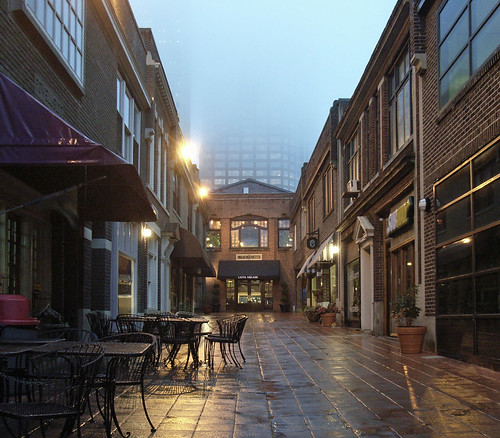
I stumbled across this delightfully human-scaled space in the middle of the variously anonymous and flashy bank towers of uptown Charlotte:

Brevard Court and Latta Arcade together provide homes for dozens of tiny businesses — Latta is divided into miniature, 500 sq. ft. bays — along a through-block passage off Tryon Street, Charlotte’s main drag. A preservation easement over the site protects it in perpetuity, even if the current tenanting plan seems a little uninspired. (Most everything was shut at 5 PM, and a few forgettable fast food chains visually dominate the space.)

Closer to home, in supposedly preservation-obsessed Oak Park, a place similar in size and scale to Latta — Westgate, a picturesque (“storybook style”) parking-court ensemble of two-story Tudor facades just half a block behind the main drag of Lake Street — is about to get summarily wiped away after 75 years. A series of insensitive developments gradually walled Westgate off from the rest of downtown: the 1950s filling in of an open-air arcade to Lake Street (the building in yellow, Tudor on the back and Deco in the front), and the botched 1990s tilt-up retail complex that “revitalized” Harlem at the expense of the town around it.

Here it is today, still mostly intact.

Of course, the same quest that led to the Harlem buildings getting wiped away in favor of hopelessly bland chain retailers in forgettable strip-mall brick boxes has come back with a vengeance. Vince Michaels has an overview of the process that led — even after an official commission heard from several professionals who urged its salvation — to the village’s announcement of an RFP to bulldoze half of what remains at Westgate and replace it with what’s optimistically termed “transit oriented mixed-use infill.” The village’s RFP only said “encouraged” teams to “investigate” saving “some of the facades.” This week, the only RFP responses selected to proceed all declined this “encouragement” in favor of teardown.

6. Historic Preservation: The Oak Park Historic Preservation Commission has indicated a preference for saving some of the facades of the Westgate buildings on the RFQ parcels and integrating them into the design of a redevelopment project. Teams are encouraged to investigate this possibility as part of their preliminary plan submittal — especially if it helps with the LEED Certification Process…

And here’s an overview of the RFP parcels (in red).

Now, I’m no reflexive NIMBY — I got excommunicated by my neighborhood association for speaking in favor of a giant condo literally in my backyard, and I’m also obviously a fan of human-scale hotels and big box retailers (what the proposals, well, propose) — but really. When you have something this exquisitely human scaled, sitting in an enviable location next to a major transit hub in an upscale area, and surrounded by underutilized land, you can make it work — by demolishing the throwaway retail boxes and parking lots at the heavily trafficked edges of the block, not the historic ensemble in the center.