Retail courts lost and found

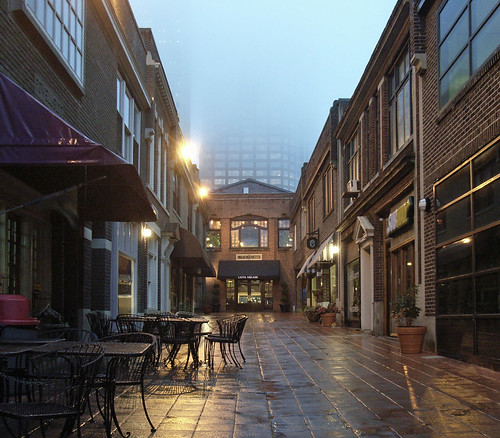
I stumbled across this delightfully human-scaled space in the middle of the variously anonymous and flashy bank towers of uptown Charlotte:

Brevard Court and Latta Arcade together provide homes for dozens of tiny businesses — Latta is divided into miniature, 500 sq. ft. bays — along a through-block passage off Tryon Street, Charlotte’s main drag. A preservation easement over the site protects it in perpetuity, even if the current tenanting plan seems a little uninspired. (Most everything was shut at 5 PM, and a few forgettable fast food chains visually dominate the space.)

Closer to home, in supposedly preservation-obsessed Oak Park, a place similar in size and scale to Latta — Westgate, a picturesque (“storybook style”) parking-court ensemble of two-story Tudor facades just half a block behind the main drag of Lake Street — is about to get summarily wiped away after 75 years. A series of insensitive developments gradually walled Westgate off from the rest of downtown: the 1950s filling in of an open-air arcade to Lake Street (the building in yellow, Tudor on the back and Deco in the front), and the botched 1990s tilt-up retail complex that “revitalized” Harlem at the expense of the town around it.

Here it is today, still mostly intact.

Of course, the same quest that led to the Harlem buildings getting wiped away in favor of hopelessly bland chain retailers in forgettable strip-mall brick boxes has come back with a vengeance. Vince Michaels has an overview of the process that led — even after an official commission heard from several professionals who urged its salvation — to the village’s announcement of an RFP to bulldoze half of what remains at Westgate and replace it with what’s optimistically termed “transit oriented mixed-use infill.” The village’s RFP only said “encouraged” teams to “investigate” saving “some of the facades.” This week, the only RFP responses selected to proceed all declined this “encouragement” in favor of teardown.

6. Historic Preservation: The Oak Park Historic Preservation Commission has indicated a preference for saving some of the facades of the Westgate buildings on the RFQ parcels and integrating them into the design of a redevelopment project. Teams are encouraged to investigate this possibility as part of their preliminary plan submittal — especially if it helps with the LEED Certification Process…

And here’s an overview of the RFP parcels (in red).

Now, I’m no reflexive NIMBY — I got excommunicated by my neighborhood association for speaking in favor of a giant condo literally in my backyard, and I’m also obviously a fan of human-scale hotels and big box retailers (what the proposals, well, propose) — but really. When you have something this exquisitely human scaled, sitting in an enviable location next to a major transit hub in an upscale area, and surrounded by underutilized land, you can make it work — by demolishing the throwaway retail boxes and parking lots at the heavily trafficked edges of the block, not the historic ensemble in the center.

Passages

One of the questions that our SSA commission has been wrestling with has been what to do with Mautene Court, a tiny, overlooked plaza just northwest of Milwaukee and Ashland. It was a stub street turned into a failed plaza, but construction all around it led to its recent closure. I’ve found a few examples of interesting precedents for this kind of “passage park”; most connect two streets, and Mautene has the potential to connect through the lot behind it to rapidly growing Division Street.

* Liberties Walk in Philadelphia. [My photos.] “Part of real estate developer Bart Blatstein’s plan to build an upscale artists’ community on his large property holdings in Northern Liberties. Blatstein designed [it] to be a mixed-use, pedestrian-oriented retail and residential corridor that would fit with the neighborhood’s architecture.” [PlanPhilly] A semi-critical article from when the plan was announced: [City Paper]

* Chess Park in Glendale, Calif. [Photos from Flickr] “The park is located in a previously underused passageway which runs between two retail shops in the Brand Boulevard business district, connecting a city parking structure to the bustling streetfront shops, restaurants, and theaters on Brand Boulevard, Glendale’s main thoroughfare.” [ASLA 2006 Awards]. An hour-by-hour photoessay about a day in the park’s life is in the September 2007 issue of Landscape Architecture magazine.

* Fruitvale Transit Village in Oakland, Calif. [My photos.] This one’s a little more problematic, a handsome two-block pedestrian street developed by a local CDC that was a bit too ambitious with the retail. Read more in New Urban News.

* The Distillery District in Toronto [photos] [previous post on business mix] is a historic industrial complex that has been renovated into an immensely popular, pedestrian-only arts and entertainment village, with galleries, shops, restaurants and cafés, performance and creative spaces, and now (after many years of development) high- and mid-rise condos. (Québec also has a number of lively pedestrian malls despite the bitter cold, like art-stall-lined Rue de Petit Champlain in Québec or restaurant-lined Rue Prince-Arthur in Montréal’s Plateau: [photo 1] [photo 2] [photo 3])

* In a more socioeconomically comparable neighborhood, Mozaic in swanky Uptown Minneapolis is a 2.5 acre site being developed as retail, entertainment, condos, and a boutique hotel in mid- to high-rises surrounding a half-acre plaza with “interactive fire and water garden.” [Flashy official site]

Another idea that’s been brewing, in a somewhat similar vein, is the notion of building a public market in the neighborhood — a citywide destination that promotes local entrepreneurs. I’ve always been a fan of a good market, but most of the famous ones are the cavernous, established downtown markets. So, I was surprised to find a 40-stall public market squeezed into about 10,000 sq. ft. in Viroqua, Wis., population 5,000. It’s not incredibly sophisticated, but it’s a great venue for entrepreneurs and a smart reuse of an existing space — an auto dealership with wood-truss vaulted ceilings, opened in 2004. Midtown Global Market is a better-capitalized new public market housing 60 larger vendors within an old Sears in South Minneapolis. Unlike those areas, though, Wicker Park has the added advantage of being termed as one of the higher-income “food deserts” in recent research (see presentation from Mari Gallagher here) — a neighborhood comparatively underserved by grocery stores.

Perhaps most interesting to this neighborhood is the Epicurious Garden [my photos], a stylish new food hall (think linear food court, or tiny and chichi public market), with ten small foodie businesses, recently opened a few doors from Chez Panisse in Berkeley’s Gourmet Ghetto. Most of the vendors face a short passage and offer takeout; around the edges are a wine bar, a classical tea house, a small garden (which still manages several seating options), and a cooking school.

Roundup

* New photos here and on the way. Wicker Park Critical Mass and my recent trip out west, for instance.

* I’ve spent far too much time lately rebutting right-wing arguments against transit funding on various blogs. Most of those responses have been crossposted (for my own reference, which is the primary reason why I have this blog) as comments under various earlier posts tagged “transit.” (Another good rebuttal: MPC’s in Friday’s Trib. However, one bus really = about 34 cars; 43 passengers per hour on CTA buses divided by 1.25 per car. An even better one: the Sun-Times’ editorial, pointing out that the tax increase amounts to $33 a year for Cook residents.)

You want to talk “backdoor fare increase”? The Economy League study of SEPTA that I’ve mentioned, examining substantial [but smaller!] cuts proposed, found that riders would pay $2.20 in higher fares, longer waits, and more driving for every $1 that government “saves” by cutting SEPTA. To pay that much via the “backdoor fare hike,” you’d have to charge up $880 in bills every day.

One common theme has been “privatize the damn thing,” as the public has little confidence in CTA’s ability to manage its current system, much less invest to renew it. However, words of caution from the libertarian-leaning City Journal‘s Nicole Gelinas:

While the private sector has a role to play in building, upgrading, and maintaining public infrastructure, it can never assume the public sector’s ultimate responsibility—financial and otherwise.

* I’ve also spent a lot of time on the phone with reporters lately. Published articles to date: Mark Lawton from the Booster on WPCM; Matthew Hendrickson from the Chicago Journal on WPCM; Nara Schoenberg from the Tribune on CCM. (Even though I didn’t get quoted in the last one, it was by far the best of the interviews: well over an hour on topics ranging from political theory to winter riding. She’d never heard so many people say “it changed my life.” One line: “the utopian eco-cyclists who pioneered the party/protest/prank in this city point to numerous achievements.”)

Forthcoming (with photos!): Chicago Tribune on car-free living, and Sierra Magazine on eco-jobs.

* Apparently, the whole Dutch-bike trend is really taking off among Manhattan models, a rather influential crowd I don’t pay much mind to. Gillian Reagan reporting in the NY Observer, quoting George Bliss of the Hub Station:

“[Lela Rose ha]s really inspired me, and now I’m focusing on the tricycle child carrier as a product for upscale women in SoHo. … That’s the niche, professionals and models because, you know, if you go to a cocktail party, you’ve got to have something to talk about. ‘Green? What’s green? Oh, bicycling!’

Ms. Rose’s paean to her bike: “it sounds ridiculous, but I don’t go anywhere anymore without bringing the bike, because to me it’s like my car. At a minimum, it’s the best way to get around. It’s for the environment. It’s great for health reasons. For me it’s just a great way to get a better peace of mind. I could go on and on about the benefits of bike riding.”

(Disclosure: I once rented a bike from George — a 50-lb. single-speed with a coaster brake — at his prior location at SoHo’s west edge.)

* MTC recently held a workshop on Smart Parking on “parking policies to support smart growth, focusing on providing strategies for interested local jurisdictions”; the presentations are online.

* A 2004 report on TDM strategies from FHWA has many interesting case studies focusing on special events and large employers.

* Socialized car insurance in B.C. (PDF from VTPI) offers the province a unique way to fine-tune the costs of driving — which might be why B.C. was among the first places to experiment with eco feebates. Another VTPI paper (page 10) demonstrates how increasing fuel economy standards could actually increase the social costs of driving by encouraging more of it.

* Dallas has a streetcar. How did I not know that?

* Here’s an interesting approach: Louisville, Colo. tested a proposed zoning designation by running six examples of ground-related multifamily housing around Denver past the code. Interestingly, all of them exhibit the kind of quasi-Dutch modernism that I saw a lot of around there: blocky massing, bright colors.

Morsels

* I feel sick. Why? Earlier today, I was hit (no damage, at midday, in the middle of the Loop) by a driver who was clearly in the wrong — double parked, no signals, suddenly backing up without looking (through an illegally black-tinted rear window) — and suddenly found myself with four cagers all simultaneously screaming obscenity-laced insults at me. (None asked if I was all right.) One person on the sidewalk, a woman smoking, seemed to care, and told me to take down details for the cops. Of course, the cops arrived 22 minutes later, moments after the driver finished his business and pulled away, and there being no blood, there was no way to press charges.

Yet when there is blood, as with architect Steven O’Rourke (evidently a friend of a friend) — his body dragged for one mile through the streets of Jefferson Park, knocked out of his shoes just steps from the home where his wife and three small children were sound asleep — it’s too late. Your best witness is dead.

Not one week later, a child riding in the middle of Critical Mass was violently struck by a car fleeing the scene of a crash; his bike was dragged under the car for six blocks. Not just any kid, either, but a regular, an eager boy whom I’d seen graduate from trail-a-bike to his own two wheels, whom I’d fed cookies to. He’s shaken and bruised, but the gall!

Soon, I won’t be able to count the number of people I know — or have known — struck by hit-and-run drivers with mere single digits. This fact, and the utterly nonchalant attitude that countless drivers and the authorities have towards this most soulless, evil-hearted cowardice, fills me with toxic rage.

* A text ad on that O’Rourke story directs readers to the Campaign for Global Road Safety, which points out that worldwide, road deaths kill more people than malaria and diabetes, and as many as either of two lung diseases (tuberculosis and lung cancers) — and that every minute, a child is killed or maimed on the world’s roads. Worldwide, most of these deaths are of pedestrians. This is beginning to get attention from the UN, with a General Assembly session on road safety set for this fall.

* How to end our long national nightmare. [Wonkette]

* At a recent event, new alderman Brendan O’Reilly mentioned one idea worth grabbing from NYC: camera enforcement of Gridlock Sam’s “Don’t Block the Box” directive. Between these, the Natarus sound cameras, and various anti-terrorist cameras, downtown could have a pretty thick network of cameras — pretty useful for also ticketing double-parkers, or for London style cordon pricing.

* Recently viewed and highly recommended: the Criterion Collection release of Tati’s Play Time. No plot whatsoever, but the views of oppressively modernist, traffic-choked “Tativille” alternating with his gentle physical humor made for an enjoyable (if long winded) viewing.

* Speaking of oppressive modernism, I was amused to see that an “urban quarter” (named Quartier sur le Fleuve, but that name currently generates no Google hits) at the northeast corner of Montréal’s Île-des-Soeurs was submitted for the LEED-ND Pilot. The place really looked like a Tati nightmare. [PDF from earlier planning process]

* Québec also passed a “carbon tax” last month, amounting to 0.8c per liter. Curiously, part of Illinois’ gas tax is really an “environmental impact fee” (415 ILCS 125/310). I’d be curious to see what kind of interesting local projects could be funded under a CMAQ-like regional grant program to cut carbon emissions: car sharing, bike sharing, hybrid cabs, beater car trade-ins, electric peak load conservation, whatever.

* “Airplane security seems to forever be looking backwards.” So, billions of dollars in America’s most valuable workers’ time is wasted stuffing “Freedom baggies” and pulling off shoes, all to CYA over yesterday’s threats. [Schneier on Security]

* Pithy comment by Carrington Ward on the Obama-arugula flub:

It’s an interesting point about the price of arugula. One of the problems Iowa farmers face is a dependence on monocrop agriculture — corn, corn, corn.

It is a flipside of the problem that many urban neighborhoods face: bodies sculpted by corn syrup, corn syrup, corn syrup.

We’d be better off as a nation if Iowa farmers were paying attention to the price of Arugula (or apples) in Chicago.

* Portland has a Courtyard Housing Design Competition underway. I’ll be curious to see how they reconcile this type (among my favorites, as you probably already know) with parking. The jury is pretty solid; my sense is that they’ll tend towards the traditional, though.

Ald. Preckwinkle, urban designer

Fran Spielman reports that Ald. Preckwinkle is now about as well trained an urban designer as you’ll probably find in Chicago:

[The alderman’s] demands [for the Olympic Village] include: Connections to the Bronzeville community to the west so the village doesn’t become an “isolated little spur of McCormick Place”; a “street grid instead of superblocks,” with streets that “go through like a real neighborhood”; a street wall “built to the lot lines” instead of the “unusual curved buildings” now proposed; and ground floor retail “so there’s some life on the street.”

“I want it to be like a neighborhood. [What they’ve proposed] is sort of architectural egotism as opposed to a real neighborhood,” Preckwinkle said of the alternating series of eight- and 16-story condo towers.

“They’ve proposed curved buildings sort of plunked there. I don’t think that contributes to having a neighborhood. The buildings are self-contained, as opposed to part of a larger community. They proposed a connection at 31st Street. That’s not good enough. There have to be intervening streets.”

Preckwinkle noted that superblocks are being eliminated in the $1.6 billion Plan for Transformation now replacing CHA high-rises with mixed income communities.

“One of the things we’ve done is put the streets back in. If you want a real neighborhood, it doesn’t work to have superblocks,” she said.

Houses not growing all that quickly

It’s a truism that American houses are growing to be elephantine; many articles on McMansions point out that the average new house in America has grown in size by 46.63% since 1973. Yet the story isn’t that simple: in fact, house sizes in recent years have grown at below trend — little more than 1% a year, a big slowdown from the mid-1980s. Also, the size of multifamily apartments is reported separately and in a different fashion (in size brackets rather than exact numbers), which makes it impossible to figure out how average new dwelling sizes are changing as multifamily grows as a share of American housing starts.

|year|size|% growth*|
|1973|1660|–|
|1976|1700|0.80%|
|1979|1760|1.18%|
|1982|1710|-0.95%|
|1985|1752|0.82%|
|1988|1995|4.62%|
|1991|2075|1.34%|
|1994|2100|0.40%|
|1997|2150|0.79%|
|2000|2266|1.80%|
|2003|2330|0.94%|
|2005|2434|1.49%|
|1973-2005|+774|2.12%|

Note: Size is in square feet, average for new construction. Source: U.S. Census, “data set C25”:http://www.census.gov/const/www/charindex.html. Sample was readjusted in 2005, with the effect of tilting sample towards Sunbelt, so results are not directly comparable to earlier years.

% growth: annualized rate, over past three years.

Latest and greatest Cottage

USA Weekend reports on the Washington, D.C.-area Katrina Cottage built for this weekend’s “Make A Difference Day”:

bq. The [Katrina Cottage] project is a realization of a group of socially conscious designers, engineers and builders, called the Congress for the New Urbanism. Their goal, in the aftermath of horrific destruction by hurricanes Katrina and Rita, was to provide affordable, dignified housing for the needy not only on the Gulf Coast but in every pocket of the country. The award-winning designs can now be translated to fit any environment.

The cottage concept, as realized by Marianne Cusato, recently won the People’s Choice at the National Design Awards sponsored by Cooper-Hewitt.

By architect Steve Mouzon’s description, the “Katrina Cottage VIII”:http://www.katrinacottages.com/interface/home/i_news.html (column on left) is a big step towards design nirvana (far closer than, say, “the LivingHome”:https://westnorth.com/2006/10/11/ostentatious):
* it can and will expand in eight different directions
* it is visitable by those in wheelchairs and adaptable (can be made fully accessible)
* its energy performance is good, befitting the first Katrina Cottage that will see snow (however infrequently) but also having a high-albedo (non-heat-sink) roof
* “it has more clever space-saving devices than you’ve ever seen”
* its interiors are solid, not veneers, hence low VOCs and with ancillary benefits like absolute flexibility with regard to wall hangings thanks to wood paneling instead of drywall on interior walls
* it has all green materials, including bamboo and slate floors
* it is already in production, built at a new factory in Louisiana
* it is designed for affordability and is sized for humble living
* it also has no garage and is being donated to a low-income family living in transit-rich Silver Spring.

Ostentatious

The November issue of Dwell (and, it turns out, a NYT blog entry by Dwell editor Allison Arieff) gives a big ol’ wet kiss in a story by Frances Anderton about Steve Glenn and his LivingHome, a company selling prefab wooden boxes, er, houses designed by a SCI-Arc avant-gardiste that come designed to LEED Platinum standards — “Zero Energy, Zero Water, Zero Waste, Zero Carbon, Zero Emissions” is the mantra. And yet:

bq. Glenn has carefully targeted his customers: They are not back-to-the-earthers, but relatively affluent people who want to consume guiltlessly — people who, in his words, “drive Priuses, buy Bosch appliances and Design Within Reach furniture, shop at Whole Foods, and give money to the Natural Resources Defense Council.”

Ugh. Someone has not been thinking outside the wooden box lately, and it shows; if going green just becomes another luxury lifestyle choice for consumers to define themselves by, then the entire project will deservedly fail. Put simply: “We can’t shop our way to sustainability.”:http://www.worldchanging.com/archives//004343.html

FSC certified hardwoods everywhere may be certified, but still consume vastly more resources than wood alternatives. The Prius has highly toxic heavy metals in its batteries and achieves a tiny fraction of the fuel economy that the driver within could achieve if he just walked away from the car. Bosch, DWR, and Whole Foods are all overpriced, marginally greenwashed (if at all), and shipped from thousands of miles away. And the house, as with all of the dozen-odd modern prefab options presented in the magazine’s 300 glossy pages, has no visual relationship with the street; heck, none of them even have a visual relationship with the _ground_.

Unfortunately for America, the rise of green building in the Aughts has coincided with both a growing national obsession with overinflated housing prices and with a government controlled by ideologues who want to kill all remaining federal housing aid to the poor; hence, almost all of the flagship attempts at green building have been not only “market rate” but obnoxiously expensive. Contrast that experience with the UK, where the Labour government has focused national attention on green building at the same time that it has advocated a muscular growth-management and housing policy.