Jefferson tries Streetmix

In 1803, Thomas Jefferson suggested to D.C.’s government that the broad Pennsylvania Avenue be lined with trees, in the manner of the elegant French gardens that he admired. The original street-section schemes, drawn by Nicholas King, are in the LOC’s collection, and thanks to Streetmix I’ve taken the liberty of updating them to imagine how they’d have evolved since then. Today’s configuration of Pennsylvania Avenue NW has wide sidewalks and double/triple rows of trees, and was designed and redesigned by various urban renewal commissions from the Nathaniel Owings Plan of 1964 through the the PADC up into the mid-1990s.

Option was the then-road, a narrow dirt path.

Jefferson's Pennsylvania Ave #2
Option #2 has a center gravel passage for horseback riders (today, cyclists?) flanked by two carriageways. I’m not sure how many roads of the day separated solo horse riders from carriages; perhaps the idea of having a separate center track was because an unburdened horse could travel considerably faster, and therefore should stay to the left of carriages. Nonetheless, the idea of a center track isn’t exactly new.

Jefferson's Pennsylvania Ave #3
Option #3 has a broad carriageway flanked by two gravel footpaths, here reinterpreted as tree-lined cycletracks. Although this carriageway looks far too wide, today’s asphalt expanse is pretty much this wide — and ensures a relatively clear vista down the middle towards the Capitol (and Treasury, I guess).

Jefferson's Pennsylvania Ave #4
I’ve illustrated Option #4 with a center transitway, although that seems like it would result in many conflicts between pedestrians/transit riders and cyclists.

The lights aren’t broken, but the design is

Uplighting by Payton Chung
Uplighting, a photo by Payton Chung on Flickr.

L’Enfant Promenade is so badly designed that it accomplishes the rare feat of making something darker by applying light. Lots and lots of lights, actually, which instead of illuminating the street surface instead just spill their coal-fired power as light pollution. This is just one of many things about this streetscape that are objectively wrong, as described by GGW commenter “Moose”:

L’Enfant Promenade is miserable. I work down there, and it’s too hot in the summer, too cold in the winter. No vegetation to help mitigate the effect of the wind canyon created by the buildings. The paving stones they used for both the road and the sidewalks are rough, and difficult for bikes and pedestrians. The “lights” they have on it don’t shed enough light at night to actually illuminate the sidewalks or road, but they do put out enough light to not let your eyes adjust to darkness (when they’re not blinking on and off, that is – there seems to be a short in the sensor or switch used to turn them on at dusk).

Yet somehow, the notion that this could be a landscape worthy of immortality (a supposedly rare privilege, as it places stewardship obligations upon future generations) actually exists out there in someone’s brain, and therefore tax money needs to be spent investigating that specious claim (perhaps at the DC Historic Preservation Review Board, if the GSA is to be believed about claims regarding Banneker Circle). Perhaps not since the SF Bike Plan has such a quantity of money been spent for planners to prove the obvious.

It’s no better by day, either. Nor is our jaundiced view just because it’s one generation old; it was hardly beloved even when it was shiny and new, if press and eyewitness reports are to be believed.

L'Enfant Promenade

Thankfully, this 1980s bulbs-and-brass interior was recently ripped away because again, it was objectively wrong — it never succeeded at being attractive, otherwise the shops around it might have done okay. Otherwise, surely someone would rush in and “rescue” it with some obviously-well-deserved historic protection.

Time warp

Two steps to a longer life

North End

1. Walk: “Time spent walking, then, is utterly free. It’s time you would have spent dead.” [Alan Durning]

2. Better yet, wander. Peter Bosselmann writes in Urban Transformation that complex routes feel longer, more enjoyable, and more satisfying. The study design used two short routes on the Berkeley campus of the same length, the same time, the same climb, the same number of passerby: one up the City Beautiful mall, the other winding behind the same buildings. Bosselmann quotes William James’s 1892 text on Psychology: “A time filled with varied and interesting experiences seems short in passing, but long as we look back. On the other hand a tract of time empty of experiences seems long in passing, but in retrospect short.”

(The discussion is on pages 187-189, citing Emelie Cheng and Yu Cao, “Time on Campus: A Study of Visual Elements,” 2004, and a map of the two routes is at Planetizen.)

Park[erings]plats, flat-packed kit edition

Park(ing) Day furnished by IKEA

The new IKEA catalog includes this reminder that there are now just 52 shopping days left until Park(ing) Day 2013 on 20 September. Having documented a few similar installations in the past, I’ll say that the practiced tiny-room-builders get these elements right:

  • Floor: define the horizontal space with “symbolic groundcover.” A large green rug is great because it’s relatively light and quickly rolled out, but for reuse purposes, keep in mind that it might get dirty. I tried hauling remnant sod to our site, but it turns out that live plants are terribly heavy. Even lighter-weight: chalk!
  • Walls 1: stake out the corners with vertical elements. Not necessarily as high as the fabric screens shown, but enough to…
  • Walls 2: structure the space so that the “backs” face cars and the “front” faces the sidewalk. They could have done a better job with sheltering the street face of this one, but that would’ve blocked the camera’s view in.
  • Ceiling: define the space above with a shading element; the umbrella shown is again a very lightweight answer.
  • Weight: A temporary installation should be literally lightweight and easy to pack in & pack out — particularly if you’re committed to a car-free Park(ing).

That said, it’ll cost more than $320 to furnish a Park(ing) Space at IKEA: a typical American parallel parking space is 9′ x 20′: large enough for four of those HAMPEN rugs, laid perpendicular to the curb, not just one laid parallel. Also, this seems like a great chance to show off some of their outdoor collection: a potted tree on a plant stand, for instance.

More resources: the official Park(ing) Day Manual, plenty of photos, and even more Flickr photos.

Red light cameras: another false “controversy”

[On deadline this week & next week, so no grand posts for now. Instead, here’s something I adapted from an online argument about red light cameras. However, I do have some meaty posts on their way.]

I know that red light cameras aren’t popular, but (1) car crashes kill about as many Chicagoans each year as murders, and many more in affluent areas; (2) the consensus of peer-reviewed research [e.g., Bochner & Walden, ITE Journal 80.5; Persaud et al, TRR 1922] shows that RLCs are significantly effective at reducing crash severity. Yes, the number of rear-end crashes increases, but the number of right-angle crashes declines by more, and those are much more severe crashes: not only do they occur at higher speeds, but directly impact the passenger cabin. RLCs would be a good investment in safety even if they did not pay for themselves.

The popular press has a way of taking a peer-reviewed study, and quotes from actual experts, and “for balance” contrasting those with quotes from less rigorous research or just base speculation. In this particular instance, the contrasting study is not peer-reviewed, does not consider crash severity, and likely doesn’t pass statistical significance.

It appears that the popular press more broadly is fabricating evidence against RLCs, appealing to readers who want to absolve themselves of responsibility for their poor driving habits (and dodge the accountability that RLCs provide). People don’t like to be reminded of the horrific consequences of driving, after all.

July shorts: aimless bicyclists, green roofs

Pearl St.
Do the French have a term for aimlessly bicycling around towns?

Cleaning out the fridge, so to speak, with several links & quotes:

1. Flaneur, randonneur: just wandering about, whether on foot in the city or on bike in the countryside, is a long-established practice in French but just doesn’t translate to English.

There’s no direct translation for randonnée (pronounced ran-don-NAY) — it can mean a long outing or trip, or a ramble in the countryside. For its practitioners, called randonneurs, it’s easier to define the event by what it isn’t: a race. There are time limits, which means riders can’t go too slowly — but they also can’t go too quickly.

2. Mayor Bloomberg speaking about the myth of the scofflaw cyclist at Citibike’s launch:

I’m sure there will be people who will, just like they are today, take their bicycles and do things that break the law. This will shock you but there are even people in automobiles who do the same thing. When you take a look at the number of people killed in automobiles, it sort of dwarfs everything put together on the road.

3. The world is filled with ironic NIMBYs, but this story still takes the cake: a retired Concorde pilot complaining about the noise from a playground.

4. Nate Berg sounded an appropriate note of skepticism over green roof cheerleading. It always really irked me that Mayor Daley would take credit for putting green roofs on big box stores in Chicago, even though the ratio of blacktop parking lot to green roof built by said stores is easily 3:1. A garden built on the ground, within a depaved parking lot, can offer more environmental benefits than a monocultural, thin green roof, and at a much lower cost. Oh, sure, someone might lose their parking space, but discouraging driving is yet another environmental benefit!

5. During the years I bike commuted through the South Side, it always fascinated me that Chicago’s ghettos were often bereft of any commerce whatsoever: for the most part, there weren’t even fast-food joints along the way, even though plenty of people lived nearby. Other U.S. cities (much less thriving Canadian inner cities) didn’t seem quite as derelict: witness the busy, if run-down, retail streets of Spike Lee’s Brooklyn. Whet Moser uncovers research by Marco Luis Small that quantifies this: “In some cases, the difference is stark. Chicago has 82% fewer small restaurants, 95% fewer small banks, and 72% fewer small convenience stores than a black poor ghetto in the average city.”

Baltimore to Philadelphia via transit/bike

Border crossing closed

For last week’s holiday multimodal adventure, I decided to try and replicate Josh Kucera’s account of getting from D.C. to NYC solely via local public transit. The Pennsy’s Northeast Corridor is the only corridor in the USA which features local (commuter), rapid (Northeast Regional), and express (Acela) services. It’s not Japan, where some lines feature five service levels, but it’s better than zero.

In particular, I hadn’t yet traversed local routes on Baltimore-to-Philadelphia leg; it’s the most thinly settled part of the corridor, one of the two rail service holes in the corridor (the other is from New London, Conn. to Providence, R.I.), a leg currently served only by Amtrak, Megabus, and Greyhound, since Philly’s Chinatown buses were recently shuttered. Long ago, mostly in the pre-Chiantown bus era, I’d done the local route via SEPTA and NJT from Philadelphia to NYC, which is common enough that the transfer at Trenton is timed and noted on the respective schedules.

My planned route took WMATA’s Red Line to WAS Union, MARC to Perryville, Cecil Transit to Elkton, DART First State bus 65 to Newark, and then SEPTA Regional Rail to 30th Street. The first few legs went off without a hitch; I feared for the tight connection at Perryville, but MARC was a bit early and Cecil Transit probably would have held the bus anyways, as we were the only customers on board.

Where things went awry was near Elkton: DART’s bus map indicates that a transfer is available in downtown Elkton, but the Cecil bus doesn’t actually go into Elkton, sticking instead to the US 40 highway strip. Its last stop is at the Maryland DMV office, just shy of the Delaware border. You’ll have to walk 1.4 miles — there’s a sidewalk most of the way — across the border (pictured above) to the first DART bus stop, in front of a Kohl’s. Once I got there (crusty with sweat), I turned around to see the last DART 55 bus roaring past, several minutes ahead of schedule. With an hour to meet SEPTA, I called in a cab from Newark for the 5-mile, $30 trip to the Newark train station. Had I brought my folding bike aboard MARC, I probably would have been fine skipping Cecil, DART, or both: US 40 seems pretty okay for bicycling, with ample shoulders and even side path signage on the sidewalk in Delaware.

I also pondered routes for biking between Baltimore and Philadelphia, where the most substantial natural obstacle involves crossing the broad Susquehanna River. The Northeast Corridor (no bikes, unless folded or Amtrak-checked), I-95, and the East Coast Greenway all do this just inland from its mouth at Havre de Grace & Perryville. That route has four downsides: MARC would be simplest but doesn’t (yet) run on weekends and doesn’t accept bikes, the Greenway relies on a shuttle service operated by a bike shop in HdG (closed on holidays), MTA’s local buses to Baltimore’s northeast operate only as far as White Marsh Mall, and heavy traffic follows US-40 and I-95. The only other crossing in Maryland, US 1 across the Conowingo Dam, allows bikes but is very narrow, with high-speed traffic. On last year’s Climate Ride, I found the Susquehanna crossing at Holtwood, Penna. to be only slightly frightening.

Since I feel lost when I’m outside the reach of transit, I thus plotted a bikes-and-transit route that heads 40 miles north through Baltimore County (thanks to the UGB set up in the Plan for the Valleys, the light rail terminus at Hunt Valley is at the edge of suburbia) via the Torrey Brown Rail-Trail and York County Heritage Trail to York, Penna., then east through Lancaster to SEPTA’s Main Line terminus at Thorndale. The rail-trail has an accessible grade, and once in Pennsylvania the route runs parallel to the east-west ridges. The transit backup plan exists on Saturdays, when city buses ply much of the east-west mileage from York: across the Susquehanna at Columbia, through Lancaster, east to Cains or Kinzer in Amish country, leaving just 20 miles to Thorndale. On Sundays, Lancaster’s buses still run, but York’s don’t, and SEPTA cuts the Main Line back to Malvern.

Combine that route with a ride back via Holtwood, a trip back via Amtrak or Greyhound (alas, bike-friendlier Chinatown buses and Bolt don’t serve the route), or a tag-on ride to NYC (where you can catch a Bolt back to DC) for a nice weekend adventure.

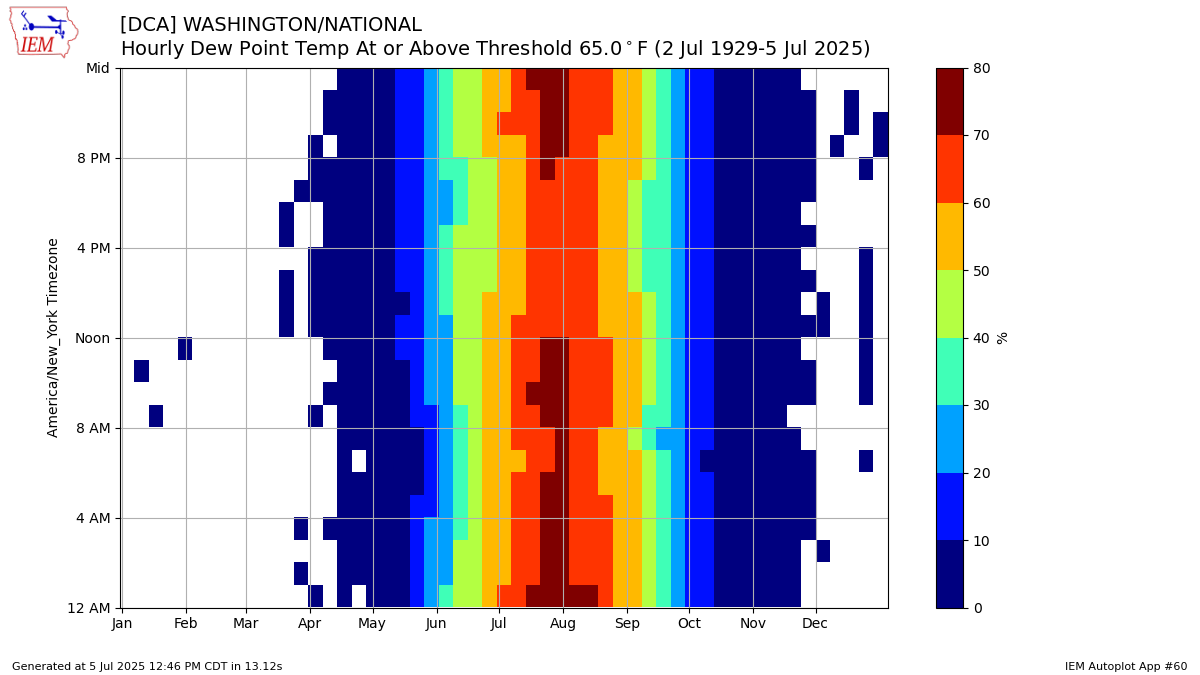
Dewpoints in DC over the year

Is it really that much more miserable outside in July? Why yes, it is. Here’s a graph of the monthly average, high, and low dew points at DCA.*

Dewpoint range & average at DCA in 2012

High, low, average dewpoint by month at DCA.

Ask people who don’t like hot, humid weather, and they’ll tell you that the weather measurement they rely on most is dew point.

Not temperature. Not relative humidity. Dew point.

“I think it’s catching on,” said meteorologist Paul Douglas. “It a superior way to, at a glance, determine what it really feels like out there.” Bill McAuliffe, Star-Tribune

I’m among those dew point fans. It, not the temperature or the heat index, best describes how it feels to be bicycling here. A hot and somewhat humid day may have a dew point of 70, identical to a cooler and off/on rainy day (of the sort we’ve had a lot of lately), but the net result is still getting drenched in sweat. My guideline for how I’ll feel when stopped (at lights, after riding):
<50 = no sweat, wear regular clothing
60 = nice, maybe change clothes at work
65 = acceptable but pushing it, go slow or get damp
70 = gross with sweat, definitely change shirt frequently
75 = I’d rather it rain, because either way I’m drenched
80 = instant dripping upon setting foot outside, tough to breathe
85 = kill me now, for surely Hades must be cooler than this

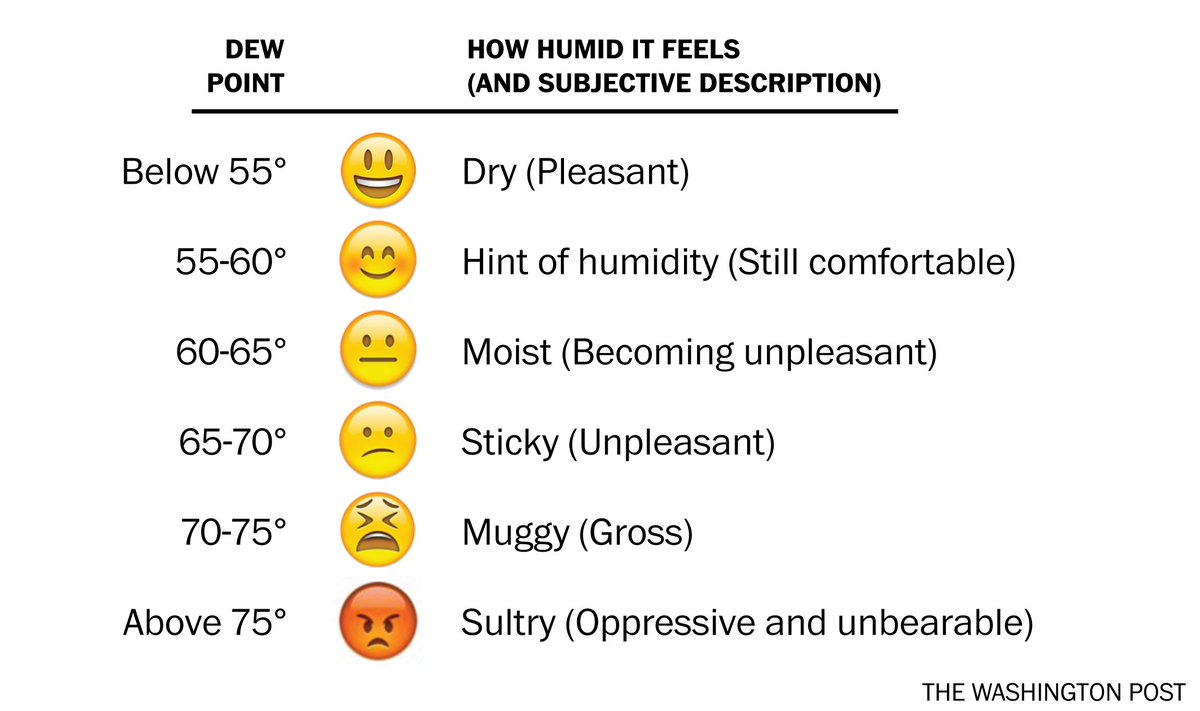
Update 13 July 2016: Capital Weather Gang has emoji’d this.

The article gives a good analogy: the dew point is the lowest temperature that it’s possible for sweat to cool your skin down to. I get uncomfortable at 70 and cranky at 80, and that corresponds nicely with the dewpoint guidance above.

The world’s highest dew points are around the Persian Gulf; high temps evaporate a lot of seawater into the air. The Plains and the South get high humidity mostly from plant transpiration.

Being able to ride outdoors without turning into a sweaty mess turns out to be a key determinant of cycling levels: at least one article (Jillian Strauss & Luis Miranda-Moreno, “Spatial modeling of bicycle activity at signalized intersections“) finds that humidity, then precipitation, then temperature determine cycling levels, even in cool Montreal.

This sensitivity to humidity might give pause to bike advocates in the eastern US before taking fashion advice from parts of the world which have very different climates.

In particular, European criticisms of how Americans dress while cycling ignore the reality of our humidity. The average August dew point in Amsterdam? 58F (average monthly temperature is 64F). Their most humid August ever had a dew point of 72F, just above the *normal* dew point here. Of course they dress normally: they can. I spent several days biking around Paris during the catastrophic August 2003 heat wave; it was hot, with temperatures around 100F, but dew points were around 60F. That’s actually kinda nice weather by D.C. standards.

Closer to home, the outdoors/activewear industry is overwhelmingly clustered in the West, which has much more courteous weather than the East or the South. Thus, “soft shell” outerwear appropriate for Cascadian drizzle leaves me drenched within minutes of venturing out into a thundershower, messenger bags pool up back sweat whereas back-saving panniers are hard to find, and everything’s much too casual for a city filled with dark suits.

Most of humanity lives in the tropics, not in balmy Mediterranean or chilly North Sea climates, and it’s about time that fashion recognized that fact. Maybe we should instead take fashion cues from other humid places instead; Japan, Korea, and northern China share both their latitude and westerly continental jet stream with the Northeast and Midwest.

* Bear in mind that these are for entire months, days and nights, and that the high/low numbers are still averaged out over the course of an entire month, so individual days will certainly differ substantially. Also, to the extent that the region has microclimates, DCA probably has the highest dewpoints of the local airports with its low elevation, river frontage, and relatively high urban heat island exposure. Upland areas might be slightly more bearable.

Wunderground

2018 update: Weather Underground’s app includes a “Smart Forecast” feature which lets users set weather parameters for outdoor activities. Foremost for me: moderate winds, and dewpoint below 72, ideally below 61.

Screen Shot 2019-11-17 at 12.03.09

2019 update: WeatherSpark has colorful graphs of dew points through the year for all US weather reporting stations. One in three late-July days at DCA has “oppressive” humidity. Take the Cardinal up into the Appalachians and it melts away; in Staunton, it’s only one in six, and at White Sulphur Springs it’s about one in twenty.

Today’s McMillan SFS testimony to HPRB

[Testimony given to the D.C. Historic Preservation Review Board this afternoon, in response to the recent HPRB staff report regarding architecture at the McMillan Sand Filtration Site.]

My name is Payton Chung, LEED AP ND, and I am a homeowner in Ward 6.

Thank you for providing this opportunity to comment on the revised master plan for the McMillan Sand Filtration Site. Moving forward with new buildings on this site, in a growing city with a housing shortage and a structural deficit, is the only realistic and financially feasible way to ensure public enjoyment of and education about the historic structures on the site. The proposal will not only, at great cost, stabilize the structure and thus open the site to the public for the first time in a century as a safe and usable park. It will also retain all of the above-ground and substantial portions of the below-ground structure interiors — in addition to the filtration cells that will remain within the park and reservoir lands to the west — while also reconstructing historic landscape elements like the Olmsted walk around the site perimeter, retain the site’s distinctive topography, and weave together the historic neighborhoods that surround the site.

The staff report’s recommendation that the buildings achieve greater architectural unity has merit, given the multiple programs and contexts present within and around the site. Greater architectural unity of the building bases could define the two maintenance corridors as urban rooms, while respectfully framing the sand silos. Similarly, though, it is entirely appropriate that the medical office buildings create an urban space from the auto dominated highway that is Michigan Avenue, and that requires a different architectural context.

Ensuring architectural unity for a site of this scale and complexity is a tall order, but the architects have made a good start and should be allowed to proceed to the Mayors Agent’s review with further guidance from the board.

Again, thank you for your time and consideration.

Towards a unified theory of midtowns

Midtown Atlanta


Downtowns, or central business districts, have been well-studied in the economic literature, but The Metropolitan Revolution is one of the few texts I’ve seen that not only mentions midtowns but posits that they hold the key to future regional economic growth. A midtown typically was a secondary business district that arose to serve the wealthy, uptown residential precincts, and eventually attracted some of the “nice” amenities that wealthy residents wanted to have close to home and away from the congestion of downtown. Yet, as eds & meds employment in particular have boomed, these tranquil bastions have become employment centers in their own right, and perhaps regional economic strategies should zero in on linkages between these areas and other regional economic nodes — and to the likely-interesting neighborhoods around them.

Pages 138-139:

What Detroit Teaches Us

Detroit is drawing a new geography of innovation, tearing down the traditional, artificial borders that have long divided downtowns and midtowns in the United States. Virtually every major city in this country has a strong central business district (mostly for the congregation of government, corporate headquarters, entertainment venues, and some cultural functions), a strong midtown area (where eds and meds and historic museums tend to concentrate), and a state-of-the-art transit corridor, mostly built within the past twenty years, connecting the two. Each of these discrete building blocks brings particular assets that, in turn, provide a platform for a key element of innovation district growth.

They point to Detroit, Houston, Cleveland, and Buffalo as prime examples, and mention Atlanta, Denver, Indianapolis, Minneapolis-Saint Paul, Pittsburgh, Philadelphia, Phoenix, Syracuse, and “even Las Vegas” in passing.

At first, I was a bit taken aback by the certainty of saying that “virtually every major city” fits this pattern, but I can’t think of many that don’t, particularly if one applies a geographically expansive definition to “midtown.” Strong examples include Westwood in LA, Longwood-Fenway or Cambridge in Boston, OSU in Columbus, or West End-Delmar in St. Louis. Sometimes downtown and midtown seamlessly blend with the CBD, as with Foggy Bottom & Georgetown in DC, McGill in Montreal, or Streeterville in Chicago.

It’s also intriguing to think that, with policies and investments directed towards creating a cohesive neighborhood, anchor institutions could be aggregated into a midtown which either never existed or deteriorated due to regional growth dynamics. UIC-Medical Center in Chicago is an obvious candidate; Howard-Washington Hospital Center in DC is another. In that instance, development of the McMillan site creates that missing physical link between the two.

Oh, and this call garners a subtle eye-roll from this generalist, who’s had a tough time monetizing that interdisciplinary knowledge:

[T]he people who deliver innovation districts would constitute a new network of metro builders who cut across disciplines, programs, practices, and professions. Modern society has deified specialists and technicians who diagnose and strive to fix discrete problems–say, traffic congestion or slum housing. Metro builders, by contrast, would be fluent in multiple city “languages”–architecture, demographics, engineering, economics, and sociology–and be cognizant of theory and practice. They would see the connections between challenges and work to devise and implement policies that advance multiple objectives simultaneously.

What Fundrise can and can’t offer

Starting to look like a grocery store
Crowdfunding built this little store.

A few years ago, during the darkest days of the financial crisis, I was the finance director for the Dill Pickle Food Co-op, launching the crowdfunding campaign that ultimately raised enough capital to open what’s now a thriving local institution. I’ve also worked in commercial real estate finance, closely examined how economics and ownership structures affect gentrification, and deeply interested in how to use capital to build authentic places. So I was obviously very interested in what Fundrise was starting here in Washington, D.C., and ultimately chose to invest in their latest project on H St. Their approach has been extensively covered in the media, for instance by Emily Badger in Atlantic Cities and David Lepeska in Next City.

Jonathan O’Connell in the Post offers a different critique: financial advisors who reviewed the offering’s legal documents had strong reservations about its merit as an investment.

My reading of the offering docs concurs with the advisers: The developers, and the large-dollar investors, get preferred classes of stock (and hence voting control, first dibs on returns, and priority in the event of liquidation), plus a guaranteed return via management fees. “The crowd” gets Class C common stock. We small shareholders, in return for our small contributions, ultimately receive no vested control over the project, stand last in line for returns, and stand first in line to be wiped out in bankruptcy.

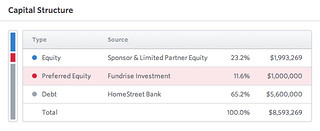
Illustrative Fundrise capital stack

One Fundrise investment‘s capital stack, showing Fundrise’s “preferred equity” (mezzanine) position.

[Update May 2015: As of this time, the majority of Fundrise offerings are currently for “preferred equity.” First, Fundrise itself purchases an equity stake with a stated return, paid either during the investment term or at the end of the term. Then, investors purchase debt backed by that stake — accounting and tax compliance are much easier for debt than for equity. Their offerings also now include a clearer illustration of the capital stack.

The short of it: as is typical with preferred equity, Fundrise investors receive no control, stand second in line for returns (with promised, but not guaranteed, returns), and stand second in line in bankruptcy (with no secured guarantees). In the capital stack illustration, control rests at the top end, risk is highest at the top end, and returns are paid first from the bottom end — debt gets paid first, then preferred equity, then equity gets what’s left over.]

Matt Yglesias in Slate points out that Fundrise can involve its “small-business silent partners” under an SEC regulation “whose main use in the recent past was financing Broadway shows” — and, indeed, I’m reminded of how little control the little-old-lady investors have over Max Bialystock in “The Producers.”

So now that expectations have been suitably lowered, what’s in it for both the developers and the community? Why did I still think this was an experiment worthy of watching from the inside?

A. Cheaper, slower money.

Think about a typical real estate situation: a homeowner with a house. When that house is sold, people get paid in this chain:
1. First mortgage
2. Second mortgage (in commercial real estate, this is a “mezzanine loan”)
3. Homeowner (“equity”)
Risk increases down the chain, but so do rewards and control.

What Class C shares do is to create an equity class with higher risk, lower returns, and no control. This equity isn’t sufficient to forego debt altogether — there’s still a mortgage on the property — but it’s enough to displace high-rate mezzanine financing, and therefore move the preferred equity investors up the chain. Since these loans are generally the highest-cost financing that a developer receives, and usually written with very brief loan terms, they create the greatest incentive to quickly lease the space to a “credit” (i.e., boring) tenant. Common stock is more patient: in fact, we Class C shareholders are so patient that we’re investing without any expectation about when, or even if, we get our money back. In short, it’s similar to a co-op’s membership equity: maybe your money will be there at the end, and maybe you’ll get paid along the way if we choose to declare a dividend, but we don’t guarantee anything and it’s probably easier to think about your equity as a donation.

The reduced cost and reduced “velocity” of capital reduces the developers’ incentive to quickly flip the property, and certainly eases longer-term thinking about the investment. Real estate has an intrinsic susceptibility to wide value swings: construction introduces an inherent delay that prevents supply from quickly aligning with demand, resulting in severe market imbalances throughout the business cycle. Patient capital that can wait out these swings is best poised to profit from true placemaking — hence the family-controlled real estate dynasties that control so much of central New York, London, and Hong Kong.

Yet in this instance, the managers might not take full advantage of their capital’s patience. The offering documents clearly state that the developer plans to sell or refinance the property after a few years, and may well cash out the Class C shareholders at that time. While this may provide Class C shareholders with a conveniently timed liquidity event, five years isn’t exactly a long-term investment in the community.

B. Participation and trust.

Perhaps a bigger — if unquantifiable — benefit for developers is that crowdfunding quite literally demonstrates community buy-in. As Yglesias writes, “A huge network of small-time, commercial real-estate shareholders could provide a much-needed counterweight to the plague of NIMBYs strangling America’s cities.”

Fundrise knows this power, which is why they’ve just floated a project on Florida Avenue that they don’t yet have control over — and even though the terms of the RFP appear to give the edge to another, conventionally financed project team. By letting residents “vote with their dollars,” Fundrise thinks that they can level the playing field between the big, bad developer and the little community. They also benefit from a broad shift in whom we trust: Americans have declining trust in institutions (government, developers, banks) and a technology-mediated concomitant increase in trust between individuals (e.g., Kiva for loans, Lyft for hitchhiking). Instead of just complaining, a well-capitalized community can act on the mantra to “be the change you wish to see in the world.”

In the context of gentrifying Washington, D.C., this strategy might not engender unlimited goodwill: the crowd looks too much like both Matt Yglesias and me: quite heavy on the “myopic little twits” of local lore: young, petit-bourgeois, tech-savvy guys with vanishingly little street cred. In a uniformly gentrified neighborhood like Cleveland Park or Brooklyn Heights or Uptown Minneapolis, “one dollar, one vote” might not be such a big deal, and community finance can definitely tap into the “silent majority” that might desire reinvestment vs. stasis. However, those locales are hardly underserved by conventional finance strategies. Instead, Fundrise is operating in more stratified urban neighborhoods, where banks are still wary of lending against more-speculative land values — and where even a modest capital requirement prevents the venture from truly reaching across the economic divide.

Even the completely community-based Dill Pickle (and other coops like it) encountered resistance by those who viewed it as an agent of gentrification. Not enough resistance to derail the project, to be sure, but plenty of grumbles nonetheless.

C. An opening for even better investment vehicles.

These two reasons — and the idea that, in terms of diversifying my portfolio exposure to real estate, H St. NE is as good a location as any for a 3-5 year speculative play — were reason enough for me to decide that Fundrise was worth a gander. I doubt that it’s really going to take off in a big way: even if its practice is standardized and the market becomes more liquid, crowdfunding still seems like a lot of legwork to raise a relatively small sum, especially given the amount of capital necessary for large-scale urban real estate development.

Fundrise is certainly a great idea, but the lack of community control limits its ability to establish trust in the community development enterprise. Yet it’s an important part of a broader conversation that’s just beginning around using crowdfunding innovations to improve communities. We can try many other tools — some new, some tried-and-true — to give communities greater control and input over their character and future. Cooperative businesses, like the one I founded, are growing all across America, and they play a key role in affordably housing thousands of Washingtonians (including myself). Financial co-ops, better known as credit unions, are quickly growing in the USA — and in some states, they have branched out past basic consumer lending and increasingly lend to or buy equity stakes in small businesses, even at the venture stage. Canadian banking law gives credit unions much wider scope, which allows them to do more for their communities: Vancouver’s Vancity isn’t just a carbon-neutral, living-wage, triple-bottom-line company, it also has $16 billion in deposits (enough to make it the largest or second-largest bank in the context of a similarly sized metro area like Denver or Pittsburgh). Over in Toronto, the Centre for Social Innovation has raised millions of dollars for community-development and clean energy projects through its community bonds. Since they’re bonds, not equity, they can be issued without prospectuses, and can even be held through RRSPs (Canada’s version of an IRA).

Edited to reflect that all Fundrise equity is “pari passu,” and has equal claim in the event of default.

Malls: the long goodbye

Second Floor, Owings Mills Mall

The slow contraction of the market for enclosed suburban shopping malls is part of a long-term trend, exacerbated by the credit crunch. I found a 2005 report from the International Council of Shopping Centers (hardly an anti-mall bunch!) that included a very noisy graph of shopping mall openings over the years. I chose to smooth the curve by (arbitrarily) calculating three-year moving averages instead, rounded to the nearest whole #:


1987-1989: 10
1990-1992: 15
1993-1995: 6
1996-1998: 6
1999-2001: 5
2002-2004: 4


The steep decline from the early ’90s occurred despite bubbly, credit-happy economies in the late ’90s and mid ’00s. Also, keep in mind that malls take several years to finance and build, so arguably developers quietly began aborting mall proposals around 1990, when the power center began its meteoric rise (and subsequent decline; Emerging Trends 2013 ranks them as the worst property type to invest in). The numbers since then (also from ICSC and from press reports) have been just dismal, both before and after the 2008 crisis:


2005: 2
2006: 1
2007: 0
2008: 0
2009: 0
2010: 0
2011: 0
2012: 1*


Even in a recent article trumpeting “Return of the Mall!,” Retail Traffic magazine admitted that “there is little, if any, room for new enclosed regional mall development… Even prior to the current downturn, the U.S. mall market was near the point of saturation. During the 1970s, the heyday of the mall, U.S. developers delivered a total of 375 million square feet of new space. By contrast, in the 2000s, new mall deliveries fell 62 percent, to 144 million square feet, according to research from CoStar.” The best that the article can muster is that trophy malls are still prospering, and that other shopping-center categories have been hit by bigger sales declines. Personally, I don’t know if that’s saying much; I’ve always thought that power centers were most vulnerable to online shopping — out-competed on price and selection (the only selling points of big box) — and we’ve seen that with the recent collapse of many big-box chains.

 
Given the number of malls that have closed — over 40% of enclosed malls built even in the DC region have shuttered — malls have been trending in reverse for almost 20 years now. They were sputtering in the mid/late 1990s, and over the 2000s I’d bet that many more have closed than opened. This isn’t some short-lived, newfangled fad, this is a seriously big shift in how Americans shop (and, in a consumer society, live).
 
Retail may have been the first property sector to see a huge momentum shift away from Edge Cities. Now that momentum in the residential and office markets** has shifted away from the suburbs, it’s hard to argue that drivable suburbia is still what Americans demand.

* City Creek Center in downtown Salt Lake City replaced two enclosed malls that had failed. Net mall count was still reduced by one.
** Emerging Trends ranked “severely handicapped” suburban office the second-worst investment. Just as with malls, this trend is a long time coming: nationally, suburban office vacancy rates used to track downtown office vacancies, but decoupled in 1998 and have stubbornly remained about 5% higher through peaks and troughs ever since. Similarly, the best housing investments were ranked as infill/intown, senior, student, and affordable, with golf course communities and master-planned resorts ranking a shade above “abysmal” as the absolute worst property subsectors to be in.