My pal Maureen made a bunch of worm composting bins for us city-dwelling environmentalists. I recently expanded mine into full-fledged Worm Flats, adding a second layer for super-simple worm management. (The worms migrate up to the second “floor,” leaving behind the now-easily emptied lower “floor.”) It’s worked flawlessly so far. Just watch the short video to join in the fun:
Congestion pricing pilots
…move forward without Chicago, of course. Over $1B in federal funding will be allocated to five cities nationwide to launch or expand congestion pricing projects under the Urban Partnerships Program. One of those five will probably be NYC; Ray Rivera in the Times writes that “Ms. Peters heaped lavish praise on the mayor’s [cordon toll] plan, calling it brave, bold and long overdue.” (The NY Academy of Sciences has a terrific briefing on the London congestion charge and Bloomberg’s proposal.) So yes, the feds are heaping money on cities so that they can access a new/expanded revenue stream of tolls. This is absolutely a no-brainer.
Denver’s proposal would extend I-25’s existing HOT lanes up US36/Boulder Pike and use the revenue to expedite BRT improvements to RTD’s existing B route; this expands on a concept introduced to local commuters with HOT express lanes on I-25.
Of course, the Kennedy Expressway has a nearly identical situation to I-25; simply adding a few I-PASS transponders and cameras would reduce congestion and generate millions of dollars in revenue for Blue Line repairs. (CMAP’s ultimate proposal included $100M in Blue Line repairs [“upgraded to eliminate slow zones caused by deteriorating infrastructure… {it} has experienced a degradation in service in recent years”], but only increases tolls on the ISTHA and Skyway portions of I-90 without adding new tolls on the Kennedy or Dan Ryan despite the existence of significant congestion and barrier separated facilities. Similarly, it references raising Chicago’s existing paid off-street parking tax, but not anything about street parking prices. Buried on the last page is a reference to a $1.6M bike rental station, too; I’ll have to find out more about that.)
“We’re asking cities to try something different, innovative and daring when it comes to fighting traffic,” said Secretary Peters.
“Different, innovative and daring” — nope, not Chicago.
FWIW, other cities’ proposal documents:
The Twin Cities would expand an existing network of HOT lanes using shoulder lanes, significantly accelerate implementation of proposed suburban BRT corridors, and explore parking pricing.
In the Bay Area, several existing HOT pilot schemes, the 511 system, and parking re-pricing in San Francisco and Berkeley.
Megalopolis
Someone on FlyerTalk asked about “megalopolis.” An edited reply:
Actually, it was a Frenchman, Jean Gottmann, whose book “Megalopolis” was published in 1961. He originally was referring, of course, to the Eastern Seaboard, but continued metropolitan growth has led to dozens of similar situations worldwide. Gottmann said as much in “Megalopolis Revisited” in 1987.
Personally, I’ve never liked the extra syllable in there; for that matter, maybe neither did Gottman, since he used “megapolitan” instead of “megalopolitan” as the adjective form.
The Lincoln Institute of Land Policy offers a better definition, perhaps, than Wikipedia’s.
In any case, some of these regions strike me more as convenient geographic constructs than as genuine supra-metropolitan units that shape human activities. Chicago is about 400 miles from Pittsburgh, Omaha, and Kansas City; Chicago arguably has similar economic and social ties to the western cities as to Pittsburgh — so why, besides the fact that Ohio is more populous than Iowa, draw the megapolitan boundary east from Chicago? (Maybe one useful and easily obtained measure might be intercity passenger and freight flows.)
Move continued
On the last possible day… it appears that all posts have moved, that any duplicates can and will be deleted, and that email sent this morning might not have gotten through. Oh well; at least everything’s here. Again, things will look funny due to different text encoding, but deal.
Funding redux
Modified version of Chicagoist comment.
I realize that I’m shouting to the breeze, but man, most of you folks don’t know much about how we pay for transit. Some common themes, and answers:
What? Why do we already pay too much for awful service?
Your fares pay about half the cost of running CTA service. Taxpayers (local sales tax) cover the rest. And the fact is, the cost of operations is increasing three times faster than tax revenue. When your cost of living goes up while your salary stays flat, you gotta make cuts.
Yeah, the trains and buses and slow, unreliable, and dirty. You know why? Because every year that we’ve played this budget crisis game, CTA has ended up spending money allocated for cleaning/repairs on daily operations instead. Basic maintenance has been put off for years, and it’s starting to show, big time.
The trains elsewhere are great, and they make money!
No mass transit agency in the world makes sufficient profit on operations to cover the cost of capital improvements. Those glorious transit systems elsewhere rely on generous tax subsidies: the Parisian transit authority gets FIVE TIMES more in tax subsidies than its equivalent here. Pick up the papers in NYC, LA, SF, DC, Boston, Philly, Pittsburgh, Toronto, Cleveland, Columbus, Atlanta, wherever: those transit agencies are also running out of money. Perhaps not as fast as ours, but nonetheless. (Philly’s SEPTA, in fact, is about to vote on what they also call “the doomsday budget,” unless the state bails them out. However, their governor and mayor have made saving transit their #1 priority, unlike here, where Blago and Richie lust after a vast new welfare state and a literally-colossal construction boondoggle.)
Let’s look at the one fully “privatized” passenger transportation industry in the USA: commercial airlines. Anyone who thinks that the airlines provide exquisite service at reasonable prices, please raise your hands. I thought not. And yet even this marvel of private-sector efficiency can’t turn a profit: in its first century, the airline industry earned $18 billion in profits — when it wasn’t chalking up $32 billion in losses. Airlines are so consistently awash in red ink that no less than Warren Buffett rued, “if I’d been at Kitty Hawk in 1903 when Orville Wright took off, I would have been farsighted enough, and public-spirited enough — I’d owe this to future capitalists — to shoot him down.”
Privatize! Fire the bums! Sell more ads!
We tried private operations of the CTA. Didn’t work; all those companies went bankrupt way back in 1947, which is how we got the CTA in the first place. Oh, and CTA can’t just pull a United Airlines and kill its pensions and benefits; that’s illegal. As for waste and graft, we the taxpayers already paid for a a giant audit of CTA, RTA, Metra, and Pace, courtesy of the state Auditor General. Finding: “the needs are real, the problems are real.” By almost any standard, our transit agencies are managing money pretty well. Yes, pensions in particular need a great big fix, but they’re so underfunded that one can hardly blame them for bankrupting CTA. Oh, and shuttering CTA headquarters tomorrow* wouldn’t even come close to filling this budget hole.
(In fact, I was recently in S.F., where a local newspaper ran a graph showing Chicago’s administrative overhead costs as far lower than LA’s or SF’s — and comparable to NYC, which theoretically would benefit from vast economies of scale.)
* Annual occupancy costs at the new HQ are lower than they were in the rented Mart space; the building was built with federal capital funds — see below — and CTA, as a state-chartered public agency, doesn’t pay property taxes on buildings it owns but does in rented space.
Advertising is not a major revenue source for transit agencies. Even auctioning off naming rights wouldn’t do much; a failed deal to rename a prime downtown station in Boston yielded just $160K a year. At that price, even renaming every Loop station would cover just 2% of CTA’s budget gap.
The Feds/Olympics will make everything better. Why all the fancy new construction?
Yes, the Feds pay half of construction (“capital”) costs for (a few) big new shiny things like Brown Line reconstruction, but they don’t pay anything for daily operations or maintenance. This is kind of like Mom paying for new clothes once Junior’s outgrown them, but refusing to pay to wash or mend the ones Jr. already has. No wonder he’s wearing flashy new shoes over hole-y socks.
You think the Feds will bail us out in 2016? Fat chance. Again, they only pay part of the construction costs; Salt Lake City, Vancouver, and other Olympic cities still had to hike local taxes big time to fund transit operations and construction. Oh, and CTA kind of needs money now, not in nine years — remember, the whole system grinds to a halt in October if no action is taken.
Cut off-peak service, don’t raise rush hour fares!
Bus and train drivers, like most of us, work full-time, eight-hour shifts. Hiring people just for rush hour is nearly impossible — would you work a split shift, 6 AM to 7 PM, without getting paid for 10 AM to 4 PM? Since the drivers are already paid to be there during rush hour, no additional drivers need to be hired for off-peak service. So, off-peak service is cheaper for CTA to provide. (Incidentally, day pass riders ride more off-peak, hence the day pass discount.)
That’s it! I’m gonna get a car!
Yeah, you and a hundred thousand other people, too. You think traffic’s bad, and parking and gas expensive? Just you wait.
Whine, whine, whine, whine, whine. Whine. (Repeat ad nauseam.)
Shut up and do something already. Visit SaveChicagolandTransit.com, read up, and take action. (Note: I am not materially affiliated with that site or with any transit agency.)
Transit operating profits in HK
The only public transit agency in the world* which makes a steady profit is the MTR in Hong Kong. To get a handle on Hong Kong’s population density, imagine moving the populations of Chicago, Aurora, and Joliet into Naperville — and, oh, cutting a really deep harbor through the middle.
Urbanized area of Hong Kong Island: 16.1 sq. mi.
Urbanized area of Kowloon peninsula: 18.1 sq. mi.
(Note: the above two areas are separated by one of the world’s busiest harbors, with just six fixed crossings, half of which are run by MTR.)
Population of above urbanized areas, 2005 est.: ~3.28 million
Total urbanized area: 34.2 sq. mi.
Population of Chicago, 2005 est.: 2,842,518
Population of Aurora, Naperville, and Joliet, the next three largest cities in the area (2003-2006, est. and Census): 443,176
Combined population of four largest Chicagoland cities: 3.285 million
Area of Naperville: 35.5 sq. mi.
You can either have profitable transit or suburban sprawl; drivers who say “hike the fares” can’t have your sprawl and eat it, too.
Oh, and 63% of MTR’s profits (and thus the funding for its capital costs, although many of its capital costs are also directly paid for by the government; note the financing sources for the line extensions mentioned at SEC EDGAR) come not from operations, but from real estate development — just like the old streetcar empires of yore.
Speaking of real estate values, nice quote in a Crain’s piece by Brandon Glenn:
“Whatever makes it harder for people to get to their jobs is bad for the city,” said Tom Kirschbraun, managing director of the real estate services company Jones Lang LaSalle Inc… Chicago’s hub-and-spoke transit system gives it a competitive advantage over most other U.S. cities, Mr. Kirschbraun said. “If you start dimming its effectiveness bit by bit, that competitive advantage starts to dwindle bit by bit,” he said.
* Tokyo’s privately owned subway systems are also profitable. I’m not sure about the public systems outside Tokyo.
Mid-May miscellany
Quick links! The new site isn’t ready, and CNU XV is next week. Wow!
1. “Everyone should bike to work for a week, if for no other reason than the people who complain about bikers breaking the law would shut the hell up…. Bicyclists disobey traffic regulations is very predictable and self preserving ways.” — BrodyV at DCist
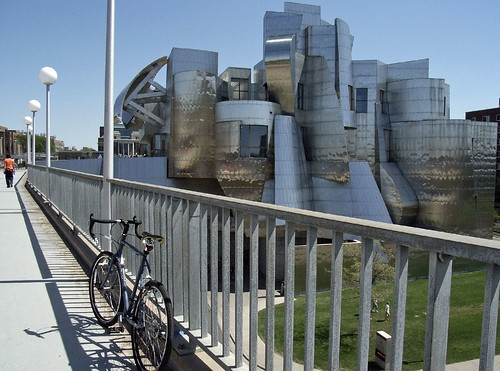
2. A new bike’s on its way! Looks like this — a Surly Long Haul Trucker, 52cm, which I test rode at Hub Bike Co-op in Minneapolis recently but have ordered from Boulevard.* The thought process behind that particular frame was similar to this guy’s: a solid road bike, eminently practical and comfy on short or long rides. Although everyone says I should go for a faster, lighter cross bike — like, say, the Cross Check. On my test rides the Cross-Check wasn’t any more responsive or sprightly (a tad squirrelier, maybe), although it did corner ever so slightly better. Oh, and touring bikes are trendy in a retro-’70s way, unlike, say:
“In the last few years, however, track bikes have won over a decidedly nontough, unathletic batch of acolytes: hipsters. Grab a latte on any random corner in the Haight, Castro, Mission, etc., and you’ll be treated to a veritable parade of carefully coiffed thin mints trucking along on bikes like me. Zut alors!” — Ephraim the Track Bike (SF Weekly)
However, I’m still leery of touring, if only because I find American countryside to be supremely boring. French countryside, though — Paris-Brest wouldn’t be my first choice, but it *is* awfully famous.
Update, 4 July: Photos of the bike. After the little Wisconsin journey, I’m looking into Amtrak supported tours along the Allegheny Passage from Pittsburgh, Lake Champlain from Burlington, and the Niagara region from Buffalo. Hmm — funny how a different perspective changes everything.
* Update, 9 May 2008: Boulevard now has a few Surly models built-up and in stock, so future purchasers can stay on this side of the Mississippi. North Central Cyclery in DeKalb always keeps some in stock, but (as with much else in exurban Illinois) it’s honestly easier for me to go to Minnesota.
4. Unlike here in Illinois, state legislators in Pennsylvania are paying attention to transit funding solutions. An editorial in the Morning Call by Rep. Douglas Reichley (R-Emmaus) calls for integrated regional transit funding:
[W]e should look seriously at the model for mass transit in New York City, where bridge and tunnel tolls subsidize fares for buses and subways. We should determine if the same kind of system could be implemented in individual cities, such as Philadelphia, or even on a regional basis.
A Lehigh Valley transit authority consisting of the parking bureaus from the three major Valley cities, the Lehigh Valley International Airport, and the Lehigh and Northampton Transit Authority (LANTA) could set up a system of fees and excise taxes to help LANTA stand on its own feet financially.
Such a transition would help to end the annual plea from mass transit systems for taxpayer bailouts, and relieve the financial drain of mass transit systems on the state budget.
Ald. Preckwinkle, urban designer
Fran Spielman reports that Ald. Preckwinkle is now about as well trained an urban designer as you’ll probably find in Chicago:
[The alderman’s] demands [for the Olympic Village] include: Connections to the Bronzeville community to the west so the village doesn’t become an “isolated little spur of McCormick Place”; a “street grid instead of superblocks,” with streets that “go through like a real neighborhood”; a street wall “built to the lot lines” instead of the “unusual curved buildings” now proposed; and ground floor retail “so there’s some life on the street.”
“I want it to be like a neighborhood. [What they’ve proposed] is sort of architectural egotism as opposed to a real neighborhood,” Preckwinkle said of the alternating series of eight- and 16-story condo towers.
“They’ve proposed curved buildings sort of plunked there. I don’t think that contributes to having a neighborhood. The buildings are self-contained, as opposed to part of a larger community. They proposed a connection at 31st Street. That’s not good enough. There have to be intervening streets.”
Preckwinkle noted that superblocks are being eliminated in the $1.6 billion Plan for Transformation now replacing CHA high-rises with mixed income communities.
“One of the things we’ve done is put the streets back in. If you want a real neighborhood, it doesn’t work to have superblocks,” she said.
Moving… moved
I got a sudden note that my web host is shutting down at the end of this month. Therefore, there will be some weirdness with the site as I move to a new host. Expect the photo galleries to finally migrate to Flickr, for instance.
Update: we’re now at WordPress.com, more or less, after wrestling with numerous export and import scripts (you’d think WordPress could handle this simply, no?). Some posts are still missing, the lack of Textile formatting here makes some posts look strange, and I’ve trashed some of the old static content, but most importantly everything’s safely backed up. Might also give TextPattern a try.
Disappointment

Catesby Leigh, “California Dreaming” in Princeton Alumni Weekly, 15 Sep 2004:
Another disappointment for Moule, Polyzoides, and other New Urbanists is the Playa Vista project in Los Angeles’ Westside section. In 1989, the couple was invited to join the project by Duany and Plater-Zyberk, whom Polyzoides had encountered as a teaching assistant at Princeton’s architecture school. Moule and Polyzoides wound up leading a team of high-profile architectural firms in the design of a new community on this 1,087-acre site fronting on the Pacific Ocean. Their models were cities like Beverly Hills and Pasadena.
Playa Vista was intended to relieve the acute housing shortage in Westside, known for its concentration of high-end, high-tech industries and services. Though the design produced by the architects assumed restoration and preservation of 300 acres of wetlands on the previously industrial site, environmentalists resisted any development at all, a contributing factor in the developer’s loss of the property. The project has gone forward under new management, and the amount of land set aside for conservation has been doubled. But while Playa Vista’s mixed-use character has been retained, Moule and Polyzoides express bitter disappointment with the project’s quality. “It’s unrecognizable to me,” Polyzoides says sadly of the portion constructed to date. “It’s absolutely unlike anything we ever imagined.” Unfortunately, New Urbanist knockoffs are not an uncommon phenomenon.
One of the rare project with participation from four CNU founders, unrecognizably dumbed down by a new developer.
Stuck at O’Hare?
My answers to some questions frequently asked by FlyerTalkers about Chicago. Since I usually fly United, answers focus on O’Hare’s Terminal 1; since I don’t drive, I’m assuming you won’t, either. Incidentally, my first visit to Chicago — and, in fact, only visit before I decided to move here — was a night spent at ORD due to a weather cancellation on a LAX-ORD-RDU trip on AA many years ago. Updated on a regular basis in response to new questions and/or inbound search inquiries. Continue reading
Keep abreast of zoning
The relaunched AlderTrack has a curious organizational scheme and a maddening lack of search function, but what a concept! The opaque world of Chicago zoning, without having to go to the meetings!