Two steps to a longer life

North End

1. Walk: “Time spent walking, then, is utterly free. It’s time you would have spent dead.” [Alan Durning]

2. Better yet, wander. Peter Bosselmann writes in Urban Transformation that complex routes feel longer, more enjoyable, and more satisfying. The study design used two short routes on the Berkeley campus of the same length, the same time, the same climb, the same number of passerby: one up the City Beautiful mall, the other winding behind the same buildings. Bosselmann quotes William James’s 1892 text on Psychology: “A time filled with varied and interesting experiences seems short in passing, but long as we look back. On the other hand a tract of time empty of experiences seems long in passing, but in retrospect short.”

(The discussion is on pages 187-189, citing Emelie Cheng and Yu Cao, “Time on Campus: A Study of Visual Elements,” 2004, and a map of the two routes is at Planetizen.)

Behold: a historic parking lot?

Town Center Towers

I really try not to let these things annoy me, but the facts of this particular case just leave me dumbfounded. Last week, my local ANC meeting was filled with condo dwellers so angry over losing their views that they are attempting to use the historic-preservation process* as an end run around development. Yes, I’ve not only seen this movie before, I’ve starred in this movie before.

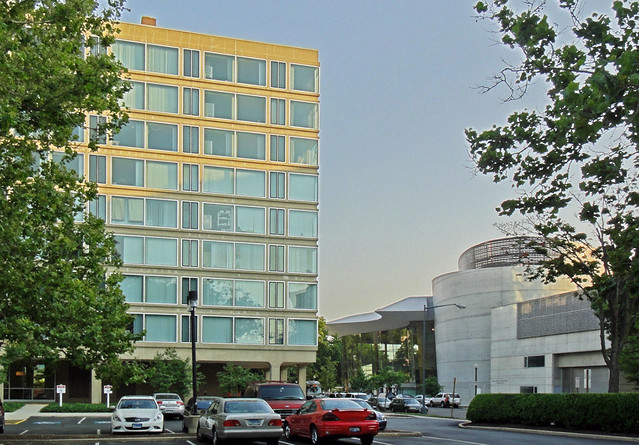
The most obvious flaw in their reasoning: it’s legally indefensible. The proposed PUD is a mirror image (two 11 story towers at the corners, low townhouses in the middle) of a PUD approved by both the city and the HPRB on an identical site one block away. (The photo is of the mirror site’s north parking lot.) Approving one plan, but rejecting an identical plan, would be the very definition of “arbitrary and capricious,” and therefore illegal, zoning.

Opposing the PUD is also a bad idea in practice. By-right zoning (R5D: 4.2 FAR, 90 ft. height, 75% lot occupancy) permits a wider, larger, but shorter building on the parcel than the one proposed, which would impair their views even more. Even though one neighbor dismissed this as “more empty threats,” there is legally nothing that can stop a by-right development. The developer should opt for taller, thinner buildings, because they still own (and rent out) one of the two impacted towers, and it’s in their interest not to impair their own property’s views — i.e., they have as much to lose as the condo owners.

Besides, the subject property is an appropriate location for a high-rise. It is a pair of 40-year-old parking lots, one 300′ (1/18 of a mile) from a Metro entrance, with two bus stops adjacent, surrounded by high-rises. The location earns 21 of 27 possible points under LEED-ND‘s Smart Location & Linkage section and 21 of the 29 points in the major Neighborhood Pattern & Design credits, -4. It’s impossible to do a full scoring without knowing more about the building design, but based on those credits, its location and program put LEED-ND Platinum (passing score 73%) well within reach.

Not only is the location appropriate for infill, the density is hardly excessive. Even with ~2,000 additional units proposed by Bernstein, Fairfield at Marina View, Sky House, and the NW/NE buildings at Waterfront Station, plus the 512 units between the four Town Center Towers, the gross density of the 31.4 acre Town Center superblock is still under 80 DUA [plus <1 FAR of commercial & civic buildings]. Heck, that’s walk-up density.

Infill developments that replaced urban renewal-era open spaces have improved property values, appearances, and amenities nationwide: in Boston’s West End, Portland’s Lloyd Center, Los Angeles’ Park La Brea, Battery Park City, even just to the north at Potomac Place Tower. Similar developments have even won awards from historic preservation groups. Attracting more shops, services, and residents to Southwest will dramatically improve the entire neighborhood’s property values, and provide homes for thousands in a growing city.

If this sets a precedent that even incidental open spaces surrounding old buildings are equally historic, then hundreds of now-historic buildings that form the fabric of our city could never have been built: not just Modernist examples like Tiber Island’s towers surrounding Law House, or the AIA headquarters that embrace the Octagon House, but even the Old Executive Office Building, DC’s courthouses, and the Mall’s museums (contrast this 1851 map to today’s built fabric). Or the striking, and now lauded, Arena Stage expansion shown above. Cities change, and the best cities have built fabrics that weave together collaged layers of history instead of freezing everything at one arbitrary moment in time.

I can’t knowledgeably comment upon what I have heard or read about the he-said, she-said back-and-forth regarding who signed what agreement or who threatened whom with nastygrams, but the offering contracts’ “not to impede… the further development” clause do not leave the homeowners with much negotiating room.

* For most communities, the only court-approved legal maneuver that allows a government to act as taste police. In DC, we also have the CFA, and back in the day Berman vs. Parker implicitly granted the Redevelopment Land Authority sweeping powers over aesthetics.

Southwest Washington: introduction

This school year, I’m working on a series of projects relating to my neighborhood of Southwest Waterfront. Since this semester’s work is with a team of other students less familiar with the neighborhood, I’ll be posting resources about the neighborhood on a periodic basis, which you can easily find using the swdc tag.

Walk through Southwest Waterfront

A few months ago, I gave a short presentation to CNU-DC based on a summertime walk around the neighborhood. Note that this covers only the Waterfront residential neighborhood, not the Southwest Rectangle (Federal Center & L’Enfant Plaza) office precinct north of I-395. You can download the PowerPoint or take a look at the photos on Flickr.

There are also a lot of great, easy-to-use online resources. I particularly like:

An extensive collection of original documents related to urban renewal in Washington can be found at the Washingtoniana Collection, on the third floor of the MLK Library at Gallery Place.

New Urbanism and bus route geometries

I remember being confronted by a transit planner with exactly Jarrett’s criticism — about town centers placed off of arterials vs. bus route geometries that should stick to the arterials — back in 2005. I hate to pass the buck, but it falls into the trap of giving New Urbanists too much credit for what they can do. (It’s a common trap, fed by the fact that many urbanists are architects and other self-aggrandizing types.)

A typical example given would be Southern Village outside Chapel Hill. That site had a few additional confounding factors: NCDOT planned to widen 15-501 and wanted strict access management, Chapel Hill had little authority over NCDOT, and the entire site sits pretty high up above the road. Luckily for them, though, Chapel Hill also wanted a permanent southern bus terminal (and a permanent greenbelt beyond Southern Village), so the compromise of having a town center and terminal bus P&R works. Newer, infill New Urbanist developments seem to have gotten better about the arterial interface. Excelsior & Grand [warning: PDF] is a great example of a state DOT relenting on design (and crashes dropped 60%!). Even the evolution between The Grove and Americana at Brand is notable; not sure if it was Caruso or Glendale that made that decision, but the arterial sides look and feel much better at the latter. It appears that the state of the art is to place the Main Street perpendicular to, and adjacent to, the arterial; it’s a rare Main Street that can sustain retail all that far into the property, anyways.

The debate reminds me a lot of the debates about couplets, something that Calthorpe was pushing with his Urban Network. Ultimately, those debates were somewhat pointless outside of those few large greenfield projects that have occurred (mainly overseas): by and large, NUists aren’t in a position to built new arterials, or even reconstruct both ROW and urban fabric along existing ones.

How I spent my summer

water temple drawings with shading

In case you were wondering where I’ve disappeared to, the answer is: architecture school! No, I didn’t reset my life to when I was 16 (geez, it’s hard to imagine that was half a lifetime ago) and opted to pursue the liberal arts instead of architecture — I’d taken an equal number of university classes in both. I did, however, enroll in the introductory class at the Catholic University of America’s Master of Architecture program, and spent 100+ hours a week through all of July in architecture studio.

I’m really glad I did that, since I (re)learned a whole lot about everything from drawing techniques to concrete structures, representation in art to working with ink and charcoal, sketching proportions to Buddhist understandings of spatial processions and deflected vistas.

I’m even more glad it’s over, and that I do not actually have to spend 100 hours a week in an architecture studio, ever.

Promising developments

Five new developments around town that will hopefully set new standards for welcoming pedestrians and cyclists:

1. Giant apartment REIT Archstone will outfit its new NoMa tower with a DIY bike maintenance facility and an outdoor movie screen. Evidently, these are the amenities that today’s luxury apartment renters want, and the REIT shareholders are going to give it to ’em.

2. A few blocks north, a “Metropolitan Branch Trail Atrium” will feature “an automatic bike pump for maintenance; a water fountain; a refreshment area with vending machines, tables and chairs; indoor bike parking and a natural ventilation system… stairs will have a bike trough” to encourage cycling to work from the elevated Met Branch Trail (which shares said Branch with the Metro and the Amtrak/MARC Northeast Corridor trains) to the Washington Gateway office complex.

Speaking of “NoMa,” everyone should quit complaining about the name. It’s not derivative of “SoHo,” and anyone who claims that obviously suffers from a goodly dose of NYC provincialism; SoHo itself was copied from Soho in London. Besides, no one seem to have no trouble with NoVa, at least written. Granted, I would have preferred a name like Union Quarter or Union Yards to reference its location behind Union Station, but maybe that would’ve kiboshed its appeal to Republican firms. Anyhow, elsewhere in northeast DC:

3. Over in Brookland, the new Bozzuto-Abdo “college town” connecting Catholic University down to the Metro will face the station with an “Arts Walk” pedestrian plaza lined with ground floor studios and convenience retail. The ground floor uses are flexible enough to work regardless of the level of foot traffic, and can evolve as the site develops.

The combination sounds like Liberties Walk in Philadelphia, whose scale and merchandising I’ve admired before:
west block
The emphasis on artisans also sounds like some of the “alleys” in LA’s Old Chinatown.

4. Speaking of pedestrian passages, a proposed Georgetown development would bring secondary retail entrances around to a 10′ wide alley, a la Cady’s Alley between M St and the C&O Canal. Developer Anthony Lanier from EastBanc: “We believe that today’s alleys can be tomorrow’s courtyards, shopping streets, or accesses.” (More on alleys, including a short history of DC coach houses’ removal and potential renaissance.)

5. Annals of ambitious private-sector redevelopment attempts: a developer has offered to buy out a full block of 1970s townhouses — purchased by the tenants as condos in 1998 — along 14th St near Logan Circle. The three-story townhouses now stick out as a relic along increasingly mid-rise, commercial 14th Street. (Heck, just the parking lots could be worth a lot if developed in situ.)

The buildings’ condo ownership structure makes redevelopment (in the absence of eminent domain) incredibly difficult. As Lydia DePillis writes, “each of the two separate condo associations would have to vote unanimously to dissolve themselves. Obviously, this would have been much easier with a single owner (whether a rental building or even a co-op, where only a majority of shares can dissolve the association), but condos’ recent proliferation as a way of making homeownership more attainable has the unintended consequence of hyper-fragmenting land ownership.

That challenge almost makes redeveloping a single-family subdivision, as at MetroWest at the Vienna Metro station, look like a picnic by comparison; in a single-family subdivision, a single hold-out can just be built around rather than holding up the entire process. Add into that contentiousness the added elements of class struggle and, inevitably, race — most of the current owners are moderate-income families of color, with some having lived there for a generation — and, well, I can’t imagine that the condo board meetings go very smoothly.

P.S. Post #1000!

Late November shorts

Indeed, it hit 70F today, so I did indeed wear shorts!

1. mqVibe looks interesting: it rates neighborhoods “in terms of edginess, residential, burbiness (i.e., how many chain businesses dominate the blocks), and other dimensions,” according to John Hendel in TBD. The rankings of local neighborhoods appear about right; will have to check out other cities’ rankings to see how it differs vs. Walk Score.

2. Old news, but since Fox News has instituted a rule stating that any discussion of global warming should be preceded by a “discussion of the debate,” I suggest another new rule: any report about radio waves (like those involving mobile phones) must also include a segment where a man in a tin foil hat presents the debate about whether such devices are actually government mind control waves. Hey, if you’re going to distort the science…

3. Street enclosure ratios make all the difference in the world — they could make even the worst excesses of mini-mall LA avenues look human scale. (Original: David Yoon)

4. “[J]ust about every one is complaining about bikes and stop signs. But the fact of the matter is, those stop signs are there to regulate speed, not right of way; two way stops actually do a better job of that. And bikes have a hard time beating the speed limit.” – Lloyd Alter at TreeHugger. Indeed, the 4-way stop is actually a very poor way of regulating right of way. In many cases, it’s difficult to tell who has the right of way, since “first to approach the intersection” and “first to get to the stop bar” are often different.

October shorts

It’s no longer shorts weather, but quick links endure!

1. Capital Bikeshare just turned one, and surprisingly has doubled its initial ridership projections and is currently running an operating surplus. [via GGW/WashCycle]

2. Economists like Ed Glaeser (and Ryan Avent, although I haven’t read his new treatise; reviewed by Rob Pitingolo in GGW and Lydia in CityPaper) often make the mistake of overly simplifying how housing markets work. Instead, numerous other important factors complicate matters, including:
– as Rob points out, housing is a bundle of goods whose utilities vary for different audiences
– housing construction can induce demand, particularly by adding amenities to a neighborhood
– housing construction can also remove amenities from a neighborhood, like a low-rise scale, thus changing other intangibles included in that bundle of goods
– construction costs don’t increase linearly; rather, costs jump at certain inflection points, like between low- and mid-rise
– housing and real estate in general are imperfect markets, since land is not a replicable commodity
– the substantial lag time for housing construction, even in less regulated markets, almost guarantees that supply will miss demand peaks

Pro-active planning remains the best and most time-honored way of pre-empting NIMBYs. Get the neighborhood to buy-in to neighborhood change early on, and then they won’t be surprised and upset when it happens.

3. Very interesting to see (via Dan Mihalopoulos/CNC) that Inspector General Joseph Ferguson has put a lot of sacred cows on the table for increasing revenue in Chicago — particularly several implicit subsidies to drivers. A downtown congestion charge, tolls on Lake Shore Drive, a commuter income tax, privatized parking enforcement, higher water/sewer fees, and higher garbage collection fees all would substantially impact suburbanites, single-family homeowners, and drivers.

4. How important are street enclosure ratios? As this gallery of reconstructed L.A. traffic sewers shows, they’re so important that almost nothing else matters if you get them right. (Photo-illustrations by David Yoon.) Back when I was reading comments on LEED-ND 1.0, a lot of complaints centered on the street enclosure requirement; I think that thinking about such urban design factors is just foreign to the architects & engineers who typically do LEED submittals. Yet it’s absolutely fundamental to defining urban rooms.

The real meaning of Park(ing) Day


Park on Penn Originally uploaded by Payton Chung

Once again, the killjoys are looking too narrowly at a fun event. DC may have many acres of park space, but the vast majority of it is inaccessible to its residents on a daily basis — cut off from the city by highways, hillsides, rivers, and too often security fences. Unlike metered parking spaces, those park spaces aren’t located right at the heart of the neighborhoods where we work, shop, and live.

More broadly, Streetsblog DC calls Park(ing) Day a “global demonstration about all the ways we can use curbside space besides automobile storage.” It’s a chance to have a thoughtful dialogue about what else we could use curbside space for, and to get a chance to see just how huge cars are relative to the other elements of our urban environment. We don’t often get a chance to see just how much other stuff can fit into the space occupied by one car — a dozen bikes? a picnic table? a kindergarten class? a City Council?

San Francisco has made Park(ing) Day permanent in many locations throughout the city by allowing businesses (and residents!) to rent curbside spaces annually. Many of them have become elegant sidewalk cafes, some house bike parking, one has a curious dinosaur themed garden. All of them offer something rewarding and engaging to walk past, and many offer the city’s economy more of a boost than yet another parked car would.

It’s not as if street parking has always had the Divine Right of Kings, either. Way back in 1924, in a paper entitled Suggestions for Relief of Street Congestion, a Chicago engineer supported banning curbside parking entirely: “It seems unreasonable that a comparatively few people can utilize the most valuable street space in our cities, practically at will, for their own pleasure and convenience and to the serious inconvenience of thousands of their fellow citizens.” (Norton, Peter. 2008. Fighting Traffic. Cambridge: MIT. p. 141.)

[posted to GGW]

Landscape vs. New Urbanism

A few notes I took at Charles Waldheim’s speech (the “LU vs. NU throwdown“) at CNU 19 in Madison:

1. Charles Waldheim didn’t show the same fangs towards NU in his talk that he has in his articles.

2. More about the “hegemony” of NU? Perhaps in theory, but anyone who talks like that merely shows how divorced ivory tower academics are from the practice of building tract houses, strip malls, and office campuses. It’s a huge world out there.

3. Waldheim takes credit for certain projects which aren’t quite what they seem. The High Line is a gold-plated park which works in that particular high-density context — but as Jane Jacobs points out with her discussion of small blocks vis-a-vis Park Avenue and Rockefeller Plaza, any new north-south route within the oversized Manhattan grid will create exceptional value. That goes double for the High Line, since NYC pursued a density-transfer approach that stacked even more buildable value along the High Line. It’s a proto-NU approach.

His slides only showed the Lower Don Lands project in Toronto as anything on the site (excepting the UDA-designed project just upstream) that included new urban fabric — and the urban design was by Ken Greenberg, who is a bona fide New Urbanist. Their proposal is a prime example of placing Buildings In Space without regard to the pedestrian connections or urban space between them; the landscape doesn’t allow the nodes of fabric to be contiguous, and the buildings’ jaunty angles don’t appear to have any rhyme or reason. Taking credit for the TTC’s carbon efficiency, and by extension the hydroelectric plants upstream, is manifestly cheating.

4. To complement point , he didn’t show the sorts of plans featured in the various LU books and journals — of fragmented separate-use, low density pods isolated by shards of landscape, resembling nothing so much as 1980s golf-course or marina subdivisions.

Today’s briefs

More briefs. Also, this is published post #1200!

1. Tomorrow’s Census 2010 initial data release will add a new column to this here table. 11AM EST.

2. Some notes from a recent book talk by Peter Calthorpe (book review).

Two laundry-list formulas that shape VMT:
VMT = location, density, demographic, transit, policy
VMT = policy, design, investment, intent

Percent of CO2 from built environment (transportation & buildings)
USA: 62%
California: 50%
Global: 37%

Think about how the world has changed in the span of 40 years — since we will have 40 years (2010-2050) to reach the -80% CO2 target. That might seem unthinkable, but much does change. From 1960-2000:
Cars per household doubled, 1.0 to 1.9
VMT per capita more than doubled, 11K to 24K
Meat consumption doubled, but grazing land per American fell from 1.35 acres to 0.16 acres thanks to feedlots

Each of these techniques will halve transportation CO2 emissions:
55 MPG standard
30% biofuel content
Smart growth
All are needed.

Regarding a slide about some silly building: “we need design as if pedestrians existed… instead, we see design as if magazines mattered”

Chris Leinberger: in recent survey, 25% of people said they considered walkability in their current house. 60% say they’ll consider it for their next house! (That’s a lot of demand chasing a little supply)

[Look up in Economist US GDP as % of GGP over past 10 years, very striking decline, overall decline narrative from Friedman and Tom Paine]

How do we talk to Republicans about these matters?
– libertarian rebuttal: drivable suburbia is “a coercive, dictatorial set of circumstances”
– sustainability measures that resonated in Utah: health impacts of air quality on children; land(scape) consumption, housing choices for children and seniors, fiscal conservatism
– my thought: are there low-carbon streetcar suburbs that vote Republican? Can’t point to Brookline or Oak Park or Bethesda or Rockridge or even Houston Heights with these people since it’s all culture war, all the time with them. Sure, “small town America” images might work, but more specific examples are needed.

3. Hath hell frozen over? “The 801 New Jersey Avenue [Wal-Mart] store would cover 75,000 to 80,000 square feet of the ground floor of a five-story mixed-use building. The remainder of the floors would be made up with 315 apartments as well as additional retail. The site is currently a parking lot.” [h/t Urbanturf]

4. One key way in which the extension would be operationally superior to an additional NJT tunnel [adapted from comment at Market Urbanism]:
The two proposal’s “dead ends” have quite different contexts. The ARC tunnel’s Herald Square dead-end would still have to figure out how to distribute a huge stream of passengers within the already overwhelmed Penn Station area. Instead, the extension’s Secaucus dead-end is at the Lautenberg station — making use of an already-built white elephant built to distribute passengers between the various NJT lines. A subway, with its higher-frequency and higher-capacity service, probably also activates greater TOD opportunities in the intervening areas, between the West Side Yards and Secaucus. The result is more balanced access improvements for more people — and all the better if it is indeed cheaper.

5. The Atlanta Journal-Constitution’s recent physical move to the northern suburbs is only the most overt manifestation of a metropolitan daily newspaper chasing readers in the city’s affluent suburbs. Even though most of these papers are locally stereotyped as liberal, they really reflect the tastes of their city’s favored quarter suburbs, long taking a cluck-cluck view of city government and banning anything that could possibly offend the business elite.

6. Oh, speaking of which, here are some maps (with commentary) of some cities’ “favored quarter,” as illustrated by where the highest proportion of advanced degree holders live in various metros. Atlanta, in particular, has a very clear 90-degree arc of northern neighborhoods and suburbs which have considerably higher levels of education and income. Historically, these favored quarters have been able to use their outsized political clout — with vehicles like newspaper editorial boards — to demand better infrastructure, which consolidates the area’s advantages. This theory, which is an extension of sociologist Homer Hoyt’s “sector model” of urban development, doesn’t necessarily play out in all cities (e.g., the Twin Cities have a halo of wealth and a bit of a southwesterly tilt), but it’s interesting to see how prevalent it is.

Atlanta

(Why focus on graduate degrees? These are the people who theoretically have the highest levels of capital and therefore the greatest locational choice. Interesting to note, per the recent Brookings “State of Metropolitan America”, that the best educated parts of metropolitan America are the dense suburbs — what Claritas, the demographics firm, has long called “Money & Brains.” The least educated part of America’s metros, with half as many college grads, are the exurbs — now riddled with foreclosures, but once key to Karl Rove’s 2004 realignment. I mentioned this over on Kaid’s blog recently.)

Data from 2005-2009 American Community Survey, generated using the NYTimes’ “Mapping America.”

7. Two interesting themes from the new Michelin Guide to Chicago:
A map of starred restaurants shows that the highest density is in the near north side — not surprising, given that it’s also the densest area for dining (between its high population density and near-monopoly on hotel rooms). However, it’s quite fascinating that Logan Square and Lincoln Park are tied among the neighborhood community areas, with 3 restaurants apiece, and that there’s nothing of note from Lakeview north — confirming my long-held suspicions about the bland north lakefront.
– Strange to see “street team” guerilla advertising for the Bib Gourmand honorees, but that is indeed quite an impressive array of $20 dinners on offer. It’s this kind of creative but casual restaurant that’s sorely missing in DC.

8. Wow: Vancouver’s Olympic Village [my photos thereof] just went into receivership — and since the city fronted much of the cost ($740M), they now take ownership. Assuming that the city settled for $40M in cash plus ownership, that’s still $1.2M in debt on each of the 580 unsold/unrented residential units. No wonder that they were asking at least $1000 per square foot on the units.

An interesting affordable housing experiment is underway a little bit north, where removing parking is seen as key to affordability: “Not providing parking has two benefits. It lowers the cost of the units, since a single parking stall typically costs $30,000 to $40,000 to build downtown; that saving will be passed on to the buyer. As well, Mr. Gillespie believes the lack of parking will act as an automatic filter to keep out better-off households.” The land is essentially receiving a writedown, since it’s bank-owned by the progressive Vancity credit union; the projected unit mix is 45% workforce ($29-36K income), 4% Habitat, and 7% community workers. Yet “The Downtown Eastside’s most vocal advocacy group says it is opposed to the project because, even though its ownership is geared to low-income households, it will still bring gentrification and increased property prices to the neighborhood.”

Housing types

Roger K. Lewis makes a less than compelling case for more family housing in DC-area TODs. Well, sure, greater housing diversity leads to more social diversity, which is always a good thing. This should probably be another lesson to learn from Vancouver (which requires a set percentage of “family housing”), although more could be done to ensure that such units aren’t restricted to penthouse apartments, giant empty-nester townhouses, or social housing.

These units also should not come at the expense of other, smaller DUs. Particularly in sunbelt areas like DC, the huge growth in smaller households — singles, couples, single-parent families — has not been adequately accommodated for in the past two generations of housing construction. Decades of severe disinvestment in cities, the places friendliest to smaller households, and the widespread imposition of snob zoning that discriminates against smaller units has undersupplied the market nationwide. That’s resulted in suboptimal outcomes for countless people who’d rather not be living with flatmates or housemates, who already find relatively few choices in the housing market, and who constitute much of the market demand for TOD.

Already in the District, less than 1/10 of households are couples with children. Even improving the local schools won’t do much to change this situation, since we’re in the midst of a baby bust (PDF warning): 1/15 of all new households in the entire region are couples with children — they’re almost outnumbered by single dads and roommate households (two very non-traditional household types), and they’re wildly outnumbered by singles (5.5 times as many) and childless couples (8.5 times as many). Delving further into the data, a cluster analysis published by the Metropolitan Transportation Commission (the Bay Area’s MPO) shows that the market sectors that most value TOD attributes — transit quality, mixed uses, and regional access — really aren’t very child-centered. As far as their priorities for planning go, schools are pretty far down the list.

For blog: TOD market segments

In some ways, the District’s tiny households are just pointing the way towards America’s demographic mix circa 2050. Yet the District’s housing stock doesn’t reflect its tiny households; as planning director Harriet Tregoning says, “Part of the challenge is to right-size our housing stock so we can have the type of housing that matches the needs of our residents.” Much of that will involve building smaller units; one-third of the District’s housing is sized for the aforementioned families with children (Census 2000 SF3, number of bedrooms per unit):

DC unit sizes

– Speaking of townhouses (and “ground related housing”), here’s Townhouse Center — a website about, well, townhouses, including a blog and a useful library. (Via Mouzon.)
– And speaking of weird housing, two people have mentioned recently that I could escape high D.C. housing prices by living on a sailboat. (One of them also, not coincidentally, had a great deal on a sailboat.) So, I checked it out, and sure enough Gangplank Marina offers “liveaboard” slips just a mile south of the Capitol, in the re-renewing Southwest Waterfront neighborhood. The slip rental fee would end up around $600/month, plus utilities, and then of course there’s the small matter of learning how to sail and care for a boat.