No subways for you, rowhouse neighborhoods

Nationals Park View
Maybe for these rowhouses, since they’re in a “Land Use Change Area.” Photo by Mr. T in DC.

Metro’s recently publicized 2040 plan for a new downtown loop line elicited a lot of consternation by many city residents, wondering why the new subway line hewed so closely to the existing downtown. The short answer is: because they won’t need new subways. It ultimately comes down to cost and benefit: new subway construction is so expensive that it can only serve the highest-density neighborhoods. Instead of a plan to connect every rowhouse in the city to a subway, it’s a plan to maximize capacity to and through the regional core at a minimal cost.

As Matt Johnson wrote in a recent GGW post, “Metro’s studies found little need for a new subways outside of downtown based on the expected travel patterns in and density of those areas in 2040.” Ben Ross clarifies in a follow-up: “Why isn’t Metro planning more rail lines inside the Beltway? One big reason is that political pressure and federal regulations require it and other transit agencies to look only at current zoning and master plans… This forecast, in practice, is prepared by cobbling together the master plans adopted by local governments, which are not anyone’s best guess of the future, but mostly reflect the desires of locally dominant political forces.”

WMATA’s staff echo this on their PlanItMetro blog: “Many of you have said that we missed or have asked why we don’t have a line to . As part of this plan, we have analyzed almost every corridor or mode that you have identified.”

A recent Cal study by Erick Guerra and Robert Cervero examined the cost-effectiveness of various rail transit extensions vs. the population and employment density of the areas served, and determined a cut-off aggregate density of 100 persons (residents and jobs) per acre as a cut-off for high-cost heavy rail:

Rail cost-effectiveness & density

In this region, per research from Terry Holzheimer at Arlington Economic Development (full PDF), only downtown D.C. and a handful of high-rise suburban centers surpass that threshold:

Gross land use intensities, 2007

Notably, though, the historic neighborhoods of Georgetown and Old Town — while surprisingly surpassing Edge Cities in intensity — fall well short of that density threshold. Laurence Aurbach calculated per-acre intensities for a few other historic neighborhoods, and of them only Dupont Circle [112.7] achieves downtown-level intensity, appropriate given that it’s chockablock with mid-rise office and hotel. Capitol Hill [44.8] and Logan Circle [57.1] also fall well short of 100 persons/acre.

The DC comprehensive plan gives precious little scope for other non-downtown areas within central DC to intensify much further. Nor do they seem to want intensification: DC neighbors will have a cow over one 6-story building one block from Metro. Contrast that to the 33-story apartment towers next to Metro in olde-timey Alexandria, 15-story office towers surrounding the Metro stations in mostly-rural Loudoun County, and heck, 40-story towers proposed along a Beverly Hills subway that’s at least ten years away. Those transit-supportive densities are impossible to build in the “neighborhood conservation areas” that comprise most of the District’s land area.

Meanwhile, the areas designated for “land use change” (in essence to be annexed to the mid-rise downtown) are NoMa and Capitol Riverfront. Connect those two neighborhoods to Union Station and Georgetown,* via bypasses of the Rosslyn and L’Enfant choke points, and add a few connecting points at the edges of downtown so that people can reach destinations like Union Station without going through Metro Center, and you’ve clearly defined WMATA’s proposed downtown loop subway.

DC comp plan policies map

Another instructive comparison to Paris might be in order: Washington, with its low density and low transit cost effectiveness, has 41 heavy rail stations and single-family rowhouses just one or two miles from the core, whereas Paris has flats stretching to the city limits, lower rail construction/operating costs, and almost 300 heavy rail stations within the city.

Of course, not all is lost, rowhouse neighborhoods! Note that light rail has much lower population density thresholds — and that DC has a plan for that.

* We can perhaps give Georgetown a pass, since the crowds of tourists visiting its shops don’t show up in either the resident or employee numbers.

All FARs are not created equal

At first glance, high-rise Arlington doesn’t seem to permit denser development than DC. The “C-O-Rosslyn” zoning permits a Floor to Area Ratio (FAR) of 10 — equal to the C-4 zoning that covers much of downtown DC, 6th to 19th and Pennsylvania to Massachusetts. A segment along the north side of Pennsylvania, 10th to 15th, is actually zoned for 12 FAR, due to its special 160′ exemption under the Height Act. (This is one of many nonsensical bits within the Height Act; other streets in downtown, like L’Enfant Plaza and the Southwest Freeway, are just as wide and thus in theory present equal opportunities, but their property owners apparently aren’t as well connected as those fine hotels along Penn.)

Yet FAR in DC goes much further than that in Arlington. Along DC avenues, rights of ways typically extend all the way to the building line; front yards are often within the right of way. For example, in Woodley Park, Connecticut Avenue is just 60′ wide — but sits within a generous 130′ right-of-way, which gives it sidewalks ample enough for ambling and dining. Rosslyn, on the other hand, developed rather more haphazardly, and many of its wide roads were widened using easements onto private property. Thus, the FAR granted to a parcel only can be built upon the fraction of the site that is actually buildable, and the same FAR yields much taller buildings. Take a look at the buildable area for 1300 Wilson, just to the left of the middle of this map:

Rosslyn property lines

Similarly, the new street network to be built through the large new developments at Tysons Corner will be built on easements through what’s now private property. Thus, the resulting FARs look low but result in fairly tall buildings. Fairfax’s implementation reports indicate that many of the developments approved or proposed at Tysons’ rail stations are in the range of 4-5 FAR. That’s about equivalent to DC’s C-3 zoning, which is what surrounds Dupont Circle, Judiciary Square, etc. (Yes, that’s substantially lower density than the C-4 in Metro Center, or the C-5 around Freedom Plaza.)

However, in both Arlington and D.C., the high density doesn’t extend very far. For now, most of the newer office areas at the edges of downtown (L’Enfant Plaza, Noma, West End, Navy Yard, Mt. Vernon Square) are zoned C-3-C, or a 6.5 FAR. (The forthcoming zoning rewrite proposes to remove FAR limits for these areas.)

Up-rising
The cloud-scraper in the middle is Living Shangri-La, at the time the tallest building in Vancouver.

By comparison, Living Shangri-La in Vancouver has an FAR of 13.41; most of the shiny new residential areas fringing its downtown have FARs of around 2-3; that’s roughly equivalent to the R-5 zoning around DuPont Circle. Same density in a radically different form. (It’s hard to compare these to other American cities, most of which are wildly overzoned; downtown Chicago starts at 12/16 FAR and goes way up from there; the Sears Tower was built as-of-right.)

The Silk Road’s detour to the Washington Channel

The first post in the watershed series mentioned that Morus alba (white mulberry) is a common invasive understory tree found at the edges of lawns along the Washington Channel, particularly along the unmown verge beside the fences that ring East Potomac Park’s recreation facilities. Given a chance, these shrubs will grow into a smallish tree of up to 15 meters, with a peculiar combination of lobed leaves on young shoots and heart-shaped leaves on older shoots. Its copious blackberry-looking fruits , which can disperse an estimated 20 million seeds per tree, make a convenient food source for birds and maybe humans — or else they leave a sticky purple mess on the walkways below.

But wait, mulberry? Isn’t that what silk is made from? How did that end up here?

White mulberry
What is this weed, and what does it have to do with the Opium Wars, Jefferson family wedding gowns, and deforestation in Ontario?

Silk production, or sericulture, was invented in China at least 4,000 years ago; legend says it was discovered by a princess who was strolling through the woods with a cup of hot tea. Young mulberry leaves are fed to silkworms, which spin silk threads around their cocoon as they metamorphose into moths. The cocoons are collected, boiled, and the threads are spun into fiber. China still accounts for most of the almost one million hectares (2.5 million acres) of mulberry under cultivation worldwide, according to the FAO, largely for silk but also for forage, wood, and even biofuel.

Yet sericulture (silk cultivation) requires that both mulberries and silkworms thrive in tandem. Mulberries obviously have adapted well enough to the local climate; thousands of years of domestication has selected for robust and easily grown varieties. The silkworms are a different story: they’ve been raised indoors for thousands of years, and thus have evolved into a very narrow ecosystem — they don’t even survive in the wild anymore, and require an exacting temperature range of 73-84° F, with high humidities, in order to thrive.

Silk was long one of the world’s most coveted agricultural products, and for centuries the world went to astonishing lengths to procure it from China.* Starting all the way back in Jamestown, Virginians attempted to get a cut of this lucrative trade by manufacturing silk: it seemed an ideal fit for the area’s warm climate and then-remote location, and potentially valuable both for the colonists and for British weavers. Yet while Virginia hews a bit closer to such temperatures than England, it isn’t exactly a room-temperature silkworm paradise. So while the robust mulberry thrived, fragile silkworms brought to Virginia didn’t, and instead Virginians profited off the native tobacco plant.

Mulberry Row

Thomas Jefferson’s family attempted silk cultivation at Monticello, and the results are telling. Above is “Mulberry Row,” the remnant of a lane lined with mulberry trees and, once upon a time, several buildings where slaves and other laborers did much of the work of the plantation. Obviously, the mulberry trees have done okay over the years — outlasting the buildings, for instance. The silkworms, though? Not so much. In 1811, Jefferson jokingly wrote to his granddaughter Cornelia,

your family of silk worms is reduced to a single individual that is now spinning his broach. to encourage Virginia and Mary to take care of it, I tell them that as soon as they can get wedding gowns from this spinner they shall be married. I propose the same to you that, in order to hasten it’s work, you may hasten home; for we all wish much to see you.

For what it’s worth, neither Mary nor Cornelia ever married, although I doubt her silkworm colony’s failure to generate enough silk for a wedding gown had much to do with that.

Silk was so valuable that Americans couldn’t be dissuaded by the industry’s failure in Virginia. Silkworms, as mentioned above, are fickle and highly adapted to the methods of Chinese sericulture; they feed almost exclusively on Morus alba, which as mentioned grows quite vigorously on Chinese farms. Eastern North America has a native variety of mulberry, Morus rubra, an understory plant suited to the area’s deep forests, but the silkworms rejected M. rubra feed.

Instead, colonists planted several Chinese mulberry varieties in hopes of keeping their silkworms happy. Colonial-era botanist William Bartram, in his travels through the South, noted dozens of instances of M. rubra but only one of M. alba trees — at a plantation near Beaufort, S.C. that was attempting sericulture (digitized book, pg. 308; location surmised between present-day Jacksonboro, S.C. and Savannah, Ga.). Later, Connecticut implemented various subsidy schemes, even including a cash bounty on planting Chinese mulberry varieties, and eventually succeeded at building a small silk industry in the 19th century.** (The Morus multicaulis mentioned in the Mansfield article is now recognized as a variety of M. alba.)

In the intervening centuries, the invasive M. alba has far outcompeted native M. rubra on its home turf: M. alba has spread much of the contiguous United States except for the desert Southwest, high plains, and taiga forest, and pushed M. rubra to endangerment in Connecticut, Massachusetts, and Ontario. Not only have widespread planting efforts like those in Connecticut spread M. alba far and wide, but it’s a tree that’s been honed by centuries of breeding for vigor, with a “high growth rate and great adaptability to adverse environments,” according to the Global Invasive Species Database: “M. alba and hybrids were evaluated to be consistently more fit than the native M. rubra in a laboratory study.” M. alba hybridizes with, and spreads root diseases, to M. rubra. Widespread deforestation and urbanization in eastern North America opened up countless opportunities for sun-loving, early-successional species like M. alba, while concomitantly destroying the deep shade that M. rubra adapted to.

* As a descendant of Cantonese merchants, perhaps I should be glad that these experiments failed? Oh, the complicated webs that history weaves for us!
** The mild success found in Connecticut indicates that perhaps it was less the climate, but Virginia’s lack of capital for indoor silkworm warms, that doomed the early industry.


This semester, I’m taking a Natural Resources class through Virginia Tech about understanding local watersheds, wherein I’ll be researching and posting knowledge about the Washington Channel. You can explore the other watersheds that my classmates are investigating over at the class blog’s page. Other posts in this series can be found using the tag watershed.

Washington Channel: more a conduit than a stream

While Washington Channel is known for its fishing, it’s not because it’s a particularly inviting habitat for fish species. Instead, its unique flow pattern of imported water make it a “trap” for fish swept upriver by the tides, and as such it sees fish species that aren’t typically found in other local waters — which, oddly, makes it popular among anglers.

Washington Channel & Tidal Basin at high tide

The most productive and diverse habitat in most waterways–the shorelines–are along the Washington Channel entirely armored with concrete. Beyond those concrete walls are monocultures — either more concrete or lawns, rather than on-shore wetlands. Between the walls, the constant scouring effect of the Channel’s twice-daily flush keeps the Channel relatively deep, so there are scant near-shore wetlands: the central channel is kept at least 9-14 feet deep for navigation purposes, but the entire channel ranges from 3-26′ deep. (The Tidal Basin is a bit more inviting to life, since it’s shallow [5-7′ throughout, average depth of 6.5 ft.] and a bit more placid.) The shallow-water ecosystems at the water’s edge, which combine sunlight, warmth, nutrients, and shelter, are largely absent along both. The Channel is, in effect, a concrete canyon.

DC Fire Rescue Boat and Army War College

This canyon isn’t very resilient, either; it can easily flood, as there’s nowhere for water to go when the river rises — or even for the wake from powerboats to do anything other than echo off the walls.

Washington Channel & Tidal Basin at high tide

The shore edge’s armor has started to degrade, though: a combination of higher water levels, subsidence by the marshy soil, inevitable concrete failure, and erosion means that some areas behind the seawall are now almost permanently wet. Some wetland species might start to colonize these damp pockets, although lawnmowers will probably thwart their progress.

Some of the shallower parts of the Washington Channel have demonstrated potential as rich habitat, though. A stretch of older seawall along Fort McNair, beginning in a small lee behind the Titanic Memorial, is a comparative haven for aquatic vegetation and fish. At one point, there was a 10-20′ wide band of submerged aquatic vegetation (SAV) off the fort’s shore — which, according to the NOAA navigation charts, is the shallowest part of the Channel at just 2-5′ deep. These underwater meadows provide valuable fish habitat, particularly for anadromous (half-ocean, half-estuary) species that spawn there before returning to the saltwater estuary downstream.

Even as Potomac River water quality has improved, habitat quality in Washington Channel remains poor. The quantity of SAV (much of it invasive hydrilla, which was still better than nothing) grew substantially in the 1990s, alongside large fish populations.

ecosystem health Wash Channel

Sadly, major rains throughout 2003 — when the Potomac carried more than 3X as much water as in the drier years 1999-2002, and twice its annual average (MWCOG/VT PDF, pg. 32-33*) — led to severe sediment and nutrient overload throughout the Potomac ecosystem, and thus to large algae blooms in 2004. These two years’ trials devastated established SAV in the upper Potomac estuary, including in Washington Channel, and so far neither plant nor animal life seems to have recovered.

Second chances: improving habitat in channelized waterways

While the Washington Channel may be the local champion for having the least natural stream banks, it’s sadly far from the only such watershed nationally. Perhaps the worst example of an “imprisoned river” is the Los Angeles River, almost all of whose banks were paved back in 1938.

Yet nature does abhor a vacuum, and so if you provide adequate habitat (as the Channel did for those few lovely years around 2000), an ecosystem will soon blossom. In Chicago, the Friends of the Chicago River built a “floating fish hotel” to provide a smidgen of near-shore-wetland habitat within downtown’s urban canyon, and plans to significantly expand upon this experiment in the near future.

* Incidentally, to update something I wrote earlier about Western and Eastern water systems, the Colorado River’s pre-diversion annual flow was 50% larger than the Potomac’s average flow (at Little Falls) today. It would rank among the largest Eastern rivers, like the Hudson or Susquehanna. This great map from the Pacific Institute clearly shows my earlier point: the East is well-watered indeed.

** 2018 update: a SAV planting program has succeeded in dramatically increasing SAV in the upper Potomac estuary since 2013, and in increasing juvenile bass populations. Floating “fish hotels” have been added next to the 7th St. “recreation” pier at the Wharf.


This semester, I’m taking a Natural Resources class through Virginia Tech about understanding local watersheds, wherein I’ll be researching and posting knowledge about the Washington Channel. You can explore the other watersheds that my classmates are investigating over at the class blog’s page. Other posts in this series can be found using the tag watershed.

Fresh policies will freshen the flow into the Washington Channel

Yesterday, I wrote about the numerous storm drains that currently dump polluted water directly into Washington Channel. The District of Columbia recently adopted some of the nation’s most stringent and innovative rainwater policies, and the Washington Channel watershed stands to significantly benefit as plans and projects adapt to these new policies and incorporate state-of-the-art practices in green infrastructure (GI). The Natural Resources Defense Council’s “Rooftops to Rivers” report give DC’s new policies a high rank (just behind Philadelphia) among their “Emerald City Criteria” for river-friendly municipal policies.

Canal Park's fountain & rain garden
The new Washington Canal Park, just a few blocks east of the Washington Channel watershed, recycles stormwater not just for its site but also for three neighboring developments.

The impetus for these changes came from the 2011 renewal of DC’s “MS4 permit,” the EPA permit for the storm drains that drain the urbanized part of the Washington Channel watershed (and 2/3 of the District), and is managed by the District Department of Environment (DDOE). As part of this process, DC has adopted a completely new set of stormwater regulations with three key innovations:

  • a DDOE impervious surface charge to generate revenue for municipal green infrastructure, encourage existing buildings to reduce impervious cover, and reward “RiverSmart” properties (this is separate from DC Water’s impervious surface charge)
  • a retention standard that requires new buildings to retain 1.2″ of rainfall on site (~90% of all rain events), and renovations to retain 0.8″ on site
  • a credit trading scheme, the first in the country, giving the retention standard flexibility for dense downtown developments, rewarding efforts that go beyond, and generating funds for comparatively inexpensive GI improvements in the neighborhoods like Canal Park. By taxing bad things, like water pollution, you create an economic incentive to create good things, like neighborhood parks. (In DC, this creates a tidy way to “tax” federal offices through utility fees, and then build neighborhood parks.)

Although DDOE expects only 1% of the city to annually be affected by the retention mandate, that’s still 10X the area currently affected each year by voluntary green infrastructure efforts.

While this change in stormwater regulations is currently only tied to the separated storm drain permit managed by DDOE, DC Water hopes that these efforts will be able to have an appreciable impact on its troublesome combined sewer system. If so, DC Water may be able to renegotiate an existing EPA mandate requiring billions of dollars in new “deep tunnel” pipes (see pg. 7 of this Brookings report).

These just-implemented policy changes are already shaping up to have a positive impact on the Washington Channel watershed, where much of the urban fabric will change in coming years.

  • The Southwest EcoDistrict, a plan currently under development (primarily by the federal National Capital Planning Commission, with ZGF Architects) for the redevelopment of several blocks of mostly federal offices centered around 10th & D Streets SW, plans a truly cutting-edge water management scheme. The overarching goal is to reduce water use by 70% even while increasing the number of people on the site. Pages 11-29 of the May 2013 PowerPoint featured on their website goes into great detail about the strategies that the EcoDistrict can employ towards that goal: treating both greywater and air conditioning condensate water for potable use, storing a 1.7″ rain event in a truly vast cistern hidden underneath an existing bridge, and (by going beyond the 1.2″ mandate) receiving stormwater credits from other developments.
  • Over half of the Washington Channel’s urban frontage (over six blocks) is included within plans for the Wharf, a proposal to completely transform the Channel’s shoreline. The development embraces the Channel with a new riverwalk and several public piers that will bring the public down to the Channel’s water — very different than today’s gated-marina frontage. Complying with DC’s 1.2″ retention standard earns the Wharf the maximum number of LEED-ND points possible under the stormwater management credit, helping it achieve its LEED-ND Gold rating. Among the innovative strategies planned: using stormwater as process water within an on-site combined heat & power (cogeneration) facility that improves both energy efficiency and reliability.
  • Recent construction underneath the National Mall, part of which is within the Tidal Basin watershed, not only rebuilt the severely compacted turf but also included 500,000 gallons of rainwater storage in two cisterns — probably the city’s largest such installation. The Park Service plans another two cisterns as part of further Mall turf renovation, to store water running off the Mall (no, compacted turf doesn’t really do a great job of absorbing rain) and its drives for future irrigation uses. These cisterns could be just the start: in 2011, NCPC studied a two-block-long cistern, the entire width of the Mall, to store 20,000,000 gallons — enough to handle a 100-year rain event, and hopefully prevent the Federal Triangle from flooding again.
  • Stormwater fees are also having an impact on a smaller scale. My own apartment building near the Washington Channel, built during the concrete-happy 1960s, has just embarked upon an aggressive program to replace paved surfaces — open roof, impermeable walkways and driveways — with green or permeable surfaces. This long-overdue plan was put into motion due to the new impervious surface charge.

In the future, big storms like tonight’s (but not quite so big) might actually improve the Washington Channel’s water quality, instead of harm it. Later: a look at the Washington Channel’s water chemistry, plus what that means for future evaluation of the channel. But tomorrow, I’ll look at how the physical form of the Channel shapes habitats along, and within it.


This semester, I’m taking a Natural Resources class through Virginia Tech about understanding local watersheds, wherein I’ll be researching and posting knowledge about the Washington Channel. You can explore the other watersheds that my classmates are investigating over at the class blog’s page. Other posts in this series can be found using the tag watershed.

The rain falls upon this plain, but then what?

Washington Monument in a different reflecting pool

As I mentioned in previous posts, the Washington Channel is quite unique in that the water contained within it has little to do with its drainage basin: instead, its water is essentially imported from downstream via the tidal cycle. As such, its water quality (unlike almost all other waterways) largely does not reflect the land and water context adjacent to it. In addition, the Channel benefits from being entirely within the District of Columbia: the federal government has long held title over the waters (Morris vs. United States), and used parkland to create and frame the Basin and Channel. As a result of that unique context, not only does parkland surround all of the Tidal Basin and most of the Washington Channel, but the surface waters are also under federal protection.

Tidal Basin & Washington Channel hydrological maps

The Tidal Basin and Washington Channel do receive surface and groundwater runoff from their immediate areas, which together add up to 1.412 square miles of the District. The Tidal Basin drains 0.423 sq. mi., of which 0.169 sq. mi. (almost 40%) is surface water. 43% of the watershed is parklands and grass areas, including parts of the National Mall, the monuments ringing the Basin, and even the small hill underneath the Washington Monument.

Tidal Basin & Washington Channel hydrological maps

The Washington Channel drains 0.989 sq. mi., of which 0.3 sq. mi. (25%) is surface water. As its north bank is heavily developed, 53% of its watershed includes urban development, and the remaining 22% is parkland.

DC’s largest water pollution problem is its combined sewer/stormwater system, or “CSO.” (I’ll write more on these systems in later posts; they’re super-important for understanding urban water quality but not entirely relevant to this post.) This system, which is responsible for dumping a toxic brew of sewage and rainwater directly into many local waterways, drains one-third of the city, including most areas built before World War 2. However, since the immediate environs of the Tidal Basin and Washington Channel were redeveloped in a somewhat recent era, they have separate sewer and stormwater systems. This map shows the large parts of the city which have combined sewers — many of which, incidentally, are named after the creeks that they replaced:

Instead, smaller, separated storm drain systems — nine along the Channel and three along the Basin, delineated by the faint lines running roughly perpendicular to the water on the map below — intercept rainwater that falls on Southwest Washington’s roofs and streets, and dumps that untreated water into either the Tidal Basin (light blue on this map) or the Washington Channel (tan on this map):

Tidal Basin & Washington Channel hydrological maps

As you can see by comparing the first and last maps, the inland boundaries of the two watersheds are defined by these artificial drainages rather than the natural contour lines seen in the first map. If you look in the vicinity of N and O Streets SW, for instance, you’ll see that there’s a valley roughly between Third Street and Half Street. Historic maps show this as what was James Creek, which drained pretty much due south to the Anacostia River, but instead these blocks now drain “uphill” to the Potomac to the west.

The storm drains dump unfiltered water, often contaminated with urban pollutants, directly into the Basin and Channel. This contributes substantially to the substantial water quality problems within these two water bodies, but plans are underway to substantially reduce the quantity of these flows in the near future.

Sources for this post, notably the maps and geographic analysis of watersheds, include the DC Department of Environment’s water quality standards documents, which I’ll report on in greater detail in an upcoming post.


This semester, I’m taking a Natural Resources class through Virginia Tech about understanding local watersheds, wherein I’ll be researching and posting knowledge about the Washington Channel. You can explore the other watersheds that my classmates are investigating over at the class blog’s page. Other posts in this series can be found using the tag watershed.

One vision for a Southwest DC that could have been

Arthur Goodwillie’s proposal for retaining the rowhouse fabric and infilling block interiors with courtyard apartments was rejected, not really due to cost but primarily due to complexity. Instead, the federal government built garden apartments in places like Arlington (WAMU story; NR nomination [PDF])

Goodwillie Plan for SW: contrast existing and proposed

[More images: closer look at redevelopment scheme | closer look at existing conditions survey | existing structures for entire Southwest neighborhood | historical material about the Capitol Park redevelopment project subsequently built on the site in question, courtesy CP II Condominium Association]

The following excerpts are from “The rehabilitation of Southwest Washington as a war housing measure : a memorandum to the Federal Home Loan Bank Board,” by Arthur Goodwillie, January 2, 1942 [LOC catalog record], a never-implemented plan for selective demolition and infill in the area subsequently cleared and redeveloped as Capitol Park. For further background, I recommend Christian James’ website about the redevelopment and Studio 27’s presentation (& book).

(Pg. 7.) The war effort should be so organized as to avoid unnecessary damage to the important peace-time values which in part — it must be remembered — we are seeking to defend. If it can be carried forward so that subordinate but highly important economic and social values will also flow from it — as by-products — then failure so to develop it is both shortsighted and indefensible.

The production of standard war housing in areas where only obsolete structures and vacant city lots now exist, as recommended in this memorandum, will also (a) eliminate — without direct cost — large slum and blighted areas; (b) restore value to much substandard Class “B” residential real estate; (c) lessen the post-war impact of new war housing on Class “B” property value and mortgage security; (d) reduce the volume of uneconomic suburban development and the costly duplication of schools, streets, utilities, etc.; (e) help stabilize the declining municipal tax base and put to productive use much unproductive, municipally owned real estate, acquired through the enforcement of tax liens; (f) provide local housing authorities with many units to offer as “equivalent elimination”; and (g) set up a large reserve of standard but low cost housing, for post-war rental to low income families, at rent levels that will reflect little or no subsidy.

(Pg. 16-19.) The population is relatively stable. A study made some years ago among white residents of Southwest Washington developed the fact that of the 10,658 persons interviewed, 9981 wanted to continue living there. The recently completed nine block Bank Board survey, on which the following report is based, showed that about 80% of the negro population has lived in the district for 5 or more years.

Present construction within the Area consists largely of two story, brick, row houses, two and three rooms deep, among which is interspersed a smaller number of frame structures of the same general type.

HOUSING PROBLEM
Although it extends to within three blocks of the Capitol of the United States, structural, economic and social conditions in the Area are shameful. Though basically sound, the brick structures of the post Civil War period are almost uniformly substandard… Interspersed among these brick dwellings is a considerable number of older frame houses. The latter are in a lamentable state of repair, dangerous, unhealthful, vermin and rat infested. They constitute a serious fire, safety and health hazard and should be demolished, as a slum clearance measure, at an early date.

Block interiors contain over 300 substandard alley dwellings, or are used as storage spaces for the miscellaneous accumulations of an indigent population. Moral and health conditions in many of these insanitary, unheated houses are deplorable. Fortunately, their use for residential purposes after 1944 is prohibited by law.

The Area, however, has many valuable assets. Were modern housing available, it would be an ideal residential location for the tens of thousands of persons who are employed in adjacent governmental Establishments, Departments and Agencies.

Streets are wide and well shaded. Water, light and sewer mains, sidewalks and pavements are in place, paid for and well maintained. Side by side with decrepit frame structures are some 2900 substandard but basically sound brick buildings, usually in rows, virtually all of which can be saved and are well worth saving. Vacant perimeter lots, vacant block interiors and land on which now stand decrepit frame structures, which should be demolished as a slum clearance measure, provide sites for an additional 5000 dwelling units. This is a total of about 8000 units for the Area, without over-crowding.*

Block interiors are unusually large and offer a unique opportunity for development as open green commons and play spaces, abutting on the new construction referred to above. Along the entire western margin of Southwest Washington is the recently developed Washington Channel waterfront. [Adequate schools, settlement houses, and churches.]

An exceedingly difficult questions which now confronts most established residential communities — whether they are depressed or not — is how to supply necessary large additions to available neighborhood recreation spaces. Adequate park provisions is not a problem in Southwest Washington, since the “Canal Reservation,” a public park which will provide ample playground facilities for the adjacent residential section, lies along the entire eastern border of the Area. Because it occupies a wedge-shaped tract between the Pennsylvania Railroad and Washington Channel, through traffic problems are also virtually non-existent.

The statement that there is a dangerously increasing housing shortage in Washington will be accepted without debate…

Pg. 53. The considerable saving in site cost [due to the low cost of land in Project block interiors] has all been allocated to new construction. If, as seems equitable, it were prorated between (a) the cost of projected new dwelling units and (b) the cost of rehabilitated units — the the over-all cost for reconditioned structures would be reduced to $725 per room** or to about 54% of that for new construction in similar areas elsewhere.

* In 2000, the Census counted 7,487 dwelling units in a comparable area, post-redevelopment, although with more office employment areas.
** emphasis in original

N & Union Streets

Shorts: movements

Striding

1. Susan Silberberg et al (via Angie at Streetsblog write that placemaking’s true value stems less from physical transformation than social transformation: “The act of advocating for change, questioning regulations, finding funding, and mobilizing others to contribute their voices engages communities.”

In short, it’s not about the bike, or the parklet: it’s about creating social space for a social movement to free now-privatized but publicly-controlled spaces, returning them to public use.

Years ago, this was a key (and under-appreciated) accomplishment of early Critical Mass rides. The event is just a means to an end, a safe space through which a social movement organized; to this day*, many confuse those ends and means.

* it’s arguably lost its urgency now that there are many other organizing venues.

not a maglev

2. There have been a few proposals to build maglev trains in the USA before, including this cross-Maryland proposal ten years ago. So what’s different about the latest version?

In a meeting with President Obama last winter, Mr. Abe offered to provide the maglev guideway and propulsion system free for the first portion of the line, linking Washington and Baltimore via Baltimore-Washington International Airport, a distance of about 40 miles. – Eric Pfanner, NYT

Those previous plans, however, did not feature Abenomics and its tidal wave of printed yen. As much as I’m skeptical of proprietary technologies, a fast and efficient connection between the two cities would certainly be momentous.

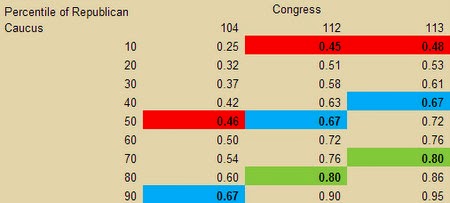
3. Thad Hall from the University of Utah (via Washington Monthly & Mischiefs of Faction) graphically shows how the House GOP has marched rightward, using DW-NOMINATE data:

The 50th-percentile average Republican in 1995 (104th Congress) — the red bar — was as conservative as today’s “RINO” moderate. Meanwhile, 1995’s firebrand 90th-percentile revolutionaries (the blue bar) then are *below* average now. The entire bell curve has shifted.

In favor of removing parking minimums downtown

With parking, at left. Without parking, at right.

[A condensed version of this post was delivered as testimony to the Zoning Commission regarding revisions to DC’s downtown zoning ordinance, Title I, on Thursday, 14 November.]

Matt Yglesias visited Chicago and was shocked at seeing high-rise parking podiums downtown, calling out parking minimums as a policy tool to “tax the poor to subsidize the rich while damaging the environment and the broader economy.”

It’s a bit unfair to pick on Chicago’s above-ground garages, since its downtown parking minimums are not terribly high by American standards. Above-ground garages sit beneath many of Chicago’s skyscrapers due primarily to the city’s high water table, which makes excavating underground parking prohibitively expensive (particularly in relation to the city’s relatively low property prices). While the downtown streetscape isn’t as dominated by parking podiums as Miami‘s (the ratios are substantially lower), the podiums definitely make a visual impression from the street and especially from the below-street-level river. The city’s increasingly stringent “landscape” requirements masked their visual impact — they’re now required to be fully enclosed, clad with similar materials to the buildings they support, and often mechanically ventilated — but it’s still pretty apparent what’s behind the fake walls.

When I lived in Chicago almost ten years ago, I chaired the Zoning for Transportation Equity Coalition, which sought to keep the city from baking a substantial increase in parking ratios into its otherwise sensitive and laudable new zoning ordinance. We enlisted several affordable-housing and environmental groups, but were not able to get market-rate developers, anxious about crossing the administration, to support us on the record. Ultimately, we succeeded in nudging the ratios down somewhat, and created such a ruckus that I think we distracted them from noticing bigger cuts in the ratios applied to downtown zones.

I am here to assure you that since then, downtown Chicago has thrived — its population has grown by 50,000, faster than any other central city in America, sales tax receipts and payrolls have both grown 50% faster than the region, and best yet, no parking riots have ensued. And here in the District, we have a more robust transportation system than Chicago: a larger rapid transit system, more walking and cycling commuters, fewer people driving to work. Furthermore, our trend lines sharply favor transportation alternatives: from 2000-2011, 1/7 of D.C. commuters switched away from cars.

For the politicians who were in charge of Chicago’s zoning rewrite process, increasing parking ratios was a no-lose proposition — an example of a free-lunch, “tax foreigners living abroad” strategy with zero present cost and only nebulous future costs. Because zoning requirements only apply to newly constructed buildings — zoning review is applied when a building permit is pulled — zoning requirements are a “newcomer tax,” levied only on speculative new construction that might or might not happen. Politicians can act like they’re “doing something” when, in fact, nothing has improved.

Similarly, advocates of parking requirements completely confuse today’s phantom “parking problem” and the zoning process. Barring wholesale reconstruction of the city, there’s no way that zoning requirements will appreciably change the parking situation today, or even in the near term. Most of today’s buildings provide parking — literally several tens of thousands of garage spaces exist downtown — and will continue to.

Even at subsidized prices, though, demand for that parking just is not high enough to fill the available spaces. Drivers’ inability to find free parking spaces outside their offices is no more deserving of a public policy response than my inability to find a free cappuccino waiting outside my office. In Chicago, one high-rise apartment developer told me that 70% of the spaces he built under the old parking requirement went unused, and the supermarket manager downstairs told me that the costly underground garage his bosses had insisted upon went empty. At newer and higher-end towers that are much further from transit (in Lakeshore East), Crain’s reports that 60% of residents forego parking spaces.

In downtown D.C., a Colliers market survey of downtown parking garages, which collectively can house several tens of thousands of cars, finds that 90% have spaces available to rent, and that garages are 20-40% empty during the day — similar to downtown Atlanta. Unreserved garage spaces downtown rent for the equivalent of $17.28/sq, ft./year, in a city where office and retail rents for well above $50, residential rents above $30, and even basement storage spaces rent for $24. The market rate for off-street parking in my downtown-adjacent neighborhood is less than half as high as in downtown, but spaces are still widely available. This pattern is consistent with the scientific literature; Bowman Cutter and Sofia Franco wrote in the July 2012 issue of the journal “Transportation Economics” that even in Los Angeles, land dedicated to on-site parking is valued significantly below the remainder of parcels.

There simply is not demand for parking that pays its own way. Thus, a parking minimum demands that the rest of us subsidize one economically infeasible land use above all others. Furthermore, a minimum demands that parking be provided, at especially high cost, within each building downtown — raising the already high cost of construction downtown, discouraging development in the most economically productive part of our region, and hurting property values in the area which pays most of the District’s taxes.

Nor will the sky fall if parking minimums go away; new buildings will still have as much parking as is necessary. A few months ago, I was at a panel where a representative from one of DC’s largest developers said that the major transit-oriented development they had under construction “was over-parked” relative to its zoning, because:

Michael Manville of Cornell University, writing about new housing built in downtown Los Angeles after an ordinance partially repealed parking minimums, found that “across all of the [exempted] rental projects, the average amount of parking installed was 1.2 spaces per unit. That’s more than the waived quota of one space.” What happened was that many of those spaces could now be provided more economically and with more flexibly, perhaps off-site or shared with other uses. What’s more, housing construction boomed — if you haven’t been lately, downtown Los Angeles has become quite lively — and the car-free housing units were significantly cheaper.

Parking is a dynamic land-use market that can be fulfilled in many ways, not only through the particularly high-cost/low-return policy lever of zoning requirements. As economist Ed Glaeser writes, “Minimum-parking requirements are a second wrong that doesn’t make a right. The original wrong is that we’ve never charged automobiles properly for using city streets, either for driving or parking.” More realistic and market-responsive prices for off-street and on-street spaces would make even more spaces readily available, with more transparency and less frustration for all. We already know that a finite supply of street parking spaces exists; it would be easy enough to allocate those via auction, splitting the supply between annual, monthly, and hourly permits. (Singapore does this with car license plates, but strangely not with their HDB parking lots.)

Better pricing can better allocate and manage the myriads of spaces that already exist: performance pricing metered and permitted on-street spaces, smarter loading zone management, sharing spaces between uses, renting out existing garage spaces, valet parking, automated garages, parking lifts, and increasingly intelligent car-sharing. The ultimate potential of better managing existing auto infrastructure is absolutely huge. If sharing can get the average American car out of the garage for just four hours a day — vs. the 1 1/2 that’s typical today — the same number of car trips could be made with 70% fewer parking spaces.

It’s these kinds of innovations that have recently started to earn the District national accolades — just today, Fast Company named D.C. the nation’s fourth-smartest city largely because of our increasingly smart transportation infrastructure. This proposed revision to the zoning ordinance can spur further innovations, increase productivity, save money, and might even help us exercise and lose weight.
DC height critics say Paris is pretty… but building Paris was not a pretty process

Charles Marville, Avenue de l'Opéra, 1877, albumen print, courtesy of Editions du Mécène
Demolition near l’Opéra in Paris, 1877, photo by Charles Marville

Those of us who imagine a Greater Greater Washington understand that the region’s population growth is a force that we can harness for great good. More people will mean more of the people and places that together make a great city: more shops and services, more exciting and innovative companies, more tax revenue, more frequent transit service, and yes, more buildings.

Yet many in Washington not only deny that growth has benefits, they deny that it is occurring, and deny that it will have tremendous consequences for our built environment.

One oft-repeated line heard from the (small-c) conservative crowd is that height limits have worked to keep Paris beautiful. That comment ignores a lot of painful history: the mid-rise Paris that we know today was built not by a democracy, but by a mad emperor and his bulldozer-wielding prefect. As Office of Planning director Harriet Tregoning said in a recent WAMU interview, “Paris took their residential neighborhoods and made them essentially block after block of small apartment buildings… if we were to do that in our neighborhoods, we could accommodate easily 100 years’ worth of residential growth. But they would be very different neighborhoods.”

A haunting exhibition of photographs by Charles Marville, currently on view at the National Gallery of Art, offers us a glimpse at how this change manifested itself in Paris. Marville was hired by the city government to document the systematic demolition of central Paris’ low-rise neighborhoods, the construction of new mid-rise neighborhoods (the ones we know today) in their stead, and the widespread displacement of the center’s low-income residents to the urban fringe — perhaps culminating in the bloody Commune revolution of 1870. (Numerous books have been written about the era, notably “Transforming Paris,” by David Jordan.) There were technological limits on buildings in that era, too: elevators were slow and expensive, and the new water mains could not supply satisfactory water pressure to the upper floors of many buildings.

Not dissimilarly, downtown DC’s horizontal march has steamrolled numerous low-rise neighborhoods in its wake, from Chinatown to Foggy Bottom. Now that only a few blocks are left for downtown to grow into, office buildings are muscling towards Shaw. This is only natural for a mid-rise city: Paris’ mid-rise urban fabric superimposed on DC would spill outside the diamond, vastly larger than the existing downtown.

That path of destruction is why most other growing cities in this century (i.e., built-out but growing central cities, from London and Singapore to New York, Portland, Toronto, and San Francisco) have gone the Vancouver route and rezoned central industrial land for high-rises. This method allows them to simultaneously accommodate new housing, and new jobs, while keeping voters’ single family houses intact. By opposing higher buildings downtown, DC’s neighborhoods are opposing change now, but at the cost of demanding far more wrenching changes ahead: substantial redevelopment of low-rise neighborhoods, skyrocketing property prices (as in Paris), or increasing irrelevance within the regional economy as jobs, housing, and economic activity get pushed further into suburbs that welcome growth.

Among large North American cities, only Toronto has joined DC in making a concerted effort to redirect growth into mid-rise buildings along streetcar lines — and only as an adjunct strategy in addition to hundreds of high-rises under construction. (The two metro regions are of surprisingly similar population today.) Yet there, just like around here, neighborhoods are up in arms at the very notion.

DC cannot put a lid on development everywhere — downtown, in the rowhouse neighborhoods, in the single-family neighborhoods, on the few infill sites we have left — and yet somehow also accommodate enough new jobs and residents to make our city reliably solvent, much less sustainable. The sum of remaining developable land in the city amounts to 4.9% of the city, which as OP demonstrates through its analysis, cannot accommodate projected growth under existing mandates.

Something will have to give. A good place to start is a loophole-ridden law imposed back when DC was a protectorate and when Greater Washington counted fewer residents than today’s greater Asheville or Davenport.

The Office of Planning has suggested a reasonable framework for a subtly revised Height Act that can accommodate growth and change while preserving the city’s cherished urban design and historic neighborhoods. Adapting the rigid 130′ cap to a street-width rule maintains the Height Act framework along our ceremonial avenues — where our city’s namesake actually set a height minimum. Along streets like L’Enfant Promenade, Washington had the right idea: taller buildings will better frame vistas. Beyond the L’Enfant City, the Comprehensive Plan and zoning ordinance will continue to ensure that most buildings never reach the 90′ Height Act maximum, but the city will have the flexibility to adapt to evolving construction techniques and special opportunity sites.

As DC re-adjusts to a new century of urban growth, after a lost generation of population decline and disinvestment, inaction poses a far greater risk than action. Paris’ combination of horizontality and verticality is undeniably beautiful, but its unique form resulted from a peculiar historical process that I would not wish upon an American city today.

(The District of Columbia Council is accepting written testimony about the Height Act through next Tuesday.)

a version of this post is cross-posted at GGW

Going with the flow: how Washington Channel’s mechanics impact its relative water quality

This semester, I’m taking a Natural Resources class through Virginia Tech about understanding local watersheds, wherein I’ll be researching and posting knowledge about the Washington Channel. You can explore the other watersheds that my classmates are investigating over at the class blog’s page.

In this installment, I’ll take a closer look at how the channel functions today, and what that means for its water quality. Other posts can be found using the tag watershed.

Last week, I examined how the silty Potomac started to clog the harbors around Washington, and mentioned how that resulted in the 1896 construction of the Tidal Basin and the Washington Channel. Today, we’ll investigate in some more detail just how the basin and channel work.

The satellite photo currently shown on Bing Maps appears to have been taken at low tide, when the Potomac River flows more or less as it always has, carrying fresh water east to the Chesapeake Bay and Atlantic Ocean:

Washington Channel: low tide

Note the high sediment levels in the Potomac, as indicated by its brownish color — it appears to carry more sediment than the Anacostia. I’ve highlighted the rivers’ silty water flows with greenish arrows.

At high tide, the picture looks very different, as the silty rivers collide with waves of clearer, darker ocean water racing upriver:

Washington Channel: high tide

The Tidal Basin-Washington Channel system uses the tidal surge to activate a pair of one-way gates. Imagine the Tidal Basin as being bound by two sets of doors that both only open inwards. The first set, the Potomac inlet gate, is at the Basin’s southern end: facing the flow of tidal water but perpendicular to the river’s flow. When the tide rises, the pressure of water flowing upstream pushes open the inlet gate, filling the relatively low basin with 250 million gallons of water:

Washington Channel & Tidal Basin at high tide

When low tide occurs, water recedes away from the Tidal Basin at the Potomac gate. The now-higher water in the basin tries to escape back out to the Potomac, but because those gates only open inwards, the water instead pushes the gates shut. (Water only pushes, not pulls.)

Meanwhile, at the Tidal Basin’s eastern end, an outlet gate leads to the Washington Channel. There, the gates open from the Basin to the Channel: they’re pushed open when the tide falls away from the Basin, spilling those 250 million gallons into the Channel, and they’re pushed shut when the tide rises.

Since the Channel is scoured during both the high and low tides, and is fed by the clearer tides and not by the muddy Potomac, sedimentation is no longer a problem and the channel retains navigable depth without the need for dredging. And since the Tidal Basin is fed by the tides — it’s always “high tide” in the Channel — the water within Washington Channel more closely resembles that of the Chesapeake Bay than the Potomac River next door. Thus its water is relatively clean, which is curious for a water body within the District of Columbia.

As a habitat, the Channel more closely resembles the brackish downstream Potomac than any of the neighboring freshwater rivers and streams. Fishermen know this, and set up along its banks to catch fish that have been swept upstream by the tide:

Washington Channel & Tidal Basin at high tide

In further installments, I’ll take a closer look at the shorelines, adjacent land use context, drainage, and water quality measures within the Channel.

Quick bibliography: shared streets

Shared streets came up a few times in discussion at Place Summit this past weekend — praised as a “complete streets” solution that’s slower, narrower, more urban, and less auto-oriented, instead of the wider roads (with bike lanes!) that many DOTs have ended up with. It turns out that the NACTO Urban Street Design Guide does offer design guidance for both residential and commercial shared streets, and for “green alleys,” their term for a shared alley.

sharing is caring

Katherine Watkins from Cambridge, Mass. presented at the 2012 NACTO conference on her city’s experience with three shared streets — one side street and one alley off Harvard Square, and one residential street. Her presentation has photos and example municipal code clarifying behavior on the shared streets: drivers must yield to pedestrians at all times, and the speed limit is 10 MPH. The NACTO guide also mentions a residential shared street in Santa Monica.

Cady's Alley, rainy day

Several experiments with shared streets are underway in the Washington, D.C. area. Most famous is Cady’s Alley, a thriving destination for high-end design retailers tucked between busy M Street and the C&O Canal in Georgetown. Developers have long struggled with how to activate the deep block of former warehouses on that block (most famously with the white-elephant Georgetown Park mall) , and here Anthony Lanier, the impresario of Georgetown real estate, has successfully created an environment that simultaneously honors the area’s 19th-century industrial heritage, incorporates cutting-edge design, provides an inviting and durable pedestrian environment, and makes so much money that he’s at it again. (I didn’t know until now that Leopold’s Konditorei was a loss leader, but it could have fooled me: it’s a fantastic place-maker and a treasure.) Approval of the street design was facilitated by the fact that it’s an alley, and therefore not subject to the usual street design standards — pedestrians aren’t expected along alleys, and therefore sidewalks don’t need to be provided.

Update: DDOT proposes a shared street (see option 2, “Flex space”) as one option to improve an existing multiway boulevard’s service lane.

Wales Alley via Google Street View

If all goes according to plan, Virtue Feed & Grain in Alexandria will soon sit at the intersection of two public shared streets: Wales Alley, which it recently converted into a shared ROW, as well as Union Street on the other side. Toole Design Group is leading the study process.

Other local shared streets have benefited from being built as private drives:
Brookland Arts Walk

Bethesda Lane

Mosaic District

From top to bottom, these are the Brookland Arts Walk and Bethesda Lane, both pedestrian streets which are open only to delivery vehicles, and District Avenue at Mosaic in Fairfax County, a more conventional street that happens to be curbless. On a much larger scale, the Wharf, a 3.2 million square foot mixed-use development, promises that all of its internal circulation will be along shared streets. (Both the Wharf and Georgetown have to undergo federal review, via the Commission on Fine Arts.)

L Street Shared Street, photo by Jacqueline Dupree/JDLand

Perhaps more interestingly, Washington Canal Park, across from the US DOT headquarters, converted the two side streets running across the site into curbless streets with lighted bollards. OLIN was the landscape architect for this Sustainable Sites Initiative pilot project.

A few other experiments have occurred around the country:

Market Square

Market Square in Pittsburgh (PPS-inspired redesign)

look ma, no curbs

Flanders Festival Street in Portland’s Chinatown (technical summary by Ellen Vanderslice for ITE)

Pearl Mall

In Columbus, Ohio, Pearl Alley went from being a convenient cut-through (in a city of excessively wide streets), to a popular summer farmers’ market, to a small-scale retail artery along a shared street.

Of course, they’re also very common outside the United States, including:

Walter Hardwick Avenue

Vancouver, B.C, where this woonerf is an integral part of what made this the first LEED ND Platinum neighborhood

Stephen Street Walk

Calgary, where partially re-opening a pedestrian mall was integral to its regeneration

shared street

Throughout Japan (this is in the small mountain city of Matsumoto), where shared local streets might even constitute the majority of street frontages.