Peak Car presentation

Taking to the street

I gave a brief Pecha Kucha presentation last night at CNU-DC‘s bimonthly 20×20 series. My topic was “Peak Car: nothing to fear here,” in a weak attempt to fit into the month’s Halloween theme. Peak Car doesn’t mean Apocalypse Now — cars will continue to be an important way for millions of people to get around — but it means that a whole series of assumptions around having to always increase pavement supply need to end, and a new set of assumptions around sharing urban spaces among many modes (and methods of interaction) needs to begin.

PK presentations don’t lend themselves to extensive quotes or footnotes, so here are three bonus items:
1. Mark Halper’s article at SmartPlanet provided background on the cost of alternative automotive fuels. Takeaway: $4+ “gas” is here to stay, regardless of whether it’s actually gasoline or something else. Joel Garreau made this point in Edge City (p. 126) back in 1991, and despite all the technological advances since then, it still holds true.
2. Christine MacDonald wrote in CityPaper about Joe Mamo, who holds a near-monopoly on DC’s gasoline supply — but not because the gas business is lucrative (it’s in a long term decline, as even oil industry CEOs admit), but because they’re an opportunistic real estate play: “The market is changing. A lot of properties are being used for best and highest use, as the properties become more expensive. So the chances are less and less gas stations in the future.”
3. The takeaway: car access to a location will slowly mean less and less in the future. Non-car access to a location will increase in importance. There are great tools out there, like Mapnificent, which can help us visualize these relative differences.

Stay tuned for a February follow-up about how America can love its streets once again.

Ethnoburbs: why not?

James Frank Dy Zarsadiaz in The Atlantic Cities writes about his ethnographic research into Asian immigrants in Diamond Bar, Calif. (where my cousin lives and works):

While scholars and researchers rightfully problematize political economies, migration patterns, and social dynamics between different racial and class groups in the contemporary ethnoburb, oftentimes post-1965 Asian immigrants moved to these neighborhoods for tangible and banal reasons. Interviewees provided various mundane and frank motives as to why the east Valley sold them twenty or thirty years ago: inexpensive new housing, reputable school districts, easy access to work, distance from urban crime and racial “others,” and by the late 1980s and 1990s, conveniences to ethnic commodities.

As banal as the reasons for moving to suburbia are, though, Asian Americans have reshaped suburbia in some interesting ways. The San Gabriel Valley’s population shift has been accompanied by an influx of a few things that conventional sprawl didn’t accommodate well — like extended families and myriad small businesses — and the towns there have started to extensively retrofit their built environment to accommodate them. By organically adding mixed uses and a wider range of housing types, they’re perhaps well out in front of suburbs elsewhere in America that are seeking to improve their resilience.

Last year, I presented as part of a “Cultural Urbanism” panel at the Next Generation of the New Urbanism which explored additional implications for urbanism that might arise as American metropolitan areas become more multi-ethnic — and assimilate different metropolitan values from the world’s cities.

My bonus slide’s call to action: Great urbanism exists outside of Europe. Before pointing to European cities in your presentations, keep in mind that the next generation of Americans looks quite different. Urban America is already majority minority, and soon America’s children will be as well.

Africa, Asia, Latin America, and even North America are filled with great examples of wonderful urbanism, in contexts no more “foreign” than Europe — so find them, and use them. Want to talk about bike infrastructure? Show off Bogota and Montreal. Transit oriented development? Curitiba and Hong Kong. Mass re-housing under capitalism? Santiago and Singapore. Organic, medieval street networks? You’ll find none more enchanting than Casablanca or Kyoto.

Help bring CaBi to DCA!


CaBi missing Originally uploaded by Payton Chung

Want to bring Capital Bikeshare to National Airport? “Like” one of the suggested Capital Bikeshare station locations at DCA on the Capital Bikeshare Crowdsourcing Map. (Hint: you’ll have to zoom into the airport to see the pins.) The map is maintained by Arlington County, which is in charge of adding new locations within Arlington. I hear that they’ve already met with MWAA about siting CaBi on airport grounds, and a whole bunch of votes could be what it takes to make sure that DCA is included in the next station expansion round.

Bike sharing at DCA would be:
– quick: just 10 minutes to Crystal City & Pentagon City, or 30 minutes to DC, and unlike shuttles is available on demand
– convenient: bike sharing is available 24 hours a day, unlike other transit services; the bikes can hold small carry-ons, which suffices for many business travelers, airline employees, and airport employees
– safe: DCA already has a completely grade-separated connection to a popular Class 1 trail, eliminating traffic conflicts; providing bike sharing could eliminate dangerous jaywalking behavior; over 3 million riders have enjoyed CaBi with an excellent safety record
– healthful: promotes a happy, healthful choice for stressed travelers and employees
– cost-effective: adds mobility at a low cost, unlike expensive remote parking options
– enjoyable: a great way for the region to show travelers the beautiful Mount Vernon Trail and the convenience of East Arlington’s neighborhoods
– economical (for MWAA): airport concessions are the only F&B outlet directly along 7.5 miles of the Mount Vernon Trail (between Rosslyn and Old Town Alexandria)

(BTW, I suggested the locations north of the terminal and west of the parking garage. These are near bike parking locations 1 and 6 on MWAA’s bike access map, and even though they’re not next to the terminal, they’re next to the trail and would keep bikes off the high-speed access roads.)

Southwest Washington: introduction

This school year, I’m working on a series of projects relating to my neighborhood of Southwest Waterfront. Since this semester’s work is with a team of other students less familiar with the neighborhood, I’ll be posting resources about the neighborhood on a periodic basis, which you can easily find using the swdc tag.

Walk through Southwest Waterfront

A few months ago, I gave a short presentation to CNU-DC based on a summertime walk around the neighborhood. Note that this covers only the Waterfront residential neighborhood, not the Southwest Rectangle (Federal Center & L’Enfant Plaza) office precinct north of I-395. You can download the PowerPoint or take a look at the photos on Flickr.

There are also a lot of great, easy-to-use online resources. I particularly like:

An extensive collection of original documents related to urban renewal in Washington can be found at the Washingtoniana Collection, on the third floor of the MLK Library at Gallery Place.

An etymology of “parking”

18:26

Ever wonder how “parking” came to mean two very diametrically opposed things — dead pavement and living green space? Historian Kirk Savage offers an explanation in his book Monument Wars:

In the nineteenth century, to park meant to plant a tree or spread a patch of turf or flowers–to create a little patch of parkland. In Washington, the Parking Commission was a group of respected horticulturalists who supervised street-tree planting. On the city’s wide streets, parking places typically referred to strips of grass, flowers, or trees plated alongside the pavement, or in the larger squares or circles. These strips of parking* not only cooled the streets but made them more manageable by reducing their great width and the amount of paving they required. By the turn of the century, such parking areas were sometimes used to hold horse-drawn carriages on special occasions; these were temporary intrusions that did not threaten the parkland itself. When automobiles started to overrun cities in the early twentieth century, parking areas were given over to car storage and the word began to refer to the cars themselves rather than the trees and grass they were replacing. The new meaning of the word intertwined with the old in strange ways. In 1924, for example, the park in front of Centre Market, “one of the few spots of green along Pennsylvania Avenue,” was converted into a “parking space” for cars over the opposition of the city’s “superintendent of trees and parkings,” who lamented that “the oil and gasoline from the parked automobiles will quickly kill whatever trees are left standing.” In early 1927, the District commissioners, acting on citizen complaints, appointed a committee to try to stop “the practice of parking automobiles on the grass-sown parkings between sidewalks and curbs.” At the same time, however, city officials were also beginning to cut down street trees throughout downtown Washington and widen pavements to make room for automobile traffic and parking (in the new sense). Literally and metaphorically, the new parking conquered the old.

skewed National Mall

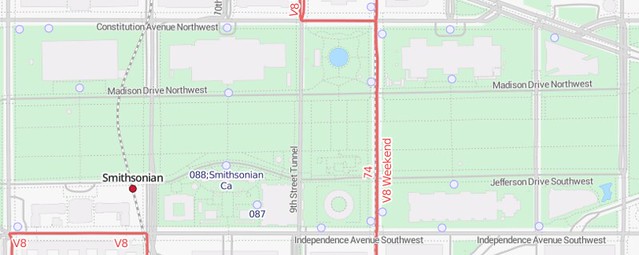
Another fun fact from the book: the axis of the National Mall was tilted about 1.5° south so that the Capitol and Washington Monument appear to line up. Since the Monument was built off-axis, it doesn’t line up anything in the L’Enfant Plan, and that’s still subtly visible in some views. Now that I know this, I can’t un-see its crookedness on any map of the city.

* In Chicago, the local dialect persists in calling areas like the planting zone between sidewalk and street “the parkway.”

Worst trail junction in town


worst junction in town Originally uploaded by Payton Chung

Okay, so this intersection isn’t exactly the royal mess that is the Lady Bird Johnson Traffic Bowl at the other end of Memorial Bridge.* However, “Peters Point” is the most infuriating point along the Potomac & Rock Creek paths, for several reasons:

1. NO SIGNAGE. This crosswalk leads under the Lincoln Memorial Circle ramps to the trail along the Potomac, and thus to Potomac Park, the Tidal Basin, etc. Continuing along the river, though, leads pedestrians up an ramp to a dead-end overlook — surrounded by six lanes of free-flowing traffic.
2. Cars speeding off of Rock Creek Parkway onto Memorial Bridge here rarely yield to pedestrians, for fear of being rear-ended at highway speeds. (The posted speed limit, as with many local NPS parkways, is lower but universally flouted.)
3. Sharp curves on the path and steep ramps. There is no way to take the curb cut shown at any speed, since it requires steering into a turn and making sure not to trip over the ramp’s sharp sides. Not to mention that the trail makes a sharp arc around this belvedere because… why?
4. Insufficient trail widths, particularly at the sharp turns.

My solution:
1. One little sign, added to the sign on that lamp post and facing north: [up] Memorial Bridge, [L] Potomac Park. Those approaching from the east (i.e., this view) have enough visual cues to know that Georgetown is to the right and the Lincoln Memorial to the left.
2. Close the little road loop. Traffic moves too quickly for anyone to pull out here and enjoy the view, anyhow. Add a bike path that cuts across its mouth.
3. Point the crosswalks such that they are not perpendicular to the road, for the convenience for drivers, but instead follow the line of the path. Widen the curb cut, and grade it gently.
4. Slow traffic approaching the crosswalk, and add something (flashing lights?) to alert drivers to stop.

* Every time I glance at a map of the Arlington riverfront, I keep thinking that there must be a way to handle those traffic flows with half as many ramps, many fewer conflicts, and in 1/4 as much space, but wow, that’s a complicated web they’ve weaved over there. The Pentagon has a long-range plan to sort out some of its parking lots and ramps (and return a whopping 50 acres of pavement to green space!), but that’s only one-third of the basket-weave.

New Urbanism and bus route geometries

I remember being confronted by a transit planner with exactly Jarrett’s criticism — about town centers placed off of arterials vs. bus route geometries that should stick to the arterials — back in 2005. I hate to pass the buck, but it falls into the trap of giving New Urbanists too much credit for what they can do. (It’s a common trap, fed by the fact that many urbanists are architects and other self-aggrandizing types.)

A typical example given would be Southern Village outside Chapel Hill. That site had a few additional confounding factors: NCDOT planned to widen 15-501 and wanted strict access management, Chapel Hill had little authority over NCDOT, and the entire site sits pretty high up above the road. Luckily for them, though, Chapel Hill also wanted a permanent southern bus terminal (and a permanent greenbelt beyond Southern Village), so the compromise of having a town center and terminal bus P&R works. Newer, infill New Urbanist developments seem to have gotten better about the arterial interface. Excelsior & Grand [warning: PDF] is a great example of a state DOT relenting on design (and crashes dropped 60%!). Even the evolution between The Grove and Americana at Brand is notable; not sure if it was Caruso or Glendale that made that decision, but the arterial sides look and feel much better at the latter. It appears that the state of the art is to place the Main Street perpendicular to, and adjacent to, the arterial; it’s a rare Main Street that can sustain retail all that far into the property, anyways.

The debate reminds me a lot of the debates about couplets, something that Calthorpe was pushing with his Urban Network. Ultimately, those debates were somewhat pointless outside of those few large greenfield projects that have occurred (mainly overseas): by and large, NUists aren’t in a position to built new arterials, or even reconstruct both ROW and urban fabric along existing ones.

How I spent my summer

water temple drawings with shading

In case you were wondering where I’ve disappeared to, the answer is: architecture school! No, I didn’t reset my life to when I was 16 (geez, it’s hard to imagine that was half a lifetime ago) and opted to pursue the liberal arts instead of architecture — I’d taken an equal number of university classes in both. I did, however, enroll in the introductory class at the Catholic University of America’s Master of Architecture program, and spent 100+ hours a week through all of July in architecture studio.

I’m really glad I did that, since I (re)learned a whole lot about everything from drawing techniques to concrete structures, representation in art to working with ink and charcoal, sketching proportions to Buddhist understandings of spatial processions and deflected vistas.

I’m even more glad it’s over, and that I do not actually have to spend 100 hours a week in an architecture studio, ever.

Sharing is “war”

The “war on cars” is about as real as the “war on Christmas” or the currently-underway “class warfare“:

How about “war” as a proper metaphor? I’d go so far as to suggest that war is precisely the correct metaphor because, you know, having to pay for parking your car is just like having shrapnel rip through your leg when a bomb explodes. Because having to wait to make a right turn because a bicyclist is in front of you is just like that movie about the land mine in Kosovo where the guy is stuck on the land mine and can’t move forever or else he’ll die. It makes perfect sense because getting a speeding ticket for blowing through a red light is exactly like 623,000 people dying in the Battle of the Somme.

Bill Lindeke via twin city sidewalks.

Leaving your luggage in Washington

[First in an occasional series of FAQs about traveling to Washington, D.C. For more, please click on the “dc-faqs” tag above. Information verified current as of September 2014.]

Left-luggage facilities are fiendishly difficult to find in the USA. Security overkill accounts for some of that, sure, but countries with far more experience with train-station terrorism still have plenty of luggage lockers.

First up: it can’t be repeated enough, but pack light. Not having to wrestle with lots of luggage means much greater flexibility. Carry as little as possible while sightseeing in Washington, and in particular, keep metal objects to a minimum. Airport-style security checks are commonplace: you will walk through a metal detector, and someone will poke through your bag. During the summer, many museums will have long lines to have bags examined, but no lines for persons. I’ve never encountered a line when carrying the absolute minimum of wallet + phone, no jewelry, no belt.

Small bags can be checked at several Smithsonian museums and must be checked at the National Gallery of Art. Just be sure to remove anything that might raise a security guard’s eyebrow, and queue up to retrieve them before the closing-hour rush. Note that Gallery Place has small lockers and closes at 7PM, not 5PM like most of the other museums. The Udvar-Hazy Center, near Dulles airport, has larger lockers that can fit most carry-ons.

If you’re departing or arriving by train and don’t need your bags overnight, Amtrak allows passengers to check bags in a day before, or to pick up checked bags days after arrival. The key caveats: relatively few stations have baggage service, and on the Northeast Corridor, bags only go on the overnight train (so you’ll have to check your bags the night before or retrieve them the day after). To retrieve your bags after the fact, go to the information desk and have them call a baggage attendant; have your claim check ready.

Similarly, you can usually check bags for airline flights anytime on the day of travel. This would be a tremendous time-suck in most cities, but it’s easily done for flights from nearby DCA.

Hotel bellhops check bags for arriving/departing guests as a courtesy, and if you play your cards right you can usually take advantage of this. Dress like a business traveler, tip generously, and don’t lie if asked. You’re best off trying large convention hotels where the bell desk is outside the lobby (not smaller hotels where it’s at the front desk); walk into a side door of the hotel and out the front door to the bell desk.

One last resort is the left-luggage facility at Union Station, next to the MARC commuter rail gates. It’s expensive, but it’s also right there.
Trail network keystone


The key stone Originally uploaded by Payton Chung

The missing link of the Anacostia trail recently received final environmental approvals (and, last month, a TIGER grant). As this map illustrates, “the arboretum section”* will complete a link through the city between the two great suburban Maryland trail networks (the 30-mile Rock Creek/CCT and the 60 miles of Anacostia trails) to Virginia’s trails and the C&O via the Potomac River trails. Since I live in Southwest, both trail networks will begin at my doorstep.

The segment will also nearly complete a full loop around most of the city, via Capital Crescent + Sligo Creek, and better link northern Prince George’s County to the heart of the region. Future links via the Fort Circle trails east of the river will connect a southern loop via the Wilson Bridge and Alexandria.

Now, if only there were a way to bring the WB&A, seen shooting off to the east through Bowie, into the equation as an eastern counterpart to the W&OD to the west.

Other cool 2012 TIGER grantees include a bikeway project in midtown Detroit, a new bike bridge in Memphis, and new train stations for Raleigh and Rochester.

* really on the east side of the river, past the Kenilworth Aquatic Gardens instead. There is no acceptable on-road route in this area, only several highways.

Campaigning on stale tax policy

I was a bit crestfallen earlier this week when Obama came out swinging in favor of extending Bush’s ill-conceived (and 13-year-old) tax policy. There’s been enough time since the last time the tax code changed; if it’s not going to get past the House anyways, why not instead suggest replacing the whole shebang with something new? This had been broadly hinted at during the debt-ceiling debacle last year.

The very words “tax reform” are music to the ears of good-government liberals like me—and Barack Obama. They bear the hope of bipartisan compromise and grand bargains in which everyone wins. Conservatives get lower rates, liberals get a fairer tax code with more revenues for social programs, and fewer giveaways to favored industries.

via Mark Schmitt in the New Republic.