Redeveloping multifamily: condos are forever, co-ops perhaps less so

“A diamond is forever, a suburban R-1 zone nearly so” – Jonathan Levine, “Zoned Out”

And what’s even more permanent than an R-1 zone? A condominium.

Dearborn Park, Chicago

See those townhouses tucked among the trees? Hope you like them, ’cause they’re there, forever. (CC photo of Dearborn Park, Chicago, by Doug Nichols)

The saga of the Frontiers West condominium along 14th St. NW — as told by Lydia DePillis a few years ago — recently came up in conversation. A few years ago, multiple developers attempted to buy the entire complex, but ran up against an implacable foe: consensus. “Redeveloping any one of the parcels,” DePillis reports, “would require unanimous consent from the owners of all 54 units—so just one person could doom any deal.”

Frontiers had been built as public housing in 1977, an attempt to revitalize a neighborhood still deeply scarred by riots a decade earlier, and was sold off to tenants in the 1990s. (Jack Kemp introduced a Thatcher-esque scheme to sell public housing to tenants during the Bush 41 administration.)

Frontiers West’s unusual backstory created an unusually wide “rent gap” (the difference between value as-built and value as highest and best use) at that location. However, condominium ownership is over 50 years old in America, and thus the first stick-built condos are probably running up against their expected service lives. For those buildings, the economics of depreciating structures will soon run up against appreciating land values, and associations with structural problems (and in good locations) will have to face tough decisions. Says one condo owner outside Vancouver (probably the most condo’d city in North America), “We don’t have a system that allows people to understand what to do at the end of their unit’s life.”

It’s not necessarily impossible to buy every single owner out. MetroWest in Fairfax is being built on what was a low-density subdivision, where every owner consented to the sale. In a single-family situation, it should be possible in most cases to buy most of the parcels and leave a few “nail houses” outstanding.* Eminent domain, as at Atlantic Yards in Brooklyn, is also an option in situations where legal justification can be found.

Steven J. Smith found one recent example of a 30-unit condo — a singularly awful 1970s building in Chicago’s Lincoln Park — that had been re-assembled. (Maybe it helps that Illinois law requires only 75% of units to force an en-bloc sale.) But for other examples, he points overseas to Singapore and Japan — both even more urbanized than the USA, but also both societies where achieving political consensus is easier (their effective one-party rule being the prime example).

Singapore took Thatcher’s idea of council-flat ownership to an extreme, encouraging Singaporeans to purchase their public housing units with their social pension funds. (It’s also a clever way of locally recycling capital to fund their ambitious housing scheme.) Now that some of these buildings have become attractive redevelopment opportunities, the government has begun a “selective en-bloc redevelopment scheme” (or SERS, in the acronym-happy Singaporean government-speak) for scores of 1950s-1980s concrete-slab tower blocks, provided that 80% of owners consent. It helps that HDB flats are technically not owned, but instead are tied to 99-year leases; this gives HDB the authority to do things like impose anti-speculation rules to keep prices stable between the time redevelopment is announced and all individual contracts close.

Speaking of unique authority, this is one area where the greater legal flexibility granted to cooperatives, rather than condos, can come in handy. Whereas New York condominium law requires 80% approval for an en-bloc sale, its cooperative law only requires 2/3 consent to dissolve the corporation. For the particularly obstinate, District of Columbia law also permits cooperatives to kick out individual members through a simple majority vote.

Northern Virginia again offers a local example, where the Hillwood Square co-op in Falls Church sold itself after a two-thirds vote:

“They were faced with the prospect [of] spending a significant amount of money to upgrade the property’s underground infrastructure… ‘Hillwood was one of the most complicated as well as the most rewarding land deals we have had the opportunity to represent in our careers,’ [broker Mark] Anstine said in a joint statement”

A condominium next to the Huntington Metro has put itself up for sale via an RFP process, with an 80% approval threshold and a requirement that replacement units be built and offered to current residents first.

An interesting application of a cooperative scheme to urban redevelopment challenges could involve capitalizing new cooperatives with existing smallholdings, or redeveloping part — but not all — of a co-op. A co-op, as a stock corporation, has relatively few restrictions on its property holdings and financial activities — especially compared to a non-profit condominium association, which typically would have to distribute excess funds to members.

Land assembly for major projects in Japan, like Roppongi Hills, can be undertaken by pooling properties together into a “Redevelopment Association.” By guaranteeing equity participation in the new development (and new on-site replacement housing), this approach ensures that landowners share equally and fairly in property value gains — thereby removing individual owners’ worry that they sold out too early/cheaply.

Cohabitation Strategies included an equitable-growth idea similar to this strategy — what it called “Cooperative Housing Trusts” — in MoMA’s recent “Tactical Urbanism” exhibit. These community land trusts could aggregate and sell otherwise unusably-small quantities of air rights, and reinvest the proceeds into permanently affordable housing. (It was the one interesting idea in the entire exhibit, IMO.)

* No examples come to mind off-hand, but this is a common practice in shopping mall redevelopments. Department stores that own their own land have been excluded from many redevelopments that engulf them, as with the aging JCPenney at North Hills in Raleigh:
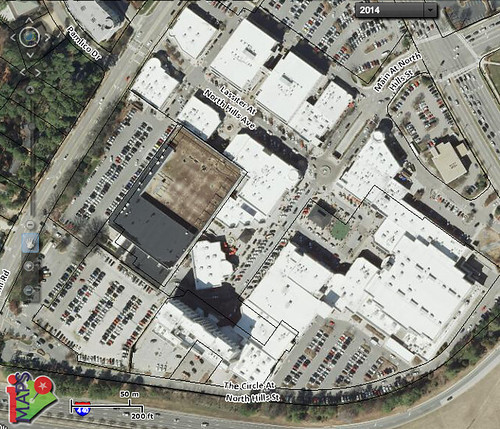
Raleigh, North Hills on iMAPS

The opposite situation was bound to happen someday, and of course it’s flailing-about Sears that is leading the way. It’s not just subdividing its boxes and adding new subtenants like Whole Foods, but in at least two cases (at Aventura, North Miami’s fortress mall, and Metrotown outside Vancouver) it’s going rogue and doing its own mini-de-malling without permission from its “landlord.” Sears’ footprint at Aventura will shrink almost 90%, to just 20,000 feet — maybe their agreement with Simon requires that they not abandon the site entirely.
Housing market myths: USA’s biggest landlord says outsiders not to blame for high SF, NY, DC rents

Conference calls announcing corporate quarterly earnings don’t usually turn up explanations about why the Rent Is Too Damn High, but then again most companies don’t own 100,000 apartments across America, clustered in the biggest and most expensive cities. These are the folks who are raising your rent, and the reasons why don’t have anything with the usual bogeymen.

So, forthwith, some annotated comments by David Santee, chief operating officer of Equity Residential, from their 2014 results call.

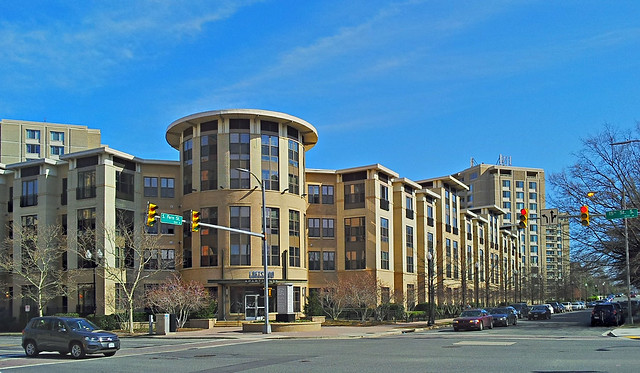
Lofts 590, Crystal City

Equity Residential owns this building, and most of the thousands of apartments in Arlington’s Crystal City neighborhood.


1. California’s multi-year drought wasn’t solved with a few days of rain this winter — and, as the state legislature’s own analysis says, the generation-long drought of housing starts won’t be solved with a few new towers here and there:

“San Francisco continues with epic pace with significant acceleration in Q4 [2014]. In one of the most under-housed cities in the country, deliveries are minuscule and simply don’t seem to be relevant.”

Indeed, San Francisco is in such negative territory with housing (and water, for that matter) that more than doubling San Francisco’s population (which would still leave it half as dense as Manhattan) might only have kept housing price inflation in line with the national average. Note that’s not “falling housing prices,” since that’s rare, just “not increase quite as fast.”

2. New York City’s too-damn-high prices can’t be blamed solely on a handful of zillionaires snapping up shoeboxes in the sky. Instead, the blame lies squarely on everyday New Yorkers, or rather on the buoyant economy they’ve created and surprisingly limited new construction they’ve permitted.

New York City specifically Manhattan remains stable, with only slight concentrations of new deliveries on the upper west side… However, with population in the metro achieving the new high of 8.4 million people, a pick up in business and professional service jobs, and the continued growth in jobs away from financial services, New York should produce four-handle revenue growth supported by an expected 155,000 new jobs in 2015.”

(“Four-handle” is bond-trader slang for “4-5%”.)

3. The era of “boomtown DC,” the city of Fox News nightmares where Barack Obama used government debt to hand out Obamacare-regulation-writing jobs like candy, appears to be ending. Or maybe it never existed: much of the District’s population growth turns out to be just the usual machinations of a large metropolitan area rearranging itself — in this case, as with many others, centripetally.

The district itself continues to see outsized population growth and 25% of our district move-ins were from folks moving closer in from Virginia and Maryland…

Not that this particular phenomenon is unique to DC, of course; Equity boss Sam Zell has noted a broad-based “increasing demand for housing in the urban markets.

The centripetal pattern also applies to the usual flow out from cities, which has been stanched in recent years:

The recession diminished this flow. Fewer than 23,000 young adults left New York annually between 2010 and 2013. Only about 12,000 left Los Angeles—a drop of nearly 80% from before the recession. Chicago’s departures dropped about 60%.
Young adults who moved to the three cities for school, internships or early jobs—or simply because it seemed cool—may now be stuck, said William Frey, a demographer at the Brookings Institution… In tough times, finding well-paying jobs may be easier in big cities, offsetting their relatively high costs of living.

This would be a terrific smart-growth opportunity to capture more population in resource-efficient, highly-productive, low-footprint urban areas — if only said cities were more affordable!

——-

While I’m quoting at length, and because it’s marginally relevant, Old Urbanist wrote up this useful comparison to how America’s zoning system systematically creates bountiful affordable housing… for cars:

American states and cities have engaged in onerous mandatory inclusionary zoning for cars (parking minimums), zoning exemptions (e.g. not counting garages toward FAR limits and allowing parking, but not housing, in mandated setbacks), tax exemptions (only 16 states maintain a personal property tax that covers automobiles) and fringe benefits (the commuter parking benefit), in addition to rent-free public housing for cars (overnight on-street parking).

Will Mayor Bowser recommit to Sustainable DC & MoveDC?

[updated 1 April]

In a recent speech to District Department of Environment employees, Mayor Muriel Bowser offered some warm words about Sustainable DC — but fell short of a full-throated endorsement:

The decisions that we make are often, I would always say, 50 year decisions… The decisions we make around transportation options, whether we put something someplace or not — again, 50 year decisions. What is clear is that we’re making decisions right now that affect the next generation, and shape the options for the generation after that.

We have to be very careful in government about how we distribute our resources, and how we take care of the community. We inherited it, and we have to leave it better for the generations that follow us…

I inherited the past successes… I inherited some good things, and one of those good things was Sustainable DC. And so what I know Tommy [Wells] will do with me is make recommendations on all the things we should keep, all the things we should push harder on, the things we have to add, and if there are things we have to change or delete we should do that too…. I was elected for a fresh start, not a start all over, and so we want to make sure that we’re building on the successes of your hard work… and push the District even farther.

Mayor Gray leaves behind a substantial legacy of ambitious plans, particularly Sustainable DC and national award winning direct descendant Move DC. Both began with citywide public involvement, set ambitious performance goals, and have started to guide real implementation efforts that would, if continued, really advance the long process of creating a truly sustainable District.

Just to put one of those performance goals into a global perspective, Sustainable DC has twin goals of increasing the District’s population by 40% and shifting 75% of commute trips out of cars — baseline goals that MoveDC started with, and crafted an implementation strategy around. Alex Block points out that this is certainly doable, but it isn’t easy.

MoveDC capacity targets

To do so will require more than doubling transit capacity, almost tripling bike capacity, and cutting car capacity by 7%. It would avert over one milion VMT every weekday — which (with current emissions factors, which assume today’s technology) would cut 580 tons a day from DC’s carbon emissions, more than 3X as much as the reviled Capitol Power Plant puts out.

Smart growth policies like MoveDC are a fine example of acting locally while thinking globally, as these are local policies that would have global consequences. The National Research Council & TRB estimate that a national shift towards denser development — including shifting more population growth into the District from the suburbs — would cut CO2 emissions from driving by 11% by 2050, even before any change in vehicle technology. That’s 132 million metric tons of CO2 each year, an amount exceeding all coal emissions from DC, Maryland, Virginia, and West Virginia. Or, put another way, smart growth cuts driving, which could cut as much CO2 as shutting down all of our region’s coal power plants.

Of course, we will absolutely need to do both — and much more — if we’re to have any hope of avoiding a certain existential threat to DC’s future. But only smart growth and energy efficiency cut emissions over the long run, and pay for themselves in the short run.

Shorts: Critical Masses

Critical Mass I Ching

A few short topics for January, all around the theme of achieving critical mass in three very different markets for metropolitan services.

1. Nathan Donato-Weinstein, reporting for the Silicon Valley Business Journal about Google’s October purchase of buildings along San Francisco Bay:

Google — which like many expanding tech companies is focused on reducing its car and shuttle trips as traffic worsens during the current boom — may be eyeing transit options beyond freeways. Pacific Shores is a half mile from the Port of Redwood City, where a Google pilot project earlier this year tested running ferries from San Francisco and Alameda to the port. The Water Emergency Transportation Authority, which administers the San Francisco Bay Ferry routes, has studied regular public ferry service to Redwood City, with a potential public terminal practically next door to Pacific Shores.
“I know they really liked the ferry and the concept. Their challenge was getting people off a boat and putting them on a bus to Mountain View, and that was taking 25 minutes,” said Kevin Connolly, director of planning and development for WETA. “This might be one way to address it.” […]
A Redwood City terminal would cost about $15 million. But the county doesn’t have ongoing operational funding, Connolly said.
A major built-in user such as Google could help make service pencil out, he said.

I’ve written critically about the peculiar geometries (and thus poor economics) of water taxi transit before. Having high-density development built on landfill immediately adjacent to a deep-water port certainly solves some of those problems — but a ferry does need at least two ports. However, most other Bay Area jurisdictions have incredibly restrictive development policies along their waterfronts, and many of the Bay Area’s most desirable residential areas are well inland (and atop hills, in fact).

Perhaps last-mile bus service would supplement a 101-bypassing ferry on one or both ends. That adds in the time and hassle of a transfer; when combined with a lower peak speed (around 40 MPH) and increased susceptibility to inclement weather, it’s tough to see how it would be a faster, more reliable, or more fuel-efficient option. (2008 figures submitted to FTA, as reported by Wayne Cottrell in Energies, indicate that ferry operators in the USA have a median fuel economy of about 10 seat-miles per gallon of fuel.)

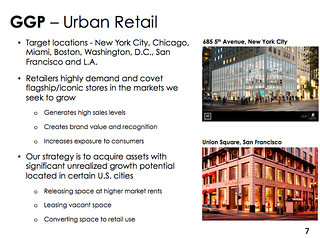
2. General Growth Properties plans a $2 billion investment in street retail, ultimately aiming to have 15% of its portfolio invested on high streets in the principal gateway cities of NYC, Chicago, Miami, Boston, DC, SF, and LA. Even in these high-rent areas, GGP sees “assets with significant unrealized growth potential,” with below-market rents and under-used vertical space.

General Growth Properties investor presentation slide

Many office REITs have focused on CBD office, but these properties have historically been neglected by large retail REITs. Adjacencies matter much more with retail than with office, which creates a “commons” problem that undermines streets with fragmented ownership.

GGP has hinted at two approaches to circumvent this. Like Acadia Realty Trust (an exceptional retail REIT that has redefined itself as a high-street owner), it might hope to aggregate enough properties to create its own mall-like ecosystem, and thus internalize the external benefits of its investment. GGP’s first big investment, an equity stake in the Miami Design District, certainly has that advantage. However, the DD is a singular example unlikely to be replicated elsewhere, so it appears that GGP will instead have to rely upon its high-rent neighbors to similarly aggressively upgrade their properties.

This could be a long waiting game, though, since a lot of urban property isn’t owned by others who need the same quick upside that a REIT does. Micah Maidenberg quotes a skeptic in Crain’s:

“The street-retail business, just like luxury hotels and other sorts of high-end projects, tend not to be a quarter-to-quarter-growth kind of business. It’s more of a long-term hold,” says Jeffrey Donnelly, a managing director at Wells Fargo Securities in Boston.

3. Two few weeks ago, I was visiting my parents in North Carolina and feeling under the weather. While looking up my out-of-area health care options, I came across an instructive article in Milbank Quarterly (by Daniel Gitterman, Bryan Weiner, Marisa Elena Domino, Aaron McKethan, and Alain Enthoven) about why Kaiser Permanente’s integrated group medical practice failed in the Triangle — where I’d previously been a satisfied customer.

My main takeaway from the case study was that, while “prepaid group practices” like Kaiser or GHC in Seattle (not to mention vertically integrated government systems like the VA) do offer tremendous cost efficiencies, they also rely on economies of scale that are difficult to set up from scratch.

The article estimates that KP’s break-even point is around 100,000 members in a metro area. That figure would have been a huge ask, given that the Triangle’s population was well below a million at that time, and spread out across a broad area. KP needs that kind of scale to build bargaining power, both:
– on the cost side, when bringing services in-house (the essential feature of their cost-containment model) or bargaining with hospitals and specialists; and
– on the revenue side, when selling their product to employers and employees who have to be sold on a choice that (a) most would find less convenient and (b) involves disrupting the “stay with my doctor” inertia many customers have.

It’s not a coincidence that prepaid group practices are best established in markets where either government employees or unionized employees bulk-purchase healthcare services. But HMOs are beginning to re-emerge now that the Triangle is bigger and denser, the ACA exchange has made the health insurance market less fragmented, and more doctors have organized into group practices linked to specialists via electronic health records. One new option in this year’s ACA marketplace for North Carolina (and especially valued, since last year only NC Blue Cross participated in the marketplace) is Coventry’s CareLink HMO, which uses Duke Medicine’s primary care network as the in-house practice.

New economic geography: fewer centers, more edges

from a plane
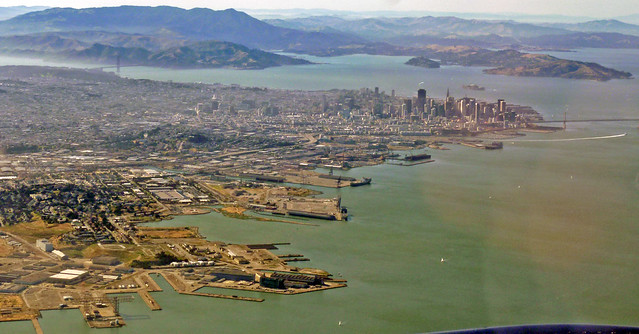
There’s obviously no room to build anything, anywhere.

October’s Economist Survey on the global economy by Ryan Avent included a shout-out to his Piketty-informed thoughts on housing prices. In short, the productivity gains from current technology have increased inequality between people and places. The returns on specialized skills are worth more in an era of cheap communication and transportation, great cities aggregate many people with such specialized skills –and furthermore, agglomeration effects appear to be growing even as communications costs decline. Even virtual reality won’t be able to replicate the everyday, subtle reinforcement of ambition that great cities provide; as Paul Graham writes:

The physical world is very high bandwidth, and some of the ways cities send you messages are quite subtle… A city speaks to you mostly by accident—in things you see through windows, in conversations you overhear. It’s not something you have to seek out, but something you can’t turn off.

Ideas have become so complex that those with specialized skills need to gather around others with complementary skills just to understand topics, much less to achieve the discovery or innovation stage. And, well, interesting people like one another; not for nothing has “assortative mating” taken off, spawning study of managing “the two-body problem” in fields like academia and medicine. (Hint: bigger cities, with bigger labor markets, are more likely to solve the problem. This has become a boon to universities recruiting in large metro areas, while those in small college towns struggle. The eight metro areas with 3+ R1 universities [Boston, New York, Philadelphia, Washington, Raleigh-Durham, Atlanta, Chicago, and Los Angeles] have a considerable advantage in this regard.)

In short, there are fewer centers and more edges. Scarcity being what it is, the centers (and only the centers) are winning more capital, and the edges are losing.

The result has been a highly uneven reallocation of wealth, whereby some places are winning in the form of skyrocketing property prices. These high prices create a substantial drag on the economy: increasingly high rents in the most productive locations steal from the most productive. This steers:

  1. Capital towards landlords, enlarging a rentier class (as Piketty notes) and starving more productive sectors.* This creates a vicious circle, as the NIMBY cartel further tightens its regulatory capture over the land use regime, and extracts ever-higher rents.
  2. Labor towards less costly, and less productive, places, creating economic losses. One recent study quantified that economic loss to the United States in 2009 at 13% of GDP — equivalent to sawing off the entire state of California.

—–

This might be worth unpacking further at a later date: Just reforming land-use regulations, or even entirely repealing the “shadow tax” of zoning, still won’t do enough to produce sufficient affordable housing. Even if zoning is reformed to “make more land,” that land’s still subject to construction’s “hard costs,” which are just too high nowadays.

Construction costs have risen faster than inflation, and far faster than stagnant workforce incomes. Slides 5-6 of this presentation [PDF] by Thomas Hoffman from Enterprise points out that even with free land, even the cheapest construction now costs 50% more than the affordable rent for a low-income family.

Sure, embedded within construction costs are other perhaps-useless regulations, but housing affordability in gateway cities is a problem with many root causes, and with many solutions as well.

—–

* Rent or mortgage principal paid, aka “housing service expenditure,” does not have a multiplier effect on GDP because it’s not factored into GDP. However, it’s worth noting that in 2000, HSE amounted to nearly $1 trillion, which supported only some of the 1.1 million jobs in real estate (NAICS 531). Reducing rental prices would take investment income from landlords and give them back to consumers, who would probably spend in other sectors that generate more jobs per dollar.

Parallel trends: bigger houses, tinier apartments

size of new houses

It’s lately become very fashionable to contrast the concurrent trend towards ever-larger new houses and ever-smaller new apartments. Recently, Richard Florida,* Kaid Benfield, and even the Streetsblog podcast have all mentioned this peculiar contradiction.

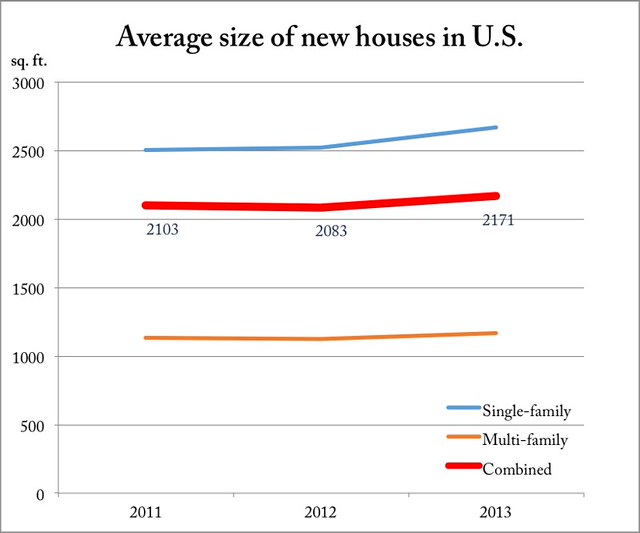
But scratch a little bit at the surface and you’ll find that it’s an artifact of the Great Recession, not an existential conundrum. Consider that the Census’ Survey of Construction, the source of said statistic, only measures a universe consisting of new single family (usually for-sale) houses. However, these share of total new housing construction that is in single-family houses continues to fall. Just from 2011 to 2013, multi-family houses went from 29% to 33% of all new housing completions. Meanwhile, their size hasn’t budged: it’s consistently been around 1,100 square feet (+/- 50) since 1999.

The chart above also comes from Census data, and tells a more complete story. The average size of new houses built in the USA, both single- and multi-family, declined from 2011 to 2012, then ticked up to a record in 2013. It hasn’t been on an upward march forever. Another reason why this data point isn’t quite as important as it might seem at first glance: many fewer Americans are in new houses, period.

houses creeping back up

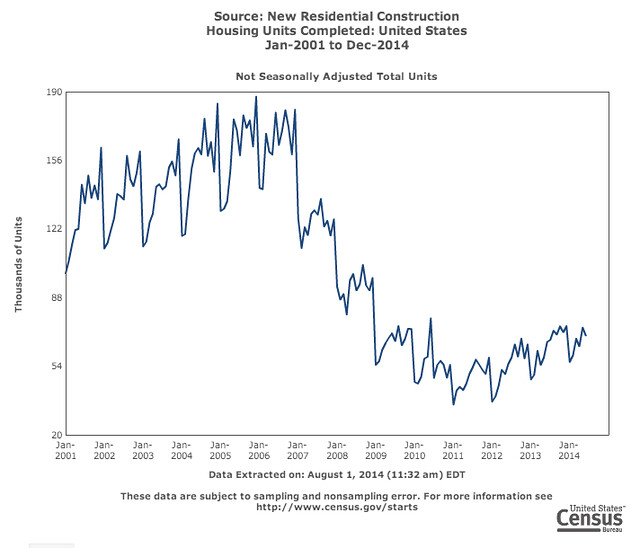
Construction may be up slightly, but it’s still well below its peak. Completions fell 70% from the 2004-2006 rate, and now we’re back up to 60% below that (completely unsustainable) rate. From builders I’ve heard at ULI panels and the like, new move-up product is still selling in the suburbs, but first-time buyers are staying in rentals longer, largely due to tighter financing. Hence, fewer small homes are getting built, as younger households stay in existing stock for much longer, and the average home size is increasing. (Oh, and remember: we’re talking about fewer smaller single-family houses. The number of multi-family houses, small and medium-sized, is increasing.)

Thus, the real story is that the for-sale single-family starter home, as a product type, is dying off. For example, when my brother recently purchased his first new house (at 35, considerably older than the 28-year-old median buyer at, say, Park Forest), he didn’t get a starter home. He went directly from an existing multi-family unit to a move-up sized house.

* Making the additional methodological error of taking the definition of “central cities” seriously.

Lumpiness: in cities’ property values, and in metro structure

Two only tangentially related thoughts on lumpy growth:

1. Richard Florida in The Atlantic Cities was one of the few major outlets to cover a report from the Demand Institute (a collaboration between Nielsen and The Conference Board) called “A Tale of 2000 Cities.”

The top 10% of American cities account for more housing wealth than the next 90%. The gains in the 2000s were tilted towards the already wealthiest communities.

The report includes an extensive look at a typology identifying nine types of American communities primarily by the strength of their local housing markets, post-recession. In keeping with the name, the results show a striking divergence, with a select handful of healthy markets sweeping up much of the gains — and leaving half of American cities and towns “currently facing fundamental economic pressure.” The report’s summary says: “In today’s global economy, nothing is more important than the strength and sustainability of the local labor market, regardless of whether employers are serving customers in Chicago, Chile, or China.”

If anything, today’s telecom-centric, information economy has resulted in the geography of opportunity getting lumpier, not more diffuse (a prediction going back to Toffler’s “electronic cottages” in 1980) — “reports of the ‘death of distance’ have been much exaggerated.” We telecommuters haven’t all decamped to mountaintops. The most valuable places are becoming even more so: they account for not only an outsized share of wealth but also the gains of recent years.

The underlying economic reality, that human capital is what drives most prosperity today, is why I differ from my colleagues who believe that “investment ready places” can thrive based on previous investments in capital goods like housing. Jane Jacobs agrees: “Many attractive looking little cities stagnate or dwindle; Scranton, where I grew up, is an instance. The determining factors, rather, are economic opportunities.”

(I’ll have more thoughts in a later post about how macroeconomic changes, and in particular greater economic inequality, have left their mark on “gateway cities.” In the meantime, I highly recommend Ryan Avent’s ‘The Spectre Haunting San Francisco,’ which ties in man-of-the-moment Thomas Piketty as well.)

(April 2018 update: Florida points to a 2016 paper by Albouy and Zabek showing that housing value inequality, which was suppressed from 1940 to 1980, is back at levels last seen in 1990 and 1930. Furthermore, this increase is primarily due to inequality within metro areas [e.g., run-ups in favored-quarter prices], which has increased fairly steadily since 1970, rather than between metros.)

On another note, the report also has a good omen for suburban retrofits in “favored quarter” suburbs, in the form of an interesting but familiar disconnect between housing supply and demand in “Affluent Metroburbs.” 58% of housing stock in these communities is detached, “but fewer than half [of those seeking to move] say they are seeking a detached single-family home, compared with a national average of 60 percent.”

Among residents of “historic skyline cities,” a broad category that includes both healthy and less-healthy cities, there isn’t exactly a stampede to the exits. 54% of those who intend to move still “intend to stay in an urban area,” and “nearly one in five” wants to move for better schools (hardly the unanimity some cry about).

2. Alon Levy has a great post about how, on a macro scale, the gridded West has a suburban layout that fosters high-coverage bus networks, whereas more organically settled Eastern suburbs have a dendritic, hub-and-spoke layout that lends itself to commuter rail. (Yes, he points out that Johnny-come-lately Washington has, through Metro, grown into the latter pattern.)

This might go some way towards explaining “the Western Paradox” in Brookings’ findings regarding transit access to jobs. In short, Western cities (particularly in the desert southwest) had a strange spread: many jobs were technically accessible by transit, but low transit-to-work mode shares. The highest mode shares were found in older eastern cities, where a large fraction of suburban service jobs are inaccessible by transit.

Where are DC’s lunch crowds?

Let’s say that you run a small foodservice business that’s looking for a location in DC. Your business offers food throughout the day, but relies primarily on the high-volume, low-margin office lunch trade. Your best-performing locations are in 24-hour areas with high employment density, medium population density, and lots of students. Seeing as Washington is not exactly Cambridge, where should you seek out welcoming crowds?

Conveniently, the Census offers “OnTheMap,” which is a way to generate online maps showing employment density (and commute flows). Here’s an employment density map of downtown DC:

job density map: greater downtown DC

Note how steeply job density drops off along Massachusetts Avenue, the northwest boundary of DC’s CBD: density roughly halves with every single block.

Indeed, in the entire broader metropolitan region, there are only a handful of business districts that meet the median quintile of job density, like downtown Baltimore, Bethesda, Tysons Corner, Old Town Alexandria, and most curiously, an industrial estate in Springfield. However, these areas still have only 1/4 to 1/3 the job density found in downtown DC. As mentioned before, downtown DC has densities far beyond anywhere else in the region.

Washington-Baltimore job density

Population density maps are rather easier to find, and offer a useful contrast; sadly, there aren’t very many mixed areas with both lunch and dinner crowds. Right along the Mass Ave boundary is one option, particularly at the junctions where it’s most permeable (e.g., Dupont or Thomas Circle). Another intriguing possibility is NoMa: it’s one of a few neighborhoods where the 2010 density maps shown above would be significantly out-of-date, and the opening of Union Market has drawn a cluster of foodie businesses to the area.

The city itself acts as a platform for entrepreneurial ecosystems

Off the Grid: Proxy Hayes Valley

A recent Economist report by Ludwig Siegele examines how the business model, and culture, of the new entrepreneurial culture radically differs from the Fordist, all-under-one-roof mode of production that immediately preceded it:

[T]he world of startups today offers a preview of how large swathes of the economy will be organised tomorrow. The prevailing model will be platforms with small, innovative firms operating on top of them… In some ways, [entrepreneurial] ecosystems can be seen as exploded corporations. Finance departments have been replaced by venture-capital funds, legal ones by law firms, research by universities, communications by PR agencies, and so on. All are nodes in a loose-knit support network for startups that does what in-house product-development teams used to do.

This combinatorial approach to business is fundamentally well suited to dense urban fabric, which relies upon smaller increments of development — and thus intrinsically offers the choice and flexibility demanded by both contemporary consumers and the experimental businesses that serve them. In a sense, both the urban grid and the urban fabric are just platforms for business growth: an urban business district has higher costs — but compared to an insular suburban corporate campus, it’s an “exploded” ecosystem of firms that each do their own thing well, and thus maximize their own productivity. Instead of a single mediocre cafeteria, we demand — and increasingly get — more and better choices. The urban collage has found its counterpart as a business model, and naturally the two get along swimmingly:

[S]tartups are doing what humans have always done: apply known techniques to new problems. The late Claude Lévi-Strauss, a French anthropologist, described the process as bricolage (tinkering)… [S]tartups are a big part of a new movement back to the city. Young people increasingly turn away from suburbia and move to hip urban districts, which become breeding grounds for new firms.

In turn, each of these specialist firms needs to generate its own economies of scale:

Tom Eisenmann of Harvard Business School explains that startup colonies are platforms with strong network effects, a bit like Windows and Facebook: the more members they have and the more activity they generate, the more attractive they become.

In researching the AIA’s Cities as a Lab report last year, I chanced upon a single image that I thought encapsulated the possibilities of how the startup mentality has fundamentally altered business and cities: the Off the Grid food court, seen at the top of this post visiting proxy in Hayes Valley. (Photo by Niall Kennedy.)

Sure, back in 1993, I would have expected that by 2013 someone in San Francisco would have a renewable-energy restaurant. Individually, all of the ingredients in this scene existed in 1993: the Hayes Valley neighborhood, left-behind spaces by freeway overpasses (this was a segment of the Central Freeway), roadside flea markets, architects as developers (think John Portman), shipping containers, food carts/trucks, photovoltaics, LEDs, point-of-sale systems, etc.

What’s changed since then is that each of these have evolved, thanks more to regulatory than technological innovation,* into ready-made, easy-to-use, off-the-shelf platforms that can be “recombined” into an endless set of novel experiences — the very essence of what makes urban life so exciting.

* Read the full report for more! Even more telling is the chapter outlining how different districts around the Research Triangle were shaped by how different planned districts have flourished by matching their respective eras of innovation — beginning with corporate campuses in 1960s Research Triangle Park, moving on to the university-led model planned in the 1990s at Centennial Campus, and finally coming full circle to new entrepreneurial ecosystems in downtown Durham (and a future “downtown RTP”).

Sears: left behind, along with their malls

Sears -- Landover, MD
[Photo © 2003 djcn0te, via Flickr]

The imminent departure of two so-perplexingly-empty-as-to-be-infamous Sears department stores — the “still open” Sears at Landover Mall (the rest of which died in 2002) and its hometown flagship at State & Madison in Chicago — brought out the usual drumbeat of obituaries about Sears. As Lewis Lazare, a standby on the Chicago biz beat, writes about State Street: “So, the drip, drip, drip that is Sears’ excruciatingly slow death march goes on.”

Wondering why isn’t this company gone yet?, I discovered a 2012 pre-obituary from Crain’s Chicago Business. They’ve even scanned in three previous cover packages, from 1978, 1988, and 1990, all of which identify pretty much the same troubles in the core department-store business — one of which being that malls had stalled as a growth platform by the late 1980s. (The 2012 article quotes former CEO Alan Lacy about the 1990s: “We did the analysis. Shoppers who used to go to the mall eight times a year now went three.”)

The 1978 article trumpets that Sears, whose then-new tower crowned Chicago’s skyline, has “gross sales account[ing] for about 1%* of the Gross National Product… Last year’s sales: $17.22 billion. Profits: $838 million.” In 2013 (based on guidance, not final report) domestic Sears sales will amount to about $20.1 billion, and domestic losses about $300-400 million. So, in nominal dollars, the company’s sales have grown! (2017 update: Whoops. 2015 sales failed to reach $15 billion, and full-year 2016 might not hit $13 billion. That’s about 40 years of lost time.) And yet…

Left behind
(1977 levels = 100)

Some have bid up SHLD, hoping that a breakup might unlock vast sums in real estate value. Well, consider that just being near a Sears for all these years likely depresses property values. Given Sears’ sheer ubiquity among malls of a certain age, it’s much more likely that only a handful of its locations remain trophies; the rest are in B/C malls which are headed for demolition.

(2017 update: Landlords that own these spaces don’t have a lot of options, Cushman & Wakefield’s VP of retail research in the Americas Garrick Brown told [Champaign Williams from] Bisnow… “I haven’t seen a great big move of subleasing, mainly because the locations that [buyers] would be open to subleasing are Class-A, and they’re the ones [retailers] don’t want to close or get out of.”)

(2017 update 2: Steven Roth’s Vornado shareholder letter mentions annual sales at the Sears in Rego Park, which leases from Alexander’s, a defunct department store now affiliated with VNO. Its nominal sales have declined from $86.8 million in 1997 to $28.7 million in 2016 — a 78% decline, adjusted for CPI.)

It seems that there’s still a long way for Sears to fall. With any luck, I hope it won’t be too ignominious an end.

* By comparison, Wal-Mart’s 2012 domestic sales were $275 billion, which accounts for 1.6% of US GDP. Perhaps there’s an implicit limit to be learned here…

How would a carbon tax affect DC?

Nature's fuel

The right thing in climate policy for all the big countries is a carbon tax, which is simpler and less vulnerable to fluctuations in emissions than cap-and-trade schemes.” – The Economist

A recent discussion spawned the idea of implementing a carbon tax within DC, and so I wrote up this brief.

What and whom would a carbon tax affect?
A carbon tax, technically a tax upon the carbon content of energy and fuels, would primarily affect electric generation, gasoline & diesel, and heating fuels (natural gas, fuel oil). A narrower tax could affect only fuels, or electricity. The UK’s carbon tax, for instance, taxes various energy sources at differing rates.

Who consumes energy in D.C., and how?
The EIA reports that DC’s total energy consumption is 70.5% imported electricity, 18.7% natural gas, 7.9% gasoline, and 2.7%fuel oil. 66.3% of energy is consumed by the commercial sector (i.e., offices), 19.9% by residences, 12.1% by transportation (i.e., cars & trucks), and 1.6% by industry.

Of carbon emissions within DC proper in 2010, natural gas was 54.6% and petroleum 45.2%. Because DC imports all of its electricity, it has the least carbon intense economy among the states, emitting 91.6% less CO2 per dollar of GDP than the US average. This does not, however, include fuel burned for electricity used by DC end users; 59.2% of DC electricity originated from fossil fuel generators.

Have carbon taxes been implemented elsewhere?
Yes, several jurisdictions have. Finland and Sweden were first, in 1990 and 1991. In North America, the provinces of British Columbia and Quebec have carbon taxes, as does the city of Boulder (on electricity only). Dozens of multinational corporations, including most oil majors, use an “internal carbon price” to evaluate corporate decisions: ExxonMobil’s is $60/ton.

How have these fared?
British Columbia’s carbon tax, unique in its broad reach even though the province works within the framework of a high-carbon-emitting country, “has been remarkably effective in reducing fuel use, with no apparent adverse impact on the province’s economy,” according to a University of Ottawa study. GDP growth paralleled Canada’s, income tax rates fell to the lowest nationwide, and fuel consumption fell by 17.4% per capita.

Have carbon taxes been proposed in U.S. states?
A bill has been introduced in the Massachusetts legislature, and a ballot measure is currently collecting signatures. In Washington state, Governor Jay Inslee has specifically directed a legislative commission to study a carbon tax, and an NGO has proposed draft legislation.

What level of tax would be appropriate?
An easy guideline for measuring the impact of a carbon tax is that a tax of $1 per ton of CO2 results in just less than 1¢ in tax per gallon of gasoline. DC’s current gas tax rate of 23.5¢ per gallon thus implies a tax rate of $27.98/ton of carbon dioxide. (Maryland’s gas tax is now 32.10¢ per gallon.) This rate is very similar to the C$30/ton that British Columbia charges, and near the midpoint of the $5-65/ton “social cost of carbon” price suggested by the White House.

Where do proceeds of carbon taxes go?
In most cases, as in British Columbia, carbon taxes are a “tax swap,” whereby other taxes — notably on income, capital, etc. — are reduced. Some bills, like that proposed by Citizens Climate Lobby, feature a “dividend,” or direct rebate back to taxpayers. Sometimes, climate actions are funded with a portion of proceeds as well; the Massachusetts bill, for instance, directs $90 million in revenue towards transportation debts and 10% to clean energy. In DC, ambitious plans have been launched, but not yet funded, for transit expansion (by WMATA and DC) and for cutting emissions, and a carbon tax would be one way of funding implementation of those plans. (Boulder’s tax was implemented to fund its climate action plan.) In addition, DC currently pays its annual operating subsidies for both WMATA ($275 million in FY2014: $58M bus, $42M rail, $22M paratransit) and DDOT transit out of general funds, and a carbon tax could be a stable, dedicated source of transit operating funds.

Who are winners and losers?
A carbon tax that includes electricity would have a much broader base and thus wider impact. It would primarily affect the office sector, and as such mostly commuters, but it might also attract Congressional attention. A carbon tax solely on fuels would mostly impact building heating/cooling; again, this would largely fall on offices, but also on DC residents’ heating bills.

Although a carbon tax typically is somewhat regressive, there are many ways to design a carbon tax to mitigate impacts on lower income consumers. In particular, a DC carbon tax could use targeted measures to offset higher home heating costs for low income residents: income tax credits, weatherization or LIHEAP assistance, and transit improvements.

Further reading
Sightline Institute: Carbon Tax Fact Sheet
Resources for the Future: Carbon Tax FAQs
Citizens Climate Lobby: DC Chapter

Crowdfunded commerce can spark conversation about community change

fundrise

Crowdfunding holds the potential to improve accountability and shine light on the currently ill-understood development process, better aligning the interests of developers and communities. No, for-profit equity issuance may not be as democratic as other means of ownership, and doesn’t guarantee community control. Yet in a conversation we had after my previous blog post, Ben Miller mentioned a few aspects about Fundrise’s plans offer a way for developers to work with, rather than against, neighborhood wishes:

1. Besides relatively cheap capital, crowdfunding allows the owners (the crowd) to learn about, openly discuss, and perhaps make the trade-offs necessary to keep an urban commercial district balanced.

Gentrification along a retail corridor usually results in a familiar tale of woe,, repeated in city after city:
– a few businesses pioneer the area
– they draw more customers in
– sales and values rise, more shops open
– land owners cash in, raise rents
– better-capitalized, less interesting shops move in
– the pioneer businesses get priced out.
The end result is a tragedy of the commons, where nobody is accountable for maintaining the “unique, authentic, cool vibe” that initially drew people to the area, which is subsequently lost as each owner maximizes her own value.

Non-profit or public ownership of anchor institutions (i.e., public markets, performing arts centers) can sometimes prevent the cycle from reaching its zenith, but much of the cool factor often stems from local, for-profit businesses ineligible for non-profit status. But as it currently stands, few owners are willing to take the financial penalty that comes with cross-subsidizing interesting retail — aside from a few examples of particularly generous landlords (whose heirs may not be so generous) or with moguls who own a significant chunk of land.

Those moguls can act like shopping mall landlords: one of the big breakthroughs for the mall was the realization that the right mix of retailers could offer something for everyone in the family, all under one roof. Unified ownership and management can afford to pick and choose tenants to perfect that mix: Jonathan O’Connell at the Post unearthed a Morningstar report about Tysons Galleria finding that some mall tenants pay almost three times as much per foot as others within the same mall.

Community ownership of retail space creates a similar opportunity: the crowd can choose to forego the higher cash rents that a chain retailer or formulaic restaurant might offer, and instead opt to derive non-monetary value from something less lucrative but more interesting. The crowd has an advantage over a mogul or mall owner: no one individual or company has all the answers, and unlike a corporate owner, the crowd isn’t obliged to answer to a financier who would probably say no.

The public policy tools available to tame the cycle of commercial gentrification are so blunt as to be useless, or even counter-productive: “formula retail” ordinances, inanely specific use regulations, liquor license moratoriums, retail rent control, or the good old-fashioned BANANA techniques of downzoning and historic-designation overreach. Even CDC control hasn’t always proved durable, since non-profit CDCs have limited access to capital markets.

2. At 906 H St., Fundrise is crowdsourcing tenant ideas; this was one of the plans from the start (and a separate platform called Popularise). The Maketto market at 1351 H St. had earlier won in a similar vote. Requests for for-profit retail amenities (rather than non-profit public facilities) also dominate other crowdsourced public involvement platforms, like Neighborland.

Pairing crowdfunding with crowdsourcing allows potential patrons to “put their money where their mouth is.” Since businesses answer only to customers with cash, directly involving only the investor pool doesn’t quite pose the same that’s-not-real-democracy quandary. Unlike with a cooperative business, the crowd has little say over the inside workings of the business — which bypasses the micro-managing tendency of co-ops, and allows individual entrepreneurs to bring their singular visions to fruition.

In instances where promised for-profit retail amenities are an important element of a community benefits package, crowdsourcing those amenities and backing them with crowdfunded capital could ensure the longevity of those businesses.

Crowdsourcing tenant ideas also reduces costs for the developers (and thus investors) for brokerage and for carrying costs. And if the crowd has an idea that doesn’t exist yet — Ben and I both wondered why there aren’t proper dive bars around* — it also has a built-in vehicle for raising capital.

3. My earlier post riffed off a Post article highlighting how wealth managers didn’t look kindly upon Fundrise as an investment. From their standpoint, it’s not a product that they understand: it’s illiquid, it’s highly speculative, and poorly diversified. A good portfolio allocation strategy should include only a small slice for crowdfunding investments for these reasons — but the same rules apply for any high-net-worth “qualified investor” who, up until now, has always had the option of making a private-placement investment of a small (or even large) slice of their portfolio into illiquid real estate equity.

It’s also funny how the same wealth managers rarely comment on the value of homeownership, a similarly large, illiquid, and leveraged investment that most Americans have over-weighted their portfolios with. Yes, diversification is a good thing, but so is community ownership, and so is education. Crowdfunding real estate investors are likely to be within their home market — one of the few markets in which their superior on-the-ground market knowledge gives them an edge over outside investors. In gateway cities like Washington, D.C., regional property values are inflated by the presence of so much outside capital chasing returns and liquidity, and crowdfunding — along with even more democratic investment vehicles like investment co-ops, credit unions, community bonds, and the like — offers a venue for urban communities to leverage their own investment dollars and assert some (limited) level of economic control over their own fates.

A correction about equity classes: Ben Miller from Fundrise (whose latest public offering sold out) noted via Twitter that my recent post about Fundrise makes “A few small errors about the equity” — which I’ve corrected, and for which I apologize. Indeed, Fundrise equity is pari passu: all classes receive equal economic rights. In the event of a liquidation, debt holders will be paid first, but if there’s a haircut for equity holders it would be equal — you get back proportionately what you paid in.

Ben explained that shareholder dilution would be more likely to occur through a recapitalization or subsequent rights offering. If the corporation needs more capital, Class A shareholders would have the opportunity to make member loans, but Class C shareholders would not — that would get complicated and probably wouldn’t be worth the paperwork. Those member loans would then be senior to equity, but junior to the mortgage.

* Yeah, I know that besides high rent, the city’s lack of a working-class heritage in the pre-TV halcyon days of Third Places, probably has a lot to do with that void.