Bike overnights from D.C. through Maryland

Harpers Ferry in October

My recent five-day bike tour through the mountains whetted my appetite for quicker escapes into the same countryside. Luckily, the DC region sits astride the fall line, which puts a variety of topographies within reach. This makes it possible to do a bike overnight, or more ambitiously, a sub-24-hour outing (S24O).

On such a short trip, it’s important to ride enough miles to make the trip an accomplishment, but not so many as to be exhausted or to preclude any off-bike adventures. One key to doing so is to strictly limit the mileage spent biking down dangerous streets in traffic-choked suburbs, and to take advantage of trails — particularly easy-grade rail or riverfront trails.

One weekday-only trip that combines these, starting in the District, is a bike trip from Poolesville, Md. to Harpers Ferry, W. Va., returning via the C&O Canal towpath along the Potomac. This takes advantage of Montgomery County’s urban growth boundary, the area’s extensive rush-hour bus system, and the centuries-old Potomac path.

One recent day, I awoke at 5 AM to board a Red Line train at 6 AM, leaving the system at Shady Grove just as the morning bike ban started. From there, I waited a few minutes for RideOn route 76, which on weekday peak hours travels from Shady Grove through Kentlands, then deep into the Ag Reserve, and eventually ends in the rural town of Poolesville. Like all RideOn buses, the buses sport dual bike racks. Interestingly, the largest business in downtown Poolesville is a tractor supply store — the last place I expected to be able to take a city bus to.

The historic center of Poolesville, Maryland, just past the terminus of RideOn route 76.

Poolesville is famous among area cyclists as a jumping-off point for rides on country roads, but I wasn’t aware of any car-free routes to get there until I scrutinized WMATA’s regional bus maps.

From Poolesville, it was a quick 5 1/2 mile, downhill ride down Whites Ferry and Wasche Road to the Dickerson Conservation Park, and then onto the C&O. Harpers Ferry is another 22 miles upriver, not far past the railroad-centric town of Brunswick, Md. Equally charming Shepherdstown, W.Va. is another 13 miles upriver.

The main street of Brunswick, Maryland.

Lodging and camping options along the way are plentiful. Shepherdstown and Harpers Ferry offer numerous B&Bs and hostels, while the C&O has walk-in campgrounds every few miles along the trail plus six historic cabins available for nightly rentals.

The return bike trip is all downhill, and can be accomplished in one day: It’s 61 miles from Harpers Ferry to Georgetown, or 73 miles back from Shepherdstown. 13 miles can be shaved by hopping across the river at White’s Ferry and picking up the W&OD trail in Leesburg, which also has a charming downtown, and ending at the Silver Line. (Even with just Phase 1, Silver extends further than any of Metro’s rail lines.)

Another, 7-day-a-week transit option that I’ve used is Metrobus B30 — yes, the BWI bus. It, too, has bike racks just like every other Metrobus, but unlike other Metrobuses it travels beyond the Patuxent River and into metro Baltimore. (This option takes much longer than MARC, which may soon add a bike car to its Penn Line weekend trains.)

From the BWI light rail station, a cyclist can:

  • Board a Baltimore light rail train into the city, with its fantastic neighborhoods and Olmsted trails — or to Hunt Valley, about half a mile short of the Northern Central Rail Trail north to York;
  • Connect to several other buses, notably MTA’s buses to Annapolis or RTA’s buses through Howard and Anne Arundel counties;
  • Ride up alongside the tracks to the BWI Trail and follow the signs to the B&A Rail-Trail to Annapolis and the Chesapeake shore;
  • Walk through the BWI Amtrak station, then ride north on Ridge Road and through old downtown Elkridge (not much there) to the Patapsco Valley state park’s trails and thence to Ellicott City.

(That said, biking all the way to Baltimore or Annapolis is certainly feasible. I’ve used Brock Bridge Road for the former, and Governors Bridge Road for the latter, and enjoyed a relatively low-stress trip. Next up: Metrobus to Olney, then riding via Columbia and Catonsville to Baltimore.)

Someday, urban cyclists in DC will be able to easily slice past the sprawl aboard commuter trains. It’s possible today to bring bikes aboard VRE midday trains, which makes it possible to leave early on Friday and ride back from Manassas or Fredericksburg. Another option to consider is VRE halfway, then a ride through the farms to Charlottesville (from F’burg or Manassas).

The region’s weekday commuter buses might also prove useful, although they’re certainly not geared to weekending cyclists. Loudoun Transit runs to Purcellville, aka the western end of the W&OD Trail, and appears to allow bikes for pre-registered users. Maryland’s commuter buses cover a vast territory from Hagerstown to the Eastern Shore, but have no specific bike policy.

Shorts: centripetal force, P3s, office park retrofit

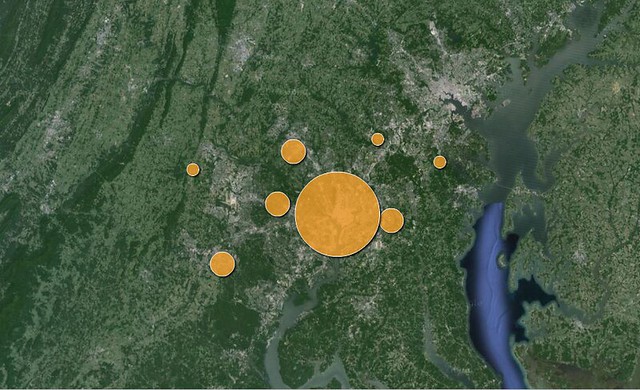
Bubble map: growth in 25-34 population, 2010-2012

Growth in 25-34 population for DC-area counties, 2010-2012, with core jurisdictions aggregated for clarity. 42% of the growth is concentrated inside “the diamond,” which is home to 18% of the region’s population. A similar trend was noted in metropolitan NYC.

1a. Another recent report (by James Hughes and Joseph Seneca, reported by my colleague Stephen Miller) confirms that population growth has overwhelmingly shifted towards the core in the New York region since 2010. Third-ring suburban counties like Dutchess and Hunterdon are actually losing population, overall suburban population growth has slowed by 80% — and the core is on pace to recoup its entire 30-year postwar population loss (1950-1980) in just one decade (2010-2020).

Also echoed: a much larger proportion of young people (20-somethings) are heading downtown. “From 1970 to 1980, suburban counties captured 96 percent of the growth in this demographic. From 2010 to 2013, that figure dropped to 56 percent, with the urban core becoming increasingly competitive.” Since the report is from Rutgers, it defines “core jurisdictions” as including Hudson, Bergen, and Essex counties.

We’ve seen these trends reported in a national (PDF) and even DC context, but it’s worth noting since the NYC area is so huge and its economy has done well since 2010.

2. This week fall, Streetsblog USA will be publishing a three-part article I co-wrote with Angie Schmitt about what befell the Indiana Toll Road P3. Bad timing and bad traffic projections were just the tip of that iceberg.

3. Jonathan O’Connell from the Post reported last week that a new Fairfax County school was repurposed from an abandoned office building.

It’s a clever response to the changing Skyline/Bailey’s Crossroads neighborhood, where an aging housing stock and distance from transit have created a Toronto-esque high-density suburban immigrant enclave. Larger immigrant families have pushed up population density and school enrollment; retail is thriving, judging from the continued traffic jams and low vacancy rates. At the same time, office users have engaged in a “flight to quality,” towards newer and more efficient buildings closer to transit.

What’s more, the cost was very competitive. Fairfax spent $19 million in 2014 to buy and refit the building for 800 students (granted, a few amenities are still forthcoming) — which is right around the national median cost for a greenfield grade school in 2010.

Building type survey: stacked flats in Norfolk

A quick trip to Norfolk last weekend turned up at least one pleasant surprise: a tradition of Chicago-esque stacked flats apartment buildings, here in the rowhouse-heavy Mid-Atlantic. Many were around the Ghent neighborhood, primarily along higher-traffic (probably former streetcar route) streets like Colonial Ave. and Hampton Blvd.

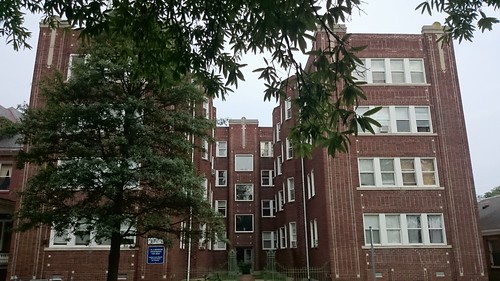
The neighborhood’s lots are a fairly generous 30′ wide, so a double lot can easily fit narrow courtyards between three-story stacked flats:

Ghent, Norfolk

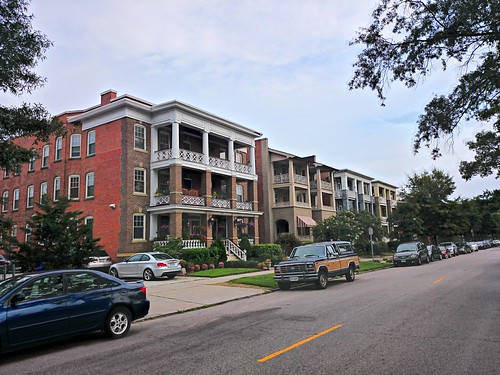
More common, though, were double-lot six-flats — with deep neoclassical porches, reflecting the fact that they are, after all, in the South:

Ghent, Norfolk

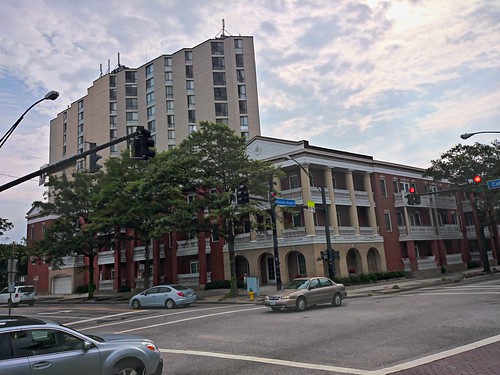
Just as surprising was this liner apartment building, apparently built in 2006 at the corner of Colonial and Princess Anne to mask a 1970s-era serrated senior housing high-rise. The porch detailing is a bit clumsily done — the building is too wide and shallow to match to the six-flats’ columns across the street — but the building holds a busy corner much better than whatever parking lot or open lawn that preceded it. Similar proposals have been controversial even in New York City, so it’s heartening to see a fairly good example.

Ghent, Norfolk

The Chicago six-flat is a particular adaptation to several factors: fairly wide (25′-28′) lots, readily available brick, and a fire code that both largely banned party walls and required two exit stairs. They’re readily identifiable from a front stair off to the side, leaving space for a spacious “front room,” and exposed “back porches.” True to form, the Norfolk houses also had exposed rear exit stairs, even in the absence of alleys.

Alas, the city’s pattern books don’t have much to say about the type.

Central DC: home to both bikes & young adults

Two recent geographic visualizations that describe my little corner of the District (and world):

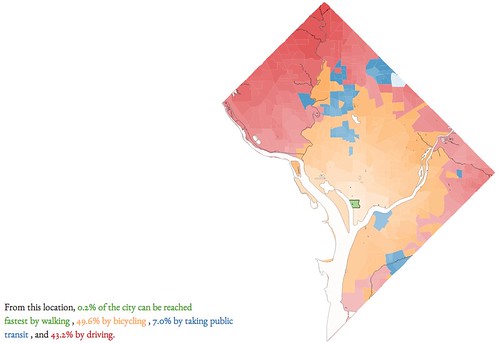
First, MIT’s Media Lab, via their YouAreHere site, generated this map of the fastest mode of transport from my neighborhood to the rest of the city:

youarehere: SW Waterfront

Indeed, this more or less describes my travel decisions: I’ll bike anywhere in the L’Enfant City (where most attractions are) or along the rivers, take transit if going along the Green Line or to Silver Spring, and don’t really bother with the edges of town (including Upper NW).

The highest “percent of the city that can be reached fastest” by bike that I found was 62.7% of the city, from Stanton Park — but for most of the L’Enfant City and Mid-City, bicycling is the fastest way to get to about half the city. For transit, it’s 27.6% from Metro Center. Yet from most of the edges of the city (whether Ward 2, 3, or 8), cars are sadly still too convenient; 80%+ of the city is most quickly reached by driving.

A sad testament to the relative lack of speed of transit in Chicago: even from downtown, only 2% of the city is most quickly reached by transit.

Second, there’s this interesting “cross-section” visualization from Luke Juday at UVa’s Demographics Research Group, which underlines the increasing self-segregation of young people within the urban core:

No, the percentage of 20-somethings in the urban core didn’t appreciably increase. However, since the region’s population is now older, the core’s percentage went from 50% higher than the metro average to 100% higher, as 20-somethings have deserted the suburbs and piled into the urban core. The only area that gained 20-somethings is the near east side of town, which is a theme that the post’s other graphs explore.

And yes, the latter phenomenon just might have something to do with the transportation characteristics outlined in the former.

Why NoMa, not your neighborhood, got $50 million for parks

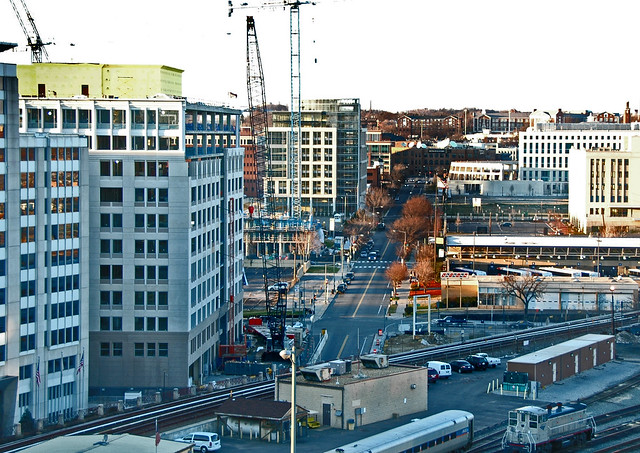
Looking north on 1st St NE

As with other new parks in general, there seems to be a lot of confusion out there about the $50 million that was recently allocated within DC’s capital budget for parks in NoMa.

First, it’s conventional wisdom at this point that upzoning NoMa without requiring any dedications of open space was “flawed.” That said, it probably seemed like a reasonable decision at the time. Nobody expected the area to develop quite as quickly as it did, or with as many residents as it did. (Office workers only require residual park space.) Besides, DC was land rich and cash poor, and thus didn’t have the capital to purchase even what seems now to be relatively cheap land; now, we’re relatively cash rich and land poor. Regret’s easy in hindsight.

Now, where did this $50 million come from? Yes, it’s now been set aside in DC’s capital plan, to be paid out over several years, and those capital funds come from general taxation. But, in another sense, it’s a thank-you to NoMa for the plentiful — and lucrative — new development that it’s brought to the District.

Way back in 2011, the NoMa BID and city councilmembers proposed a tax increment financing (TIF) district for NoMa. The TIF would have captured $50 million from the property taxes that NoMa properties paid, diverting it from the general fund to a BID-administered fund to pay for local parks. That’s a lot of money, sure, but consider that, by 2012, NoMa was paying $49 million each year in additional property taxes (over 2006 levels). Under a TIF, only NoMa taxes would pay for NoMa parks — although it’s true that government spending is theoretically fungible.

DC’s CFO had concerns about the TIF, which they outlined in this testimony to the Council. Their two key complaints centered on accountability of the BID-administered funds, and an odd feature of DC’s governance: its self-imposed debt cap. By diverting general property tax revenues, the CFO argued, the proposed TIF could jeopardize the way DC’s debt-to-income ratio is calculated, and push the District past that magic (and, again, self-imposed) line.

(Note that by borrowing from future tax revenues, a TIF is a nifty way to solve that “land rich, cash poor” conundrum I mentioned above. DC doesn’t have very many TIFs, compared to other cities.)

With that in mind, the Council declined to pass the proposed NoMa TIF legislation, and the NoMa BID instead pushed to include the parks within the city’s general capital budget. Mayor Gray did exactly that in 2013, adding the $50 million to his FY 2014 budget. Subsequently, the Council adopted the 2014 budget.

So, yes, NoMa did get $50 million in tax revenue to pay for parks. However, it did so by paying the city far more than that in advance, and by threatening to withhold future tax revenues. Until your neighborhood can raise similar funds from its own development projects — as the Yards and the Wharf have done, for example, or as Georgetown Waterfront did from the neighborhood’s deep pockets — you can’t necessarily expect the same outcome for your neighborhood.

One more note about local parks: it appears that NPS (which isn’t funded through local value capture) is aware of local trails’ safety shortcomings, including the “Peter’s Point” junction I’ve previously complained about.

Lumpiness: in cities’ property values, and in metro structure

Two only tangentially related thoughts on lumpy growth:

1. Richard Florida in The Atlantic Cities was one of the few major outlets to cover a report from the Demand Institute (a collaboration between Nielsen and The Conference Board) called “A Tale of 2000 Cities.”

The top 10% of American cities account for more housing wealth than the next 90%. The gains in the 2000s were tilted towards the already wealthiest communities.

The report includes an extensive look at a typology identifying nine types of American communities primarily by the strength of their local housing markets, post-recession. In keeping with the name, the results show a striking divergence, with a select handful of healthy markets sweeping up much of the gains — and leaving half of American cities and towns “currently facing fundamental economic pressure.” The report’s summary says: “In today’s global economy, nothing is more important than the strength and sustainability of the local labor market, regardless of whether employers are serving customers in Chicago, Chile, or China.”

If anything, today’s telecom-centric, information economy has resulted in the geography of opportunity getting lumpier, not more diffuse (a prediction going back to Toffler’s “electronic cottages” in 1980) — “reports of the ‘death of distance’ have been much exaggerated.” We telecommuters haven’t all decamped to mountaintops. The most valuable places are becoming even more so: they account for not only an outsized share of wealth but also the gains of recent years.

The underlying economic reality, that human capital is what drives most prosperity today, is why I differ from my colleagues who believe that “investment ready places” can thrive based on previous investments in capital goods like housing. Jane Jacobs agrees: “Many attractive looking little cities stagnate or dwindle; Scranton, where I grew up, is an instance. The determining factors, rather, are economic opportunities.”

(I’ll have more thoughts in a later post about how macroeconomic changes, and in particular greater economic inequality, have left their mark on “gateway cities.” In the meantime, I highly recommend Ryan Avent’s ‘The Spectre Haunting San Francisco,’ which ties in man-of-the-moment Thomas Piketty as well.)

(April 2018 update: Florida points to a 2016 paper by Albouy and Zabek showing that housing value inequality, which was suppressed from 1940 to 1980, is back at levels last seen in 1990 and 1930. Furthermore, this increase is primarily due to inequality within metro areas [e.g., run-ups in favored-quarter prices], which has increased fairly steadily since 1970, rather than between metros.)

On another note, the report also has a good omen for suburban retrofits in “favored quarter” suburbs, in the form of an interesting but familiar disconnect between housing supply and demand in “Affluent Metroburbs.” 58% of housing stock in these communities is detached, “but fewer than half [of those seeking to move] say they are seeking a detached single-family home, compared with a national average of 60 percent.”

Among residents of “historic skyline cities,” a broad category that includes both healthy and less-healthy cities, there isn’t exactly a stampede to the exits. 54% of those who intend to move still “intend to stay in an urban area,” and “nearly one in five” wants to move for better schools (hardly the unanimity some cry about).

2. Alon Levy has a great post about how, on a macro scale, the gridded West has a suburban layout that fosters high-coverage bus networks, whereas more organically settled Eastern suburbs have a dendritic, hub-and-spoke layout that lends itself to commuter rail. (Yes, he points out that Johnny-come-lately Washington has, through Metro, grown into the latter pattern.)

This might go some way towards explaining “the Western Paradox” in Brookings’ findings regarding transit access to jobs. In short, Western cities (particularly in the desert southwest) had a strange spread: many jobs were technically accessible by transit, but low transit-to-work mode shares. The highest mode shares were found in older eastern cities, where a large fraction of suburban service jobs are inaccessible by transit.

A rising Potomac: oh, dam it

30m sea level rise along the Potomac

30 meters of sea level rise would wipe out most of the L’Enfant City, put the White House underwater, and leave the Capitol on a little island — but it could still be managed by damming the Potomac River at key locations, like Quantico or Mason Neck.

Of the world’s major coastal-plain cities, Washington, Rio, and London are among the few that could conceivably be saved by damming estuaries, although I’m sure the Japanese will still try. (Or maybe Houston.)

The same can’t be said for Philadelphia, where the Delaware has a very broad valley, or even New York, where dams at Verrazano Narrows and Arthur Kill will have to be supplemented by very extensive construction to block Long Island Sound. Boston either becomes an archipelago or a polder at a mere 7m of SLR. Even Montreal faces serious property loss over 20m; at 30m Beijing becomes coastal and tides could reach Lake Champlain and the Caspian sea.

Much more than 30m, like the 60m these guys have in mind, and most everything on the east coast below the fall line would be gone. Even dams at the Golden Gate and St. John’s would no longer protect San Francisco or Portland. That’s when inland real estate might become rather more valuable.

Surprisingly, my river-view apartment should be okay up to +10m or so even without a downstream barrier.

Generated using flood.firetree.net/

[Posted to Flickr on 12 June 2012, but today’s Antarctic ice sheet news reminded me that I never cross-posted it here.]

Planning’s fruits include Shaw’s Progress(ion Place)

Progression Place

Eight years on, the District seems to have gotten a nice return on its $20 million investment into Progression Place, the long-awaited development that replaced a city-owned parcel above the Shaw Metro that some called “the block of blight.” Not only has the Mid-City neighborhood gained an employment anchor (DC’s grants went to the office portion) and 50 units of affordable housing, but Progression Place also created a lively block of walkable retail that complements DC’s adjacent investments in the Metro and the Howard Theater. So yes, although you may have to wait a while, sometimes city plans do eventually work according to plan.

From a planning perspective, Progression Place features a broad mix of uses at a fairly high intensity:

  • It anchors a new uptown office district, with 100,000 sq. ft. of new offices being built now for the UNCF and Teach for America. Next door, the Wonder Bread factory has another 98,000 feet, for a combined daytime population at lease-up exceeding 1,000. It’ll be interesting to see who moves in here; even beyond the Digital DC initiative focused here, TFA is known as having a younger constituency than most other federal programs. Although the Green Line has spurred great residential and retail growth, its potential for office is rather less tested.
  • 205 apartments; 1/4 inclusionary, with both low and moderate income price points.
  • The retail tenant mix has a few nationals (Bank of America and Sprint) alongside several established local operators, led off with a critical mass of food & beverage destinations. The merchandising by StreetSense is also first-rate, and not only because I’ve a known soft spot for beer, bakeries, and tea. Having great retail in place (and thus a high Walk Score) will help residential leasing. I suspect that retail is somewhat of a loss leader here, which might explain why the retail and residential are under one owner.
  • There’s underground parking, but the overall parking ratio is about 0.57 spaces per 1,000 sq. ft., shared with the historic Howard Theater next door. A comparable project in the suburbs might include 4-5 times as much parking.

Just as importantly, the building’s architecture pulls off the “vanishing high-rise” trick quite well by setting the tower 35′ behind the storefronts. What could be an overwhelming slab of an apartment building — with a net density of 301 dwelling units per acre, excluding the site’s office and T Street wings — disappears at street level behind the historic row of storefronts:

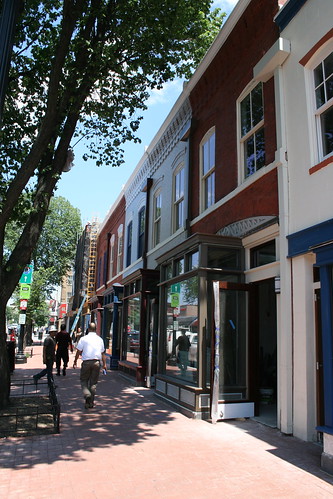
Progression Place Storefronts

The 19,500 sq. ft. of retail is almost entirely housed behind retained and rehabilitated historic storefronts, retaining not only their appearance but also the fine-grained scale — i.e., the neighborhood’s classic rhythm of narrow lots and small bays. The original finishes, like exposed brick, carry through to the interior — but behind the front room, modern new building services are provided in the back of the house, as part of the new structure. This transition (visible in the retail floor plan) is subtle enough to have evaded notice by at least one table of architects I was dining with.

In some respects, this project probably benefitted from having local firms in charge of development and leasing, including layering a complex capital stack, and then selling the property on to a national income-oriented owner. Four Points’ next project might well be downtown Anacostia, a site they’ve been waiting on for several years.

Disclosure: I have no financial interest in any businesses or properties named, or located on named sites.

[Blogging update: now that I’m working at Streetsblog, I might be able to repost some pieces from there, and will continue reposting items cross-posted to Greater Greater Washington or written for other venues.]

Where are DC’s lunch crowds?

Let’s say that you run a small foodservice business that’s looking for a location in DC. Your business offers food throughout the day, but relies primarily on the high-volume, low-margin office lunch trade. Your best-performing locations are in 24-hour areas with high employment density, medium population density, and lots of students. Seeing as Washington is not exactly Cambridge, where should you seek out welcoming crowds?

Conveniently, the Census offers “OnTheMap,” which is a way to generate online maps showing employment density (and commute flows). Here’s an employment density map of downtown DC:

job density map: greater downtown DC

Note how steeply job density drops off along Massachusetts Avenue, the northwest boundary of DC’s CBD: density roughly halves with every single block.

Indeed, in the entire broader metropolitan region, there are only a handful of business districts that meet the median quintile of job density, like downtown Baltimore, Bethesda, Tysons Corner, Old Town Alexandria, and most curiously, an industrial estate in Springfield. However, these areas still have only 1/4 to 1/3 the job density found in downtown DC. As mentioned before, downtown DC has densities far beyond anywhere else in the region.

Washington-Baltimore job density

Population density maps are rather easier to find, and offer a useful contrast; sadly, there aren’t very many mixed areas with both lunch and dinner crowds. Right along the Mass Ave boundary is one option, particularly at the junctions where it’s most permeable (e.g., Dupont or Thomas Circle). Another intriguing possibility is NoMa: it’s one of a few neighborhoods where the 2010 density maps shown above would be significantly out-of-date, and the opening of Union Market has drawn a cluster of foodie businesses to the area.

How Vienna voted itself better, cheaper housing

Christopher Bonanos, in New York magazine’s recent “welcome, Mayor DeBlasio” package, highlights several housing production strategies that could both increase the desperately short supply of housing. Doing so isn’t just the only reliable way to break the price spiral, but several of the tactics provide the city with enough leverage to ensure that the units that it does build (not nearly as many as suspected) better address the city’s workforce housing needs. Building on city-owned parcels like the Javits Center or infilling NYCHA’s parking lots, and sharpening inclusionary incentives to push more workforce and fewer luxury units, might involve political hardball but offer rich rewards.

Anyhow, the idea that the city should take a more aggressive stance on housing production reminded me of the lasting legacy of Red Vienna:

Promised, delivered
[Wall poster by Victor Theodor Slama, 1927. In 1923, the SPD government promised Vienna 25,000 houses; it built 32,000 and many public facilities like kindergartens. Many of the future promises are results of additional housing construction.]

Last year, I wrote a report with classmate Priya Desai [full document] about the aggressive housing construction program implemented by the Social Democratic government of Vienna between the world wars. The Gemeinde Wien program was probably the most aggressive urban renewal program implemented by a democratically elected government during the 20th century — and a lasting success that still provides decent, walkable housing for hundreds of thousands.

Reumann-Hof
[Reumann-Hof along Margaretenguertel, the first large Gemeinde Wien building. See more photos…]

Vienna’s government had neither the developable land nor the patience to continue to address its housing crisis in such a piecemeal fashion (Blau 1999, 154). Further suburban expansion was impossible within a city-state covering just 150 square miles — about the size and population of the present-day City of Philadelphia, but also squeezing a greenbelt within its bounds — and hemmed in on all sides by a hostile province. Meanwhile, city leaders were under great pressure to rapidly expand the scope and speed of their housing development strategy. Doing so would simultaneously address the city’s housing crisis, improve living conditions and social services for vulnerable populations, and boost employment and industrial production from their depressed postwar levels. The city also sought to center its vast new housing estates around communal recreation, health, and education facilities, hoping to raise a new generation of socialist Viennese and freeing urban women from toiling on the land. These new facilities could uplift and unify what were poor and haphazardly built quarters at the edges of the city, reversing the imperial government’s long-time development focus on the splendid central city (167)…

Red Vienna’s success was a triumph of democracy. A city stripped of its empire, with a population on the brink of starvation, mustered its own strengths to accomplish a public works project of historic scope. The Gemeindebauten they built not only met Vienna’s pressing housing challenges; they have left a durable legacy in the city’s physical and social landscape. Today, the Gemeindebauten anchor stable, sanitary, service-rich urban neighborhoods that complement Vienna’s historic core, all of which are wrapped by an intact metropolitan greenbelt. In the course of rapidly building hundreds of Gemeindebauten, the city unerringly kept its focus on efficiently empowering the masses through sanitary housing rather than remaking the city in some idealized socialist image. The pragmatic adaptations to its housing construction program incorporated lessons learned along the way, from the early shift to high-density Gemeindebauten to the later expansion of apartment sizes.

Today, Vienna’s social housing programs house about 500,000 Viennese, about 30% of the entire city population in more than 2,000 housing developments around the city (Wohnservice Wien, 2012). The original vision of Red Vienna extended beyond simply re-housing and reshaping a city but into its everyday social life: “to enrich life through design, and achieve a sense of community through shared kitchens and nurseries, integrating the domestic and the social” (Fiel 2012). As the Social Democrats subtly intended, the Gemeindebauten have indeed socialized generations of Viennese with its ideology: the party has swept every single municipal election ever since.

It was Dan Solomon’s book, wherein he credits the Gemeindebauten with inspiring his intricate affordable housing blocks in California, which first piqued my curiosity about the history of humane housing projects in cities like Vienna and Hong Kong. (Interestingly, in both Vienna and Hong Kong, housing crises were precipitated by not just industrialization and war, but also by an influx of rural migrants. Although public housing allocation in many places now persists as a way to reward “seniority” and exclude newcomers — not unlike rent control — it began as a way to welcome people to the city.)

If there’s one city in the United States which can leverage resources towards building mass housing, and where the term “public housing” isn’t irreparably tainted, it’s New York City. NYC wouldn’t be able to implement Vienna’s demand-side solution of a steeply tiered housing tax that breaks private landlords overnight, but it does have the power to implement various supply side solutions. Getting into the construction game might give the city an incentive to finally tackle unnecessarily high construction costs. Keeping control of land in the hands of public entities, land trusts or limited-equity coops, CDCs, or new L3Cs (low-profit corporations) can ensure that housing serves locals and remains permanently affordable — of all cities, surely NYC can structure financial innovations that can match yield-hungry, tax-shy investors to the steady rent checks (if limited capital appreciation) afforded by non-volatile, low-vacancy workforce housing.

There are plenty of tools, and plenty of examples throughout history, where cities acting alone have built their way out of a housing crisis. The question’s now how, it’s if our mayors have the same will.

Update: Paul Berman makes a similar call in the New Republic, pointing to previous union-built workforce housing schemes across the city: “The Socialists built cooperative apartment houses for working people, some 100,000 apartments or more, which amounts to a small city, and the projects offered and in many cases still offer some of the best housing in New York City for people with modest incomes.” Singapore’s public housing scheme also got attention in the Times.

* That depends on how democratic one views elections in cities like Singapore [photo], or some in the eastern bloc, which also underwent extensive urban renewal in the postwar years, but it’s a sharp contrast to the renewal of Paris, for instance.

Update 2: Somewhat relevant, Chua Beng Huat from NUS points out that Singapore‘s universal social housing owes much to systematic expropriation of land in the early years of independence. Similarly, Hong Kong was working with colonially expropriated land, and Vienna had the gift of former imperial lands just beyond the old city boundaries. Landowners (and sovereign states/provinces) have much greater rights to impose development conditions on their sites than municipalities.

MLK Library as preservation controversy

King Library
Take a photo tour of DC’s MLK Library

With the architectural future of DC’s central public library, the Mies van der Rohe-designed Martin Luther King, Jr., Memorial Library, currently being debated, I’m sharing presentation notes I wrote up for a recent historic preservation class — both a critique of MLK as a work of art, and a timeline of the recent (and still somewhat ongoing) controversy over preserving it as a library.

Overview & Program 

9th & G NW at Gallery Place. 400,000 sq. ft., 3 basements (including parking, storage, meeting rooms) & 4 above ground levels

Constructed 1968-1972 — began just before riots following MLK’s assassination touched even downtown DC, leading for calls to name library after King. (Was only memorial to King in DC from 1970-2011.) Mies died in 1969; other buildings were also in the pipeline but finished before, so this was “last Mies building.” Building is <40 years old (usual cut-off for National Register designation)

Replaced a Carnegie library on Mount Vernon Square (MVS), now home to the local historical society and used as event space.

Has always been DC’s central library, housing numerous special collections and programs including Washingtoniana on 4th floor, civil rights history, children’s, and adult literacy

The International Style

In Poppeliers et al, 92: “Concrete, glass and steel… Bands of glass became as important a design feature as the bands of ‘curtain’ that separated them… Balance and regularity… Cantilever and ground-floor piers”

International Style elements prominent in King library include an emphasis on the structural grid flowing inside and outside the building, wrapping around building with the I-beam mullions. Material palette is classic “less is more” Mies, honestly expressing the structure: black painted steel panels and beams, clear/bronze glass, tan brick, terrazzo and granite floors (no travertine, though), Helvetica Extended font on signage

The building displays many hallmarks of Miesian design (see this great MoMA online exhibit), particularly in its palette of materials, proportions derived from the golden ratio, and the use of ornaments like I-beam mullions. The quintessentially Modern design draws attention to its glass curtain walls and to the seamless flow between interior and exterior design elements through its large expanses of glass — most notably in a recessed ground floor lobby space that extends outside. (Gallery of Mies van der Rohe building photos.)

This is the only Mies mid-rise that I’ve seen; everything else is 1-2 stories or a skyscraper.

Interesting to note that architecture had largely moved on from Mies’ studious minimalism by 1972, embracing sharper angles, a wider palette of materials, and even some decorative flourishes. This was a bit old-fashioned at the time.

History, Threat, Controversy

1972 (Sep): building dedicated

1976: Air conditioning and heating both fail, temporarily closing library twice

1998: Anthony Williams, then CFO of DC (appointed by President Clinton) wins election as mayor, succeeding Marion Barry; Control Board cedes back executive authority. Launches several large construction projects, including Washington Convention Center [2003] and Nationals stadium [2006]

1999: pedestrian mall along G St removed

2003: Williams reported to be interested in $150M new library at old convention center site.

  • Construction began on new convention center (C.C.) north of MVS, opening up site of old C.C. (south of MVS) for development. City owns both C.C. sites. 
  • Hines consortium selected to develop old convention center site, included civic use in program.
  • 9th & G was revitalizing, and the corner would be sought after for retail, office, or another cultural use — numerous office redevelopments along 9th St, many recent retail and private museum developments along G: renovated Portrait Gallery, Spy Museum, Crime & Punishment museum, Verizon Center, Hotel Monaco, etc.
  • Many other cities (particularly in West) have built grand new central libraries as part of downtown redevelopment schemes, reflecting new library programs: Seattle (Koolhaas), San Jose, Salt Lake, Denver, Minneapolis, Montreal, Vancouver BC. Interestingly, many of these cities were replacing Brutalist libraries also built circa 1970.

2004: Williams convenes Future of Public Library System task force. DC Preservation League, in nominating the site to its 2004 Most Endangered List: “[T]he only building in Washington, DC by any of the ‘big three’ (Mies, Wright, and Le Corbusier) Modernist architects. The Martin Luther King, Jr. Memorial Library has stood as the only monument to Dr. King in the nation’s capital for the past 30 years… the only [library] ever designed by Mies, was constructed with a flexible interior plan and the capacity to add a fifth story when needed…”

2006 – The big push by Williams

  • January: task force appointed by Williams recommends $450M overhaul of libraries, including $280M for new central library (includes $100M opportunity cost of taking site from Hines) and $170M for neighborhood libraries. “Besides being depressing, and aside from all the deferred maintenance, the Mies building is a very inefficient building,” said developer Richard Levy, who heads the library board’s facilities committee.
  • February: federal budget includes $30M match for $70M in local funds for library system construction. (Laura Bush was a librarian.)
  • May 1: Library Transformation Act introduced by Mayor Williams into Council, requires “preserves the historic character of the building.” Estimated revenue of $60M from a 99-year lease + $50M from a 30-year PILOT (TIF-like mechanism that applies to leased land), leaving a $70M funding gap for the new library, to be filled by $40M TIF + $14M federal. Referred to council committee, not voted out
  • May 2: Hines unveils master plan for old convention center site, includes 2.5 acres for “potential new library”
  • Summer: Public Library Foundation solicits additional schemes (e.g., adding wings surrounding Carnegie Library)
  • Summer: DC Preservation League & Committee of 100 nominate library as landmark, raise concern over cost of new library
  • September: Adrian Fenty wins Democratic mayoral primary (and general election in November); during campaign, supported Williams plan for new central library

2007 – Fenty backs down

  • January: elevator replacement begins (they last worked in 2001)
  • Spring: discussions begin with library, HPO, and “interested groups”
  • June 27: Fenty shelves new library plan, report on library repairs
  • June 28: HPRB unanimously votes to list King Library as landmark, forwards to National Register; library director testifies in favor
  • July: elevators fixed
  • September: MLK Design Guidelines Committee formed, DC Public Library Foundation retains firm to draft Design Guidelines
  • November 22: added to National Register (building is 35 years old)

Key Issues

  • Does a building under public ownership need to be landmarked?
  • Are public owners necessarily good stewards? Will they respect design guidelines to shape future updates?
  • Can a public owner perform “demolition by neglect”?
  • How can public owners benefit from preservation incentives, since tax incentives mostly apply to rented commercial buildings?
  • How do assumptions about construction costs shift public dialogue about preserving historic structures?
  • Are construction costs for replacement vs. rehab comparable?
  • Are all well-used public buildings going to become landmarks?
  • Do “keystone” public buildings need to be new in order to have an economic development impact? Is it easier to finance new buildings? Is TIF/PILOT funding transferable between sites?

Rationale for Preservation

The King library is a unique example of a mid-rise Mies building, besides the numerous other “only” distinctions that it holds. It deserves the protection of local and national historic recognition, as a locally unique example of the 20th century’s most notable architectural style. As a “universal space,” it is uniquely capable of adapting to changes in library programs as media continue to evolve; it was designed with the flexibility to last 150 years.

Unfortunately, accretions over the years have diminished the interior’s openness — a hallmark of Mies’s low-rise pavilion structures. However, these can be repaired and likely will, given the library’s renewed commitment to design.

DCPL recently initiated renovations, replacements, or expansions at 15 branch libraries, including historic buildings in Georgetown and Mount Pleasant. Several of the new libraries have very striking modern designs, including those in Shaw and Ward 7.

Kennicott writes in the Post: “Mies’s vision was symbolically perfect — at the time — for a library. It emphasizes a clear view into a glass box for books… These layers of accumulation, each a small response to a community need, deprive the building of the silence it needs to speak clearly. The rhythm of Mies’s black I-beams, which give the tiers of windows above street level their basic meter, can’t be heard against the low but constant cacophony of competing messages that have been attached to the building.”  

Still, is Mies’ Universal Space really functionally suitable as a library? The reading rooms are nice, and it has many library-specific features like book elevators (dumbwaiters), but:

  • Dark, undersized corridors in interior of building
  • Circulation confusingly hidden along back or sides of building — most of the new libraries handle circulation very well, epitomized by Seattle’s glowing escalators
  • Stacks exposed to light (even indirect, bronzed glass)
  • HVAC problems over the years contribute to deterioration of materials
  • Owners don’t have resources to maintain fixtures/furniture, fix or replace systems
  • Potential energy efficiency implications of old glass
  • “Covered front porch” attracts vagrants; there’s no way to better activate the space without compromising the front wall of building

Stipe’s prologue provides a few rationales that might apply to a defense of MLK Library:

  • “1. Physically link us to our past” — libraries are places of great collective memory 
  • “4. Relation to past events, eras, movements, and people” — MLK memorial, an International Style exemplar in a prominent location, and a formidable investment in Downtown DC at a time of precipitous decline
  • “5. Intrinsic value as art, designed by some of America’s greatest artists” — only structure in DC by a world-leading Modernist architect (well, except maybe Breuer)

Stubbs, on the other hand, argues “To save the prototype” and only the prototype: “There can only be one true original of an authentic work of art, although copies can be made.” The King library is one of many of Mies’s works, and not his best; it suffers in many ways. It’s an adept copy of Mies’ groundbreaking high-rise or pavilion works, but it suffered from a shortchanged budget and the form (reminiscent of a truncated Mies high-rise) is too unwelcoming for use as a library, which involves extensive internal circulation. Stubbs takes a rather dim view of modern architecture in general: “Tens of millions of buildings from this period are found throughout the world; many have neither proven durable nor served their inhabitants well… In the early years of the world’s adoption of the International Style, protection of interior spaces from direct sunlight… was minimal or nonexistent…”

Bibliography

Philip Kennicott, “Mies’s modernist D.C. library building is getting a complementary companion,” Washington Post, May 30, 2010, E09.

“Most Endangered Places for 2004: Martin Luther King, Jr. Memorial Library,” D.C. Preservation League, accessed 5 September 2011, http://www.dcpreservation.org/endangered/2004/mlklibrary.html

John C. Poppeliers, S. Allen Chambers, and Nancy B. Schwartz, What Style Is It (Washington: National Trust, 1983), 92.

R. E. Stipe, “Prologue: Why Preserve?” in A Richer Heritage: Historic Preservation in the Twenty-first Century (Chapel Hill: UNC, 2003), xxvii-xv.

J. Stubbs, “Why Conserve Buildings and Sites?” in Time Honored: A Global View of Architectural Conservation (Hoboken: 2009), 33-63

G. E. Kidder Smith, Sourcebook of American Architecture (Princeton: Princeton Architectural, 2000).

Alice Sinkevitch, ed., AIA Guide to Chicago, Second Edition (New York: Harcourt, 2004).

“King Library,” Docomomo, accessed 6 September 2011.

Kriston Capps, “For once in a public building in Washington, there is excellence throughout,” Grammar.Police, accessed 3 October 2011, http://grammarpolice.net/archives/000929.php

“CityCenterDC In The News,” Hines|Archstone, accessed 3 October 2011, http://www.oldconventioncenter.com/news_inthenews.php

“Designation Procedures and Criteria,” DC Preservation League, accessed 3 October 2011, http://www.dcpreservation.org/districtscrit.html

EHT Traceries, Inc., Martin Luther King Jr. Memorial Library Design Guidelines (Washington: DC Public Library Foundation, 2008?), 22-26.

Rob Goodspeed, “What Will be the Fate of Washington’s Martin Luther King Jr. Memorial Library?,” Goodspeed Update, accessed 3 October 2011, http://goodspeedupdate.com/2006/2051

Rob Goodspeed, “New Central Library Plans ‘Shelved’,” Goodspeed Update, accessed 3 October 2011, http://goodspeedupdate.com/2007/2113

“Library Transformation Act of 2006, Bill 16-734,” DCWatch, accessed 4 October 2011, http://www.dcwatch.com/council16/16-734.htm

“Martin Luther King Jr. Memorial Library the newest DC Landmark,” DC Preservation Advocate (DC Preservation League newsletter), Summer 2007, 1.

Elissa Silverman, “D.C. Library Gets Sorely Needed Lift,” Washington Post, July 24, 2007, B1.

Debbi Wilgoren, “Overhaul Urged For D.C. Libraries,” Washington Post, January 18, 2006, A1.

Debbi Wilgoren, “Libraries Could Get Federal Funding,” Washington Post, February 6, 2006, B1.

How would a carbon tax affect DC?

Nature's fuel

The right thing in climate policy for all the big countries is a carbon tax, which is simpler and less vulnerable to fluctuations in emissions than cap-and-trade schemes.” – The Economist

A recent discussion spawned the idea of implementing a carbon tax within DC, and so I wrote up this brief.

What and whom would a carbon tax affect?
A carbon tax, technically a tax upon the carbon content of energy and fuels, would primarily affect electric generation, gasoline & diesel, and heating fuels (natural gas, fuel oil). A narrower tax could affect only fuels, or electricity. The UK’s carbon tax, for instance, taxes various energy sources at differing rates.

Who consumes energy in D.C., and how?
The EIA reports that DC’s total energy consumption is 70.5% imported electricity, 18.7% natural gas, 7.9% gasoline, and 2.7%fuel oil. 66.3% of energy is consumed by the commercial sector (i.e., offices), 19.9% by residences, 12.1% by transportation (i.e., cars & trucks), and 1.6% by industry.

Of carbon emissions within DC proper in 2010, natural gas was 54.6% and petroleum 45.2%. Because DC imports all of its electricity, it has the least carbon intense economy among the states, emitting 91.6% less CO2 per dollar of GDP than the US average. This does not, however, include fuel burned for electricity used by DC end users; 59.2% of DC electricity originated from fossil fuel generators.

Have carbon taxes been implemented elsewhere?
Yes, several jurisdictions have. Finland and Sweden were first, in 1990 and 1991. In North America, the provinces of British Columbia and Quebec have carbon taxes, as does the city of Boulder (on electricity only). Dozens of multinational corporations, including most oil majors, use an “internal carbon price” to evaluate corporate decisions: ExxonMobil’s is $60/ton.

How have these fared?
British Columbia’s carbon tax, unique in its broad reach even though the province works within the framework of a high-carbon-emitting country, “has been remarkably effective in reducing fuel use, with no apparent adverse impact on the province’s economy,” according to a University of Ottawa study. GDP growth paralleled Canada’s, income tax rates fell to the lowest nationwide, and fuel consumption fell by 17.4% per capita.

Have carbon taxes been proposed in U.S. states?
A bill has been introduced in the Massachusetts legislature, and a ballot measure is currently collecting signatures. In Washington state, Governor Jay Inslee has specifically directed a legislative commission to study a carbon tax, and an NGO has proposed draft legislation.

What level of tax would be appropriate?
An easy guideline for measuring the impact of a carbon tax is that a tax of $1 per ton of CO2 results in just less than 1¢ in tax per gallon of gasoline. DC’s current gas tax rate of 23.5¢ per gallon thus implies a tax rate of $27.98/ton of carbon dioxide. (Maryland’s gas tax is now 32.10¢ per gallon.) This rate is very similar to the C$30/ton that British Columbia charges, and near the midpoint of the $5-65/ton “social cost of carbon” price suggested by the White House.

Where do proceeds of carbon taxes go?
In most cases, as in British Columbia, carbon taxes are a “tax swap,” whereby other taxes — notably on income, capital, etc. — are reduced. Some bills, like that proposed by Citizens Climate Lobby, feature a “dividend,” or direct rebate back to taxpayers. Sometimes, climate actions are funded with a portion of proceeds as well; the Massachusetts bill, for instance, directs $90 million in revenue towards transportation debts and 10% to clean energy. In DC, ambitious plans have been launched, but not yet funded, for transit expansion (by WMATA and DC) and for cutting emissions, and a carbon tax would be one way of funding implementation of those plans. (Boulder’s tax was implemented to fund its climate action plan.) In addition, DC currently pays its annual operating subsidies for both WMATA ($275 million in FY2014: $58M bus, $42M rail, $22M paratransit) and DDOT transit out of general funds, and a carbon tax could be a stable, dedicated source of transit operating funds.

Who are winners and losers?
A carbon tax that includes electricity would have a much broader base and thus wider impact. It would primarily affect the office sector, and as such mostly commuters, but it might also attract Congressional attention. A carbon tax solely on fuels would mostly impact building heating/cooling; again, this would largely fall on offices, but also on DC residents’ heating bills.

Although a carbon tax typically is somewhat regressive, there are many ways to design a carbon tax to mitigate impacts on lower income consumers. In particular, a DC carbon tax could use targeted measures to offset higher home heating costs for low income residents: income tax credits, weatherization or LIHEAP assistance, and transit improvements.

Further reading
Sightline Institute: Carbon Tax Fact Sheet
Resources for the Future: Carbon Tax FAQs
Citizens Climate Lobby: DC Chapter