CNU conversations: Can we build authentic, small-scale communities that subtly adapt to change?

A few thoughts on a CNU 23 presentation by Russell Preston and Matt Lambert about their ongoing work on defining and fostering authenticity within New Urbanist places. Other thoughts will be forthcoming, as I write them up.

Once and forevermore

Do design and development really disrupt enduring neighborhoods? This block in Guangzhou, China, changed tremendously, but in some ways didn’t change at all.

1. Role of design
Flexible, adaptable buildings allow uses to change in their natural cycles. Crucially, notoriously fickle uses like production and retail must be given room to adapt. Not only do shop concepts and merchandise change, but the volume of these uses needed rises and falls with economic cycles. Tactical urbanism has shown us that design details may not be quite as important as broader questions of scale and program. Such a “stage set” approach may be especially appropriate in an era where programs frequently change.

2. Small scale
To the extent that smaller, more “honest” enterprises can be designed around, perhaps the best physical model relies on creating adaptable space along many smaller frontages — a fractal approach, as it were. More marginal businesses have long turned to side streets and passages to be near, but not in the middle of, the retail action.

Since these frontages are inherently not as valuable, they can remain affordable even amidst higher rents for premier locations nearby. Just as coach houses are “naturally affordable housing,” consider the value of alleys, passages, and even enclosed arcades as “naturally affordable retail.”

Another CNU 23 session, ostensibly about pedestrian malls, featured examples of pedestrian-only ancillary passages where smaller retailers thrive just off Main Street. Beth Anne Macdonald spoke about Division Street in Somerville, N.J., where commerce has thrived after the street was turned into a pedestrian mall in 2012. Division (like Bethesda Lane, which Tim Zork presented at the same session) was intended as shared space but ended up being car-free 24/7 — a testament to that type’s tremendous flexibility. Despite its Spartan design of concrete and streetlamps, Division is thoroughly programmed year-round.
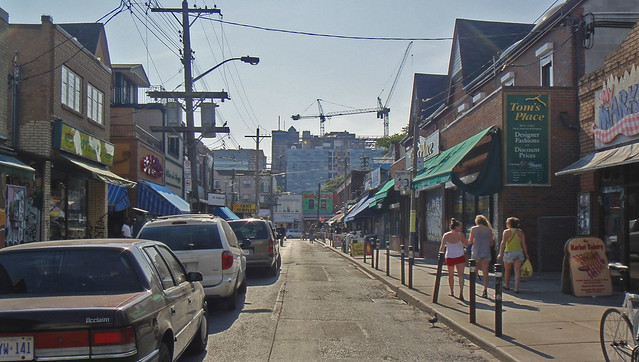
Downtown in the distance

Kensington Market in Toronto has a built environment that’s a terrible jumble of everything, but it gets the scale — and thus the feel — just right. It’s car-free on summer Sundays, thanks to gates that cost just $180,000.

Similarly, I’m setting up a walking tour in October of how retail is thriving away from the main streets in Georgetown, along its alleys, side streets, and the pedestrian-only C&O trail. The neighborhood’s historic scale — its small blocks and small spaces — and relatively flexible zoning permits this natural shift between uses. That these processes can work illustrates two chapters in “Death and Life”: small blocks and aged buildings.

Of course, financing these spaces can be a challenge. Yet this country is plagued with throwaway retail space, much of it ancillary to upstairs office and residential. Whether the ground floor of an apartment complex is given over to “amenity space,” or to small retailers who may or may not reliably pay rent, shouldn’t be of much interest to the bankers — and, arguably, many of the apartment tenants might well prefer the latter! Designing the public and private spaces with the flexibility to accommodate whatever uses might be demanded could prove a greater challenge.

At the Louisville NextGen meeting, the one example of a new-construction informal street market that I could think of was a set of buildings in Downtown LA’s Fashion District. They appeared to have been built largely as paid parking garages, for which there are many local comparables, but had clear-span ground floors to accommodate small wholesale clothing retailers. It was awesome.

3. Policy and non-market structures
Market prices for prime space in gateway cities have — due to high outside-investor interest — reached heights that stifle innovation and organizations that evaluate their impact in primarily non-market means. Furthermore, not all institutions are lucky enough to have purchased their property “back when it was cheap.”

The 5M model (final program & renderings) has promise — identifying “community anchors” more broadly than just non-profits, offering free or discounted space to these community serving entities, and profiting by selling ancillary services. The other innovation is that this project’s pro forma has been turned on its head: the community space is accepted as a given at the starting point, and the market-rate buildings sized accordingly. (Since every development in San Francisco is discretionary, you might as well ask for the moon.)

But what about the next community that comes along? Will tomorrow’s fresh ideas and institutions have similarly protected spaces? Is this model flexible enough to accommodate new institutions, or shifting missions among the existing institutions? Rather like rent control, this approach privileges those who showed up at the right time, excludes newcomers — and leaves the question of capital renewal unanswered. Could a similar space, like [innovation] District Hall, be continually refreshed with new concepts and competitions on a regular basis?

(We had a detailed conversation about a potential corporate structure to ensure long-term community affordability on the following day. Notes about that conversation are forthcoming.)

4. Chinatowns, new
At least some suburban communities have successfully retrofitted smaller scale uses into strip-mall suburbia: the “ethnoburbs” that Asian immigrants have settled across North America. Even shiny, new buildings still foster small businesses, due in part to high density, tiny footprints (see above), management that understands the business models, and perhaps other factors that could be identified.
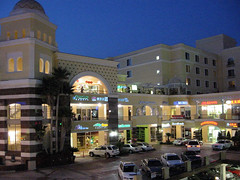
Meanwhile in ethnoburbia

San Gabriel, Calif.

These retail centers can be built in a more transit-oriented manner; the vertical malls cropping up around Flushing have a mind-boggling spatial complexity. The vertiginous skyscrapers of Hong Kong, clustered around mass transit, have organically evolved 3-D pedestrian networks so intricate that they defy description, but which host all sorts of authentic communities.

5. Chinatowns, old
These neighborhoods appear to maintain a remarkably stable level of economic diversity — of activities, of economic groups — and appear, from the outside, to have stable populations. Yes, some of this stability is real, and partially results from capital that gets locally recycled, through local institutions.

But what looks like stability from the outside also hides considerable turbulence under the surface. There’s constant upheaval among the community’s participants, as high in-migration balances out community members “lost” to assimilation. By and large, assimilation (as institutional racism declines/morphs) has undermined most of American cities’ other mixed-income ethnic enclaves, but since Han Chinese easily outnumber every other ethnic group in the world, there will always be a inflow of migrants — or will there?

Another less-than-replicable factor behind Chinatown’s staying power is a lack of effective enforcement (“It’s Chinatown, Jake”). Thus, things don’t quite happen to code; it’s cheaper, but somebody might get hurt. Whether that trade-off is worthwhile is your judgment call, but it does illustrate that over-regulation might be a factor in driving high costs.

6. Community change and the word “authentic”
It’s worth thinking through a bit more about how “authenticity” (see this discussion by Sharon Zukin) like any other aspect of community character, will move in cycles. Every community changes its participants, and is changed by its participants. The people who come after us have different experiences, and what we do shapes how they understand the world around them. This feedback loop can either result in a virtuous, or a vicious, cycle.

The pace of change also matters. Change is literally a fact of life, but violent upheaval is rarely welcomed. Many communities today are upset by the roller-coaster ride that property markets have put them on, with prices rising much faster than social infrastructure can adapt.

What appears authentic and novel to us will seem workaday and fake to someone else: If I cooked one of my grandfather’s recipes for you, you’d see it as “authentic” and he’d see the exact same dish as “fake.” It’s exactly that interplay, exchange, and evolution that makes cities — and especially American cities — such interesting and exciting places. It’s a tough edge to surf on, to simultaneously embrace and resist change, to honor established practices while inventing new ways, but it’s a worthwhile endeavor.

High rises’ high costs, part 3: Maintenance costs

Earlier, I’ve written about how high-rises face higher up-front costs, stemming from both lower efficiency and higher construction costs. But the high-rise cost penalty doesn’t just apply to upfront construction costs — their ongoing maintenance expenses are typically higher than for low-rise buildings.

Eastgate Village & Mercy Hospital

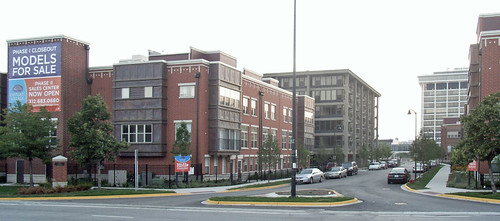
Even within this one development, condo fees for 1-bedroom units are 30% higher in the renovated mid-rise than in the new low-rises.

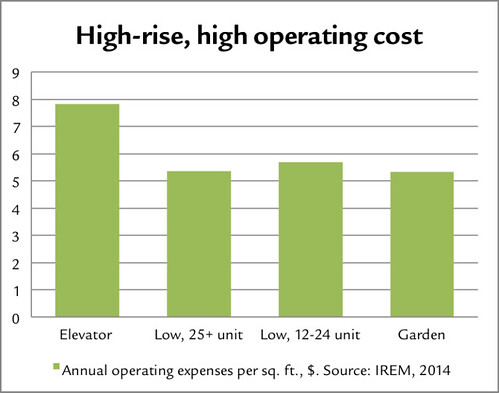
The Institute of Real Estate Management publishes an annual benchmarking report for property managers, showing average operating expenses for 717,000 apartments nationwide. IREM’s 2014 report found that “elevator” buildings (both mid- and high-rise) have operating costs that are 43% higher per square foot.

IREM apt ops data

Frank Schliewinsky, writing in Strategics Vancouver Condo Report, analyzed MLS data to find that “Monthly strata [condo] fees for low-rise projects tend to be less than those for high-rise projects.” Fees averaged 22-25% higher per unit in high-rise buildings across metro Vancouver, both in low- and high-cost markets, and both for new construction and older buildings.

(Factors that may explain the discrepancy between the two figures may relate to definitions — many low-rise buildings still have costly elevators — and/or the smaller unit sizes typical in high-rises.)

Some of these increased costs stems from the upfront construction: high-rises have more materials and bigger systems to maintain, and their less efficient floor plans mean more common areas have to be maintained.

Another curious factor is at work, though. The higher costs for high rises creates a vicious cycle: Higher costs (per square foot, and per unit) mean higher rents are needed to justify high-rise construction. Those higher rents can only be achieved by aiming for that segment of the market which wants to pay higher rents — by definition, the luxury segment, who can be enticed to pay higher costs by adding ever more amenities. Those amenities further increase costs, both up front and in the long run.

None of this is to disparage high-rises, of course: I live in a high rise, after all, and enjoy its sunlight, views, sound attenuation, and proximity to services. (And, frankly, don’t really use the high-cost swimming pool very often.) When I was younger, though, I lived in lower-cost low-rise apartments and aspired to someday live in the sky.

The intrinsically high costs of building and maintaining high-rises makes it dangerous to recommend that high-rises will absorb a large share of housing growth — particularly in metro areas that already suffer from high housing costs, which don’t need even more housing that’s inherently costly.

(Again, to be continued.)

High rises’ high costs, part 2: Land-efficient, but not floorspace-efficient

clearing

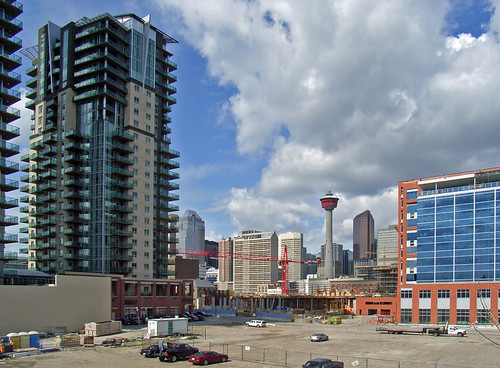
High-rises, like these in Calgary, may be land-efficient, but aren’t really floorspace-efficient.

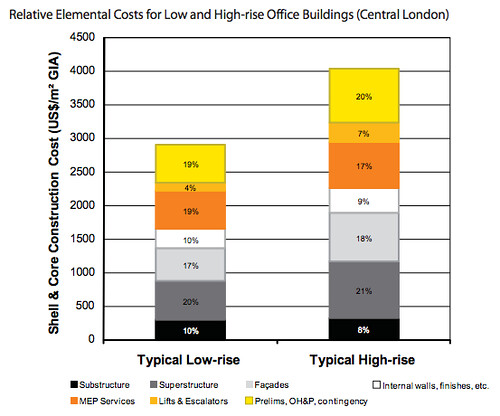
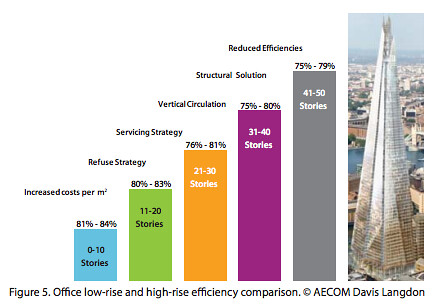
I wrote earlier about how higher per-square-foot construction costs make high-rise housing considerably more expensive to build than low-rise housing. Those higher prices don’t stem from any one factor; costs for everything increase as buildings get taller (courtesy James Barton and Steve Watts of Davis Langdon/AECOM, in a CTBUH Technical Paper):

Elements of higher cost for high-rises

Increasing building heights doesn’t linearly decrease the cost of land per unit, as economic theory suggests, since taller buildings cost more (and in non-linear ways): they cost more to build, and they inherently waste more of their floor space.

The “efficiency” of high-rise (and mid-rise) buildings is typically lower than for low-rise buildings, and as Tom Steidl points out, especially so under American building codes. “Efficiency” in this context is an architectural term describing the “net to gross” ratio, of “rentable” or net internal area to gross internal area. As Steve Watts of Davis Langdon/AECOM points out in CTBUH Journal:

Tall buildings are less efficient than low-rise schemes because:
– Structural frames and core walls are larger and thicker
– More area is taken by plant and risers
– Smaller floor plates result in relatively high space-taken by lifts, stairs, circulation, etc.

Floorplate efficiencies of high-rises at various heights

Essentially, connecting all of the stuff above down to the ground requires taking space away from all the floors below. Every additional floor requires a tiny slice of every single floor below. The result is that 15%-25% of a high-rise’s floor area is typically wasted space. Steidl helpfully shaded these diagrams of towers in Vancouver (88.8% efficient) and Los Angeles (80.9% efficient), with net square feet in orange:

Ground-related housing types minimize this efficiency loss by eliminating interior hallways and vertical circulation. A typical Chicago three-flat achieves almost 90% net-to-gross efficiency, and every additional flat makes the design even more efficient — six flats can be accommodated with the same circulation area, yielding almost 95% efficiency. Alternate designs, like Montreal’s exterior-stair triplexes or the “Charleston triplex” (a Torti Gallas invention at King Farm that gives three flats their own internal staircases) can yield even higher efficiencies, approaching 100% — while achieving densities exceeding 30 dwelling units per acre.

Putting the two together, a high-rise unit faces a 15% efficiency penalty, and a 40% (or higher) cost penalty per square foot. The compound penalty of these two factors amounts to a 60% (or higher) construction cost premium per high-rise unit. Plus, ground-related housing can often be “self-parked,” i.e., can meet parking requirements with surface lots rather than costly multi-story parking.

What’s more, interior common areas don’t just have to be built today; they have to be maintained tomorrow — a subject for another post.

Redeveloping multifamily: condos are forever, co-ops perhaps less so

“A diamond is forever, a suburban R-1 zone nearly so” – Jonathan Levine, “Zoned Out”

And what’s even more permanent than an R-1 zone? A condominium.

Dearborn Park, Chicago

See those townhouses tucked among the trees? Hope you like them, ’cause they’re there, forever. (CC photo of Dearborn Park, Chicago, by Doug Nichols)

The saga of the Frontiers West condominium along 14th St. NW — as told by Lydia DePillis a few years ago — recently came up in conversation. A few years ago, multiple developers attempted to buy the entire complex, but ran up against an implacable foe: consensus. “Redeveloping any one of the parcels,” DePillis reports, “would require unanimous consent from the owners of all 54 units—so just one person could doom any deal.”

Frontiers had been built as public housing in 1977, an attempt to revitalize a neighborhood still deeply scarred by riots a decade earlier, and was sold off to tenants in the 1990s. (Jack Kemp introduced a Thatcher-esque scheme to sell public housing to tenants during the Bush 41 administration.)

Frontiers West’s unusual backstory created an unusually wide “rent gap” (the difference between value as-built and value as highest and best use) at that location. However, condominium ownership is over 50 years old in America, and thus the first stick-built condos are probably running up against their expected service lives. For those buildings, the economics of depreciating structures will soon run up against appreciating land values, and associations with structural problems (and in good locations) will have to face tough decisions. Says one condo owner outside Vancouver (probably the most condo’d city in North America), “We don’t have a system that allows people to understand what to do at the end of their unit’s life.”

It’s not necessarily impossible to buy every single owner out. MetroWest in Fairfax is being built on what was a low-density subdivision, where every owner consented to the sale. In a single-family situation, it should be possible in most cases to buy most of the parcels and leave a few “nail houses” outstanding.* Eminent domain, as at Atlantic Yards in Brooklyn, is also an option in situations where legal justification can be found.

Steven J. Smith found one recent example of a 30-unit condo — a singularly awful 1970s building in Chicago’s Lincoln Park — that had been re-assembled. (Maybe it helps that Illinois law requires only 75% of units to force an en-bloc sale.) But for other examples, he points overseas to Singapore and Japan — both even more urbanized than the USA, but also both societies where achieving political consensus is easier (their effective one-party rule being the prime example).

Singapore took Thatcher’s idea of council-flat ownership to an extreme, encouraging Singaporeans to purchase their public housing units with their social pension funds. (It’s also a clever way of locally recycling capital to fund their ambitious housing scheme.) Now that some of these buildings have become attractive redevelopment opportunities, the government has begun a “selective en-bloc redevelopment scheme” (or SERS, in the acronym-happy Singaporean government-speak) for scores of 1950s-1980s concrete-slab tower blocks, provided that 80% of owners consent. It helps that HDB flats are technically not owned, but instead are tied to 99-year leases; this gives HDB the authority to do things like impose anti-speculation rules to keep prices stable between the time redevelopment is announced and all individual contracts close.

Speaking of unique authority, this is one area where the greater legal flexibility granted to cooperatives, rather than condos, can come in handy. Whereas New York condominium law requires 80% approval for an en-bloc sale, its cooperative law only requires 2/3 consent to dissolve the corporation. For the particularly obstinate, District of Columbia law also permits cooperatives to kick out individual members through a simple majority vote.

Northern Virginia again offers a local example, where the Hillwood Square co-op in Falls Church sold itself after a two-thirds vote:

“They were faced with the prospect [of] spending a significant amount of money to upgrade the property’s underground infrastructure… ‘Hillwood was one of the most complicated as well as the most rewarding land deals we have had the opportunity to represent in our careers,’ [broker Mark] Anstine said in a joint statement”

A condominium next to the Huntington Metro has put itself up for sale via an RFP process, with an 80% approval threshold and a requirement that replacement units be built and offered to current residents first.

An interesting application of a cooperative scheme to urban redevelopment challenges could involve capitalizing new cooperatives with existing smallholdings, or redeveloping part — but not all — of a co-op. A co-op, as a stock corporation, has relatively few restrictions on its property holdings and financial activities — especially compared to a non-profit condominium association, which typically would have to distribute excess funds to members.

Land assembly for major projects in Japan, like Roppongi Hills, can be undertaken by pooling properties together into a “Redevelopment Association.” By guaranteeing equity participation in the new development (and new on-site replacement housing), this approach ensures that landowners share equally and fairly in property value gains — thereby removing individual owners’ worry that they sold out too early/cheaply.

Cohabitation Strategies included an equitable-growth idea similar to this strategy — what it called “Cooperative Housing Trusts” — in MoMA’s recent “Tactical Urbanism” exhibit. These community land trusts could aggregate and sell otherwise unusably-small quantities of air rights, and reinvest the proceeds into permanently affordable housing. (It was the one interesting idea in the entire exhibit, IMO.)

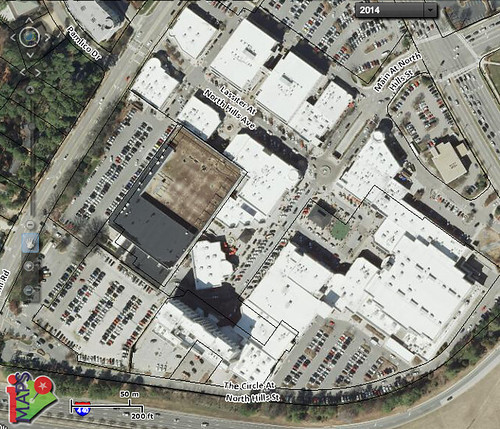
* No examples come to mind off-hand, but this is a common practice in shopping mall redevelopments. Department stores that own their own land have been excluded from many redevelopments that engulf them, as with the aging JCPenney at North Hills in Raleigh:

Raleigh, North Hills on iMAPS

The opposite situation was bound to happen someday, and of course it’s flailing-about Sears that is leading the way. It’s not just subdividing its boxes and adding new subtenants like Whole Foods, but in at least two cases (at Aventura, North Miami’s fortress mall, and Metrotown outside Vancouver) it’s going rogue and doing its own mini-de-malling without permission from its “landlord.” Sears’ footprint at Aventura will shrink almost 90%, to just 20,000 feet — maybe their agreement with Simon requires that they not abandon the site entirely.

NIMBYs: loss aversion and, geography of, and rhetorical fallacies of

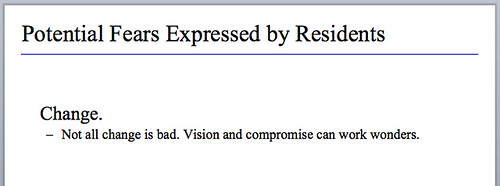
Not all change is bad.

It won’t rank high in the annals of “speaking truth to power,” but it’s interesting to read Washingtonian writer Marisa M. Kashino’s take on DC’s systemic housing underproduction: “But the District hasn’t shown much nerve when it comes to making big changes… Which brings us to the unusual power wielded by the city’s NIMBYs.” (City magazines usually aren’t known for taking their wealthy readers to task.)

But Megan McArdle, writing for Bloomberg View, says this is an unlikely scenario. Writing about the current back-and-forth regarding DC’s zoning, she says it’s been “Two steps forward, sure, but such little steps, and now we’re looking at going backward again.” But why are zoning fights so inherently difficult? McArdle points to cognitive biases: “At the heart of the matter is loss aversion: people will fight harder to preserve something they have than they will for a potential gain.”

Three related thoughts on NIMBYs:

1. History doesn’t offer much encouragement. In theory, a clear majority of citizens would benefit from abundant housing, but they rarely voice broad support on behalf of their minimal gains — and certainly rarely can drown out the fewer but louder voices who could lose benefits under the current system. For example, Red Vienna democratically chose to tax the rich to build mass public housing, but it took an abominable housing crisis (and the World War-spurred collapse of an empire) to force the electorate into action.

2. It’ll be interesting to see how similar politics plays out in other policy arenas — a thought that came to mind when listening to a recent talk about the feasibility of “deep decarbonization,” i.e. reaching the -80% CO2/2050 goal necessary to stabilize a changing climate. Although the study found that total energy services costs will increase only slightly — by about 1% of GDP by 2050 — it found that, within that energy services budget, the balance will shift from fuel providers to capital.

A clean energy economy will build renewable power plants (i.e., cap ex) which cost more upfront, but thereafter will throw off energy with very little ongoing costs. In the case of “negawatts” from efficiency, highly efficient or even net-zero buildings cost more up front, but cost much less to operate and maintain. This is a huge contrast from the existing system, whereby fuel providers extract huge rents from the rest of the economy.

Geographically, this shift should benefit most places, since green power is widespread — somewhat like Portland’s Green Dividend. However, the relatively few places that currently live off of fossil-fuel “resource rents” will lose out, and will fight back. Even though just three small states produce almost 60% of US coal, their representatives’ passion for coal far outweighs the millions who would benefit if coal pollution were reduced.

3. One of the NIMBYs’ favorite rhetorical fallacies is “the shill gambit,” an ad hominem attack that proclaims any non-NIMBY to be a secret, Astroturf-esque “paid shill” for development interests. (Some people can’t conceive that there are non-monetary, non-selfish reasons to hold a given position.) This contemptible lie — which slanders the opponent’s ethics to “poison the well” and thus avoid an argument on the merits — is readily leveled against pro-density forces even when it’s demonstrably false, including SFBARF in San Francisco or, of course, against yours truly.

This particular lie isn’t unique to arguments about development, of course. Naturally, conspiracy theorists of all stripes like to paint their opponents as all part of the same conspiracy that’s out to get them. It’s especially common among “alternative medicine” quacks, who love to call anyone who questions their arguments pharma shills — a label some have embraced with the hashtag #shillarmy. In an indication of how tired and un-useful the argument is, it’s been banned on parts of Reddit. If only such moderators were active elsewhere.

Housing market myths: USA’s biggest landlord says outsiders not to blame for high SF, NY, DC rents

Conference calls announcing corporate quarterly earnings don’t usually turn up explanations about why the Rent Is Too Damn High, but then again most companies don’t own 100,000 apartments across America, clustered in the biggest and most expensive cities. These are the folks who are raising your rent, and the reasons why don’t have anything with the usual bogeymen.

So, forthwith, some annotated comments by David Santee, chief operating officer of Equity Residential, from their 2014 results call.

Lofts 590, Crystal City

Equity Residential owns this building, and most of the thousands of apartments in Arlington’s Crystal City neighborhood.


1. California’s multi-year drought wasn’t solved with a few days of rain this winter — and, as the state legislature’s own analysis says, the generation-long drought of housing starts won’t be solved with a few new towers here and there:

“San Francisco continues with epic pace with significant acceleration in Q4 [2014]. In one of the most under-housed cities in the country, deliveries are minuscule and simply don’t seem to be relevant.”

Indeed, San Francisco is in such negative territory with housing (and water, for that matter) that more than doubling San Francisco’s population (which would still leave it half as dense as Manhattan) might only have kept housing price inflation in line with the national average. Note that’s not “falling housing prices,” since that’s rare, just “not increase quite as fast.”

2. New York City’s too-damn-high prices can’t be blamed solely on a handful of zillionaires snapping up shoeboxes in the sky. Instead, the blame lies squarely on everyday New Yorkers, or rather on the buoyant economy they’ve created and surprisingly limited new construction they’ve permitted.

New York City specifically Manhattan remains stable, with only slight concentrations of new deliveries on the upper west side… However, with population in the metro achieving the new high of 8.4 million people, a pick up in business and professional service jobs, and the continued growth in jobs away from financial services, New York should produce four-handle revenue growth supported by an expected 155,000 new jobs in 2015.”

(“Four-handle” is bond-trader slang for “4-5%”.)

3. The era of “boomtown DC,” the city of Fox News nightmares where Barack Obama used government debt to hand out Obamacare-regulation-writing jobs like candy, appears to be ending. Or maybe it never existed: much of the District’s population growth turns out to be just the usual machinations of a large metropolitan area rearranging itself — in this case, as with many others, centripetally.

The district itself continues to see outsized population growth and 25% of our district move-ins were from folks moving closer in from Virginia and Maryland…

Not that this particular phenomenon is unique to DC, of course; Equity boss Sam Zell has noted a broad-based “increasing demand for housing in the urban markets.

The centripetal pattern also applies to the usual flow out from cities, which has been stanched in recent years:

The recession diminished this flow. Fewer than 23,000 young adults left New York annually between 2010 and 2013. Only about 12,000 left Los Angeles—a drop of nearly 80% from before the recession. Chicago’s departures dropped about 60%.
Young adults who moved to the three cities for school, internships or early jobs—or simply because it seemed cool—may now be stuck, said William Frey, a demographer at the Brookings Institution… In tough times, finding well-paying jobs may be easier in big cities, offsetting their relatively high costs of living.

This would be a terrific smart-growth opportunity to capture more population in resource-efficient, highly-productive, low-footprint urban areas — if only said cities were more affordable!

——-

While I’m quoting at length, and because it’s marginally relevant, Old Urbanist wrote up this useful comparison to how America’s zoning system systematically creates bountiful affordable housing… for cars:

American states and cities have engaged in onerous mandatory inclusionary zoning for cars (parking minimums), zoning exemptions (e.g. not counting garages toward FAR limits and allowing parking, but not housing, in mandated setbacks), tax exemptions (only 16 states maintain a personal property tax that covers automobiles) and fringe benefits (the commuter parking benefit), in addition to rent-free public housing for cars (overnight on-street parking).

Will Mayor Bowser recommit to Sustainable DC & MoveDC?

[updated 1 April]

In a recent speech to District Department of Environment employees, Mayor Muriel Bowser offered some warm words about Sustainable DC — but fell short of a full-throated endorsement:

The decisions that we make are often, I would always say, 50 year decisions… The decisions we make around transportation options, whether we put something someplace or not — again, 50 year decisions. What is clear is that we’re making decisions right now that affect the next generation, and shape the options for the generation after that.

We have to be very careful in government about how we distribute our resources, and how we take care of the community. We inherited it, and we have to leave it better for the generations that follow us…

I inherited the past successes… I inherited some good things, and one of those good things was Sustainable DC. And so what I know Tommy [Wells] will do with me is make recommendations on all the things we should keep, all the things we should push harder on, the things we have to add, and if there are things we have to change or delete we should do that too…. I was elected for a fresh start, not a start all over, and so we want to make sure that we’re building on the successes of your hard work… and push the District even farther.

Mayor Gray leaves behind a substantial legacy of ambitious plans, particularly Sustainable DC and national award winning direct descendant Move DC. Both began with citywide public involvement, set ambitious performance goals, and have started to guide real implementation efforts that would, if continued, really advance the long process of creating a truly sustainable District.

Just to put one of those performance goals into a global perspective, Sustainable DC has twin goals of increasing the District’s population by 40% and shifting 75% of commute trips out of cars — baseline goals that MoveDC started with, and crafted an implementation strategy around. Alex Block points out that this is certainly doable, but it isn’t easy.

MoveDC capacity targets

To do so will require more than doubling transit capacity, almost tripling bike capacity, and cutting car capacity by 7%. It would avert over one milion VMT every weekday — which (with current emissions factors, which assume today’s technology) would cut 580 tons a day from DC’s carbon emissions, more than 3X as much as the reviled Capitol Power Plant puts out.

Smart growth policies like MoveDC are a fine example of acting locally while thinking globally, as these are local policies that would have global consequences. The National Research Council & TRB estimate that a national shift towards denser development — including shifting more population growth into the District from the suburbs — would cut CO2 emissions from driving by 11% by 2050, even before any change in vehicle technology. That’s 132 million metric tons of CO2 each year, an amount exceeding all coal emissions from DC, Maryland, Virginia, and West Virginia. Or, put another way, smart growth cuts driving, which could cut as much CO2 as shutting down all of our region’s coal power plants.

Of course, we will absolutely need to do both — and much more — if we’re to have any hope of avoiding a certain existential threat to DC’s future. But only smart growth and energy efficiency cut emissions over the long run, and pay for themselves in the short run.

Abundant housing supply moderates prices, but only drastic oversupply cuts prices

Daniel Kay Hertz assembled a few current examples of how overbuilding in the rental apartment market is keeping rents down.

South Michigan

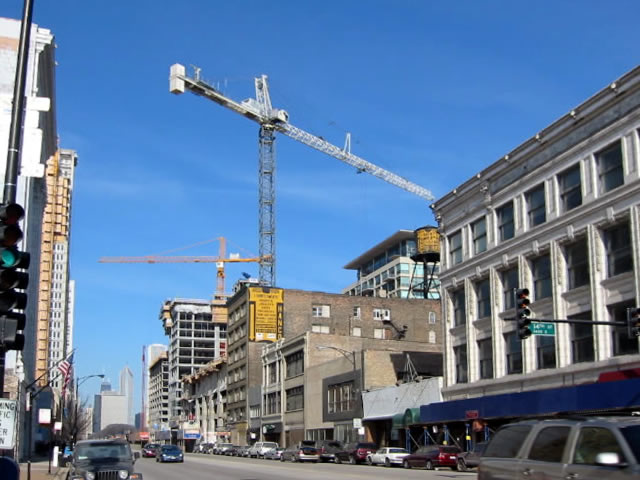
Market-rate and affordable apartments under construction side by side in the South Loop.

A commenter pointed out that the South Loop multifamily market cratered in 2009 — and more broadly, the downtown Chicago market was flat over the entire 2000-2010 real estate cycle. People who bought some of the first Loop loft conversions have not earned more than the rate of inflation. In 1999, the buildings at 208-212 W. Washington St. were purchased for loft conversion, which was truly unusual then. (I worked just a few blocks east, and was in the market for a condo when it was closing out.) Today, 212 W. Washington St. #2108 is on the market for $395,000, less than the $414,411 that its $319,000 sale price in 2002 inflates to. Other properties in the building have recently sold for less than their 2001 nominal prices. This is despite a “hot” market that’s “running out of condos.

(I brought up this example during the Height Act battle, when some obtuse conservatives claimed that skyscrapers caused, rather than merely correlated with, high housing prices in Manhattan. Well, Chicago builds more skyscrapers, which allows its downtown housing supply to match growing demand.)

More broadly, the entire 2008 financial crisis is one big national case study in house price decline. Namely, it’s the prime example of why house price declines are rare: housing is so highly leveraged, and so central to household wealth, that falling prices really hurt the entire economy. As Ryan Avent writes: “since buyers are heavily leveraged, losses in value are magnified, raising the risk that price declines become crises.”

In a Brookings post-mortem [PDF] on the 2008 crisis, Karl Case (yes, of Case-Shiller) notes that broad housing price declines are rare: “nominal prices never fell over any full quarter between 1975 and 2005,” and that fact gave bankers’ computer models undue confidence in ever-rising prices. Moderate oversupply rarely results in falling prices because housing markets have other ways of discounting — sellers trade time for money and just wait it out:

Another important aspect of housing market efficiency is that prices tend to be sticky downward. In most markets, when excess supply develops, prices fall quickly to clear the market. But housing downturns have been characterized by sticky prices. Sales and starts drop but prices are slow to respond…
Downwardly sticky prices lead to “quantity clearing markets” rather than “price clearing markets.” […] Demand drops. The inventory of unsold homes rises. Prices stick. Output falls. The inventory of unsold property remains high (because a house is a durable good, not a consumable). But household formation rates remain positive, and the new households eventually absorb the excess inventory and output rebounds. Assuming there is upward inertia, prices then rise and ultimately overshoot; demand again slows, starting the next cycle.

For rented real estate, contract rents are only one way to set prices. Other ways of discounting abound: free months of rent, tenant improvement allowances, improvements to fixtures or common areas, bundled services (like utilities), additional amenities, and outright gimmicks can effectively act as “discounts” even while nominal rents don’t decline.

Case also mentions that housing is a heterogenous good, where each property is different. In real estate markets, that usually plays out as a “flight to quality” where prices hold up for the best buildings, and prices fall for lesser locations and uglier buildings. This phenomenon has dampened urban dwellers’ memories of the 2008 crisis — they’re less likely to remember the price decline, since “home values have generally held up better the closer a home is to the city center.”

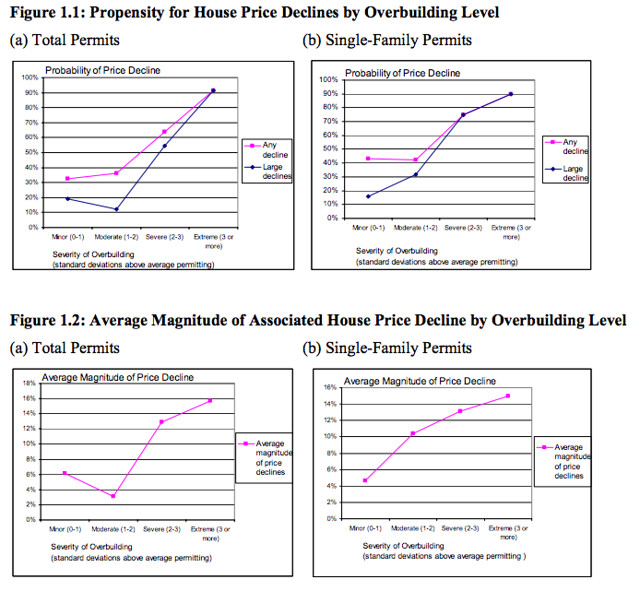
At a local or regional level, though, housing prices do decrease on a pretty frequent basis, and over-supply is usually why. In “Why Do House Prices Fall?,” a pre-crisis paper written by Daniel McCue and Eric S. Belsky for the Harvard Joint Center on Housing Studies, the authors found that severe overbuilding almost always leads to housing price declines.

“While only about a third of all spells of moderate overbuilding resulted in price declines, nearly two out of every three spells of severe overbuilding resulted in price declines, and eleven of the twelve spells of extreme overbuilding resulted in price declines, all of which were large.” [emphasis added, extraneous definitions omitted]

housing price declines

The graphs do appear to vindicate the notion that market forces alone can, without subsidies, cause housing prices to decline. The housing-permit equivalent of a 300-year flood will almost guarantee that prices will drop by around 15%.

McCue and Belsky note that such overbuilding has basically disappeared from major cities in recent years, though. Instead, these cities have extirpated the rare beast and now systematically underproduce housing. Since nobody can remember prior oversupply crises, they now feel free to deny that such a thing is even possible.

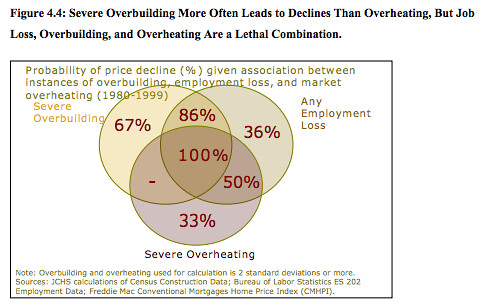
Note that of the three major factors McCue and Belsky tie to house price declines, overbuilding is implicated more often than either employment loss or overheated prices. Just high housing prices on their own rarely led to corrections; because housing prices are sticky, high prices just plateau for a while.

housing price declines

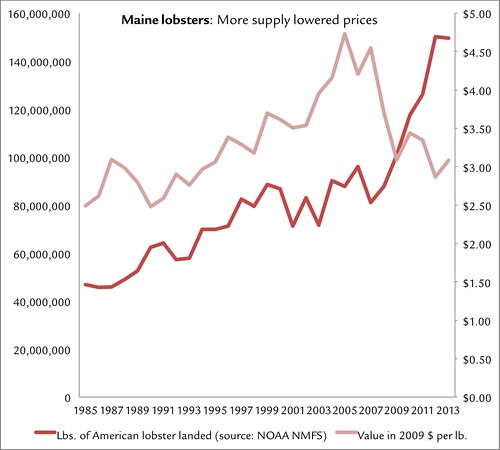
Even in the realm of luxury goods (which some wrongfully claim that housing is), a good old supply shock is always eventually able to bring prices back into line. Here’s the supply and price of Maine lobsters, whose prices collapsed as the recession cut demand for ostentatious restaurant meals, but where growing supply has kept prices down even as demand rebounded: “Lobster, long considered a luxury, is becoming a little more ordinary.”

lobsters

Sadly, San Francisco has underbuilt to the point where it would take a a 26% increase to its current housing stock to get the market back into balance.

DC will not become ‘like Amsterdam.’ It’ll be better.

District of Columbia Mayor Muriel Bowser said this week “that the District will not become ‘like Amsterdam,’ as though being ‘like Amsterdam’ would be a bad thing,” says a blog post by the Netherlands Embassy.

The embassy backed up their umbrage with a stylish infographic showing off several metrics where Amsterdam handily surpasses the District — particularly in transportation choices, as Amsterdam offers its current residents more waterways, more bikeways, and more streetcar lines.

For one point, the infographic concedes that the District is bigger and better than Amsterdam: Washingtonians can now legally possess over 11 times as much marijuana as Amsterdammers. But since the Netherlands has more permissive laws regarding the retail sale of marijuana than the United States, many visitors (like, perhaps, Mayor Bowser) instinctively use “Amsterdam” as shorthand for a place with libertine drug laws. (Dutch society has a long history of taking a uniquely hands-off approach to social policy.)

On several other points, though, the infographic shows that although DC isn’t quite there yet, we’re well on our way. DC already has ambitious plans to beat Amsterdam on two points: the Sustainable DC Plan projects another 250,000 Washingtonians, for a total of 868,000 to Amsterdam’s 810,000; and the Move DC plan has plotted out 343 miles of bikeways, including 72 miles of Dutch-style protected bike lanes, which easily beats the mere 250 miles of bikeways in Amsterdam.

DC is also making significant progress in closing the 12-museum gap with Amsterdam. With an evergrowing number of museums here, DC is well on its way to overtaking Amsterdam in this particular metric. (I don’t have statistics handy, but it seems likely that DC has fewer but larger museums, which probably have an edge in terms of collection size and total visitors.)

On two other metrics, though, we have a long way to go. At the current rate of construction, it will be a while until DC manages to build its 16th streetcar line — but note that the Dutch embassy conveniently doesn’t count Metro lines, as DC boasts six to Amsterdam’s five (almost), as construction on their north-south line is almost as delay-prone as our streetcar.

The yawning gap between the two cities’ canal networks is only half as dire as the Dutch say. Yes, Amsterdam has 165, but DC actually has two operating canals, not one: The embassy may have been confused by the name of Washington Channel, which is a brackish waterway built to drain tidal flats and to keep open a shipping channel. In other words, it’s hydrologically far more similar to Amsterdam’s canals than the freshwater C&O.

In any case, I’ll concede that more of Amsterdam is below sea level than Washington. In an era of rising sea levels, though, that’s probably not something worth trumpeting.

On definitions: equitable communities, magpie infrastructure, vibrant centers, gentrification

Bellevue goes upscale

Bellevue was not one of the “suburban vibrant centers” examined for a NAIOP report on office occupancy trends.

Some recent reports left me appreciative of their aims and ends, but not exactly how they got there, and in particular with how other analyses have defined key terms.

1. The Living Community Challenge certainly provides an inspiring goal to reach for, notably in its use of elegant performance criteria that broadly require “net positive” environmental performance on site — broadly, that new developments can strive to shrink their ecological footprints to fit within their actual footprints. It also pretty seamlessly integrates the Transect throughout, and in a balanced way that sometimes rewards and sometimes penalizes both ends of the spectrum.

However, having participated in the creation of LEED for Neighborhood Developments, it’s telling that some of the same battles in that scheme have emerged within this one. Prescriptive approaches still occur throughout, and some of the personal-health ones are somewhat wishy-washy. (The emerging science of health impact assessments may have been a useful complement here.) The equity section (“petal”) has a lovely intro, but its imperatives don’t address many social criteria — affordable housing is a notable omission — and almost entirely use prescriptive standards. Another long-running debate was over the use of prerequisites in the rating scheme: It seems strange that a baseline, “Petal Community” certification can be done while ignoring a majority (four of the seven) of the petals.

I’ll be interested to learn more about the Challenge in the coming weeks, and to see how others feel about whether it’s rigorous and balanced.

2. Kriston Capps brings up Mikael Colville-Andersen’s term “magpie infrastructure” in a recent CityLab piece. Bicycle and pedestrian infrastructure, examples like the Bloomingdale Trail aside, rarely needs architects’ attention — their structure-first solutions are usually fundamentally anathema to bicyclists’ lazy inclination to not climb hills. By and large, people should be encouraged to stay at grade, and landscape architects and engineers should be entrusted with their care.

Closer to MCA’s home, the current BIG exhibit at the NBM includes Loop City (video; skip to 2:30), a proposal for an elevated rail loop around Copenhagen + Malmo. The proposal lifts up the stations so that trains decelerate on the approach and accelerate as they exit — a clever idea lifted from subways like Montreal’s. When done below-ground, this brings trains closer to the surface just where they’re needed, but when above-ground, the same approach antagonizes the energy needs of the passengers (who need to climb ever-higher escalators to get to the platforms) and the energy needs of the trains.

Another obvious flaw is that the proposal repeats the Corbu-in-Algiers mistake of thinking people would want to live in flats beneath a railway, without realizing that below-the-tracks spaces are almost always only valuable in situations (I’m thinking in Ginza, the Viaduc des Arts, or 9 de Julio) where such space is just the cheapest way of getting valuable ground-level, street frontage. Even maglevs are pretty awful to stand right underneath.

Besides, haven’t we tried grade-separation of different modes before?

3. NAIOP recently published a report offering slight encouragement to the notion that office users are increasingly choosing mixed use environments — namely, 24-hour CBDs and 18-hour “suburban vibrant centers” (their terminology, not mine) — over single use suburban office parks. Their findings indicate that rental rates are indeed higher in CBDs, but that CBDs haven’t seen as much absorption as suburbs, whereas “vibrant” parts of suburbs had a verifiable edge in the leasing market. There’s certainly plentiful anecdotal evidence, and this has been the mantra of “Emerging Trends” and other qualitative reports for quite some time, but I’ve seen few attempts to quantitatively analyze the phenomenon.

Yet the two sets were compared quite differently. The comparison of CBDs vs. suburbs was strictly quantitative, an approach that didn’t control for the quality of the urban environments — downtown absorption was hurt by including a great many “dead” downtowns (Dayton, St. Louis, Hartford) among the comparison set. Most of the liveliest downtowns have seen strong positive absorption, since it’s less the CBD location than the mixed-use amenities that draw users.

The “vibrant centers,” on the other hand, were compared using a robust paired-case approach: single-use suburban areas were paired with mixed-use suburban areas within the same part of town. They even came up with a pretty strict definition of such centers and their comparison sites, using Walk Score and building-level maps. This better methodology dives into why people are migrating towards such sites, and goes beyond the not-terribly-nuanced submarket definitions found in typical office market reports.

Although the lower absorption figures for CBD office may look discouraging at first glance, it’s necessary to consider both that higher rents might result in tenants using CBD space more economically. Square feet don’t necessarily correspond with people, much less dollars. (Edit 26 Feb: City Observatory has a new report indicating that job growth has indeed been more robust in CBDs than in suburbs.) In addition, the supply constraints on new downtown office might suppress demand from space-hungry users — e.g., many large companies are expanding both in San Francisco and Silicon Valley, but adding more jobs in the Valley where construction isn’t limited by constraints like Prop M.

4. For good measure, here’s one instance where the methodology and the results both turned out okay: Governing’s recent analysis of gentrification at the Census tract level. The scale of the analysis is correct, the results pass the smell test, and the variables used (rankings of changes in household income and physical [home values] and cultural capital [college attainment]) seem reasonable.

A few more thoughts on beautiful Brutalism

Board formed concrete

Writing “The five best Brutalist buildings in DC” required a lot of attention to definitions. The article’s less about the “best” Brutalist buildings than about examples of Brutalism that fit in well with their urban surroundings (or, in one case, rural surroundings). I love the Hirshhorn Museum’s courtyard, for instance, but it’s pretty awful towards everything around it, so it didn’t merit a mention in the article.

That said, I did check each of the buildings against Reyner Banham’s original 1955 article on Brutalism, which established these three criteria:

1, Memorability as an Image;
2, Clear exhibition of Structure; and
3, Valuation of Materials ‘as found.’

If any of the seven buildings are “on the cusp” per Banham, the CFPB and Canadian Embassy fit in too well with the perimeter-block typology of the city around them — and therefore don’t quite have the cartoonishly simple standalone imageability* typical of the Brutalist sculpture-as-building. Yet both are very clear in plan and intent and have imageable elements. Perhaps the Canadian Embassy’s devalued materials make it more of a postmodern spin on Erickson’s own Brutalism, but that’s a fun tautology.

Commenters have disputed Dulles Airport’s inclusion, perhaps because they actually like it and want to reserve “Brutalism” for stuff they don’t like. Yet it easily meets Banham’s definition, and furthermore celebrates a vast expanse of béton brut like no other local structure.

Other links I wanted to include, but that didn’t quite fit:
– Sometimes, even a clumsy Brutalist building can be better integrated into the urban fabric through changes to landscaping and circulation; such repairs are underway at Boston’s City Hall.
– Over in supposedly kinder Ottawa, Brutalism was the house style for many cultural institutions, and insensitive changes to these buildings are proving controversial.
– The BBC is currently airing a two-part series on Brutalism.
– Some very highly expressive concrete canopies are on view now in an exhibit at the Art Museum of the Americas about the work of Félix Candela, whose soaring but paper-thin concrete shells enclosed everything from bandshells to cathedrals throughout Mexico.

* Favorite story about this: A cab driver in Shanghai didn’t know which Hyatt hotel I wanted to go to. Instead of fishing around for the address, I drew the shape of the building, and we were off. (It turns out that “Hyatt” was Sinicized in Cantonese, perhaps because the chain opened in Hong Kong before China, so when written in Mandarin it’s pretty much gibberish.)