Bike overnights from D.C. through Maryland

Harpers Ferry in October

My recent five-day bike tour through the mountains whetted my appetite for quicker escapes into the same countryside. Luckily, the DC region sits astride the fall line, which puts a variety of topographies within reach. This makes it possible to do a bike overnight, or more ambitiously, a sub-24-hour outing (S24O).

On such a short trip, it’s important to ride enough miles to make the trip an accomplishment, but not so many as to be exhausted or to preclude any off-bike adventures. One key to doing so is to strictly limit the mileage spent biking down dangerous streets in traffic-choked suburbs, and to take advantage of trails — particularly easy-grade rail or riverfront trails.

One weekday-only trip that combines these, starting in the District, is a bike trip from Poolesville, Md. to Harpers Ferry, W. Va., returning via the C&O Canal towpath along the Potomac. This takes advantage of Montgomery County’s urban growth boundary, the area’s extensive rush-hour bus system, and the centuries-old Potomac path.

One recent day, I awoke at 5 AM to board a Red Line train at 6 AM, leaving the system at Shady Grove just as the morning bike ban started. From there, I waited a few minutes for RideOn route 76, which on weekday peak hours travels from Shady Grove through Kentlands, then deep into the Ag Reserve, and eventually ends in the rural town of Poolesville. Like all RideOn buses, the buses sport dual bike racks. Interestingly, the largest business in downtown Poolesville is a tractor supply store — the last place I expected to be able to take a city bus to.

The historic center of Poolesville, Maryland, just past the terminus of RideOn route 76.

Poolesville is famous among area cyclists as a jumping-off point for rides on country roads, but I wasn’t aware of any car-free routes to get there until I scrutinized WMATA’s regional bus maps.

From Poolesville, it was a quick 5 1/2 mile, downhill ride down Whites Ferry and Wasche Road to the Dickerson Conservation Park, and then onto the C&O. Harpers Ferry is another 22 miles upriver, not far past the railroad-centric town of Brunswick, Md. Equally charming Shepherdstown, W.Va. is another 13 miles upriver.

The main street of Brunswick, Maryland.

Lodging and camping options along the way are plentiful. Shepherdstown and Harpers Ferry offer numerous B&Bs and hostels, while the C&O has walk-in campgrounds every few miles along the trail plus six historic cabins available for nightly rentals.

The return bike trip is all downhill, and can be accomplished in one day: It’s 61 miles from Harpers Ferry to Georgetown, or 73 miles back from Shepherdstown. 13 miles can be shaved by hopping across the river at White’s Ferry and picking up the W&OD trail in Leesburg, which also has a charming downtown, and ending at the Silver Line. (Even with just Phase 1, Silver extends further than any of Metro’s rail lines.)

Another, 7-day-a-week transit option that I’ve used is Metrobus B30 — yes, the BWI bus. It, too, has bike racks just like every other Metrobus, but unlike other Metrobuses it travels beyond the Patuxent River and into metro Baltimore. (This option takes much longer than MARC, which may soon add a bike car to its Penn Line weekend trains.)

From the BWI light rail station, a cyclist can:

  • Board a Baltimore light rail train into the city, with its fantastic neighborhoods and Olmsted trails — or to Hunt Valley, about half a mile short of the Northern Central Rail Trail north to York;
  • Connect to several other buses, notably MTA’s buses to Annapolis or RTA’s buses through Howard and Anne Arundel counties;
  • Ride up alongside the tracks to the BWI Trail and follow the signs to the B&A Rail-Trail to Annapolis and the Chesapeake shore;
  • Walk through the BWI Amtrak station, then ride north on Ridge Road and through old downtown Elkridge (not much there) to the Patapsco Valley state park’s trails and thence to Ellicott City.

(That said, biking all the way to Baltimore or Annapolis is certainly feasible. I’ve used Brock Bridge Road for the former, and Governors Bridge Road for the latter, and enjoyed a relatively low-stress trip. Next up: Metrobus to Olney, then riding via Columbia and Catonsville to Baltimore.)

Someday, urban cyclists in DC will be able to easily slice past the sprawl aboard commuter trains. It’s possible today to bring bikes aboard VRE midday trains, which makes it possible to leave early on Friday and ride back from Manassas or Fredericksburg. Another option to consider is VRE halfway, then a ride through the farms to Charlottesville (from F’burg or Manassas).

The region’s weekday commuter buses might also prove useful, although they’re certainly not geared to weekending cyclists. Loudoun Transit runs to Purcellville, aka the western end of the W&OD Trail, and appears to allow bikes for pre-registered users. Maryland’s commuter buses cover a vast territory from Hagerstown to the Eastern Shore, but have no specific bike policy.
Majority rule, minority rights — or Moses and NIMBYs

Terror alert

I snarkily wrote up a little headline last Monday: “Belmont Bypass’ Immediate Neighbors Slam Outreach, Will Vote On Keeping Bottleneck.” Then Daniel Kay Hertz wrote a somewhat fuller reponse, pointing out that a few people would vote on a project that impacts rail service for hundreds of thousands.

(Not surprisingly, the referendum failed, with 583 votes against. In June 2014, the three rail lines that would benefit from the bypass carried 6,353,313 passengers.)

Many broadly beneficial, but locally detrimental, projects are subject to being torpedoed by hyper-local concerns. As with any Locally Undesirable Land Use (LULU), the benefits are broadly distributed but the costs are highly focused. Many will gain a bit, but the benefits are in the distant future and somewhat speculative, so the issue has soft salience to the majority. On the other hand, a few will lose a lot, so those loss-averse few have a strong incentive to fight tooth and nail against threats to their homes. It’s just human nature.

Later comments directed at both Hertz and I raised the specter of Robert Moses bulldozing East Tremont for the Cross-Bronx Expressway. Yes, there are some surface similarities: properties expropriated for a transportation improvement. Yet these projects differ incredibly, not just in what is being done, but more importantly in how they are done.

A new highway arguably fails a cost-benefit analysis once social costs are calculated: It exacts leviathan costs, from destroying communities to contributing mightily to destabilizing the planet’s climate. (This probably even applied in Moses’ era, before thousands of miles of highways were built, subjecting further investments to the law of diminishing returns.) A new transit connection has a much better balance sheet. The Belmont Bypass has particularly high leverage, since it finally unleashes the bottlenecked potential of the miles of four-track structure beyond it.

More important is how the project is executed. In a democracy, the majority rules with respect for the basic rights of the minority. Moses infamously low-balled property owners when seizing land, and paid tenants (and rent-controlled tenants in an era of high housing inflation arguably hold a claim resembling property) almost nothing; such expropriation is clearly contrary to the Fifth Amendment or to the UDHR‘s Article 17.

Several property owners stand to lose their property to the Belmont Bypass. In such a high-profile situation, which public opinion broadly in their favor and multimillion-dollar properties on the line, I imagine that this group will receive just compensation — quite unlike the residents of East Tremont, who were largely ignored by the press, whose cries for help went almost entirely unheard by their legislators, and who lacked funds to file lawsuits.

Yes, a slightly larger population will be inconvenienced by construction for a few years, and this crowd appears to have provided most of those damning 583 votes. While pollution, even non-toxic pollution such as carbon, can justifiably be construed as violating others’ right to life, the noise and dust from construction can be mitigated to a significant extent.

In short, the substantial benefit that the majority will derive can justly be seen as outweighing the relatively minor rights claims in this instance, and the comparison to Robert Moses is spurious.

Of course, it’s rare for citywide transit agencies to make decisions at the hyperlocal level. Yet it’s absolutely typical for decisions to be made about permitting additional housing at almost a parcel level; in that case, the marginal benefit to other regional residents is so marginal as to be doubted entirely. Yet affordable rentals, in particular, are a LULU that local NIMBYs have successfully engineered the regulatory regime to discriminate against. Ryan Avent writes in the Economist: “The benefits and costs of population growth occur in a way that practically guarantees highly restrictive building rules.” Michael Lewyn takes the view that “cities cannot be trusted to weigh the citywide interest in new housing against neighborhood concerns… the chances of abuse are simply so high that a higher authority must step in.”

New economic geography: fewer centers, more edges

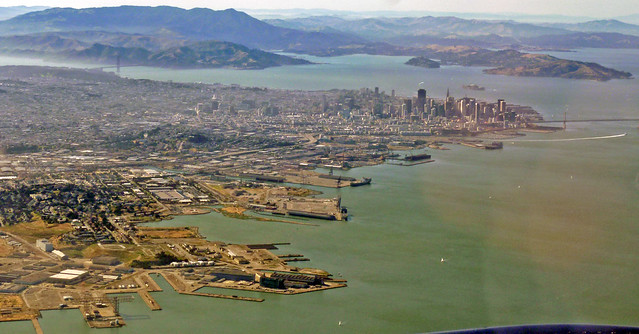
from a plane
There’s obviously no room to build anything, anywhere.

October’s Economist Survey on the global economy by Ryan Avent included a shout-out to his Piketty-informed thoughts on housing prices. In short, the productivity gains from current technology have increased inequality between people and places. The returns on specialized skills are worth more in an era of cheap communication and transportation, great cities aggregate many people with such specialized skills –and furthermore, agglomeration effects appear to be growing even as communications costs decline. Even virtual reality won’t be able to replicate the everyday, subtle reinforcement of ambition that great cities provide; as Paul Graham writes:

The physical world is very high bandwidth, and some of the ways cities send you messages are quite subtle… A city speaks to you mostly by accident—in things you see through windows, in conversations you overhear. It’s not something you have to seek out, but something you can’t turn off.

Ideas have become so complex that those with specialized skills need to gather around others with complementary skills just to understand topics, much less to achieve the discovery or innovation stage. And, well, interesting people like one another; not for nothing has “assortative mating” taken off, spawning study of managing “the two-body problem” in fields like academia and medicine. (Hint: bigger cities, with bigger labor markets, are more likely to solve the problem. This has become a boon to universities recruiting in large metro areas, while those in small college towns struggle. The eight metro areas with 3+ R1 universities [Boston, New York, Philadelphia, Washington, Raleigh-Durham, Atlanta, Chicago, and Los Angeles] have a considerable advantage in this regard.)

In short, there are fewer centers and more edges. Scarcity being what it is, the centers (and only the centers) are winning more capital, and the edges are losing.

The result has been a highly uneven reallocation of wealth, whereby some places are winning in the form of skyrocketing property prices. These high prices create a substantial drag on the economy: increasingly high rents in the most productive locations steal from the most productive. This steers:

  1. Capital towards landlords, enlarging a rentier class (as Piketty notes) and starving more productive sectors.* This creates a vicious circle, as the NIMBY cartel further tightens its regulatory capture over the land use regime, and extracts ever-higher rents.
  2. Labor towards less costly, and less productive, places, creating economic losses. One recent study quantified that economic loss to the United States in 2009 at 13% of GDP — equivalent to sawing off the entire state of California.

—–

This might be worth unpacking further at a later date: Just reforming land-use regulations, or even entirely repealing the “shadow tax” of zoning, still won’t do enough to produce sufficient affordable housing. Even if zoning is reformed to “make more land,” that land’s still subject to construction’s “hard costs,” which are just too high nowadays.

Construction costs have risen faster than inflation, and far faster than stagnant workforce incomes. Slides 5-6 of this presentation [PDF] by Thomas Hoffman from Enterprise points out that even with free land, even the cheapest construction now costs 50% more than the affordable rent for a low-income family.

Sure, embedded within construction costs are other perhaps-useless regulations, but housing affordability in gateway cities is a problem with many root causes, and with many solutions as well.

—–

* Rent or mortgage principal paid, aka “housing service expenditure,” does not have a multiplier effect on GDP because it’s not factored into GDP. However, it’s worth noting that in 2000, HSE amounted to nearly $1 trillion, which supported only some of the 1.1 million jobs in real estate (NAICS 531). Reducing rental prices would take investment income from landlords and give them back to consumers, who would probably spend in other sectors that generate more jobs per dollar.

Trails don’t make a suburb walkable, urban fabric does

Paths in Greenbelt

Trail underpass in Greenbelt, Md.

A century ago, cars first started appearing on city streets and subsequently began running over everyone else. The 1920s epidemic of traffic fatalities, particularly among children, led to a fad in town planning to rigorously separate paths for cars and people, and to turn over the roads entirely to cars.

This philosophy was implemented in several New Towns — most notably in Radburn, New Jersey, but more extensively in three suburban Washington communities (Greenbelt, Columbia, and Reston). For the most part, though, existing cities proved too expensive to retrofit, and most other American suburbs just built the car-only roads without their pedestrian counterparts.

Garden side

Greenbelt Museum

In both Radburn and Greenbelt, houses were even “turned” to face the walkways, with back doors facing alley-like auto access roads. Yet as these places have matured, most households have rotated their houses and enclosed their public front yards into private backyards; communities have added sidewalks to the streets. (Above, the museum/house at right has been restored to its original appearance, but the house at left is typical.)

Reston: Lake Anne Village

Trail crossing street in Lake Anne Village, Reston, Va.

Examples built from the 1960s-1980s, like Reston, typically threaded trails past backyards. LIFE magazine wrote in 1965: “The need for automobiles in the village is virtually eliminated by a network of footpaths and bridges which connect residential areas with the shopping center.” (Indeed, my own 1960s neighborhood was replatted with a half-completed secondary grid, which I do use occasionally.)

Interestingly, two of my Streetsblog colleagues, Jeff Wood and Steven Vance, both lived in Kingwood, outside Houston, and both made extensive use of the trails as kids. In an email exchange, Steven writes:

Those trails, the Greenbelt, connected every subdivision with homes (there was an entrance 50 feet from my house), community pools, and passed behind every school. They also took me to the shopping areas. I “delivered” myself and my sister to school and the pool.

Jeff Wood made a distinction between walkability and runability on a recent episode of the Streetsblog podcast (sorry, can’t find the link!). While the trails in these communities are still prized as a recreational amenity, they are not a useful travel option for adults because they’re not really “irresistible”: distances are far (because densities are low), travel paths are circuitous, and there’s frankly not much to look at. While those attributes were suitable for Jeff’s track and field team, they don’t suffice for people walking to destinations — and who have the option of driving instead.

MWCOG travel survey

It later occurred to me that neighborhood-level household travel data is in fact available for one of these New Towns. In 2011, MWCOG did a geographically focused household travel survey aimed at understanding community scale differences in travel behavior. The chart above shows weekday trips for all purposes, arranged in distance from the regional core. The first five are within the Beltway, and the second five are outside the Beltway, but only Logan Circle is prewar fabric (within the L’Enfant City, even).

For a control, though, I’ll focus on White Flint. Both the Reston and White Flint survey areas have high household incomes, a high proportion of multifamily (49% in Reston, 61% in White Flint), upscale regional retail and substantial office employment at their core, and began development in the 1960s. White Flint has an established Metro line, higher density (6,000 residents/sq. mi.), and smaller households (1.4 average size). Reston’s Metro stop only opened recently, but it has had local and express bus service to other regional centers, larger households (2.2, still small by suburban standards), and generous open spaces that reduce overall density to 4,000/sq. mi. Most importantly, though, Reston has an extensive trail network, while White Flint has better street connectivity.

Sure, Reston has a substantial walk mode share of 14% — more than 50% higher than the regional average of 9%. Yet it’s not much higher than Woodbridge or Frederick, both of which have large expanses of haphazardly planned subdivisions surrounding a walkable “old town.” And it’s substantially below the 18% of trips that White Flint residents make on foot.

Steven points to Boulder and Davis as counter-examples: [T]hat kind of trail network that helps Boulder, CO, and Davis, CA, have high bicycling rates… [Boulder’s] bike map emphasizes their 10% bike-to-work mode share, while in Chicago we can’t seem to nudge past 1.6% (although for some neighborhoods it’s pushing 4.5%).

Yes, extensive trail networks are a great thing to have at a regional level, and certainly have something to do with the relative popularity of cycling in metro areas like the Twin Cities, Denver, and DC. Yet in explaining Boulder or Davis, I’d give less credit to infrastructure and more credit to favorable demographics, culture, and geography — they’re compact, connected, relatively high density, and mixed-use.

Every once in a while, I’ll encounter advocates who argue that trails are the only acceptable environment for pedestrians or cyclists, occasionally pointing to surveys showing that off-street trails are rated in most surveys as the gold standard of bike facilities, especially for those who don’t already regularly bike.

Sure, a trail network is great to have, and should be connected or created at every opportunity. However, we already have a fantastically extensive bike/ped circulation system that touches everyone’s front door — it’s just that our streets are filled with dangerous cars.

Yet the same surveys show that excellent on-street infrastructure is almost as good at enticing people onto two wheels. And since most new development will happen in places that are already built, it’s kind of a moot point, anyways.

Focusing on building up the fabric, and adding the best infrastructure available, is also the approach that Reston and White Flint are taking, and I expect that future household travel surveys will show that the approach will bear fruit for both areas.

[based on an email exchange]

Shorts: centripetal force, P3s, office park retrofit

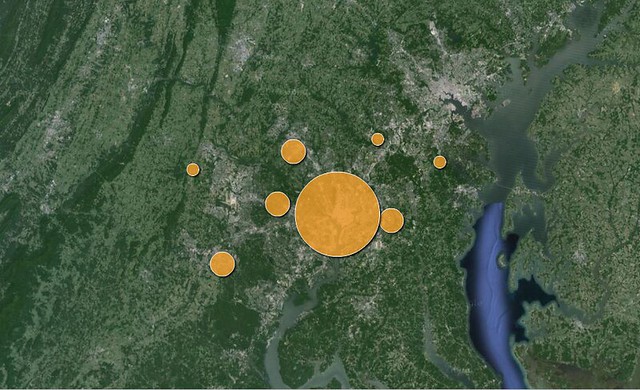
Bubble map: growth in 25-34 population, 2010-2012

Growth in 25-34 population for DC-area counties, 2010-2012, with core jurisdictions aggregated for clarity. 42% of the growth is concentrated inside “the diamond,” which is home to 18% of the region’s population. A similar trend was noted in metropolitan NYC.

1a. Another recent report (by James Hughes and Joseph Seneca, reported by my colleague Stephen Miller) confirms that population growth has overwhelmingly shifted towards the core in the New York region since 2010. Third-ring suburban counties like Dutchess and Hunterdon are actually losing population, overall suburban population growth has slowed by 80% — and the core is on pace to recoup its entire 30-year postwar population loss (1950-1980) in just one decade (2010-2020).

Also echoed: a much larger proportion of young people (20-somethings) are heading downtown. “From 1970 to 1980, suburban counties captured 96 percent of the growth in this demographic. From 2010 to 2013, that figure dropped to 56 percent, with the urban core becoming increasingly competitive.” Since the report is from Rutgers, it defines “core jurisdictions” as including Hudson, Bergen, and Essex counties.

We’ve seen these trends reported in a national (PDF) and even DC context, but it’s worth noting since the NYC area is so huge and its economy has done well since 2010.

2. This week fall, Streetsblog USA will be publishing a three-part article I co-wrote with Angie Schmitt about what befell the Indiana Toll Road P3. Bad timing and bad traffic projections were just the tip of that iceberg.

3. Jonathan O’Connell from the Post reported last week that a new Fairfax County school was repurposed from an abandoned office building.

It’s a clever response to the changing Skyline/Bailey’s Crossroads neighborhood, where an aging housing stock and distance from transit have created a Toronto-esque high-density suburban immigrant enclave. Larger immigrant families have pushed up population density and school enrollment; retail is thriving, judging from the continued traffic jams and low vacancy rates. At the same time, office users have engaged in a “flight to quality,” towards newer and more efficient buildings closer to transit.

What’s more, the cost was very competitive. Fairfax spent $19 million in 2014 to buy and refit the building for 800 students (granted, a few amenities are still forthcoming) — which is right around the national median cost for a greenfield grade school in 2010.

Hong Kong’s revolution is in the streets, not the skyways

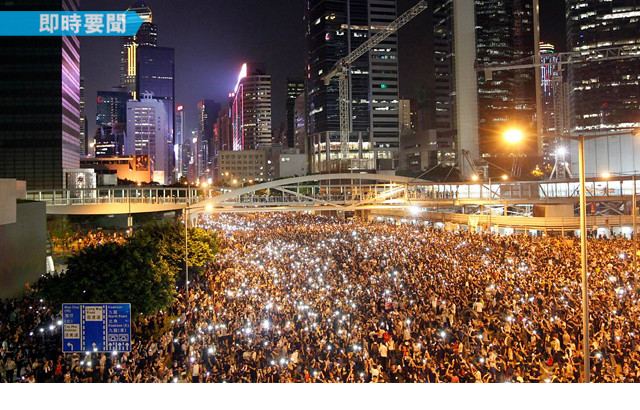
Even in “the city without ground,” #UmbrellaRevolution has taken not to the ersatz quasi-public spaces floating above Central, but instead to the ground — or at least to the traffic-sewer highways that fill what little is left of the ground:

(c)2014 NextMedia

It’s an interesting contrast with Occupy Wall Street, which happened to fill privately owned public space even though New York has comparatively more truly public spaces.

Trevor Boddy’s essay about North American “skyway” systems in Variations on a Theme Park seems prescient:

Heretofore streets functioned as periodic reminders and enforcers of the civic domain; the new patterns of city building remove even this remaining vestige of public life, replacing them with an analogue, a surrogate.

Precisely because downtown streets are the last preserve of something approaching a mixing of all sectors of society, their replacement by the sealed realm overhead and underground has enormous implications for all aspects of political life. Constitutional guarantees of free speech and of freedom of association and assembly mean much less if there is literally no peopled public space to serve as a forum in which to act out these rights…

[Protest] activities have been displaced over the past decade from the square and main street to the windswept emptiness of City Hall Mall or Federal Building Plaza. To encounter a ragtag mob of protestors in such places today renders them even more pathetic, their marginality enforced by a physical displacement into so unimportant, uninhabited, and unloved a civic location.

Only a full-scale revolt, involving hundreds of thousands, can be taken seriously under these conditions.

Not that a U.S. Supreme Court case matters much in this context, but Thurgood Marshall’s concurring opinion in the Pruneyard Shopping Center case is also worth remembering (emphasis added):

[S]hopping center owners had opened their centers to the public at large, effectively replacing the State with respect to such traditional First Amendment forums as streets, sidewalks, and parks…. Rights of free expression become illusory when a State has operated in such a way as to shut off effective channels of communication.

(Image of Occupy Central on Monday, 29 September 2014 from Apple Daily/NextMedia.)

My five days on the GAP + C&O trails

GAP ride

Overlook just east of the continental divide.

Three general observations after a week on the Great Allegheny Passage and C&O Canal towpath:

  • Six days would be perfect; the five-day schedule offered insufficient recovery/slack time and left me feeling rushed, despite good stretches at 15+ MPH. In my case, a rainy morning and the Fallingwater side trip ended up taking up a good chunk of day two, which left me with almost a century to accomplish on day three. Plus, the towns were more interesting than I expected.
  • For the most part, you actually might not want to stay overnight in the most interesting towns (IMO: Ohiopyle, Cumberland, Harpers Ferry). Their attractions are mostly open during the day, whereas for an overnight location you mostly just want to eat dinner and crash. Specifically, I’d recommend stopping at Harpers Ferry during the day when the historic park’s attractions are open, then overnighting at Lockhouse 28, and then a leisurely reintroduction to metropolitan civilization the next day.
  • The C&O’s surface varies tremendously. Some of the sections are, like the parts closest to DC, very rocky and tough to take at speed, but others are much smoother (and often muddier). I did appreciate taking breaks from it, though.

The daily itinerary, as it played out:

  1. Pittsburgh to Ohiopyle, Penna. 77 mi. slightly uphill via McKeesport, West Newton, Connellsville. Stopped at Target in Homestead to buy a $30 tent, which did in fact pay off. Some of the Steel Valley towns would have been worth a side trip, but the main goal was to get out of town. Highlight: Appalachian Juice Company in Connellsville.
  2. Ohiopyle to Meyersdale, Penna. 42 mi. uphill via Confluence, Rockwood. The morning trip to Fallingwater was very steep: it’s 780′ of vertical over less than five miles. By comparison, the GAP’s first hundred miles rise by about the same amount. I’d planned to make it over the divide to Frostburg, but had to stop 15 miles short once night fell — it’s really, truly dark. That said, Fallingwater is truly transcendent.
  3. Meyersdale to Hancock, Md. 93 mi. mostly downhill via eastern continental divide, Cumberland, Paw Paw. Detour onto Western Maryland Rail-Trail. Highlight: dinner at Buddy Lou’s in Hancock.
  4. Hancock to Sandy Hook, Md. (Harpers Ferry) 48 mi. flat via Williamsport, Sharpsburg. Detoured over land from Williamsport through Antietam Battlefield. This cut out about 16 miles by keeping us away from a particularly windy stretch of the Potomac; plus, the main uphill was from the valley up to Williamsport, where we were stopping for lunch anyways. Highlights: lunch at Desert Rose Cafe in Williamsport and Nutter’s Ice Cream in Sharpsburg. However, we did end up bypassing Shepherdstown, W.V., a town that other riders commended.
  5. Sandy Hook to Reston, Va. 45 mi. via Leesburg, switching to W&OD via White’s Ferry. Took the Silver Line to Washington Union Station from there. Highlight: ultra-smooth cold-brewed Hopscotch Coffee. Although this was the only day that passed by any breweries (Crooked Run, Old Ox, Lost Rhino, Mad Fox, Bluejacket, etc.), we were in too much of a hurry for any stops.

Update, 1 June 2015, for benefit of whoever landed here searching for a five-day itinerary: Finished another trip last week. This itinerary was more balanced miles-wise, owing to an evening rather than midday ending on Day 5. Three nights of camping also helped keep the itinerary more flexible:

  1. Pittsburgh > Braddock > West Newton > Connellsville 59 mi. Camped behind a supermarket (24-hour!) at the edge of town in Connellsville, which was convenient if not scenic.
  2. Connellsville > Ohiopyle > Confluence > Rockwood 47 mi. Lunch at Ohiopyle was a perfect “last stop in civilization.” The surroundings get very rural past there, but Rockwood did at least have pizza and campsites.
  3. Rockwood > Frostburg > Cumberland > Lock 62 campsite (past Paw Paw) 72 mi. Frostburg is empty after the college lets out. Stocked up on supplies in Cumberland ahead of the only night of primitive camping.
  4. Lock 62 > Hancock > Williamsport > Sharpsburg > Shepherdstown 74 mi. Shepherdstown was a better overnight stop than HF, with better nightlife even when school’s not in session.
  5. Shepherdstown > Leesburg > Herndon 55 mi. Spent a while lingering around Harpers Ferry during the day. Took the 5A from Herndon-Monroe rather than the Silver Line because it was rush hour, and got a warning from the bus driver about our front racks not fitting — but we were fine.

Update 2025: Anyone planning <50 mile days on the C&O should note that there are no towns and few accommodations on the C&O trail between Brunswick (mile 55) and Georgetown DC (mile 1). The C&O National Historical Park sits within a canyon through this stretch, and strict suburban zoning prevents so much as a B&B along the way. Indeed, the only food along the trail is at Whites Ferry (MP 35.5) or Great Falls Tavern (MP 14.4). The only accommodations along the trail are the NPS campgrounds (none closer than MP 16.6) and the six “Canal Quarters” houses (each of which can only be booked by one group).

The W&OD in Virginia is a paved suburban rail-trail with many more services, but getting there now requires an on-road detour. My preferred scenic and direct route: exit the C&O at Point of Rocks and cross the Potomac River on US 15; traffic is heavy but slow. Turn right immediately after the river and climb (unpaved) Furnace Mountain Road; the total climb is around 200 feet. Take this to the village of Taylorstown: turn right at Taylorstown Road (VA 668), then almost immediately left on Loyalty Road (VA 665). Continue south past Waterford village; it becomes Clarkes Gap Road (VA 662). This ends at Paeonian Springs and VA 9; cross and continue south on Simpson Circle to the W&OD trail.

Parallel trends: bigger houses, tinier apartments

size of new houses

It’s lately become very fashionable to contrast the concurrent trend towards ever-larger new houses and ever-smaller new apartments. Recently, Richard Florida,* Kaid Benfield, and even the Streetsblog podcast have all mentioned this peculiar contradiction.

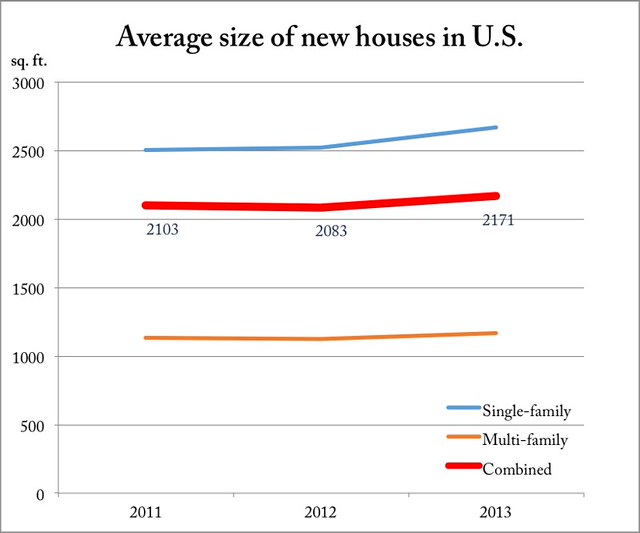
But scratch a little bit at the surface and you’ll find that it’s an artifact of the Great Recession, not an existential conundrum. Consider that the Census’ Survey of Construction, the source of said statistic, only measures a universe consisting of new single family (usually for-sale) houses. However, these share of total new housing construction that is in single-family houses continues to fall. Just from 2011 to 2013, multi-family houses went from 29% to 33% of all new housing completions. Meanwhile, their size hasn’t budged: it’s consistently been around 1,100 square feet (+/- 50) since 1999.

The chart above also comes from Census data, and tells a more complete story. The average size of new houses built in the USA, both single- and multi-family, declined from 2011 to 2012, then ticked up to a record in 2013. It hasn’t been on an upward march forever. Another reason why this data point isn’t quite as important as it might seem at first glance: many fewer Americans are in new houses, period.

houses creeping back up

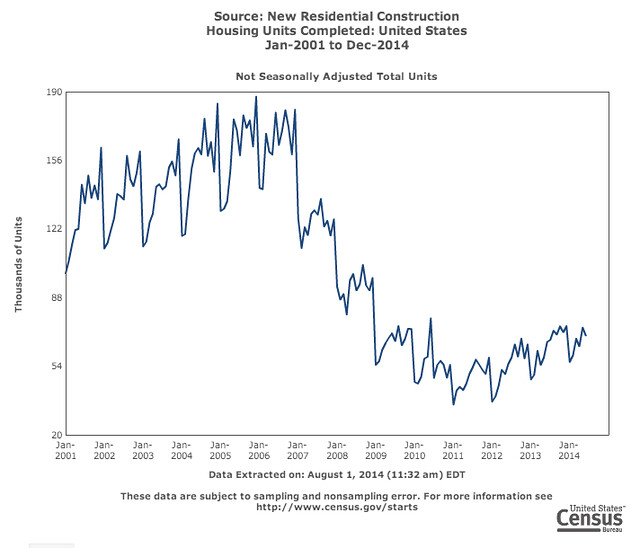
Construction may be up slightly, but it’s still well below its peak. Completions fell 70% from the 2004-2006 rate, and now we’re back up to 60% below that (completely unsustainable) rate. From builders I’ve heard at ULI panels and the like, new move-up product is still selling in the suburbs, but first-time buyers are staying in rentals longer, largely due to tighter financing. Hence, fewer small homes are getting built, as younger households stay in existing stock for much longer, and the average home size is increasing. (Oh, and remember: we’re talking about fewer smaller single-family houses. The number of multi-family houses, small and medium-sized, is increasing.)

Thus, the real story is that the for-sale single-family starter home, as a product type, is dying off. For example, when my brother recently purchased his first new house (at 35, considerably older than the 28-year-old median buyer at, say, Park Forest), he didn’t get a starter home. He went directly from an existing multi-family unit to a move-up sized house.

* Making the additional methodological error of taking the definition of “central cities” seriously.

LocationAffordability’s denominator problem

Location Affordability: numerator problem

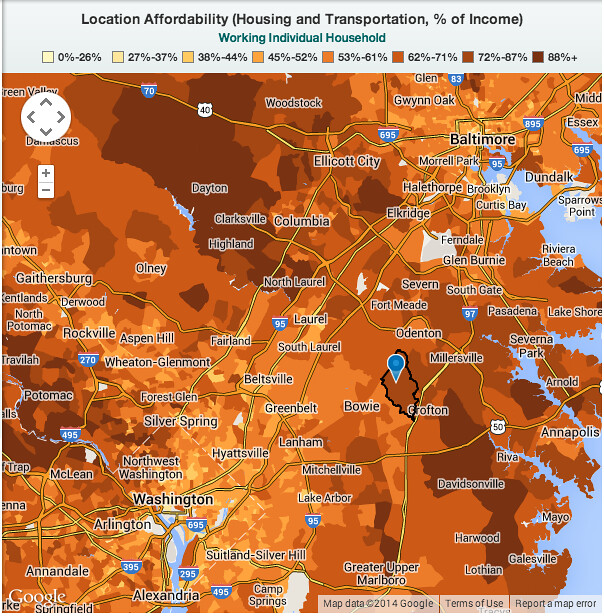
HUD’s LocationAffordability.info, which maps CNT’s H+T Index ([housing + transportation costs]/income), shows a sharp affordability divide slicing across Maryland’s suburban heartland, from the northwest to the southeast. This particular example emerged while I was researching yesterday’s Streetsblog USA post about the Citizens Budget Commission’s report citing DC, SF, and NYC as being rather affordable from an H+T perspective — but using some slightly odd figures.

Here, I’ve highlighted Crofton, Maryland, just inside Anne Arundel County, with apparently more affordable Bowie just inside Prince George’s County next door. Curiously, though, costs are $700 higher in Bowie, but it’s still deemed “more affordable.” How? Prince George’s is within metropolitan Washington, where median households have incomes $10,000 higher than in metropolitan Baltimore, which includes Anne Arundel.

The added irony: median household incomes in Anne Arundel (again, metro Baltimore) are quite high: $14,000 higher than in Prince George’s. Similarly, Howard County (Clarksville, Columbia) is Maryland’s wealthiest, with median household incomes $12,000 higher than in neighboring Montgomery (Olney, Gaithersburg). Although Anne Arundel and Howard derive much of their income from their legions of Washington commuters, they do border Baltimore County and the Maryland state legislature has designated them as part of metro Baltimore. Thus, for the H+T Index’s purpose, they’re comparatively deprived.

The H+T Index is a useful tool, but it does rely on a lot of moving data points. In this case, it’s a bit strange that the numerator (H+T costs) are defined by a very small geography (census tracts in the map, cities in the CBC report), but the denominator (income) is related to entire metro areas. While it’s true that labor markets are metropolitan in scale, it’s also true that incomes vary locally just as much as housing and transportation costs do.

Building type survey: stacked flats in Norfolk

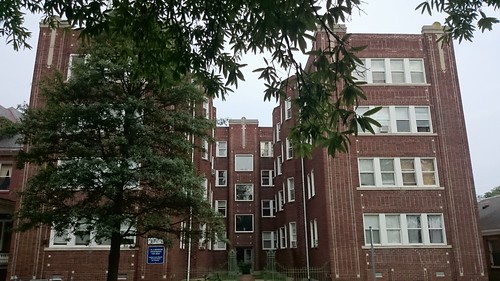
A quick trip to Norfolk last weekend turned up at least one pleasant surprise: a tradition of Chicago-esque stacked flats apartment buildings, here in the rowhouse-heavy Mid-Atlantic. Many were around the Ghent neighborhood, primarily along higher-traffic (probably former streetcar route) streets like Colonial Ave. and Hampton Blvd.

The neighborhood’s lots are a fairly generous 30′ wide, so a double lot can easily fit narrow courtyards between three-story stacked flats:

Ghent, Norfolk

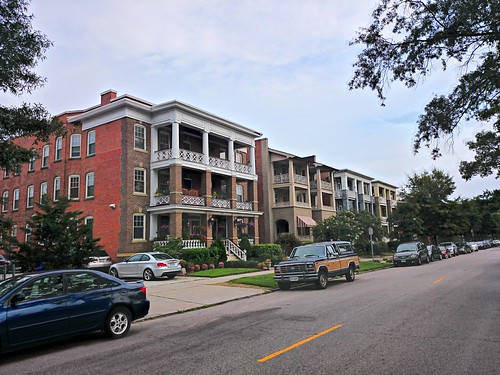
More common, though, were double-lot six-flats — with deep neoclassical porches, reflecting the fact that they are, after all, in the South:

Ghent, Norfolk

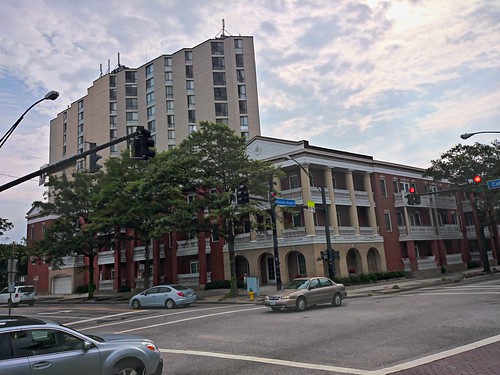
Just as surprising was this liner apartment building, apparently built in 2006 at the corner of Colonial and Princess Anne to mask a 1970s-era serrated senior housing high-rise. The porch detailing is a bit clumsily done — the building is too wide and shallow to match to the six-flats’ columns across the street — but the building holds a busy corner much better than whatever parking lot or open lawn that preceded it. Similar proposals have been controversial even in New York City, so it’s heartening to see a fairly good example.

Ghent, Norfolk

The Chicago six-flat is a particular adaptation to several factors: fairly wide (25′-28′) lots, readily available brick, and a fire code that both largely banned party walls and required two exit stairs. They’re readily identifiable from a front stair off to the side, leaving space for a spacious “front room,” and exposed “back porches.” True to form, the Norfolk houses also had exposed rear exit stairs, even in the absence of alleys.

Alas, the city’s pattern books don’t have much to say about the type.

Why inclusionary zoning has a cash-out provision

Daniel Kay Hertz has a recent post about how Chicago’s inclusionary zoning (IZ) policy is insufficient at creating enough units to meet Chicago’s affordable housing needs.

Montgomery Ward Complex

Some of the loft condominiums within the former Montgomery Ward Catalog House, where one penthouse unit sold last October for $2.95 million, were set aside as public housing replacement units.

When I was working for the Chicago Rehab Network 11 years ago, I wrote up the broad outlines of what was eventually adopted as Chicago’s IZ policy. (It’s on the last page of this quarterly memo to the city’s Department of Housing.) I certainly concur that it is not going to solve the affordability crisis in Chicago anytime soon, but I still think it’s a reasonable approach to providing workforce-level affordable housing within the context of how Chicago builds housing — and once it was implemented, IZ multiplied the number of affordable units that Chicago’s Department of Housing could take credit for (primarily through LIHTC).

During the process of drafting this policy, we anticipated and understood that IZ would absolutely not be a cure-all, regardless of how future politicians would try and take credit for it. Furthermore, as Alex Block points out in a comment to the post, IZ absolutely does attempt to do two, contradictory things: (1) integrate gentrifying neighborhoods by creating new, permanently affordable units and (2) creating as many units as possible. [Yes, permanently affordable: IZ units in Chicago are enrolled in a land trust.]

Since CRN is a coalition of CDCs, almost all of whom work exclusively in poor neighborhoods, the CDCs stood to benefit more from approach , and so the law probably errs in that favor. Even CRN’s members who worked in fast-gentrifying neighborhoods, though, would rather have served two families in Oakland than one in the South Loop, and the cash-out provision allows them to do so. I certainly don’t blame them, even if the net result does to a small extent perpetuate socioeconomic segregation.

As part of the process of creating this legislation, we conferred with developers of both low-rise and high-rise units, who shared their pro formas with us, and with very extensive research done by groups like MPC and BPI, mostly relying on established policies in primarily low-rise places like Montgomery County, Md. and Burlington, Vt. We saw very few examples of successful policies that worked in a high-rise context. And since a large share of the development in Chicago, then as now, was in downtown high-rises, we needed to find some way to get buy-in from high-rises.

In short, affordable units within high-rises turn out to be very difficult to create and administer. High-rises are costly to build per square foot, and there isn’t much latitude to trim the costs through things like unit sizes and finishes. Most crucially, high-rises are subject to  numerous cost thresholds, beyond which the primary incentive of IZ (“free land” in the form of higher density) can become worthless — e.g., a 7-story building is actually far less profitable than a 6-story building. Their incredibly high per-square-foot construction costs, usually fairly generous FAR limits, and low ratio of land-to-hard-costs make the prospect of bonus density (=free land) far less enticing than in suburban contexts.

And once a high-rise is completed, it’s difficult to balance the operating costs of luxury amenities (concierge, pool, etc.) across market and affordable units, which has recently been in the news with the “poor door” controversy. (This is somewhat less of a problem in MoCo, since the Washington area’s very high AMI allows for luxury studio apartments to be counted as “moderately priced dwelling units.”)

So, given these difficulties — and given the CDCs’ thirst to capitalize a housing trust fund that could significantly expand their efforts at helping low-income families in neighborhoods (rather than moderate-income singles downtown), we went with the “cash-out” provision that pretty much exempts downtown high-rises.

As for exempting small developments, that’s solely related to the fact that the requirement kicks in based on the number of units, and it’s impossible to deliver a fraction of a housing unit.

Two perspectives on the future of urbanism(s)

Kentlands just hosted its 25th anniversary celebration, a milestone that now firmly places it among the various New American Towns that dot the lower Potomac valley. In this time, what has New Urbanism accomplished, and where does the future lie? Two perspectives, both from the vanishing world of print-only publications, are excerpted below.

mid-rises

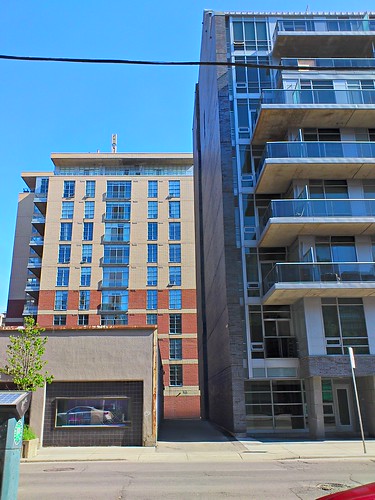
New mid-rises in Toronto.

1. Spacing Magazine‘s 10th anniversary issue (which we [few] American subscribers get pretty late in the game) has a great article by Dylan Reid about “the future of urbanism,” or rather the challenges ahead:

This rise of urbanism is good. It is creating cities that are healthier, more efficient, and more sustainable fiscally and environmentally — and they are more enjoyable to live in. The fact that an ever-increasing number of people actually want to live in dense downtown neighborhoods is an astonishing transformation from two decades ago, and essential to urbanism’s success…

Urbanism’s problems don’t discredit it (although some would like them to); rather they mean that the movement needs to test, challenge, and extend itself rather than rest on its laurels…

Urbanists also need humility. The familiar urbanist solutions work in the older parts of the city and, perhaps, in concentrated blank slates like brownfields, but they won’t work out-of-the-box in the suburbs.

Reid then posits and elaborates upon ten challenges, first as statements and then as questions that elude easy answers, which I’ll quote here [with my clarifications]:

  1. How do we adapt and extend the benefits of urbanism to the suburbs in a way that will be welcomed?
  2. Can we figure out how to build avenues and greenfield neighborhoods that are vibrant?
  3. How do we ensure that everyone is able to enjoy the advantages of urbanism?
  4. How can we ensure that extending rail transit and walkability doesn’t simply push low-income households further away?
  5. How do we maintain viable spaces for creativity, or create new ones, in the face of gentrification?
  6. How do we keep small waterways without undermining the density and connections that make a city efficient and sustainable?
  7. How do we make sustainable local food available and affordable to everyone in the city?
  8. How do we maintain the role of manufacturing and food processing in our urban economy and start to integrate them into sustainable urbanism?
  9. How will we find the money and political will needed to fund the next waves of transit investment?
  10. How can we increase the number of year-round cyclists?

The list is heavy on questions of affordability, inclusion, displacement, and gentrification. While at first these might seem to be concerns primarily for fast-growing cities, they do speak to the need for urbanism to address a broader range of people, which would improve its prospects in slower growing cities as well.

Toronto is also exemplary in its embrace of mid-rise development along mostly auto-oriented strips — reinventing the highway strip into streetcar/BRT strips — but the implementation so far has been subpar.

Lively, affordable strip malls full of independent shops are being replaced by dull condo buildings with chain stores, because the new condo retail is too expensive and often too spacious for independents, and condo boards resist all but the safest tenants… Transit is tangled in politics and not getting built. The new buildings still feel isolated rather than part of a continuing streetscape.

2. Over in the more highfalutin’ Harvard Design Review, Alex Krieger asks a similar question:

One set of ideas about good urbanism may not be sufficient. We know from experience, and from the many prefixes that we attach to the word, that across an urban region there are multiple urbanisms, hardly all conjuring up the same well-scaled, well-defined finite “urb” guarding its enduring spatial character…

What is more interesting, and found in many mature areas of urbanization, is the juxtaposition of different patterns of settlement in close proximity. Competing urbanisms may actually be a good thing for an urban region…

My intent in applauding a range of urban environments found in a metro region is to question the ferocity behind the ideological battles under way among today’s various guardians of a particular urbanism. Isn’t a proliferation of ideas about urbanization a good thing? [….]

Conversely, and equally disrespectfully, many dismiss New Urbanism as if its proponents offer no insights about cities. This too is foolish. The New Urbanism movement has raised public awareness about the social and environmental limitations of extensive suburbanization; convinced many subdivision developers to think differently about their generic layouts; pointed to outdated zoning codes that privilege single-use districts; altered the Department of Housing and Urban Development’s view on what public housing should look like and how it should be best arranged; and highlighted the “un-usefulness” of the engineering profession’s concern for optimizing the movement of cars above all. These are not inconsequential achievements for a movement that progressive architects dismiss for the sin of promoting traditional architectural imagery. Newly minted Landscape Urbanists can also be dismissive when implying that those who wish to learn from traditional urban patterns are simply Luddites…

Jacobs explains, cities are environments of not one but multiple complex problems. While not always apparent, each aspect of urban complexity is somehow interconnected to others. Planning for human settlement, therefore, requires the seeking out of both direct and subtle interdependencies prior to posing conclusions or plans… Perhaps too few of us get to page 448 in Death and Life. If we side with Jacobs (and who claims not to), then we need today’s urban polemicists to continue to offer their insight, if fewer of their universal truths — to keep jousting intellectually and, more important, to endeavor to seek out the interdependencies among their positions.

Going forward, let’s all strive to understand the multiple complexities that comprise our cities.