Decking over freeways isn’t as lucrative as you might think — but there are alternatives

Ponte Vecchio for a new era

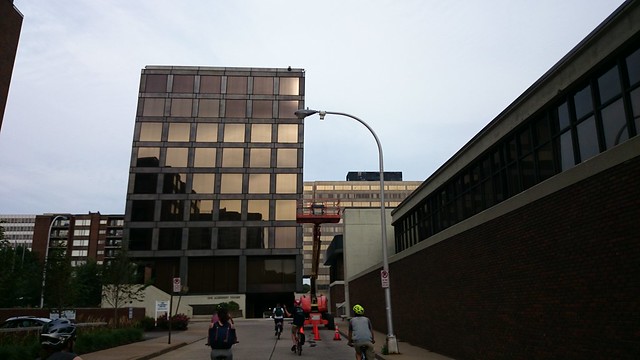
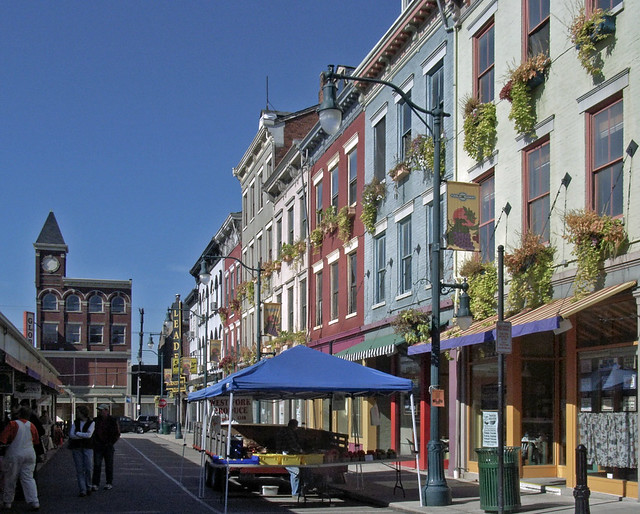
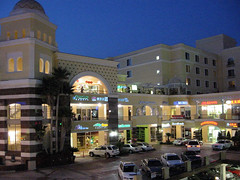
I-670 hides below this building in Columbus, Ohio.

Whether I’m biking down F Street and running headlong into it, or dodging its construction equipment on the infrequent occasions when I have to drive through the I-395 tunnel, it’s hard to miss Capitol Crossing — now the largest development underway within downtown Washington, DC. I knew that this was an unusual project, but it turns out that it’s incredibly unusual: the only instance of a privately financed freeway deck anywhere in the country.

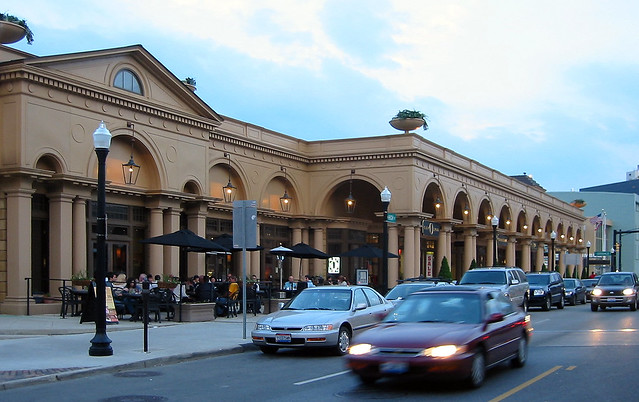
The “Ponte Vecchio” example that everyone points to is The Cap at Union Station: two narrow retail buildings alongside the principal spine of Columbus, Ohio, all built on a bridge over a freeway. It is a marvelous example of a place connector, one that seamlessly unites two emerging neighborhoods to one another.

However, these caps aren’t exactly something that can be replicated everywhere, since it’s an incredibly expensive way to fix a place. The Columbus example was funded by the federal government, as a mitigation measure for widening the freeway below. Most other recent cap proposals resulted from similar mitigation measures — and thus most are parks, both because that’s what the government builds and because their relatively light weight keeps the cost of building a deck down. Klyde Warren Park in Dallas is one example; 70% of the money came from the federal and state governments.

Three things to keep in mind when evaluating a freeway cap:
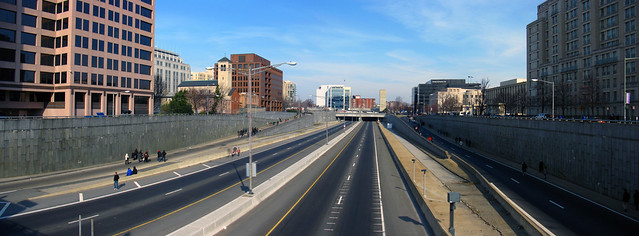
2009 01 20 - 0573-0575 - Washington DC - I-395

The future site of Capitol Crossing, on a rare car-free day (Inauguration Day 2009). Photo by Bossi, via Flickr.

1. The price of the structure is only justifiable if you’re surrounded by very high-value land — namely, a high-rise, high-rent CBD of a high-cost city. This limits the situations where these caps make economic sense to premier sites. For instance, a few blocks of air rights over the Massachusetts Turnpike in Boston’s Back Bay are currently in the planning/proposal phase, having seen prior plans fall apart during the Great Recession.

Capitol Crossing’s developers paid the District $60 million for air rights and are sinking another $400 million into constructing a platform over I-395 just east of Union Station, yielding a cost per “FAR-foot” (square foot of potential development) of around $150-200. That’s substantially higher than the $75 per FAR-foot seen in recent transactions for development sites at the periphery of downtown — but comparable to the $190 per FAR-foot paid for “dirt” within downtown DC, which is pretty much extinct. The net result of this scarcity and high prices is that only the very highest value land uses, namely office and retail, are economically feasible at this development — residential just doesn’t pay enough.

(Calculation based on pre-construction cost figures and final buildout of 2.2 million square feet. Post building calculation doesn’t include demolition costs.)

The economic feasibility line might also be teased out from the RFI responses that Virginia DOT received regarding two sites over I-66 in Arlington — one at the edge of Rosslyn’s high-rise core, and another in low-rise East Falls Church (actually within Arlington County). Almost none of the responses deemed the EFC parcel economically feasible, but many of the responses indicated that the effective “land cost” for the Rosslyn parcels, including cost of construction, at nearly $100 per square foot of FAR.

Unlike private development, a park’s feasible land value is set off-market and is thus completely subjective. In a neighborhood in dire need of a park, or on an irreplaceable waterfront site, the value of a new park may indeed justify the cost of construction.

2. It’ll be much easier, and cheaper, to build a cap if the freeway is completely closed for a while — say, for a major reconstruction. Staging construction over an operating freeway is risky, dangerous, and ultimately costly. Hence, many existing freeway-lid projects, like the Prudential Center and Copley Place in Boston, were constructed before the road underneath them opened to the public. Columbus’ lid was built during an 18-month closure of I-670, for example.

Even at Capitol Crossing, the developer realized the folly of trying to keep the freeway open during construction, and proposed to close 395 entirely for 15-18 months. The closure eventually came to naught due to politics, but would have “cut in half the construction time,” according to the Post: “Building the deck requires installing about 150 caissons along the median to support a network of steel girders… installing the caissons while the highway is in use would be hazardous and disturb nearby residents.”

3. A more entrepreneurial approach that governments can take to such a project is suggested by Matthew Kiefer, who worked on an earlier iteration of the MassPike deal:

MassDOT should adjust its expectations about the revenue potential of these difficult sites to reflect economic reality. It should rely more on rent derived from the net profit of a stabilized real estate asset – percentage rent or a share of proceeds of future sales or refinancings – and less on initial land value, which can be illusory. The Commonwealth will be around for a long time to realize patient returns.

In this PPP structure, the state “speculatively” builds the platform, then executes a “ground lease” for the air rights while keeping the property under state control. This may require a more entrepreneurial attitude towards monetization than most state DOTs are willing to take, but well-located center-city land is a great long term investment. If you really believe in the quality and long-term value of the place that you’re creating, a percentage-rent ground lease is a great way to discount the rent up front but to participate in the long-term gains.

Interestingly, Brandywine Realty Trust also suggested the same net-lease arrangement in its response to VDOT.

4. There are lower-cost alternative to a full bridging project while minimizing the freeway’s footprint and impact. In many cases, the most expensive bit will be bridging the through-traffic lanes — but even sunken urban freeways usually have lots of other spaces. Embankments are usually excessive, and building platforms can be cantilevered out over their edges. Lower-traffic ramps and shoulders are easier to close temporarily for construction. Skybridges can be assembled off-site rather than in-situ, providing more connectivity across the site while minimizing closures of through lanes.

ULI sponsored a governors’ advisory panel study about another downtown Boston air rights parcel in 2012; it recommended a lighter approach than a full-on deck, with buildings surrounding the interchange and bridges over it. (Ironically, the parcel was created through the Big Dig project!)

5. Railroad air rights have also seen active development in recent years, e.g., Hudson Yards in NYC, River Point in Chicago, and 30th Street Yards in Philadelphia. However, the costs aren’t truly comparable to freeway decks: the column spacing can be much closer for railroads than for freeways, and the vehicle movements are rather more predictable.

Friday photo: CIAM’s embarrassing questions about your rowhouse

Jose Luis Sert book: Why is your house gloomy?

Can Our Cities Survive,” Jose Luis Sert’s provocative 1942 treatise on the future of Western cities, posed this set of “embarrassing” questions to residents of the era’s cities. Those who claim that rowhouses are uniquely well-suited for families might recall that, not that long ago, they were widely seen as “gloomy” and unfit for family habitation unless extensively modified — and that most of America still thinks so.

Of course, Sert was largely wrong — in particular, the automotive menace should be solved by restricting the cars, not the children — and the Modernists were never quite successful at convincing families that high-rises were worthwhile.

Attitudes had softened just a bit by 1950, when the regional chapter of the AIA issued a report called “Of Plans and People.” Washington was then in a frenzy over the need to house its exploding population. Rowhouses were merely “disreputable,” rather than intrinsically awful:

Home owners have insisted on increasingly severe restrictions against apartment buildings and row-houses–this despite the fact that for many families they are the most suitable forms of housing. Part of this opposition results from the crude design of these buildings. The ugliness of the typical Washington row-house with its two-story back porches has done more than anything else to bring the row-house into disrepute. If builders were more concerned about good design, the public might feel less need for “protection” against apartments and row-houses.

Friday photo: Mixed residential densities vs. single-density zoning

Richmond: around the Fan

Monument Avenue at Belmont, Richmond, Virginia: one, two, and six-family houses, side by side, on one of America’s most famous residential boulevards

Many of America’s most celebrated urban neighborhoods, like the Fan in Richmond, have a fine grain of different residential densities. Neighbors might live in buildings of broadly similar sizes, but at substantially different densities. But the entire premise of American zoning, as established in Euclid vs. Ambler, was to maintain uniformly single-family districts — uniquely among any country, as Sonia Hirt as shown.

The world’s best loved cities are the way they are not because of zoning bylaws but in spite of whatever zoning may now be in place… Serendipity, complexity, conjunction, anticipation, surprise and delight: these very human experiences are what great cities offer. But zoning is a blunt, inflexible tool. Zoning is by definition exclusionary, limiting things to a preordained set of possibilities. It determines what cannot be done, rather than what can be It does not anticipate nor nurture new, untried forms of city-building or habitation. It does not, in short, encourage the city of desire.

So little of the [American] city was built before zoning was introduced that its more deleterious effects are much magnified. There is very little evidence of the organic city, the intricate web of urban spaces and built forms that rose before the heavy hand of zoning was applied. There is no “old town” core of narrow lanes and multiple layers of use. And there is very little unpredictability, no edge. At the risk of sounding simplistic, it is boring.

— Lance Berelowitz, “Dream City” (Douglas & McIntyre, 2005), pg. 223.

Richmond: around the Fan

Bonus: down the street, an illegal mix of uses. Orchid shops and churches, oh my!

How growing income inequality affects places, part 2: The favored quarter gets richer, the wrong side of the tracks still suffers

The same divergence in fortunes appears to be accentuating price differentials between metropolitan sectors (essentially, “sides of town”). In an economy where the rich are getting richer than everyone else, the rich side of town is also increasing its comparative advantage over everywhere else.

LA office rents

This split was apparent during a recent trip to Southern California. The region might still be “polycentric,” but where one side of town — the Westside favored quarter — now completely dominates local wealth creation. What were merely lopsided prices before have now become absurdly imbalanced, with mediocre buildings on the Westside commanding top rents while perfectly nice areas, like Long Beach and Pasadena, are lagging badly.

In cities where houses or offices on the “right” side of town are scarce, such real estate becomes a privilege only available to the wealthiest people — who, as we’ve noted, are getting wealthier, and in large part because of their houses on the “right” side of town. Even though real estate prices generally track local incomes, the favored quarter of Los Angeles now has prices that track only the exploding incomes of the ultra-rich.

This Redlands ISEA animation of LA-area housing prices from 1988 to 2011, over the course of several cycles, illustrates the “flight to quality” that has occurred during the three busts (mid-90s, early-00s, 2010). At the start, high-value areas are relatively well dispersed across the basin, with only the inner city (particularly the near south and east) suffering from low prices. But, over time, the cumulative advantage of being near the beach increases over time — especially because prices don’t fall as much during the busts, but grow by just as much during the booms.

The trend is perhaps in sharpest relief in high-Gini areas like LA, but is broadly occurring across the country. Joe Light reports in the Wall Street Journal that lower-priced houses are lagging even as prices nationally rebound:

Between January 2006 and May of 2015, the median value of homes in the bottom third of the market has dropped 13% to $101,900, according to Zillow. The median in the middle third is down 6% to $172,600, while in the top third it is off 4.5% to $325,800… The [disinvestment] cycle has been hard to break in large part because low-wage workers have seen little, if any, income growth during the recovery—putting them in weak position to qualify for mortgages.

Recently, Rolf Pendall at the Urban Institute identified the most and least privileged neighborhoods in metro areas nationwide in the 1990, 2000, and 2010 censuses. Over those two decades, the most privileged neighborhoods saw home values rise by an extra $80,000, and their residents actually benefitted from that gain — their homeownership rate is twice as high as in the least privileged neighborhoods. (Since fewer than half of households in the least privileged areas are homeowners, their property value gains accrued to someone else.) Privileged neighborhoods also stockpiled human capital: the growth in their college attainment rate was four times higher than in the least-privileged areas.

This has tremendous implications for intergenerational social mobility, which is closely tied to income, human capital, and wealth. Not only do wealthier families have more private resources for their children, but in a country where schools are largely funded with local property taxes, wealthy communities have more public resources for their children. Three generations ago, legal segregation awarded suburban nest eggs to white families while denying black families the same opportunity — resulting in a “titanic wealth gap” between the races today. (Furthermore, generations of zoning have sought to freeze this status quo, and perpetuate the original injustice)

Thus, the “segregation tax” that penalizes property values in majority-minority communities creates a vicious cycle both for families and for communities, and one that is only getting more pernicious — sadly illustrated recently by the events in Ferguson, Missouri.

Locally, stagnant housing prices in Prince George’s County have contributed to an ongoing foreclosure crisis. Stagnant housing demand from the “underwater limbo” is compounded by its relative isolation from the favored quarter’s jobs engine, and the area’s ongoing “segregation tax” discount. For example, in 1965-1975, the Levitt firm built two large “Levittowns” in suburban DC — Belair in north Prince George’s and Greenbriar in south Fairfax. Even though these are the favored and less-favored sides of their particular counties, near-identical ranches recently sold for an average of $300K in Bowie and $440K in Fairfax.

(An even more striking dynamic can be seen in the Philadelphia area’s twin LevittownsLevittown, PA has property values twice as high as Willingboro, NJ. What’s more, over the 2007-peak-to-2012-trough cycle, Levittown property values declined by only 25%, whereas Willingboro values declined by 50%. And yet, all of the Levittowns began as mostly or exclusively white.)

Meanwhile, formerly moribund downtowns adjacent to job-creating Favored Quarters are finding some success reinventing themselves as the easiest place to add new residential, away from the fierce FQ NIMBYs. The boom in downtown LA’s residential and retail market diverges sharply from its flatlining office market — which still suffers from 20%+ vacancy even though dozens of office towers have been converted to other uses. Downtown Atlanta and Dallas are similarly benefitting from escalating prices to their north.

Friday photo: Greedy developers built your city

Two rental houses on Capitol Hill

I recently came across these plans by a fantastically wealthy land speculator, seeking to profit by ruining DC’s pristine Capitol Hill neighborhood with a towering building crammed full of tiny rental “microunit” apartments for immoral singles — rather than wholesome nuclear families! This kingpin practices his avarice from posh Fairfax County, within a “resplendent” mansion overlooking the Potomac.

This paragon of greedy, out-of-town developers is, of course, George Washington, the very namesake of Washington city. (Yet another greedy developer, Alexander “Boss” Shepherd, is memorialized with a statue right outside the Wilson Building.) Cities don’t arise via immaculate conception; they’re built by developers.

John DeFerrari’s book Lost Washington has a much more detailed account of the houses, showing that the NIMBY nightmare of “out of scale” “overdevelopment” was indeed what this city, and all other cities, was built on. (Otherwise, we’d all still be in caves!) Washington wrote to his architect, “Although my house, or houses… are I believe, upon a larger scale than any in the vicinity… capable of accommodating between twenty and thirty boarders.” A later, even greedier, developer popped up (and popped-under) the ruined buildings in the aftermath of 1814’s fire, and the buildings grew to six stories tall. Anti-pop-up NIMBYs might take heart from its fate: it then descended into criminal infamy and was bulldozed for a park.

[The plans in the photo above are from GW’s Albert Small Collection. More background, including photographs and illustrations of the houses at various points in time, is at Streets of Washington.]

Friday photo: The first sprouts in a freshly plowed field will be weeds

Country road again

An ecological analogy for retail:

Many of the plants we call weeds originally evolved in tough conditions, where there is annual glaciation, periodic flooding, or severe fires – extreme events that leave exposed, bare earth. It’s in these devastated conditions that our weeds are at home. They germinate first and grow the fastest. And through these characteristics they have found important roles in re-establishing healthy ecosystems… Once the weeds are established, longer-lived plants, less adapted to disturbance, germinate and the process of succession begins. The process may end in a grasslands, woodlands or forest, depending on the soil and climate. Indeed, the weeds create the conditions of their own inevitable demise – inevitable unless of course the disturbance recurs.

The “weedy species” that so many bemoan, the token dry-cleaners and fast-food joints that sprout in brand-new buildings, are one key to building a retail market. Over time, better adapted shops will take root — and given enough stability, species will evolve into very specific ecological niches. These new species will both adapt to their environment, and also change the environment around them. The key is to give the habitat time to evolve by avoiding excessive disturbance — a condition ecologists call “disclimax.”

Cultivating biodiversity requires striking the right balance between stability and renewal. The goal should be less to conserve individuals than to maintain the health of overall communities, to not seek out stasis forever but to manage change for the long term.

Gradual change within human communities also helps to sustain and build linkages, according to a paper by sociologist Katherine King: “A gradual pace of redevelopment resulting in historical diversity of housing significantly predicts social relations.”

CNU conversations: Striking before the neighborhood’s hot

DeKalb Market, Long Island University

Yet more thoughts from our (apparently quite long) lunchtime conversation about community-building.

We talked extensively about how, but where would these strategies have the greatest impact? It’s important to jump off the price escalator — to opt out of the gentrification process — early on, before outside capital floods into the neighborhood.

The “tipping point” in neighborhoods is always tied to outside money. First, an urban neighborhood is “discovered” by suburbanites looking to spend their extra $20s in cute restaurants, then by institutional investors looking for $2 million investments, and pretty soon the whole place jumps the shark. But if the small dollars are ever going to have a chance to win the game, they’re going to have to start early on — or else console themselves to small, subsidized slices of the neighborhood, post shark-jump.

“Favored quarter” locations in gateway cities are probably too far gone (more on this in a future post). Even the immediately adjacent areas have probably been bid up too far to be affordable without turning to outside capital. A Place Corp takes a substantial investment of time, rather than money, so the key is not to overpay.

One approach that can work where explosive change appears inevitable is what I’d call a “waterfall TIF.” This uses redevelopment revenue from a “sacrificial” area — for instance, an underutilized industrial corridor separating a gentrifying area from a stable area — to shore up the affordable housing stock in adjacent areas. Two examples:

  • The Hill District in Pittsburgh is a historically poor, African-American neighborhood overlooking downtown. The Lower Hill was demolished for urban renewal, displacing 8,000, but it was never fully developed, except for one arena. A recently adopted TIF to develop the site will direct property tax revenue “into two separate accounts: one for infrastructure needs in the Lower Hill and one for reinvestment in the Middle and Upper hill.”
  • In Houston, the Midtown TIRZ spent $15 million to purchase 34 acres of the adjacent Third Ward, including hundreds of vacant lots, which was then handed to nonprofits and thus taken off the market.
    • Kinder Institute: “Adjacent to the Third Ward, the quasi-public tax increment reinvestment zone that was transforming Midtown — an area formerly divided between the Third and Fourth Wards — was required to dedicate a portion of its revenues for affordable housing. But [State Rep. Garnet] Coleman saw that property values there were rising so quickly, affordable housing would be a difficult pitch to developers, so he convinced a related agency, the Midtown Redevelopment Authority, to use the money to buy properties in Third Ward instead. The redevelopment authority would then sell the property to developers who were required to build affordable single-family homes and rental units. Today, the authority owns 3.5 million square feet of land in Greater Third Ward. Coleman started banking land through the authority in the neighborhood he grew up in, hoping to buy up enough to make a sizable percentage of its future housing affordable. That scheme has already yielded a crop of single-family homes and plans for apartment complexes.”

By the time the usual affordable-housing resources, like TIF funds and inclusionary units start to flow, it’s already too late — prices will already be on an upswing. For maximum effect, resources need to start flowing before new construction and new investment create new amenities, which raise property values. Of course, this requires neighborhood organization (and probably capacity-building) beforehand, to identify areas about to undergo change, and to plan for the process.

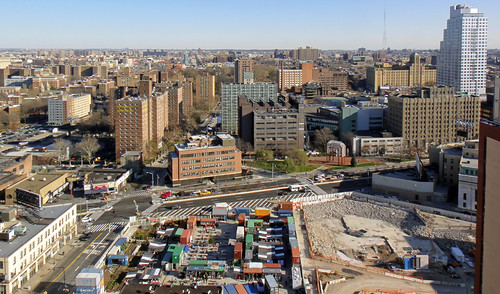
Think of it as an approach comparable to Transferable Development Rights, which have preserved many rural communities, just applied to urban communities instead. To use the photo as an example, imagine if some of the value created by the Downtown Brooklyn rezoning (affecting the sites in front of Flatbush) could also have steered capital funds towards rehabilitating and expanding NYCHA’s Ingersoll Houses (at back right).

Friday photo: Vanquished twin cities

Pittsburgh various

Vanishing twin syndrome” is an eerie phenomenon wherein one fetal twin seems to absorb another. Its counterpart, in the annals of American cities, might be called “vanquished twin syndrome”: where one city annexes another, then proceeds to obliterate any trace of its core through concerted redevelopment.

Some of the more notable examples are cities settled at confluences, which naturally offer a choice of multiple townsites on various riverbanks.

Denver faced Auraria across Cherry Creek, the Allegheny River separated its eponymous town (pictured above) from Pittsburgh, and the fork of the Milwaukee and Menomonee rivers fostered three towns — Juneau (east), Kilbourn (west), and Walker’s Point (south). Portland consolidated with East Portland and Albina across the Willamette. Baltimore subsumed Jonestown to its east, oddly giving its newer rival the nickname “Oldtown.”

Yet as these towns were absorbed into larger cities across the way, the old downtowns of Auraria, Allegheny, and Kilbourn all declined into Skid Rows, offering a uniquely cheap combination of deteriorated, frontier-era buildings within a short walk of the principal downtown. Shunned and looked down upon by the ascendant city’s downtown elite and starved for resources (namely the intra-city transportation links that funneled commuters to the principal downtown), they became prime targets for urban renewal.

Kilbourn was wiped out early on, by a City Beautiful government complex. Allegheny’s center was leveled by Alcoa in the 1960s. Auraria was demolished for a university campus in the 1970s. Oldtown was only partially leveled for housing projects; its main street was then important enough to warrant a federally funded pedestrian mall.

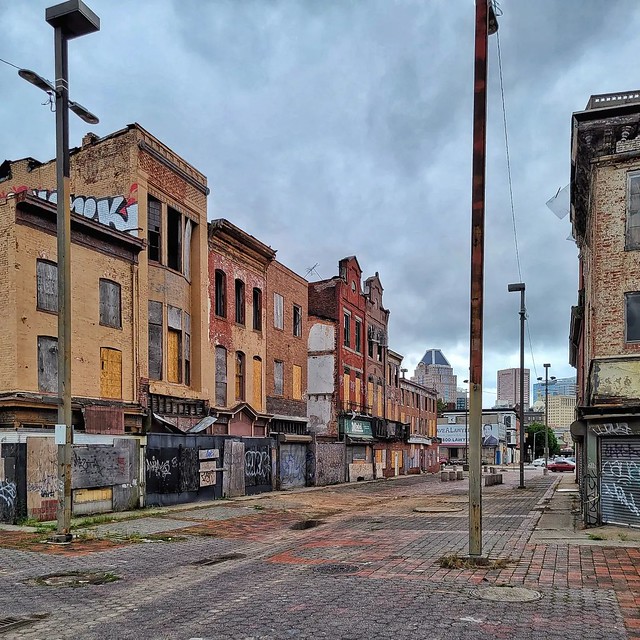
Oldtown Mall

In a weird twist on the theme, Minneapolis absorbed its rival St. Anthony — but proceeded to tear down its own birthplace, while neglecting its rival for so long that it remained standing until the adaptive-reuse age could rescue it.

“Missing Middle Housing”: missing in action for 30 years

Housing completions by # of units in building

Missing Middle Housing” refers to a broad spectrum of smaller-scale multifamily building types that occupy the middle ground between single-family detached and large apartment buildings. At its edges, the term can cover rowhouses and 5+ unit apartments, but in my mind, the core of the “missing middle” are “plexes” — two, three, or four flats on a single city lot. Small apartment buildings like these line the side streets of most of America’s walkable urban neighborhoods: two- and three-flats in Chicago, Polish flats in Milwaukee, three-deckers in Boston, or brownstones in New York.

Census data show that 2-4 unit buildings have almost evaporated over the past generation. As recently as the early 1970s, over 1/4 of multifamily units built were in small buildings. Now, it’s only about 4%.

Despite the steep mid-1970s recession, over 10X as many units were built in small multifamily buildings as today. In boom years, 14X as many were built. It was during the Reagan era that these buildings broadly fell out of favor.

2-4 unit buildings have been a relatively small share of all multifamily construction in the postwar era. Since the 2008 recession, they’ve practically disappeared — with only a few thousand units built nationwide every year:

Housing completions by # of units in building

Next up: Wait, you mean today’s apartment boom isn’t actually that big?

CNU conversations: Introducing the Place Corp

west block

Findlay Market in Cincinnati, where a nonprofit market manager and CDC are working alongside private developers to create a mixed-use destination based around small, local shops.

Our earlier lunchtime conversation in Dallas quickly morphed into some constructive criticism of the community development field. We’re doers, so we delved into some of the mechanics of how a community could control its destiny, and ensure affordability over longer time scales.

In theory, Community Development Corporations have tremendous capacity to manage community change, but even where good CDCs exist — as in Boston and Chicago — their efforts are often quickly overwhelmed by the monstrous quantities of capital involved in gentrification. CDFIs were started to help leverage greater sums of capital, but never quite seemed to move beyond a little niche.

The work that community development organizations do is so labor-intensive that it doesn’t end up being very scalable. Some of that is good — community organizing and small-scale development in disinvested neighborhoods is tough. Some of that is bad — there’s so much bureaucracy involved in securing grants or tax-credit financing (or securing property for a Community Land Trust), and in complying with restrictions on spending that money, that staff capacity gets stretched thin.

(As a side note, why don’t we at CNU talk more often with the community development sphere? Sure, there’s some buy-in when individuals from CDCs get invited to present, but otherwise there’s scarcely any overlap. Perhaps siloization is to blame: CDCs/CDFIs have their own conferences, their own language, their own processes.)

Yet surely there are other vehicles that can provide a middle ground of financing for community development. In a gardening analogy, LIHTC-funded, CDC-built subsidized housing is like a trickle of water from a hand-carried watering can, and Wall Street money is like turning a fire hose onto your flowerbeds. Surely there’s some happy medium: a way to use local capital within a neighborhood, to fund incremental, community-positive projects that make a solid but uneventful return, over the long run.

There’s recently been a lot of renewed buzz about low-profit corporations and B-corps. Richard Plunz’s magisterial history of New York City housing shows us that many of the most innovative efforts at community-building there stemmed from just such endeavors, many underwritten by philanthropists or unions who sought investments with steady returns.

We discussed some of the innovation going on with cooperatives — the most established of low-profit, broadly-owned corporations. I talked up some experiments in the Upper Midwest, like the River West Investment Cooperative in Milwaukee, the considerable excitement around the Northeast Investment Cooperative in Minneapolis, and efforts to minimize business displacement along the Central Corridor light rail. In both cities, local capital is fostering communities of cooperative businesses in “emerging” neighborhoods. And unlike the Mondragon cooperatives, these coops are focusing on serving neighborhood needs, rather than exporting. Nationwide, a few credit unions (like Self-Help in North Carolina) have built substantial commercial-lending businesses, even in real estate.

But as much as we liked the idea of cooperatives, not everywhere has the fertile legal or cultural setting of Minnesota or Wisconsin. While cooperatives are great for certain kinds of businesses, they’re not for everyone: They can raise modest sums of capital, but struggle with large sums; their structures aren’t always flexible enough to accommodate multiple capital classes; their plodding, consensus-based nature makes them resistant to entrepreneurs’ bold ideas. Big-money equity investors (aka venture capital) are critically important to getting small businesses going, and are rewarded with high returns and an outsized say in governance — neither of which can be accomplished with a co-op’s flat structure.

dscf0099

The history of Minneapolis’ West Bank neighborhood is an instructive example of co-ops’ promise and limitations. Uniquely among the ’60s hippie havens, federal urban renewal was leveraged to place most of the neighborhood’s housing stock within limited equity co-ops or Section 8. Alas, idealism and local control proved unable to adapt to either obsolescence or succession [PDF]. Photo: Michael Hicks, via Flickr.

Co-ops are a proven success within steady markets that provide community necessities, like workforce housing or groceries or child care or bike repair or bakeries — but perhaps aren’t the best vehicle for more colorful businesses. In many ways, commercial real estate development is just such a business.

Which brought us to the big small-business finance innovation of recent years: crowdfunding. Numerous “community investing” vehicles have been floated, like direct/P2P lending, lending through community financial institutions, conventional Kickstarter-style rewards (perhaps with interest paid in-kind), equity investments, etc. Crowdfunding has become almost de rigeur in certain popular, high-growth businesses. It first swept thin markets for trinkets that would typically be distributed online — e.g., board games. As the dollar amounts have grown, and as regulators have gradually warmed to the idea, platforms specializing in more capital-intensive bricks and mortar projects have sprouted for sectors like breweries and restaurants. Business models that defy categorization, like the McMenamin’s brand of alcohol theme parks, might be particularly well-suited to crowdfunded equity.

Several new platforms have emerged within this space. I’m most familiar with Fundrise. It’s evolved its primary offering away from common equity investments and towards what it calls “project payment dependent notes,” a hybrid of mezzanine debt (it’s debt, with a promissory note) and preferred equity (even though there’s a pre-determined target return, dividends are only paid when there’s adequate cash flow). For small developers, crowdfunding — even in the currently half-baked, accredited-investors-only form — holds significant advantages, namely cheaper, slower money, plus broader community buy-in.

Interestingly for our purposes, at least one nonprofit community development institution has begun to use Fundrise as part of its capital stack, and in particular in an attempt to save a for-profit community institution. The San Francisco Community Land Trust used Fundrise to raise its 38% equity stake (a local nonprofit offered the other 62% as equity) in an attempt to buy a mixed-use building housing the nation’s oldest African American bookstore, in a neighborhood otherwise ravaged by urban renewal. (Alas, the attempt foundered when the landlord changed the offering price.) All that the city could do was to landmark the building, perhaps in an attempt to reduce its market value, and to offer the business inclusion on a “legacy business” roster.

Mezzanine debt seems to also be the sweet spot for small business-oriented lenders like ZipCap. Their business model mirrors the built-in customer base of a cooperative, “recruiting an ‘Inner Circle’ of customers who pledge to spend a set amount of money in a fixed period of time.” Instead of relying upon just that circle for funds [as a co-op would do with equity memberships, or Member Loans], ZipCap uses those pledges as collateral for outside loans.

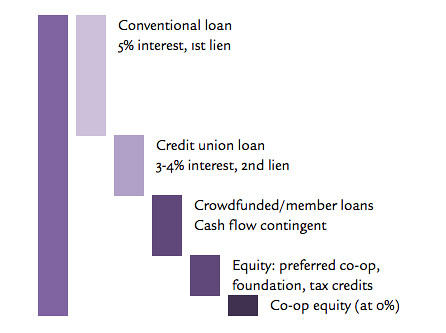
Combining all of the above vehicles — not-for-profits, low-profit cooperatives, and crowd funded for-profits — into interrelated entities might solve the scalability problem by allowing each entity to contribute its own strengths to a capital stack:

investment co-op waterfall

We called this entity a Place Corp, which has the ability to construct a capital stack from various tranches of capital, while keeping control within the community. (Outside investors and developers can help to build pieces, with the Place Corp hopefully maintaining some control via equity, but are treated merely as means towards an end.) Investors can choose from a wide variety of risk/return combinations, and can invest either time or money, choosing negative returns (gifts, grants), zero return (co-op equity), or modest returns. The Place Corp is diversified across property types, but not in location — like the family firms or community banks of yore. The durable, long-term returns of placemaking will create financial rewards for some investors — but for most, the place itself will be the return.

Next in the series: Where? And what sort of services might a Place Corp provide beyond just financing?

Thanks to some of those who contributed to this series of conversations: Karja Hansen, Matt Lambert, Russell Preston, George Proakis, Padriac Steinschneider, Seth Zeren

One (faraway) city sees its authentic retail as “basic infrastructure,” even amidst gentrification

Singapore Hawker Center

A case study (quite literally) about the struggle to maintain authenticity through small-scale retail operations is profiled in this week’s Economist. In Singapore, the government somewhat inadvertently nurtured one of the world’s most exciting food cultures through its “hawker centers.” Anthony Bourdain explained their history in “The Layover“:

The hawker centers of Singapore were a shrewd strategy to incorporate and control what was once a chaotic but pervasive culture of street carts. To control the health, safety, and traffic aspects, vendors were brought inside these covered structures still open to the air, but in stalls with regulated running water, refrigeration, and strict rules of food handling.

In short, they’re food courts with one key twist — they’re government-owned, often located within HDB public housing estates. Today, rising rents and rising living standards both threaten the culinary treasures that are so integral to Singaporean culture:

The main problem is that Singaporeans have grown used to paying prices that the market can no longer bear… The government, says Dr [Leslie] Tay, “has committed to providing cheap food for the masses”. With tiny flats and cramped kitchens, and with the number of two-working-parent families steadily rising, plenty of Singaporeans count on hawker markets for their sustenance. But with the first generation of hawkers retiring and their replacements paying market rents, food prices will certainly rise.

And as the masses change, so will the food. Some Singaporeans lament that a recent influx of immigrants from northern China has made their traditional Teochew or Hokkien [ethnic groups from southeastern China] favourites harder to find.

The article arose from a blog post by Dr Tay where he recommended instituting non-market mechanisms for allocating space in the government-owned markets: “Wouldn’t it be great if the officers can just recognize his status as a Heritage Hawker and help him get a stall at pioneer hawker prices?” (Pioneering stalls were subsidized in an attempt to entice hawkers off the streets, and today those rents are 90% below market rate, according to the 2015 case study by Tan Shin Bin for NUS’ Lee School.)

Indeed, but would you necessarily trust a government to make good decisions about what constitutes “good food”? Perhaps not, but plenty of America’s most successful public markets (like those in Milwaukee and Seattle) are run by nonprofits. An early effort at a nonprofit hawker centre in Singapore failed, but the government has signed new management agreements with cooperatives and “social enterprises,” as recommended by a 2012 panel.

A prior experiment in renting out a hawker center to a for-profit operator failed, and won’t be repeated; Minister Vivian Balakrishnan, whose ministry runs most centers, maintains that “Hawker centres are social infrastructure – and not an opportunity for property speculation or rent seeking by commercial entities.” Instead, nonprofit managers will get the opportunity to reinvest surpluses into social development and entrepreneurship, and prioritize operators that provide affordable food and heritage cuisines.

“Social infrastructure,” as Minister Balakrishnan put it, provides a useful frame for talking about “authenticity.” Cities are living things that require supporting infrastructure: physical infrastructure, social infrastructure, green infrastructure. They also need room to grow and change.

How can cities simultaneously build physical infrastructure (transportation, housing, workplaces) while also supporting and fostering social infrastructure, and regenerating ecological infrastructure? The answer might seem simple, but unlike physical infrastructure, social infrastructure is itself also living — and a somewhat fickle, slow-growing, and slow-rooting species at that. These make them tremendously resilient, but also slower to adapt than other forms of infrastructure.

As Singapore’s experience indicates, the answer probably lies with the social enterprise sector. How could those be structured? One potential answer’s coming up.

CNU conversations: Can we build authentic, small-scale communities that subtly adapt to change?

A few thoughts on a CNU 23 presentation by Russell Preston and Matt Lambert about their ongoing work on defining and fostering authenticity within New Urbanist places. Other thoughts will be forthcoming, as I write them up.

Once and forevermore

Do design and development really disrupt enduring neighborhoods? This block in Guangzhou, China, changed tremendously, but in some ways didn’t change at all.

1. Role of design
Flexible, adaptable buildings allow uses to change in their natural cycles. Crucially, notoriously fickle uses like production and retail must be given room to adapt. Not only do shop concepts and merchandise change, but the volume of these uses needed rises and falls with economic cycles. Tactical urbanism has shown us that design details may not be quite as important as broader questions of scale and program. Such a “stage set” approach may be especially appropriate in an era where programs frequently change.

2. Small scale
To the extent that smaller, more “honest” enterprises can be designed around, perhaps the best physical model relies on creating adaptable space along many smaller frontages — a fractal approach, as it were. More marginal businesses have long turned to side streets and passages to be near, but not in the middle of, the retail action.

Since these frontages are inherently not as valuable, they can remain affordable even amidst higher rents for premier locations nearby. Just as coach houses are “naturally affordable housing,” consider the value of alleys, passages, and even enclosed arcades as “naturally affordable retail.”

Another CNU 23 session, ostensibly about pedestrian malls, featured examples of pedestrian-only ancillary passages where smaller retailers thrive just off Main Street. Beth Anne Macdonald spoke about Division Street in Somerville, N.J., where commerce has thrived after the street was turned into a pedestrian mall in 2012. Division (like Bethesda Lane, which Tim Zork presented at the same session) was intended as shared space but ended up being car-free 24/7 — a testament to that type’s tremendous flexibility. Despite its Spartan design of concrete and streetlamps, Division is thoroughly programmed year-round.

Downtown in the distance

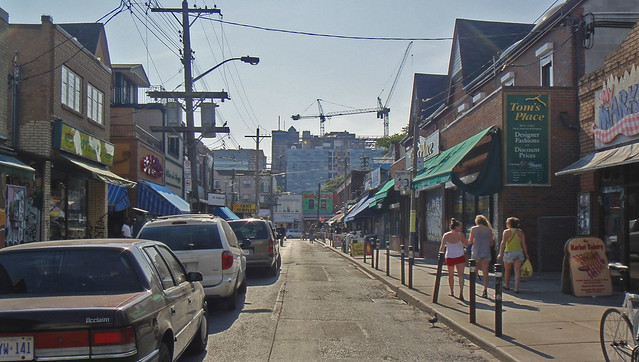
Kensington Market in Toronto has a built environment that’s a terrible jumble of everything, but it gets the scale — and thus the feel — just right. It’s car-free on summer Sundays, thanks to gates that cost just $180,000.

Similarly, I’m setting up a walking tour in October of how retail is thriving away from the main streets in Georgetown, along its alleys, side streets, and the pedestrian-only C&O trail. The neighborhood’s historic scale — its small blocks and small spaces — and relatively flexible zoning permits this natural shift between uses. That these processes can work illustrates two chapters in “Death and Life”: small blocks and aged buildings.

Of course, financing these spaces can be a challenge. Yet this country is plagued with throwaway retail space, much of it ancillary to upstairs office and residential. Whether the ground floor of an apartment complex is given over to “amenity space,” or to small retailers who may or may not reliably pay rent, shouldn’t be of much interest to the bankers — and, arguably, many of the apartment tenants might well prefer the latter! Designing the public and private spaces with the flexibility to accommodate whatever uses might be demanded could prove a greater challenge.

At the Louisville NextGen meeting, the one example of a new-construction informal street market that I could think of was a set of buildings in Downtown LA’s Fashion District. They appeared to have been built largely as paid parking garages, for which there are many local comparables, but had clear-span ground floors to accommodate small wholesale clothing retailers. It was awesome.

3. Policy and non-market structures
Market prices for prime space in gateway cities have — due to high outside-investor interest — reached heights that stifle innovation and organizations that evaluate their impact in primarily non-market means. Furthermore, not all institutions are lucky enough to have purchased their property “back when it was cheap.”

The 5M model (final program & renderings) has promise — identifying “community anchors” more broadly than just non-profits, offering free or discounted space to these community serving entities, and profiting by selling ancillary services. The other innovation is that this project’s pro forma has been turned on its head: the community space is accepted as a given at the starting point, and the market-rate buildings sized accordingly. (Since every development in San Francisco is discretionary, you might as well ask for the moon.)

But what about the next community that comes along? Will tomorrow’s fresh ideas and institutions have similarly protected spaces? Is this model flexible enough to accommodate new institutions, or shifting missions among the existing institutions? Rather like rent control, this approach privileges those who showed up at the right time, excludes newcomers — and leaves the question of capital renewal unanswered. Could a similar space, like [innovation] District Hall, be continually refreshed with new concepts and competitions on a regular basis?

(We had a detailed conversation about a potential corporate structure to ensure long-term community affordability on the following day. Notes about that conversation are forthcoming.)

4. Chinatowns, new
At least some suburban communities have successfully retrofitted smaller scale uses into strip-mall suburbia: the “ethnoburbs” that Asian immigrants have settled across North America. Even shiny, new buildings still foster small businesses, due in part to high density, tiny footprints (see above), management that understands the business models, and perhaps other factors that could be identified.

Meanwhile in ethnoburbia

San Gabriel, Calif.

These retail centers can be built in a more transit-oriented manner; the vertical malls cropping up around Flushing have a mind-boggling spatial complexity. The vertiginous skyscrapers of Hong Kong, clustered around mass transit, have organically evolved 3-D pedestrian networks so intricate that they defy description, but which host all sorts of authentic communities.

5. Chinatowns, old
These neighborhoods appear to maintain a remarkably stable level of economic diversity — of activities, of economic groups — and appear, from the outside, to have stable populations. Yes, some of this stability is real, and partially results from capital that gets locally recycled, through local institutions.

But what looks like stability from the outside also hides considerable turbulence under the surface. There’s constant upheaval among the community’s participants, as high in-migration balances out community members “lost” to assimilation. By and large, assimilation (as institutional racism declines/morphs) has undermined most of American cities’ other mixed-income ethnic enclaves, but since Han Chinese easily outnumber every other ethnic group in the world, there will always be a inflow of migrants — or will there?

Another less-than-replicable factor behind Chinatown’s staying power is a lack of effective enforcement (“It’s Chinatown, Jake”). Thus, things don’t quite happen to code; it’s cheaper, but somebody might get hurt. Whether that trade-off is worthwhile is your judgment call, but it does illustrate that over-regulation might be a factor in driving high costs.

6. Community change and the word “authentic”
It’s worth thinking through a bit more about how “authenticity” (see this discussion by Sharon Zukin) like any other aspect of community character, will move in cycles. Every community changes its participants, and is changed by its participants. The people who come after us have different experiences, and what we do shapes how they understand the world around them. This feedback loop can either result in a virtuous, or a vicious, cycle.

The pace of change also matters. Change is literally a fact of life, but violent upheaval is rarely welcomed. Many communities today are upset by the roller-coaster ride that property markets have put them on, with prices rising much faster than social infrastructure can adapt.

What appears authentic and novel to us will seem workaday and fake to someone else: If I cooked one of my grandfather’s recipes for you, you’d see it as “authentic” and he’d see the exact same dish as “fake.” It’s exactly that interplay, exchange, and evolution that makes cities — and especially American cities — such interesting and exciting places. It’s a tough edge to surf on, to simultaneously embrace and resist change, to honor established practices while inventing new ways, but it’s a worthwhile endeavor.