CNU conversations: If CBAs are broken, should they be turned upside down?

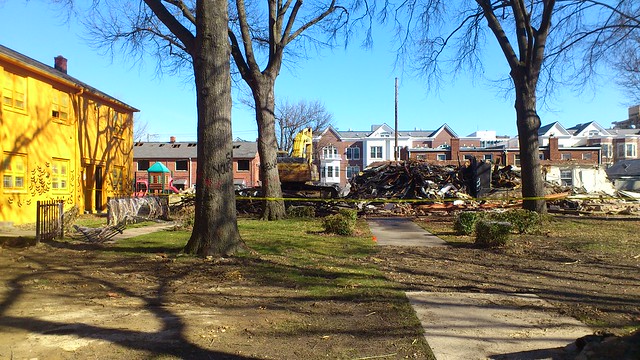
Demolition

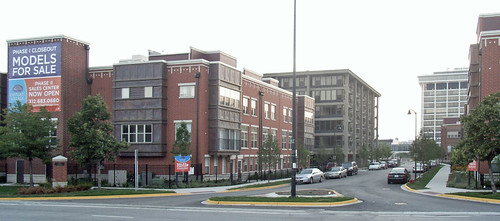
Redevelopment of Alexandria public housing near Braddock Metro in 2013. The slightly taller buildings with gables in the back include replacement units.

A subsequent conversation at CNU bemoaned how “tollbooth zoning” (as Ben Ross calls it) has turned everyone into their worst nightmare of a money-grubbing Chicago machine pol, rasping “ubi est mea?” over a cigar.

Ross’ description: “payment, in cash or in kind, is exacted from developers as the price of passage… The most common technique for forcing developers through the tollbooth is to zone for much less density than anyone really wants… When someone wants to build, they either apply for rezoning or seek approval of an ‘alternate’ use of the land” — and thereby pulls up to the tollbooth. It seems cost-less, but only because it’s a way current voters/residents can extract payments (tolls, ransoms) from future residents.

In Chicago, the racketeering operation was simple — you paid, you played. You want to build something? Fine, pay up and we’ll talk. (This indictment was a classic.) In many cities today, it’s pretty much the same. We’re systematically under-zoning (and over-planning) everything to maximize the possible value granted through zoning relief, and demanding the difference back through legalized bribes we call community benefits agreements.

Because the contents of the CBA or PUD are up for negotiation at one point in time, communities end up with whatever’s convenient then, not what’s actually needed. The results can be baffling. One local municipality has a surfeit of tiny “black-box” theaters that don’t get used, since theaters can only be purchased in increments of one, and the cheapest performing-arts giveaway is a black-box theater. (Someday, I’ll pull together a tour of the laughable “arts spaces” that zoning’s required around Penn Quarter.)

The most obvious solution would be to buy upzones using cold, hard cash on a per-foot basis, but that’s not allowed — if it’s a tax (or impact fee), it requires a legal nexus. [Update: Of course, Chicago has since devised a cash-for-upzoning scheme. Don’t try this at home.] So instead, communities get whatever the developer feels generous enough to give. Not to mention that the entire process, since it’s all boils down to political power, favors those who already have political power — large, well-connected developers vs. squeaky-wheel communities. Small developers get shut out of any opportunity to build, and disempowered communities (the homeless, for instance) never get a chance.

Now, since we’ve established that the zoning is entirely arbitrary anyways, why not flip the equation and start with the community benefits? The quantity of stuff permitted on the site ultimately doesn’t matter as much as the quality of what goes there.

This “upside down pro forma” is already being done in several instances, notably in situations where municipalities are seeking to maximize affordable housing output. For instance, cities that have committed to 1:1 public housing replacement — as HUD’s Choice Neighborhoods program does — have long had to work backwards to find enough market-rate units to make the pro forma pencil out. Alexandria has operated under a 1:1 public housing replacement policy since 1972 (“Resolution 830,” PDF), and the results are very impressive — seamlessly integrated urban fabric, both socially and physically.

Canada never had HOPE VI as federal policy, and its municipalities have a firmer hand in land use control. (For instance, Ontario’s Section 37 permits cash payments within a negotiated CBA. Sounds filthy, but actually cash is nice in that it’s easily measured.) So, working backwards from the benefits to the proposal isn’t unusual.
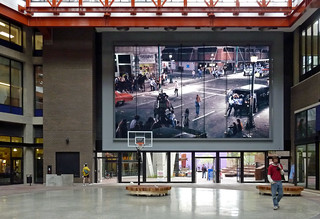
Woodward's

The art inside the Woodward’s enclosed retail court shows a police riot that took place nearby.

In Vancouver, the mind-bogglingly complex Woodward’s redevelopment used a public RFP process to stack a vertical mixed-use community with just about everything onto an abandoned department-store block right on Skid Row.

In Toronto, zoning bonuses paid for a 68-unit artist live/work space. Regent Park’s redevelopment has created 1:1 replacement units, plus 15% so far. As part of the development agreement, space for social infrastructure was built early on; the Daniels Spectrum “includes several state-of-the-art performance spaces, a locally run café, a green roof, and two floors for various educational, arts and community groups that have long operated in and around Regent Park. Many relied on informal or rented space, and some had been uprooted when the demolition began. The need for this kind of social infrastructure remained.”

Regent Park redevelopment continues

Regent Park in Toronto, where a commitment to better than 1:1 replacement housing (and additional retail and social services) is resulting in much higher densities.

That’s certainly one approach for maximizing the community benefits, but it introduces a few huge risks. It still only works for huge projects, it still relies on political power, and it still subjects the CBA to the fads of the moment. And what happens if the approach fails? The developer might just decide there’s nothing in it and walk away. (Another argument for good phasing.)

Even though the “tollbooth” system is the one we’re used to, it’s in large part to blame for making development complicated and costly — thus shutting out smaller producers, resulting in under-production and higher costs for everyone. Those higher costs go into landlords’ pockets. A rational system would instead make it easier to build, lower housing prices, and instead steer the same dollars to higher taxes and better services for all needy people, regardless of whether they live near a CBA-extracted theater or not.

To finish off the analogy: instead of fighting over who gets to sit inside the tollbooth, maybe it’s time to replace tolls with VMT charges and carbon taxes.

(Updated 4/2018)

Friday photo: 555 Hudson, in 2015

555 Hudson Street

Of course “The Next Step Realty” (“brokerage for grads moving to NYC“) will be in Jane Jacobs’ old house. The city depends on churn, and even back in her day the neighborhood was filled not just with barbers and longshoremen but with “well-dressed and even elegant women and men with brief cases.”

High rises’ high costs, part 3: Maintenance costs

Earlier, I’ve written about how high-rises face higher up-front costs, stemming from both lower efficiency and higher construction costs. But the high-rise cost penalty doesn’t just apply to upfront construction costs — their ongoing maintenance expenses are typically higher than for low-rise buildings.

Eastgate Village & Mercy Hospital

Even within this one development, condo fees for 1-bedroom units are 30% higher in the renovated mid-rise than in the new low-rises.

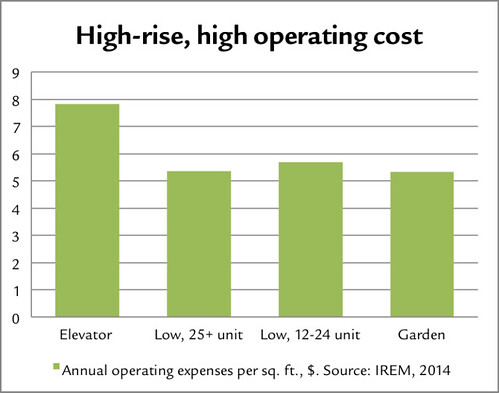
The Institute of Real Estate Management publishes an annual benchmarking report for property managers, showing average operating expenses for 717,000 apartments nationwide. IREM’s 2014 report found that “elevator” buildings (both mid- and high-rise) have operating costs that are 43% higher per square foot.

IREM apt ops data

Frank Schliewinsky, writing in Strategics Vancouver Condo Report, analyzed MLS data to find that “Monthly strata [condo] fees for low-rise projects tend to be less than those for high-rise projects.” Fees averaged 22-25% higher per unit in high-rise buildings across metro Vancouver, both in low- and high-cost markets, and both for new construction and older buildings.

(Factors that may explain the discrepancy between the two figures may relate to definitions — many low-rise buildings still have costly elevators — and/or the smaller unit sizes typical in high-rises.)

Some of these increased costs stems from the upfront construction: high-rises have more materials and bigger systems to maintain, and their less efficient floor plans mean more common areas have to be maintained.

Another curious factor is at work, though. The higher costs for high rises creates a vicious cycle: Higher costs (per square foot, and per unit) mean higher rents are needed to justify high-rise construction. Those higher rents can only be achieved by aiming for that segment of the market which wants to pay higher rents — by definition, the luxury segment, who can be enticed to pay higher costs by adding ever more amenities. Those amenities further increase costs, both up front and in the long run.

None of this is to disparage high-rises, of course: I live in a high rise, after all, and enjoy its sunlight, views, sound attenuation, and proximity to services. (And, frankly, don’t really use the high-cost swimming pool very often.) When I was younger, though, I lived in lower-cost low-rise apartments and aspired to someday live in the sky.

The intrinsically high costs of building and maintaining high-rises makes it dangerous to recommend that high-rises will absorb a large share of housing growth — particularly in metro areas that already suffer from high housing costs, which don’t need even more housing that’s inherently costly.

(Again, to be continued.)

Redeveloping multifamily: condos are forever, co-ops perhaps less so

“A diamond is forever, a suburban R-1 zone nearly so” – Jonathan Levine, “Zoned Out”

And what’s even more permanent than an R-1 zone? A condominium.

Dearborn Park, Chicago

See those townhouses tucked among the trees? Hope you like them, ’cause they’re there, forever. (CC photo of Dearborn Park, Chicago, by Doug Nichols)

The saga of the Frontiers West condominium along 14th St. NW — as told by Lydia DePillis a few years ago — recently came up in conversation. A few years ago, multiple developers attempted to buy the entire complex, but ran up against an implacable foe: consensus. “Redeveloping any one of the parcels,” DePillis reports, “would require unanimous consent from the owners of all 54 units—so just one person could doom any deal.”

Frontiers had been built as public housing in 1977, an attempt to revitalize a neighborhood still deeply scarred by riots a decade earlier, and was sold off to tenants in the 1990s. (Jack Kemp introduced a Thatcher-esque scheme to sell public housing to tenants during the Bush 41 administration.)

Frontiers West’s unusual backstory created an unusually wide “rent gap” (the difference between value as-built and value as highest and best use) at that location. However, condominium ownership is over 50 years old in America, and thus the first stick-built condos are probably running up against their expected service lives. For those buildings, the economics of depreciating structures will soon run up against appreciating land values, and associations with structural problems (and in good locations) will have to face tough decisions. Says one condo owner outside Vancouver (probably the most condo’d city in North America), “We don’t have a system that allows people to understand what to do at the end of their unit’s life.”

It’s not necessarily impossible to buy every single owner out. MetroWest in Fairfax is being built on what was a low-density subdivision, where every owner consented to the sale. In a single-family situation, it should be possible in most cases to buy most of the parcels and leave a few “nail houses” outstanding.* Eminent domain, as at Atlantic Yards in Brooklyn, is also an option in situations where legal justification can be found.

Steven J. Smith found one recent example of a 30-unit condo — a singularly awful 1970s building in Chicago’s Lincoln Park — that had been re-assembled. (Maybe it helps that Illinois law requires only 75% of units to force an en-bloc sale.) But for other examples, he points overseas to Singapore and Japan — both even more urbanized than the USA, but also both societies where achieving political consensus is easier (their effective one-party rule being the prime example).

Singapore took Thatcher’s idea of council-flat ownership to an extreme, encouraging Singaporeans to purchase their public housing units with their social pension funds. (It’s also a clever way of locally recycling capital to fund their ambitious housing scheme.) Now that some of these buildings have become attractive redevelopment opportunities, the government has begun a “selective en-bloc redevelopment scheme” (or SERS, in the acronym-happy Singaporean government-speak) for scores of 1950s-1980s concrete-slab tower blocks, provided that 80% of owners consent. It helps that HDB flats are technically not owned, but instead are tied to 99-year leases; this gives HDB the authority to do things like impose anti-speculation rules to keep prices stable between the time redevelopment is announced and all individual contracts close.

Speaking of unique authority, this is one area where the greater legal flexibility granted to cooperatives, rather than condos, can come in handy. Whereas New York condominium law requires 80% approval for an en-bloc sale, its cooperative law only requires 2/3 consent to dissolve the corporation. For the particularly obstinate, District of Columbia law also permits cooperatives to kick out individual members through a simple majority vote.

Northern Virginia again offers a local example, where the Hillwood Square co-op in Falls Church sold itself after a two-thirds vote:

“They were faced with the prospect [of] spending a significant amount of money to upgrade the property’s underground infrastructure… ‘Hillwood was one of the most complicated as well as the most rewarding land deals we have had the opportunity to represent in our careers,’ [broker Mark] Anstine said in a joint statement”

A condominium next to the Huntington Metro has put itself up for sale via an RFP process, with an 80% approval threshold and a requirement that replacement units be built and offered to current residents first.

An interesting application of a cooperative scheme to urban redevelopment challenges could involve capitalizing new cooperatives with existing smallholdings, or redeveloping part — but not all — of a co-op. A co-op, as a stock corporation, has relatively few restrictions on its property holdings and financial activities — especially compared to a non-profit condominium association, which typically would have to distribute excess funds to members.

Land assembly for major projects in Japan, like Roppongi Hills, can be undertaken by pooling properties together into a “Redevelopment Association.” By guaranteeing equity participation in the new development (and new on-site replacement housing), this approach ensures that landowners share equally and fairly in property value gains — thereby removing individual owners’ worry that they sold out too early/cheaply.

Cohabitation Strategies included an equitable-growth idea similar to this strategy — what it called “Cooperative Housing Trusts” — in MoMA’s recent “Tactical Urbanism” exhibit. These community land trusts could aggregate and sell otherwise unusably-small quantities of air rights, and reinvest the proceeds into permanently affordable housing. (It was the one interesting idea in the entire exhibit, IMO.)

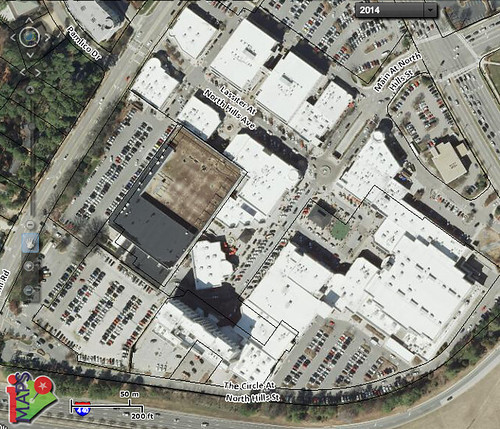
* No examples come to mind off-hand, but this is a common practice in shopping mall redevelopments. Department stores that own their own land have been excluded from many redevelopments that engulf them, as with the aging JCPenney at North Hills in Raleigh:

Raleigh, North Hills on iMAPS

The opposite situation was bound to happen someday, and of course it’s flailing-about Sears that is leading the way. It’s not just subdividing its boxes and adding new subtenants like Whole Foods, but in at least two cases (at Aventura, North Miami’s fortress mall, and Metrotown outside Vancouver) it’s going rogue and doing its own mini-de-malling without permission from its “landlord.” Sears’ footprint at Aventura will shrink almost 90%, to just 20,000 feet — maybe their agreement with Simon requires that they not abandon the site entirely.

DC will not become ‘like Amsterdam.’ It’ll be better.

District of Columbia Mayor Muriel Bowser said this week “that the District will not become ‘like Amsterdam,’ as though being ‘like Amsterdam’ would be a bad thing,” says a blog post by the Netherlands Embassy.

The embassy backed up their umbrage with a stylish infographic showing off several metrics where Amsterdam handily surpasses the District — particularly in transportation choices, as Amsterdam offers its current residents more waterways, more bikeways, and more streetcar lines.

For one point, the infographic concedes that the District is bigger and better than Amsterdam: Washingtonians can now legally possess over 11 times as much marijuana as Amsterdammers. But since the Netherlands has more permissive laws regarding the retail sale of marijuana than the United States, many visitors (like, perhaps, Mayor Bowser) instinctively use “Amsterdam” as shorthand for a place with libertine drug laws. (Dutch society has a long history of taking a uniquely hands-off approach to social policy.)

On several other points, though, the infographic shows that although DC isn’t quite there yet, we’re well on our way. DC already has ambitious plans to beat Amsterdam on two points: the Sustainable DC Plan projects another 250,000 Washingtonians, for a total of 868,000 to Amsterdam’s 810,000; and the Move DC plan has plotted out 343 miles of bikeways, including 72 miles of Dutch-style protected bike lanes, which easily beats the mere 250 miles of bikeways in Amsterdam.

DC is also making significant progress in closing the 12-museum gap with Amsterdam. With an evergrowing number of museums here, DC is well on its way to overtaking Amsterdam in this particular metric. (I don’t have statistics handy, but it seems likely that DC has fewer but larger museums, which probably have an edge in terms of collection size and total visitors.)

On two other metrics, though, we have a long way to go. At the current rate of construction, it will be a while until DC manages to build its 16th streetcar line — but note that the Dutch embassy conveniently doesn’t count Metro lines, as DC boasts six to Amsterdam’s five (almost), as construction on their north-south line is almost as delay-prone as our streetcar.

The yawning gap between the two cities’ canal networks is only half as dire as the Dutch say. Yes, Amsterdam has 165, but DC actually has two operating canals, not one: The embassy may have been confused by the name of Washington Channel, which is a brackish waterway built to drain tidal flats and to keep open a shipping channel. In other words, it’s hydrologically far more similar to Amsterdam’s canals than the freshwater C&O.

In any case, I’ll concede that more of Amsterdam is below sea level than Washington. In an era of rising sea levels, though, that’s probably not something worth trumpeting.

On definitions: equitable communities, magpie infrastructure, vibrant centers, gentrification

Bellevue goes upscale

Bellevue was not one of the “suburban vibrant centers” examined for a NAIOP report on office occupancy trends.

Some recent reports left me appreciative of their aims and ends, but not exactly how they got there, and in particular with how other analyses have defined key terms.

1. The Living Community Challenge certainly provides an inspiring goal to reach for, notably in its use of elegant performance criteria that broadly require “net positive” environmental performance on site — broadly, that new developments can strive to shrink their ecological footprints to fit within their actual footprints. It also pretty seamlessly integrates the Transect throughout, and in a balanced way that sometimes rewards and sometimes penalizes both ends of the spectrum.

However, having participated in the creation of LEED for Neighborhood Developments, it’s telling that some of the same battles in that scheme have emerged within this one. Prescriptive approaches still occur throughout, and some of the personal-health ones are somewhat wishy-washy. (The emerging science of health impact assessments may have been a useful complement here.) The equity section (“petal”) has a lovely intro, but its imperatives don’t address many social criteria — affordable housing is a notable omission — and almost entirely use prescriptive standards. Another long-running debate was over the use of prerequisites in the rating scheme: It seems strange that a baseline, “Petal Community” certification can be done while ignoring a majority (four of the seven) of the petals.

I’ll be interested to learn more about the Challenge in the coming weeks, and to see how others feel about whether it’s rigorous and balanced.

2. Kriston Capps brings up Mikael Colville-Andersen’s term “magpie infrastructure” in a recent CityLab piece. Bicycle and pedestrian infrastructure, examples like the Bloomingdale Trail aside, rarely needs architects’ attention — their structure-first solutions are usually fundamentally anathema to bicyclists’ lazy inclination to not climb hills. By and large, people should be encouraged to stay at grade, and landscape architects and engineers should be entrusted with their care.

Closer to MCA’s home, the current BIG exhibit at the NBM includes Loop City (video; skip to 2:30), a proposal for an elevated rail loop around Copenhagen + Malmo. The proposal lifts up the stations so that trains decelerate on the approach and accelerate as they exit — a clever idea lifted from subways like Montreal’s. When done below-ground, this brings trains closer to the surface just where they’re needed, but when above-ground, the same approach antagonizes the energy needs of the passengers (who need to climb ever-higher escalators to get to the platforms) and the energy needs of the trains.

Another obvious flaw is that the proposal repeats the Corbu-in-Algiers mistake of thinking people would want to live in flats beneath a railway, without realizing that below-the-tracks spaces are almost always only valuable in situations (I’m thinking in Ginza, the Viaduc des Arts, or 9 de Julio) where such space is just the cheapest way of getting valuable ground-level, street frontage. Even maglevs are pretty awful to stand right underneath.

Besides, haven’t we tried grade-separation of different modes before?

3. NAIOP recently published a report offering slight encouragement to the notion that office users are increasingly choosing mixed use environments — namely, 24-hour CBDs and 18-hour “suburban vibrant centers” (their terminology, not mine) — over single use suburban office parks. Their findings indicate that rental rates are indeed higher in CBDs, but that CBDs haven’t seen as much absorption as suburbs, whereas “vibrant” parts of suburbs had a verifiable edge in the leasing market. There’s certainly plentiful anecdotal evidence, and this has been the mantra of “Emerging Trends” and other qualitative reports for quite some time, but I’ve seen few attempts to quantitatively analyze the phenomenon.

Yet the two sets were compared quite differently. The comparison of CBDs vs. suburbs was strictly quantitative, an approach that didn’t control for the quality of the urban environments — downtown absorption was hurt by including a great many “dead” downtowns (Dayton, St. Louis, Hartford) among the comparison set. Most of the liveliest downtowns have seen strong positive absorption, since it’s less the CBD location than the mixed-use amenities that draw users.

The “vibrant centers,” on the other hand, were compared using a robust paired-case approach: single-use suburban areas were paired with mixed-use suburban areas within the same part of town. They even came up with a pretty strict definition of such centers and their comparison sites, using Walk Score and building-level maps. This better methodology dives into why people are migrating towards such sites, and goes beyond the not-terribly-nuanced submarket definitions found in typical office market reports.

Although the lower absorption figures for CBD office may look discouraging at first glance, it’s necessary to consider both that higher rents might result in tenants using CBD space more economically. Square feet don’t necessarily correspond with people, much less dollars. (Edit 26 Feb: City Observatory has a new report indicating that job growth has indeed been more robust in CBDs than in suburbs.) In addition, the supply constraints on new downtown office might suppress demand from space-hungry users — e.g., many large companies are expanding both in San Francisco and Silicon Valley, but adding more jobs in the Valley where construction isn’t limited by constraints like Prop M.

4. For good measure, here’s one instance where the methodology and the results both turned out okay: Governing’s recent analysis of gentrification at the Census tract level. The scale of the analysis is correct, the results pass the smell test, and the variables used (rankings of changes in household income and physical [home values] and cultural capital [college attainment]) seem reasonable.

Modest proposal: depave Foggy Bottom’s riverfront, but leave I-66

Neil Flanagan recently wrote about current and past proposals to heal the urban-renewal scars that separate the Kennedy Center — which should be a terrific urban amenity — from the city around it.

Erasing RCP by the Kennedy Center

The KenCen, along with the Watergate complex and what’s now the Saudi embassy, stands in a tiny island isolated from both the city and the river by two parallel highways. Neil’s post focuses on a long history of proposals to bridge the chasm of I-66, built alongside this island as part of the grand urban renewal scheme that obliterated Foggy Bottom’s industrial heritage.

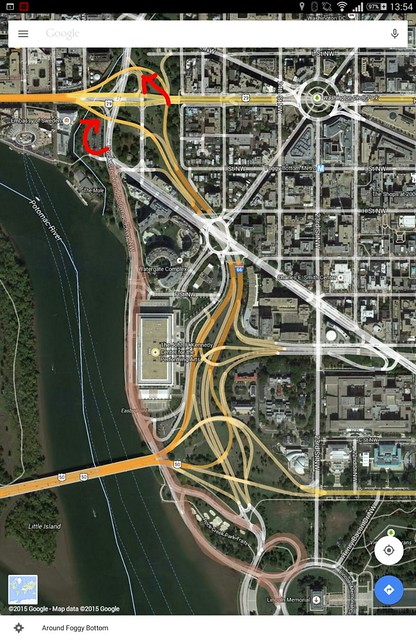
Yet the 1920s-era Rock Creek Parkway that runs on the riverfront through this stretch is perhaps a greater urban offense. It’s a limited-access highway that squeezes strolling pedestrians and cyclists into a narrow riverfront strip. It intervenes between the bike path and the river at one point, creating a particularly confusing, and dangerous, joint in the otherwise admirably complete trail network along the region’s waterways, and pretty much completely interrupting any pedestrian flow between the Mall and the waterfront. (Speaking of harrowing junctions, its at-grade intersection with I-66 creates a terrifying two-stage left turn at the end of I-66’s Independence Avenue ramp.)

And it could be eliminated with just two ramps — the ones shown in red in the map, linking the existing and underused ramps that link I-66 Extension to the Whitehurst Freeway, to Rock Creek Parkway. Adding these two ramps would enable cars that currently use Rock Creek Parkway to use the woefully empty I-66 that runs just two blocks east — and thus permit depaving Rock Creek Parkway (in pink), south of Virginia Avenue and north of the Lincoln Memorial.*

(A 1998 FHWA study also proposed the same ramp at the northeast quadrant of the interchange, but instead of a loop suggested a signal and a left exit. It also proposed to leave RCP, and grade-separated the Ohio/RCP intersection.)

Creating a linear park along the river between the Thompson Boat Center and the Lincoln Memorial would more clearly link three great linear open spaces — the Mall, Rock Creek Park, and Georgetown Waterfront Park and the upstream parks. (A clearer, perhaps grade-separated walkway behind the Lincoln Memorial would still be needed.) It would finally connect the KenCen and Watergate to the water, and break apart the asphalt chains that encircle the old Watergate Steps. It would also attach this little urban island to the city (well, Georgetown).

It would accomplish these aims at a cost far lower than decking over I-66, a proposal that has failed several times for want of funding. The surrounding renewal-era fabric would require retrofitting if such a deck were built, since most of it was built with high walls that ignore I-66.

Yes, direct access between Memorial Bridge and Rock Creek Parkway would be eliminated. Drivers would instead have access to the Roosevelt Bridge, which is currently denied, and could use Virginia and 23rd to reach Lincoln Circle and thus Memorial Bridge.

A similar concept was floated on POP in 2012 and roundly criticized in the comments, although it seems most of the commenters misunderstood which segment of RCP was being referred to.

* On second glance, the north Lincoln Memorial loop may be needed to allow Independence Avenue traffic to flow onto Memorial Bridge.

Downzoning R4: Zoning Commission testimony

Price per square foot premium

My name is Payton Chung, I live in yes, an apartment in Ward 6, and I am testifying with regard to Case 14-11.

This rezoning amounts to a severe reduction in the potential number of housing units within the District. This action seems incongruous with the Office of Planning’s recent arguments that the District is adding a thousand residents each month, which will result in exhausting its “zoned capacity” for new development within 25 years — and perhaps sooner, if ambitious plans like the Sustainable DC plan bear fruit.

OP has suggested that existing single-family neighborhoods should accommodate some of that growth, through accessory dwelling units and corner stores. Yet now OP has reversed course, shutting the window on secondary units in one-third of the central city, and in some regards (like with height) making R4 more restrictive than the lower-density R1, R2, and R3.

The supposed principal rationale that OP offers, that further restricting an already severely constrained supply of housing will somehow make housing more affordable to a select class of households, is spurious and discriminatory towards smaller households like mine. As former OP director Harriet Tregoning once said, “Part of the challenge is to right-size our housing stock so we can have the type of housing that matches the needs of our residents.”

Tregoning pointed out then that larger housing units are already amply supplied within the District. Today, there are 2.4 large housing units in DC for every one household that needs one. More specifically, 33.5% of our housing units have three or more bedrooms, but 13.9% of our households have four or more residents.

This imbalance results in the market awarding a substantial discount to large units. On a per square foot basis, three-bedroom units sell for 15% less than the citywide average, while zero and one bedroom units pay a 15% premium. And yet OP wishes to exacerbate this crisis by further constraining the supply of small housing units, with no guarantee that larger units will be at all affordable.

I happen to enjoy living in a high-rise apartment building, but it is neither feasible nor desirable to shoehorn all residential growth solely into the rapidly diminishing areas available for high-rises — which are, of course, subject to the Height Act. High-rises have intrinsically high costs due to their fireproof construction, elevators, and interior corridors.

It’s no accident that most of North America’s great urban neighborhoods, from Boston to Brooklyn to Chicago to San Francisco, are comprised of small, low-rise buildings with 2-4 units apiece. Such buildings are affordable to build and maintain, yet create just enough density to keep eyes on the street and shops within walking distance. In fact, Milwaukee reveres two-unit pop-ups as the city’s characteristic housing type — former mayor John Norquist described its so-called “Polish flats”  as a housing type “specifically designed both to accommodate and to accelerate the economic improvement of the family.”

Almost 40% of Boston households live in 2-4 unit buildings, and so do nearly one-fourth of households in New York City and San Francisco. Yet here in DC, scarcely one in nine of our households do.

This text amendment certainly has a number of supporters, but in the end we must also consider its inadvertent result: to deny thousands of people the option to live in neighborhoods like Columbia Heights, Mount Pleasant, Park View, Trinidad, and Capitol Hill; to further diminish the prospect of more walkable retail within these neighborhoods; to sharply limit investment in some of the region’s most centrally located areas; to make Washington even less affordable to the young strivers who are, more than ever, its lifeblood.

Thank you for your time.

Majority rule, minority rights — or Moses and NIMBYs

Terror alert

I snarkily wrote up a little headline last Monday: “Belmont Bypass’ Immediate Neighbors Slam Outreach, Will Vote On Keeping Bottleneck.” Then Daniel Kay Hertz wrote a somewhat fuller reponse, pointing out that a few people would vote on a project that impacts rail service for hundreds of thousands.

(Not surprisingly, the referendum failed, with 583 votes against. In June 2014, the three rail lines that would benefit from the bypass carried 6,353,313 passengers.)

Many broadly beneficial, but locally detrimental, projects are subject to being torpedoed by hyper-local concerns. As with any Locally Undesirable Land Use (LULU), the benefits are broadly distributed but the costs are highly focused. Many will gain a bit, but the benefits are in the distant future and somewhat speculative, so the issue has soft salience to the majority. On the other hand, a few will lose a lot, so those loss-averse few have a strong incentive to fight tooth and nail against threats to their homes. It’s just human nature.

Later comments directed at both Hertz and I raised the specter of Robert Moses bulldozing East Tremont for the Cross-Bronx Expressway. Yes, there are some surface similarities: properties expropriated for a transportation improvement. Yet these projects differ incredibly, not just in what is being done, but more importantly in how they are done.

A new highway arguably fails a cost-benefit analysis once social costs are calculated: It exacts leviathan costs, from destroying communities to contributing mightily to destabilizing the planet’s climate. (This probably even applied in Moses’ era, before thousands of miles of highways were built, subjecting further investments to the law of diminishing returns.) A new transit connection has a much better balance sheet. The Belmont Bypass has particularly high leverage, since it finally unleashes the bottlenecked potential of the miles of four-track structure beyond it.

More important is how the project is executed. In a democracy, the majority rules with respect for the basic rights of the minority. Moses infamously low-balled property owners when seizing land, and paid tenants (and rent-controlled tenants in an era of high housing inflation arguably hold a claim resembling property) almost nothing; such expropriation is clearly contrary to the Fifth Amendment or to the UDHR‘s Article 17.

Several property owners stand to lose their property to the Belmont Bypass. In such a high-profile situation, which public opinion broadly in their favor and multimillion-dollar properties on the line, I imagine that this group will receive just compensation — quite unlike the residents of East Tremont, who were largely ignored by the press, whose cries for help went almost entirely unheard by their legislators, and who lacked funds to file lawsuits.

Yes, a slightly larger population will be inconvenienced by construction for a few years, and this crowd appears to have provided most of those damning 583 votes. While pollution, even non-toxic pollution such as carbon, can justifiably be construed as violating others’ right to life, the noise and dust from construction can be mitigated to a significant extent.

In short, the substantial benefit that the majority will derive can justly be seen as outweighing the relatively minor rights claims in this instance, and the comparison to Robert Moses is spurious.

Of course, it’s rare for citywide transit agencies to make decisions at the hyperlocal level. Yet it’s absolutely typical for decisions to be made about permitting additional housing at almost a parcel level; in that case, the marginal benefit to other regional residents is so marginal as to be doubted entirely. Yet affordable rentals, in particular, are a LULU that local NIMBYs have successfully engineered the regulatory regime to discriminate against. Ryan Avent writes in the Economist: “The benefits and costs of population growth occur in a way that practically guarantees highly restrictive building rules.” Michael Lewyn takes the view that “cities cannot be trusted to weigh the citywide interest in new housing against neighborhood concerns… the chances of abuse are simply so high that a higher authority must step in.”

New economic geography: fewer centers, more edges

from a plane
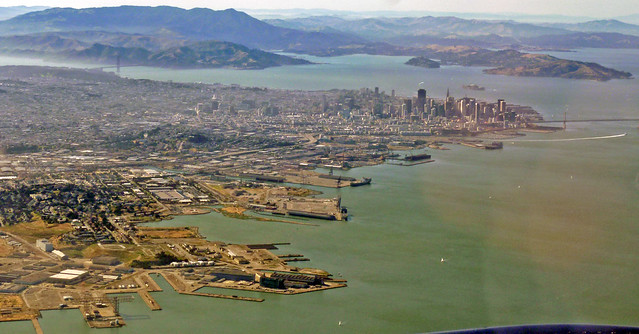
There’s obviously no room to build anything, anywhere.

October’s Economist Survey on the global economy by Ryan Avent included a shout-out to his Piketty-informed thoughts on housing prices. In short, the productivity gains from current technology have increased inequality between people and places. The returns on specialized skills are worth more in an era of cheap communication and transportation, great cities aggregate many people with such specialized skills –and furthermore, agglomeration effects appear to be growing even as communications costs decline. Even virtual reality won’t be able to replicate the everyday, subtle reinforcement of ambition that great cities provide; as Paul Graham writes:

The physical world is very high bandwidth, and some of the ways cities send you messages are quite subtle… A city speaks to you mostly by accident—in things you see through windows, in conversations you overhear. It’s not something you have to seek out, but something you can’t turn off.

Ideas have become so complex that those with specialized skills need to gather around others with complementary skills just to understand topics, much less to achieve the discovery or innovation stage. And, well, interesting people like one another; not for nothing has “assortative mating” taken off, spawning study of managing “the two-body problem” in fields like academia and medicine. (Hint: bigger cities, with bigger labor markets, are more likely to solve the problem. This has become a boon to universities recruiting in large metro areas, while those in small college towns struggle. The eight metro areas with 3+ R1 universities [Boston, New York, Philadelphia, Washington, Raleigh-Durham, Atlanta, Chicago, and Los Angeles] have a considerable advantage in this regard.)

In short, there are fewer centers and more edges. Scarcity being what it is, the centers (and only the centers) are winning more capital, and the edges are losing.

The result has been a highly uneven reallocation of wealth, whereby some places are winning in the form of skyrocketing property prices. These high prices create a substantial drag on the economy: increasingly high rents in the most productive locations steal from the most productive. This steers:

  1. Capital towards landlords, enlarging a rentier class (as Piketty notes) and starving more productive sectors.* This creates a vicious circle, as the NIMBY cartel further tightens its regulatory capture over the land use regime, and extracts ever-higher rents.
  2. Labor towards less costly, and less productive, places, creating economic losses. One recent study quantified that economic loss to the United States in 2009 at 13% of GDP — equivalent to sawing off the entire state of California.

—–

This might be worth unpacking further at a later date: Just reforming land-use regulations, or even entirely repealing the “shadow tax” of zoning, still won’t do enough to produce sufficient affordable housing. Even if zoning is reformed to “make more land,” that land’s still subject to construction’s “hard costs,” which are just too high nowadays.

Construction costs have risen faster than inflation, and far faster than stagnant workforce incomes. Slides 5-6 of this presentation [PDF] by Thomas Hoffman from Enterprise points out that even with free land, even the cheapest construction now costs 50% more than the affordable rent for a low-income family.

Sure, embedded within construction costs are other perhaps-useless regulations, but housing affordability in gateway cities is a problem with many root causes, and with many solutions as well.

—–

* Rent or mortgage principal paid, aka “housing service expenditure,” does not have a multiplier effect on GDP because it’s not factored into GDP. However, it’s worth noting that in 2000, HSE amounted to nearly $1 trillion, which supported only some of the 1.1 million jobs in real estate (NAICS 531). Reducing rental prices would take investment income from landlords and give them back to consumers, who would probably spend in other sectors that generate more jobs per dollar.

Trails don’t make a suburb walkable, urban fabric does

Paths in Greenbelt

Trail underpass in Greenbelt, Md.

A century ago, cars first started appearing on city streets and subsequently began running over everyone else. The 1920s epidemic of traffic fatalities, particularly among children, led to a fad in town planning to rigorously separate paths for cars and people, and to turn over the roads entirely to cars.

This philosophy was implemented in several New Towns — most notably in Radburn, New Jersey, but more extensively in three suburban Washington communities (Greenbelt, Columbia, and Reston). For the most part, though, existing cities proved too expensive to retrofit, and most other American suburbs just built the car-only roads without their pedestrian counterparts.

Garden side

Greenbelt Museum

In both Radburn and Greenbelt, houses were even “turned” to face the walkways, with back doors facing alley-like auto access roads. Yet as these places have matured, most households have rotated their houses and enclosed their public front yards into private backyards; communities have added sidewalks to the streets. (Above, the museum/house at right has been restored to its original appearance, but the house at left is typical.)

Reston: Lake Anne Village

Trail crossing street in Lake Anne Village, Reston, Va.

Examples built from the 1960s-1980s, like Reston, typically threaded trails past backyards. LIFE magazine wrote in 1965: “The need for automobiles in the village is virtually eliminated by a network of footpaths and bridges which connect residential areas with the shopping center.” (Indeed, my own 1960s neighborhood was replatted with a half-completed secondary grid, which I do use occasionally.)

Interestingly, two of my Streetsblog colleagues, Jeff Wood and Steven Vance, both lived in Kingwood, outside Houston, and both made extensive use of the trails as kids. In an email exchange, Steven writes:

Those trails, the Greenbelt, connected every subdivision with homes (there was an entrance 50 feet from my house), community pools, and passed behind every school. They also took me to the shopping areas. I “delivered” myself and my sister to school and the pool.

Jeff Wood made a distinction between walkability and runability on a recent episode of the Streetsblog podcast (sorry, can’t find the link!). While the trails in these communities are still prized as a recreational amenity, they are not a useful travel option for adults because they’re not really “irresistible”: distances are far (because densities are low), travel paths are circuitous, and there’s frankly not much to look at. While those attributes were suitable for Jeff’s track and field team, they don’t suffice for people walking to destinations — and who have the option of driving instead.

MWCOG travel survey

It later occurred to me that neighborhood-level household travel data is in fact available for one of these New Towns. In 2011, MWCOG did a geographically focused household travel survey aimed at understanding community scale differences in travel behavior. The chart above shows weekday trips for all purposes, arranged in distance from the regional core. The first five are within the Beltway, and the second five are outside the Beltway, but only Logan Circle is prewar fabric (within the L’Enfant City, even).

For a control, though, I’ll focus on White Flint. Both the Reston and White Flint survey areas have high household incomes, a high proportion of multifamily (49% in Reston, 61% in White Flint), upscale regional retail and substantial office employment at their core, and began development in the 1960s. White Flint has an established Metro line, higher density (6,000 residents/sq. mi.), and smaller households (1.4 average size). Reston’s Metro stop only opened recently, but it has had local and express bus service to other regional centers, larger households (2.2, still small by suburban standards), and generous open spaces that reduce overall density to 4,000/sq. mi. Most importantly, though, Reston has an extensive trail network, while White Flint has better street connectivity.

Sure, Reston has a substantial walk mode share of 14% — more than 50% higher than the regional average of 9%. Yet it’s not much higher than Woodbridge or Frederick, both of which have large expanses of haphazardly planned subdivisions surrounding a walkable “old town.” And it’s substantially below the 18% of trips that White Flint residents make on foot.

Steven points to Boulder and Davis as counter-examples: [T]hat kind of trail network that helps Boulder, CO, and Davis, CA, have high bicycling rates… [Boulder’s] bike map emphasizes their 10% bike-to-work mode share, while in Chicago we can’t seem to nudge past 1.6% (although for some neighborhoods it’s pushing 4.5%).

Yes, extensive trail networks are a great thing to have at a regional level, and certainly have something to do with the relative popularity of cycling in metro areas like the Twin Cities, Denver, and DC. Yet in explaining Boulder or Davis, I’d give less credit to infrastructure and more credit to favorable demographics, culture, and geography — they’re compact, connected, relatively high density, and mixed-use.

Every once in a while, I’ll encounter advocates who argue that trails are the only acceptable environment for pedestrians or cyclists, occasionally pointing to surveys showing that off-street trails are rated in most surveys as the gold standard of bike facilities, especially for those who don’t already regularly bike.

Sure, a trail network is great to have, and should be connected or created at every opportunity. However, we already have a fantastically extensive bike/ped circulation system that touches everyone’s front door — it’s just that our streets are filled with dangerous cars.

Yet the same surveys show that excellent on-street infrastructure is almost as good at enticing people onto two wheels. And since most new development will happen in places that are already built, it’s kind of a moot point, anyways.

Focusing on building up the fabric, and adding the best infrastructure available, is also the approach that Reston and White Flint are taking, and I expect that future household travel surveys will show that the approach will bear fruit for both areas.

[based on an email exchange]

Parallel trends: bigger houses, tinier apartments

size of new houses

It’s lately become very fashionable to contrast the concurrent trend towards ever-larger new houses and ever-smaller new apartments. Recently, Richard Florida,* Kaid Benfield, and even the Streetsblog podcast have all mentioned this peculiar contradiction.

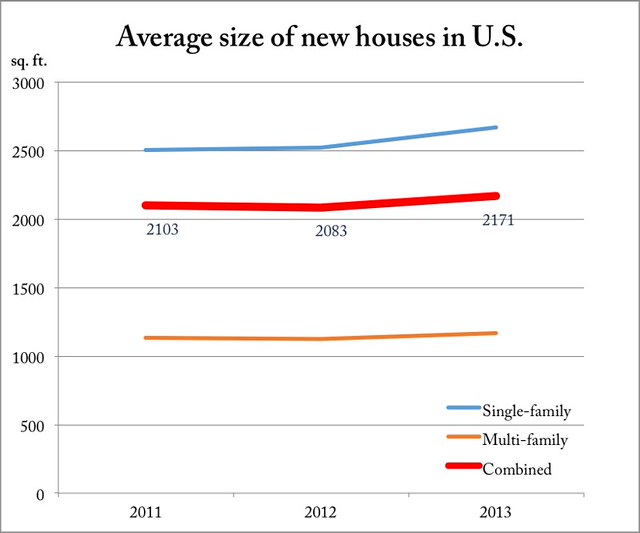
But scratch a little bit at the surface and you’ll find that it’s an artifact of the Great Recession, not an existential conundrum. Consider that the Census’ Survey of Construction, the source of said statistic, only measures a universe consisting of new single family (usually for-sale) houses. However, these share of total new housing construction that is in single-family houses continues to fall. Just from 2011 to 2013, multi-family houses went from 29% to 33% of all new housing completions. Meanwhile, their size hasn’t budged: it’s consistently been around 1,100 square feet (+/- 50) since 1999.

The chart above also comes from Census data, and tells a more complete story. The average size of new houses built in the USA, both single- and multi-family, declined from 2011 to 2012, then ticked up to a record in 2013. It hasn’t been on an upward march forever. Another reason why this data point isn’t quite as important as it might seem at first glance: many fewer Americans are in new houses, period.

houses creeping back up

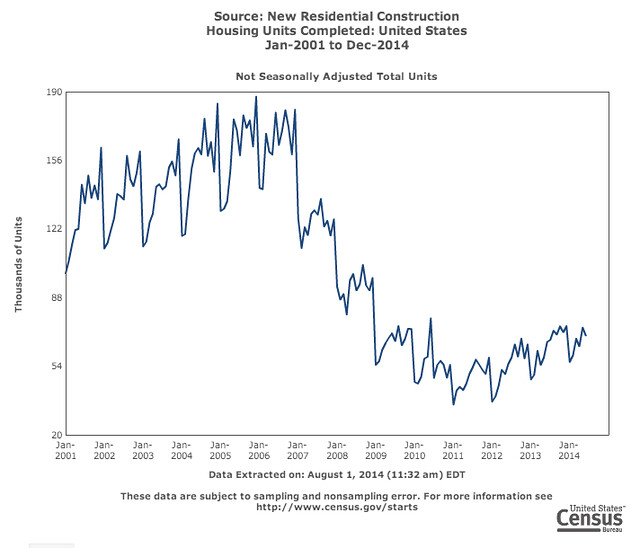
Construction may be up slightly, but it’s still well below its peak. Completions fell 70% from the 2004-2006 rate, and now we’re back up to 60% below that (completely unsustainable) rate. From builders I’ve heard at ULI panels and the like, new move-up product is still selling in the suburbs, but first-time buyers are staying in rentals longer, largely due to tighter financing. Hence, fewer small homes are getting built, as younger households stay in existing stock for much longer, and the average home size is increasing. (Oh, and remember: we’re talking about fewer smaller single-family houses. The number of multi-family houses, small and medium-sized, is increasing.)

Thus, the real story is that the for-sale single-family starter home, as a product type, is dying off. For example, when my brother recently purchased his first new house (at 35, considerably older than the 28-year-old median buyer at, say, Park Forest), he didn’t get a starter home. He went directly from an existing multi-family unit to a move-up sized house.

* Making the additional methodological error of taking the definition of “central cities” seriously.