“Build all the new housing in downtown’s backyard” isn’t working out well for DC

Construction around Navy Yard Metro

Part three of my multi-part series about housing production in DC went live on GGWash this week. Further installments will examine the impact of so much new housing construction on how central-city neighborhood planning — and begin to examine alternative forms that new housing besides central-city high-rises.

Part 1 – DC built 13% less housing over the past decade than its own citywide plan calls for: In 2006, DC adopted a Comprehensive Plan to guide its development efforts. At the time, the District’s population had just started to perk up after six decades of decline, and the plan reasonably foresaw that growth could continue into the future. The District’s population has indeed grown substantially, but its housing stock isn’t keeping pace.

Part 2 – The lion’s share of DC’s new housing is only going in one part of the city: Over the last decade, DC has built 13% less housing than its Comprehensive Plan calls for. Of the new housing that is going up, most of it is confined to the central city even though the plan recommends only 30% go there. Meanwhile, most parts of the District are building little or no new housing.

Part 3 – Most of DC’s new housing is in high-rises, which most people can’t afford to live in
At first glance, the District’s central-city housing boom might seem to be completely benign: as long as new housing is being built, does it matter where it is? But by funneling almost all new residences into central-city high-rises, the District is all but requiring that new housing be built with only the most expensive construction techniques, on the most expensive land. Potential residents need more choices.

A few possible bike + train itineraries via Amtrak’s Capitol Limited

Harper's Ferry in October

The Capitol Limited rolls into Harpers Ferry, W.V.

The launch of roll-on/roll-off bicycle service on Amtrak’s Capitol Limited makes it much easier for bicyclists to travel the Great Allegheny Passage and C&O canal towpath. Although the train’s mileage is very similar to the trail’s, a look at the mileage charts will still come in handy when planning an expedition.

For instance, one could complete the trip over two (slightly ambitious) or three (light) weekends, rather than blocking off an entire workweek and hoping for no rain. Starting from DC, this might look like:

Capitol Limited schedule

Capitol Limited, 2015 schedule

C&O Friday
4 PM: Amtrak from DC to Cumberland; overnight. (The late departure makes it possible to get most of a workday in.)
C&O Saturday
Bike 85 miles from Cumberland to Williamsport
C&O Sunday
Bike 68 miles from Williamsport to Reston; Silver Line back

GAP Thursday
4 PM: Amtrak from DC to Pittsburgh; overnight
GAP Friday
Bike 76 miles from Pittsburgh to Ohiopyle
GAP Saturday
Bike 75 miles from Ohiopyle to Cumberland
GAP Sunday
9 AM: Amtrak from Cumberland to DC

The trip’s even easier starting from Pittsburgh, since you can roll off the early-morning Capitol Limited and have a full day of bicycling ahead. Here’s an easy-pace three-weekend schedule, involving just one weekday:

GAP (Part 1) Saturday
5 AM: Amtrak from Pittsburgh to Connellsville
Bike back to Pittsburgh (downhill)

GAP (Part 2) Saturday
5 AM: Amtrak from Pittsburgh to Connellsville
Bike 44 miles to Rockwood
GAP (Part 2) Sunday
Bike 45 miles from Rockwood to Cumberland (mostly a fantastic downhill)
7 PM: Amtrak from Cumberland to Pittsburgh

C&O Friday
5 AM: Amtrak from Pittsburgh to Cumberland, arrive 9:31 AM
Bike 60 miles to Hancock
C&O Saturday
Bike 65 miles to Harpers Ferry
C&O Sunday
Bike 59 miles to Washington DC
4 PM: Amtrak from DC to Pittsburgh

For Washingtonians, Harpers Ferry is also a gateway to a great many weekend road rides in the western hills. Begin with the 4PM ride out on a Friday, and an overnight in the old town. The next day, choose between several loop routes near Harpers Ferry, like around Antietam or South Mountain. After one more overnight (no need to carry everything), take the train back the following morning.

Or take the train out on a Friday evening and begin riding back east along the C&O, perhaps spending a night at a trailside campsite or a cabin (Lockhouse 28 and the Bald Eagle Island campsite are 10 miles downriver, bikeable before sundown during DST). Then, head up out of the valley to explore northern Loudoun or western Montgomery counties. Ultimately, either the W&OD or C&O (or even RideOn on Monday morning from Poolesville) offer a return trip into town.

Another, less complete trail links two other cities along the Capitol Limited — Pittsburgh and Cleveland. Here’s how that trip would work as a one-way.

Friday photo: Georgetown Park, in memoriam

Remnant of Georgetown Park mall

The Shops at Georgetown Park opened in 1981 with one of the most exuberant postmodern interiors in DC. Its fantastical neo-Victorian atrium, accented with the requisite brass railings and stamped ironwork, was meant as an elegant escape from the busy streets outside, filled with specialty shops catering to the carriage trade. It’s strange that its loss raised not a peep in such a preservation-obsessed neighborhood, just as postmodernism is starting to gain attention from the preservation community.

This little scrap of the old atrium railing is within a tiny elevator lobby off M Street, next to Forever 21. The elevator is apparently used for Anthropologie’s loading and for its offices, but also has stops on floors that have been abandoned. One of the mall’s skylights is also intact, above the cash/wrap at H&M.

Friday photo: Cranes at the Wharf, from spring into summer

Cranes at the Wharf, 10 July

10 July 2015.

Cranes at the Wharf

15 March 2015.

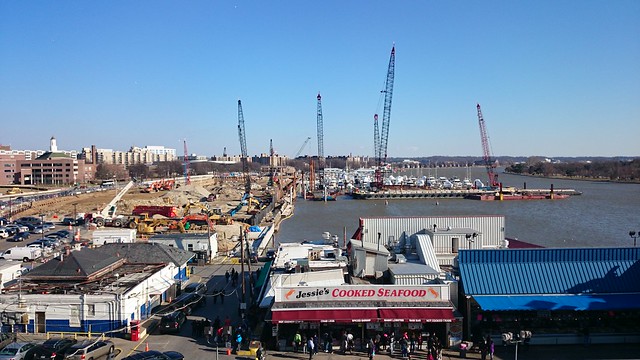
I’ve been trying out a faux-time-lapse-photo series of the ongoing construction of the Wharf, the mega-project just a few blocks down the street. The photos are taken from the Case Bridge, under the “L’Enfant Promenade, Keep Right” sign.

Since the lower photo was taken in March, the piers have been substantially completed, thousands of foundation piles have been nailed into the ground, excavation has been completed for the sitewide underground parking garage, and some of the first structural supports. Since the site is just about at sea level, substantial pumping will continue to keep seawater out of the hole until the foundation is complete. Two of seven tower cranes have arrived on this side.

Also, be sure to check out my posts at Greater Greater Washington. I used to crosspost all of them, but haven’t done so as much lately.

DC built 13% less housing over the past decade than its own citywide plan calls for

A version of this post was posted at Greater Greater Washington.

Nine years ago, the District of Columbia adopted a Comprehensive Plan to guide planning efforts throughout the city. At the time, the District’s population had just started to perk up after six decades of decline, and the plan reasonably foresaw that growth could continue into the future. Yet even though the District’s population has grown substantially, its housing stock isn’t keeping pace.

Three years before the comp plan was adopted, Mayor Anthony Williams pointed to recent population gains when he announced a bold goal to bring 100,000 new residents to the District within a decade [PDF]. The 2006 Comprehensive Housing Strategy Task Force recommended adding 55,000 new housing units over 20 years (a recommendation reaffirmed by a 2012 housing strategy update). Not only would that figure meet long-term population growth goals (accommodating 114,400 residents at the then-current household size of 2.08), but it seemed attainable: The District issued building permits to 2,860 housing units in 2005.

The comp plan incorporated much of the Housing Strategy, noting in its Housing Element that “The increase in [housing] demand has propelled a steep upward spiral in housing costs, impacting renters and homeowners alike… The housing shortfall will continue to create a market dynamic where housing costs increase faster than incomes.” To address the shortfall, the plan’s very first policy opens with the statement: “The District must increase its rate of housing production if it is to meet current and projected needs through 2025 and remain an economically vibrant city,” and raised the forecast slightly, to 57,100 additional housing units over the plan’s 20-year horizon.

The city as a whole isn’t meeting its goals

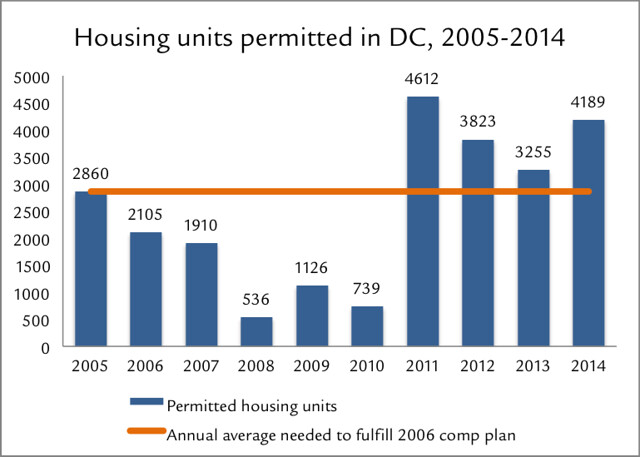
Yet despite all the new construction over the past decade, including two building booms, DC’s currently on track to miss its 2025 goal by 13%. Instead of building 2,855 units per year, DC’s averaged fewer than 2,500 each year over the past decade.
dc permits

The big reason why is that homebuilding nationally came to a near-standstill during the 2008 crisis, and the District was no exception: building permits crashed by 81% from 2005 to 2008, and remained at low levels through 2010. Many proposed projects, like CityCenterDC and Half Street, came to a halt when banks collapsed. Yet all that time, the city’s population, and thus the demand for new housing, continued to grow.

Construction has since rebounded to new highs, with 39% more building permits issued each year between 2011 and 2014 than in 2005. Still, the new boom hasn’t yet erased the 3,000-unit backlog from the slow years.

To get back on track, building permits would have to keep up at recent years’ record-setting pace for at least another three years — and perhaps longer, since the next ten years will also inevitably include another economic slowdown that will subdue construction.

Housing growth has lagged population growth

Even though housing construction has lagged projections, the city’s population has continued to grow. Instead of moving into new housing, all of these new residents have in recent years just filled holes in the existing housing stock.

Vacant units — the slack in the District’s housing market — have steadily disappeared in recent years. Between 2010 and 2013, the Census reports that the number of vacant housing units in the District plummeted by 13,319 (or 31%), far outpacing the 6,850 units that were added to the District’s housing stock.

It’s convenient that so many vacant housing units just happened to be available just when the District’s population began booming, but that feat can’t continue forever. A growing population will, at some point, require new housing.

Indeed, current market indicators show that there’s still tremendous demand for newly built housing: Even though a record number of new apartments have been built, they’re being snapped up as soon as they’re available.

The recent slowdown in the District’s population growth isn’t reason to rest: It could be that slower population growth is a result of inadequate housing growth. Slower population growth largely results from reduced domestic migration, and the reason behind domestic out-migration from DC is because of its inadequate housing. (No surveys track why people choose not to move to DC in the first place, but the reasons are likely similar.)

Yet meeting local environmental goals requires even more population, and housing

David Alpert’s article on Sunday referred to the District and the greater Washington region’s aspirations to a greener future, which require that the District add many more residents. DC’s Sustainable DC Plan, which was adopted in 2012, acknowledges that the District needs to “increase urban density to accommodate future population growth within the District’s existing urban area,” and sets a target of welcoming 250,000 new residents by 2032. That target implies at least 100,000 new housing units, a figure confirmed by recent studies from George Mason University and echoed in the region’s long-range plans.

Adding more residents to the region’s core will result in a substantially smaller environmental impact than adding those residents at the region’s edges. Accommodating more population growth within existing built areas, like the District, reduces the overall environmental impact of new development, and not only by diverting pressure to pave over outlying wildlife habitat and green space.

People who live in dense settings close to the regional core live more lightly on the earth as a matter of course: Residents of the urban core drive less than half as much as residents of sprawling suburbs — a fact that regional transportation plans rely upon to keep traffic congestion, and road expansion, down.

DC can take a fresh look at housing

As Alpert wrote on Sunday, “a great opportunity” to review DC’s housing needs “will come when the District begins the process of revising its Comprehensive Plan.” As part of that review, the Office of Planning should examine the comp plan’s policies in light of the District’s new, more ambitious goals — and the District’s failure so far to deliver sufficient new housing to meet demand.

Yet it’s getting harder, not easier, to build new housing in the District. New zoning restrictions, like the “pop-up ban,” have made it even more difficult and costly to build new housing units in large swaths of the District. Even when proposed developments meet existing zoning, they often face costly and time-consuming litigation.

Since the comp plan guides the zoning regulations, a revised comp plan should guide future zoning changes to make it easier for the District to meet its housing and environmental goals. A revised comp plan should also determine where new housing can and should go; a future post will show how the existing comp plan has fallen short in that regard.
Friday photo: Greedy developers built your city

Two rental houses on Capitol Hill

I recently came across these plans by a fantastically wealthy land speculator, seeking to profit by ruining DC’s pristine Capitol Hill neighborhood with a towering building crammed full of tiny rental “microunit” apartments for immoral singles — rather than wholesome nuclear families! This kingpin practices his avarice from posh Fairfax County, within a “resplendent” mansion overlooking the Potomac.

This paragon of greedy, out-of-town developers is, of course, George Washington, the very namesake of Washington city. (Yet another greedy developer, Alexander “Boss” Shepherd, is memorialized with a statue right outside the Wilson Building.) Cities don’t arise via immaculate conception; they’re built by developers.

John DeFerrari’s book Lost Washington has a much more detailed account of the houses, showing that the NIMBY nightmare of “out of scale” “overdevelopment” was indeed what this city, and all other cities, was built on. (Otherwise, we’d all still be in caves!) Washington wrote to his architect, “Although my house, or houses… are I believe, upon a larger scale than any in the vicinity… capable of accommodating between twenty and thirty boarders.” A later, even greedier, developer popped up (and popped-under) the ruined buildings in the aftermath of 1814’s fire, and the buildings grew to six stories tall. Anti-pop-up NIMBYs might take heart from its fate: it then descended into criminal infamy and was bulldozed for a park.

[The plans in the photo above are from GW’s Albert Small Collection. More background, including photographs and illustrations of the houses at various points in time, is at Streets of Washington.]

Friday photo: DMU in Trenton

Hello DMU - NJ River Line

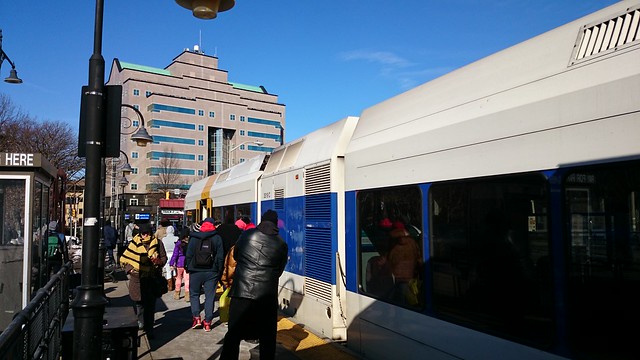
Look, an LRV with no catenary! The diesel powerplant in the middle (note the stained exhaust vents) produces its characteristic vibration and noise, and unlike a commuter train, the passenger compartments are all subjected to it. It’s also definitely slower; by one calculation, an electric LRV could do the same route 18% faster. It seemed out of place in the urban centers on either end, but more appropriate in the suburban villages in between.

These might be appropriate for other “interurban” lines with wide stop spacing and relatively low station-area densities. Given that most suburban areas are already arrayed along roads rather than rails, and that the train isn’t much faster than a bus, perhaps this isn’t the panacea for suburban transit.

Friday photo: a minimalist memorial

Richmond riverfront

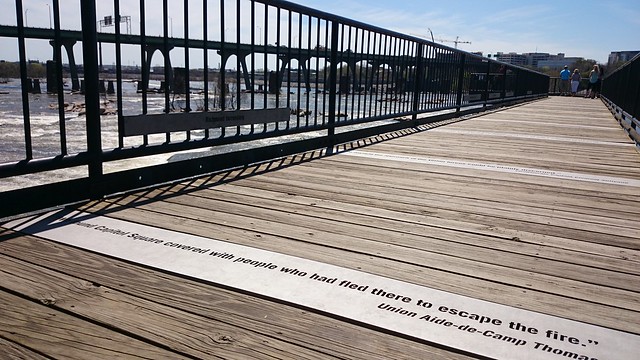
The 1865 Exhibit,” a surprisingly moving exhibit (full text) comprises of a terse timeline (pictured here: “Richmond surrenders”), plus primary-source quotes from the three-day liberation of Richmond. Obviously, the surroundings help: swirling waters, road and rail traffic on bridges old and new, the city skyline and the woods.

A soldier with the 11th Connecticut, quoted in James Loewen’s Lies Across America in its chapter about the curious then-omission of Richmond’s liberation from the city’s landscape:

Our reception was grander and more exultant than even a Roman emperor, leading back his victorious legions with the spoils of conquest, could ever know… The slaves seemed to think that their day of jubilee had fully come. How they danced, shouted, waved their rag banners, shook our hands, bowed, scraped, laughed all over, and thanked God, too, for our coming.

Sometime soon, the walkway (built over a dam that fed an adjacent canal) will again cross the river.

Housing market myths: USA’s biggest landlord says outsiders not to blame for high SF, NY, DC rents

Conference calls announcing corporate quarterly earnings don’t usually turn up explanations about why the Rent Is Too Damn High, but then again most companies don’t own 100,000 apartments across America, clustered in the biggest and most expensive cities. These are the folks who are raising your rent, and the reasons why don’t have anything with the usual bogeymen.

So, forthwith, some annotated comments by David Santee, chief operating officer of Equity Residential, from their 2014 results call.

Lofts 590, Crystal City

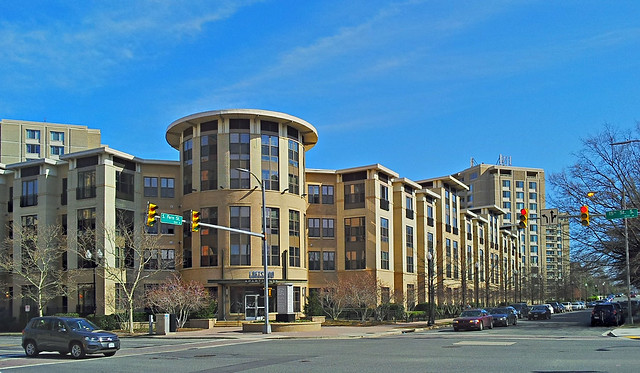
Equity Residential owns this building, and most of the thousands of apartments in Arlington’s Crystal City neighborhood.


1. California’s multi-year drought wasn’t solved with a few days of rain this winter — and, as the state legislature’s own analysis says, the generation-long drought of housing starts won’t be solved with a few new towers here and there:

“San Francisco continues with epic pace with significant acceleration in Q4 [2014]. In one of the most under-housed cities in the country, deliveries are minuscule and simply don’t seem to be relevant.”

Indeed, San Francisco is in such negative territory with housing (and water, for that matter) that more than doubling San Francisco’s population (which would still leave it half as dense as Manhattan) might only have kept housing price inflation in line with the national average. Note that’s not “falling housing prices,” since that’s rare, just “not increase quite as fast.”

2. New York City’s too-damn-high prices can’t be blamed solely on a handful of zillionaires snapping up shoeboxes in the sky. Instead, the blame lies squarely on everyday New Yorkers, or rather on the buoyant economy they’ve created and surprisingly limited new construction they’ve permitted.

New York City specifically Manhattan remains stable, with only slight concentrations of new deliveries on the upper west side… However, with population in the metro achieving the new high of 8.4 million people, a pick up in business and professional service jobs, and the continued growth in jobs away from financial services, New York should produce four-handle revenue growth supported by an expected 155,000 new jobs in 2015.”

(“Four-handle” is bond-trader slang for “4-5%”.)

3. The era of “boomtown DC,” the city of Fox News nightmares where Barack Obama used government debt to hand out Obamacare-regulation-writing jobs like candy, appears to be ending. Or maybe it never existed: much of the District’s population growth turns out to be just the usual machinations of a large metropolitan area rearranging itself — in this case, as with many others, centripetally.

The district itself continues to see outsized population growth and 25% of our district move-ins were from folks moving closer in from Virginia and Maryland…

Not that this particular phenomenon is unique to DC, of course; Equity boss Sam Zell has noted a broad-based “increasing demand for housing in the urban markets.

The centripetal pattern also applies to the usual flow out from cities, which has been stanched in recent years:

The recession diminished this flow. Fewer than 23,000 young adults left New York annually between 2010 and 2013. Only about 12,000 left Los Angeles—a drop of nearly 80% from before the recession. Chicago’s departures dropped about 60%.
Young adults who moved to the three cities for school, internships or early jobs—or simply because it seemed cool—may now be stuck, said William Frey, a demographer at the Brookings Institution… In tough times, finding well-paying jobs may be easier in big cities, offsetting their relatively high costs of living.

This would be a terrific smart-growth opportunity to capture more population in resource-efficient, highly-productive, low-footprint urban areas — if only said cities were more affordable!

——-

While I’m quoting at length, and because it’s marginally relevant, Old Urbanist wrote up this useful comparison to how America’s zoning system systematically creates bountiful affordable housing… for cars:

American states and cities have engaged in onerous mandatory inclusionary zoning for cars (parking minimums), zoning exemptions (e.g. not counting garages toward FAR limits and allowing parking, but not housing, in mandated setbacks), tax exemptions (only 16 states maintain a personal property tax that covers automobiles) and fringe benefits (the commuter parking benefit), in addition to rent-free public housing for cars (overnight on-street parking).

Will Mayor Bowser recommit to Sustainable DC & MoveDC?

[updated 1 April]

In a recent speech to District Department of Environment employees, Mayor Muriel Bowser offered some warm words about Sustainable DC — but fell short of a full-throated endorsement:

The decisions that we make are often, I would always say, 50 year decisions… The decisions we make around transportation options, whether we put something someplace or not — again, 50 year decisions. What is clear is that we’re making decisions right now that affect the next generation, and shape the options for the generation after that.

We have to be very careful in government about how we distribute our resources, and how we take care of the community. We inherited it, and we have to leave it better for the generations that follow us…

I inherited the past successes… I inherited some good things, and one of those good things was Sustainable DC. And so what I know Tommy [Wells] will do with me is make recommendations on all the things we should keep, all the things we should push harder on, the things we have to add, and if there are things we have to change or delete we should do that too…. I was elected for a fresh start, not a start all over, and so we want to make sure that we’re building on the successes of your hard work… and push the District even farther.

Mayor Gray leaves behind a substantial legacy of ambitious plans, particularly Sustainable DC and national award winning direct descendant Move DC. Both began with citywide public involvement, set ambitious performance goals, and have started to guide real implementation efforts that would, if continued, really advance the long process of creating a truly sustainable District.

Just to put one of those performance goals into a global perspective, Sustainable DC has twin goals of increasing the District’s population by 40% and shifting 75% of commute trips out of cars — baseline goals that MoveDC started with, and crafted an implementation strategy around. Alex Block points out that this is certainly doable, but it isn’t easy.

MoveDC capacity targets

To do so will require more than doubling transit capacity, almost tripling bike capacity, and cutting car capacity by 7%. It would avert over one milion VMT every weekday — which (with current emissions factors, which assume today’s technology) would cut 580 tons a day from DC’s carbon emissions, more than 3X as much as the reviled Capitol Power Plant puts out.

Smart growth policies like MoveDC are a fine example of acting locally while thinking globally, as these are local policies that would have global consequences. The National Research Council & TRB estimate that a national shift towards denser development — including shifting more population growth into the District from the suburbs — would cut CO2 emissions from driving by 11% by 2050, even before any change in vehicle technology. That’s 132 million metric tons of CO2 each year, an amount exceeding all coal emissions from DC, Maryland, Virginia, and West Virginia. Or, put another way, smart growth cuts driving, which could cut as much CO2 as shutting down all of our region’s coal power plants.

Of course, we will absolutely need to do both — and much more — if we’re to have any hope of avoiding a certain existential threat to DC’s future. But only smart growth and energy efficiency cut emissions over the long run, and pay for themselves in the short run.

Modest proposal: depave Foggy Bottom’s riverfront, but leave I-66

Neil Flanagan recently wrote about current and past proposals to heal the urban-renewal scars that separate the Kennedy Center — which should be a terrific urban amenity — from the city around it.

Erasing RCP by the Kennedy Center

The KenCen, along with the Watergate complex and what’s now the Saudi embassy, stands in a tiny island isolated from both the city and the river by two parallel highways. Neil’s post focuses on a long history of proposals to bridge the chasm of I-66, built alongside this island as part of the grand urban renewal scheme that obliterated Foggy Bottom’s industrial heritage.

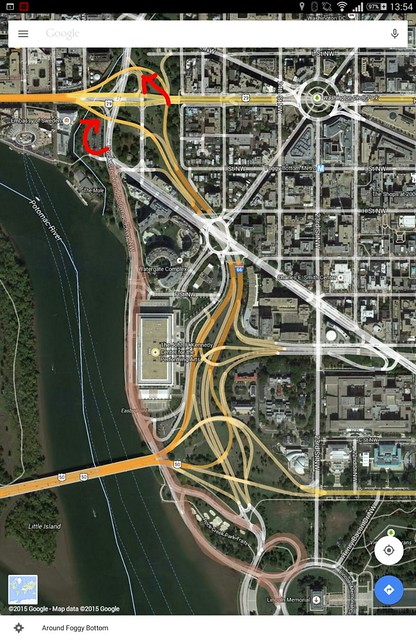
Yet the 1920s-era Rock Creek Parkway that runs on the riverfront through this stretch is perhaps a greater urban offense. It’s a limited-access highway that squeezes strolling pedestrians and cyclists into a narrow riverfront strip. It intervenes between the bike path and the river at one point, creating a particularly confusing, and dangerous, joint in the otherwise admirably complete trail network along the region’s waterways, and pretty much completely interrupting any pedestrian flow between the Mall and the waterfront. (Speaking of harrowing junctions, its at-grade intersection with I-66 creates a terrifying two-stage left turn at the end of I-66’s Independence Avenue ramp.)

And it could be eliminated with just two ramps — the ones shown in red in the map, linking the existing and underused ramps that link I-66 Extension to the Whitehurst Freeway, to Rock Creek Parkway. Adding these two ramps would enable cars that currently use Rock Creek Parkway to use the woefully empty I-66 that runs just two blocks east — and thus permit depaving Rock Creek Parkway (in pink), south of Virginia Avenue and north of the Lincoln Memorial.*

(A 1998 FHWA study also proposed the same ramp at the northeast quadrant of the interchange, but instead of a loop suggested a signal and a left exit. It also proposed to leave RCP, and grade-separated the Ohio/RCP intersection.)

Creating a linear park along the river between the Thompson Boat Center and the Lincoln Memorial would more clearly link three great linear open spaces — the Mall, Rock Creek Park, and Georgetown Waterfront Park and the upstream parks. (A clearer, perhaps grade-separated walkway behind the Lincoln Memorial would still be needed.) It would finally connect the KenCen and Watergate to the water, and break apart the asphalt chains that encircle the old Watergate Steps. It would also attach this little urban island to the city (well, Georgetown).

It would accomplish these aims at a cost far lower than decking over I-66, a proposal that has failed several times for want of funding. The surrounding renewal-era fabric would require retrofitting if such a deck were built, since most of it was built with high walls that ignore I-66.

Yes, direct access between Memorial Bridge and Rock Creek Parkway would be eliminated. Drivers would instead have access to the Roosevelt Bridge, which is currently denied, and could use Virginia and 23rd to reach Lincoln Circle and thus Memorial Bridge.

A similar concept was floated on POP in 2012 and roundly criticized in the comments, although it seems most of the commenters misunderstood which segment of RCP was being referred to.

* On second glance, the north Lincoln Memorial loop may be needed to allow Independence Avenue traffic to flow onto Memorial Bridge.