Friday photo: a room with a view

C&O Lockhouse 22: your very own waterfall (well, waste weir)

Click for video

The C&O Canal’s Lockhouse 22 made a great destination for a Thanksgiving-holiday S24O. Not only is it an easy 40-mile roundtrip from Georgetown along the easy towpath, but Pennyfield Lock is situated on a secluded stretch of the river, surrounded by protected lands on both sides of the river — Blockhouse Point Park, the Dierssen waterfowl sanctuary, and NoVa’s Seneca Park.C&O Lockhouse 22, Travilah/Tobytown, MD

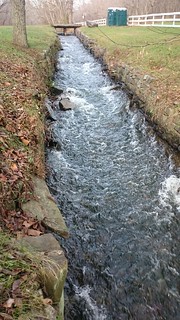
Not mentioned among Lockhouse 22’s amenities was that running water surrounds this lockhouse. Mike High’s book notes that Pennyfield has a “waste weir” that directs canal overflows into the Potomac just upstream of the lock; since this is the first lock below Seneca, where the downstream reach of the canal is watered, there’s usually a good flow across the weir. There’s also a bypass flume just inland from the canal, which also burbled with water headed for a small, stream-fed pool just below the lock.

By contrast, the closer-in Canal Quarters lockhouses (#6 and ) might have electricity but are surrounded by traffic (Clara Barton Parkway) rather than water. Lockhouse #25 is just a few miles up, but looks out at the Lansdowne golf course rather than parkland. At mile 49, #28 pushes the boundaries of a weekend trip and sits next to busy railroad tracks, and #49 looks grand but is way out west.

Yes, the cabin was chilly — the thick stone walls keep the interior cave-like year-round — and a bit spooky at night, especially when light reflected off the rising moon suddenly appeared. The firewood had been scattered about the woods by vandals, but fallen wood was plentiful. Since it was winter, the water pumps are locked and we had to pack in a couple of bottles of water. At $100 a night, it would make a superb rustic getaway for a small group.

Al Hanna and the case of the missing Chicago comp plan

Chicago zoning envelope illustration, 1923

My once-colleague Steven Vance recently noted Chicago’s surprising lack of planning. Indeed, for a couple of years there (as Hunt and DeVries point out in Planning Chicago [great PDF overview]) the city bureaucracy didn’t even have a planning department — just Housing and [economic] Development. That was just as well, of course, since there wasn’t any planning being done then, or since.

Chicago technically did adopt a Comprehensive Plan… in 1966. (Next year, it’ll be eligible for the National Register of Historic Places.) I had long been under the impression that Chicago simply strong-armed pliant courts into not prosecuting this absurd state of affairs, but Steven’s post prompted me to look up Illinois’ municipal code regarding planning and zoning. To my surprise, Illinois has always had a surprisingly lenient Municipal Code — which relieves cities of any obligation to update their comp plans, or to have their zoning be consistent with a comp plan. Under Illinois law, if the Plan Commission says the zoning is so, then so be it; “arbitrary and capricious” claims be damned.

Nonetheless, one brave gadfly, Lincoln Park mortgage broker Al Hanna, once somehow managed to escalate the little matter of zoning’s potential unconstitutionality into state courts some years ago. (This was while I was in college, and working on a project related to the city’s zoning code update — which, of course, drew no legal authority from any stinkin’ comp plan.) Judge Sidney Jones remanded the case with the comment that “[t]he City of Chicago has, and had, no comprehensive plan for development… which renders its zoning decisions to become more subject to scrutiny… [the downzoning] was not passed for public welfare or the public good, but was passed only in deference to the wishes of a few individuals.”

Alas, the city’s lawyers have wiggled their way out from most of Hanna’s suits. For example, Chicago long ago (apparently in 1970, via Public Act 76-583) dropped a special “lawsuit poison pill” into the state’s zoning enabling law [emphasis added]:

(65 ILCS 5/11-13-8) In municipalities of 500,000 or more population,* when any zoning ordinance, rule or regulation is sought to be declared invalid by means of a declaratory judgment proceeding, not more than 30 days before filing suit for a declaratory judgment the person filing such suit shall serve written notice in the form and manner and to all property owners

I don’t agree with Al about the legal merits of Chicago’s historic landmark law, but on zoning, he does have a point. Outside of downtown, no plan grounds Chicago’s zoning ordinance in the facts.

* This, and similar constructs, is legal code for “City of Chicago” and is found throughout Illinois state law. Illinois’ second-largest city has a population of fewer than 200,000.

Update 2018: Hanna exacts a bit of revenge, by funding CAFHA’s damning report on how non-planning directly reinforces segregation.

Friday photo: Canopy street

image

America’s federal government (unlike governments elsewhere) has historically frowned upon continuous canopies of roadside trees — or, indeed, any roadside trees at all. After all, anything that distracts drivers from the task of racking up lots of miles, at high speeds, is simply inadmissable.

Thus, I was pleasantly surprised to find these few hundred linear feet of bucolic bliss lining a federally maintained road just a few miles from the Beltway. Of course, this road is within the USDA’s Beltsville Agricultural Research Center, and the USDA is probably friendlier to (cultivated) trees than its counterparts in other agencies.

Full of sound and fury, Signifying nothing.

Already in my front yard, but my side yard? The world will END

Already in my front yard, but my side yard? The world will END!

A high-rise is already across the street from this resident’s front yard. But build one across the street from the side yard? That’s “contextual disharmony”! These signs have the gall to proclaim an urgent need to “Save the SW community” from high-rises — and, ostensibly, from the awful people (like most of their neighbors) who would dare to live in them.

This language marginalizes and dehumanizes the majority of Southwesters, who already live in high-rises and so apparently don’t count as “the SW community.” (They’re hardly the only rowhouse residents in DC who think apartment-dwellers are subhuman scum undeserving of equal rights.) And since we high-rise residents don’t have land-wasting, water-sucking yards, we can’t litter the streets with dead-tree petitions that list our grievances.

I read and re-read the City Paper’s cover story about the former Southeastern University building, looking for even a glancing mention that the “multi-story building” proposed is surrounded not only by “dozens of two- to three-story townhouses” but also by several other multi-story buildings — including Waterside Towers, just across the corner, which dozens of the townhouses already abut. But no, the writer took the side of the “underdog” homeowners, sitting pretty in their $700K-$1.2 million homes, and who only want to be surrounded by other million-dollar houses.*

The NIMBYs can whine all they want about “contextual disharmony,” but towers + townhouses is exactly the urban pattern that defined Urban Renewal Southwest from the moment ground was broken on Capitol Park. The neighborhood’s own original architects**, whose original vision is worshiped at several local temples by the preservation crowd, called it “an interlocking pattern of high apartment buildings and town houses.” In a neighborhood where high-rise residents make up the vast majority of the 10,000 local residents, 300 signatures means little. Indeed, 300 signatures are outweighed by the 300+ residents and employees who will live and work in the proposed apartment building — a number far fewer than the 2,000+ students, faculty, and staff who were at SEU in its heyday.

Others will argue about the sanctity of the zoning and the comprehensive plan — but those documents were politically defined, not monuments to sound planning; they merely enshrine existing conditions and a “do-nothing” approach. When the Office of Planning zoned Southwest in 1992 (OZ case 92-7) after the old NCRC (urban renewal authority) was disbanded, everything was zoned for precisely what existed at the time. I can walk down the hall from my apartment and through three different zoning districts, all without going outside. If my building burned to the ground, it could only be rebuilt in exactly the same shape that was planned in the 1960s; even something that rearranged the same density differently on the site would be illegal. Thus, any change to the built environment in Southwest necessarily requires a zoning change, and that’s been true of almost all of the new developments being built.

(The pre-urban renewal zoning for the site was “zone B,” permitting a 55′ tall building on 70% of the lot. The 2017 proposal for the site is 50′ tall, with 75% lot occupancy.)

Zoning only specifies an upper boundary to density, dating back to its origins as a legal tool that 1920s economic elites could use to enforce their own anti-“parasite,” racist, classist aesthetic tastes. Thus, only “overdevelopment” gets a legal definition and police-power enforcement tools, whereas the equally subjectively defined (but just as pernicious) “underdevelopment” isn’t a matter worthy of government interference.

The comprehensive plan, as I’ve hinted at, includes a fundamental contradiction: Its text begrudgingly admits that great change must come to the city, but its map bravely assures an anxious public that almost nothing will change across almost all of the city. Like most climate-change plans, the contradictory Comprehensive Plan sets lofty goals — the easy part — but doesn’t quite follow through. It’s like a diet book that tells readers that cutting calories is great in the abstract, while also assuring readers that they don’t have to change a thing about their current diet of cheeseburgers and chocolate cake.

The Southwest small area plan was meant to raise the idea of updating the zoning and facilitating more development, but as usual any attempt at defining a long-range vision was subsumed by short-term reactionary opponents of this specific project. Eric Shaw’s insinuation in the CityPaper that there was unanimity around this site is false; I know that I specifically added comments in support of rezoning this site, and about generally accommodating new development on select sites.

Other long-standing institutions in the neighborhood — specifically, Greenleaf Gardens, the mainline Protestant churches, and the government facilities in the “auto service center” around the DMV and post office — all got spot upzones through the small area plan. Their sites were redesignated as “medium density” rather than “moderate density,” in order to facilitate the eventual sale of their air rights through redevelopment. Ironically, SEU’s inability to secure an identical upzoning happened not on the merits — it’s much closer to transit and to everyday retail than the “auto service center,” and the church across the street got a density bump — but probably because it didn’t last long enough as an institution to argue its case before OP.

Yes, it’s silly that the developer bought the property banking on a zoning change; that’s not a strategy I would have put money behind, and not one that would work almost anywhere in Northwest. But developers do it all the time, since both zoning and the comp plan are more closely related to NIMBY objectives (read: the world is perfect as-is and shouldn’t change, so everyone hold their breath!) than to actual planning goals.

Apartments in Georgetown, across from Tudor Place (5 acre estate)

Apartments have been staring down upon Tudor Place, one of the most elegant estates in Georgetown, for almost a century — yet the world still goes on.

* Not to mention that nobody at all stood up for plans to build million-dollar houses at two sites in Southwest where they would have had negligible impact on neighbors: the Wharf’s Pier 4 (mentioned here; they actually would have reduced noise and traffic, relative to the cruise ships) and at the Portals.

Which reminds me of another pet peeve: The Fifth Amendment does not guarantee any Constitutional right to forever-appreciating property values. If there was one, there would definitely be a “disparate impact” claim to be made.

** I.M. Pei, “Urban Renewal in Southwest Washington,” AIA Journal 39 (January 1963): 66.

Infilling Columbus Circle: What’s it worth?

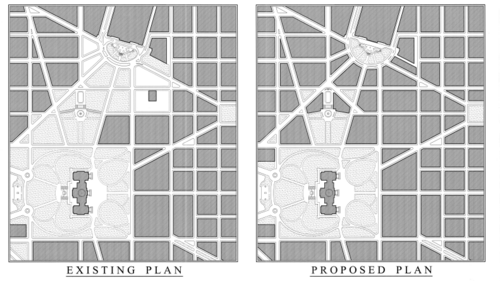
Dan Morales’ proposal to fill the parking crater between Union Station and the Capitol complex.

Dan Morales recently shared some renderings on GGWash of what new buildings fronting Columbus Circle (the plaza in front of Union Station) might look like. The site is now mostly Senate-staffer parking, which has long annoyed the local chattering classes. The Capitol parking lots are, after all, the very last parking crater to mar the otherwise continuous urban fabric of central DC, and they sit right in front of heavily used Union Station.

It’s not that the Architect of the Capitol (AOC) particularly loves its surface parking. After all, they commissioned WRT to do a lovingly rendered plan to eliminate not just all of the surface lots, but even many of the surface roadways (ahem, I-395) on the House side. Instead of surface parking and unlovely parks, the 2050 plan shows more office buildings, with parking relocated to new standalone garages over/next to I-395. (A prime motivation is to eliminate the parking beneath office buildings, now considered a security hazard.) In short, AOC’s been land-banking the entire Hill in the assumption that its space needs will grow in the future.

Yet new planning efforts might identify that offices and support facilities continue to get more space-efficient, and that some of the land may be surplus to even the longest-term planning horizon. And, well, commercial prices are really rich…

//platform.twitter.com/widgets.js

Those numbers piqued my interest. Let’s see, clockwise around Columbus Circle NE, the parking lots are:

  • Massachusetts to 1st (square 723, lot 800): 107,436 sq. ft.
  • 1st to Delaware (square 682, lot 808): 52,721 sq. ft. (currently park, not parking)
  • Louisiana to E (square 680, lot 801): 30,329 sq. ft.
  • E to Massachusetts (square 680, lot 805): 40,474 sq. ft.
  • I chose not to evaluate six other blocks that Morales proposed to fill in, in the interests of leaving a park between Delaware and Louisiana, and a one-block buffer between C and D.

The blocks to the west are zoned C-3-C, with a maximum FAR of 6.5. That would fit underneath the 80′ height maximum applied to Columbus Circle under the Height of Buildings Act. Thus, a maximum of 1.5 million square feet of office could be built on all four parcels, or 1.16 million on the three parking lots. Based on a land value of $200 per FAR-foot for offices in downtown DC, that’s $300 million for all four parcels, or $231.7 million for just the parking lots.

That value’s substantially higher than the $350 million that Lydia DePillis calculated as the value of all AOC’s surface parking, using tax valuations (which often lag market values).

How could a deal be structured? GSA, under the leadership of Dan Tangherlini, started dealing in “swap-construct exchanges” for sites like Federal Triangle South. In that arrangement, a developer builds a new building for GSA, which in turn “pays” the developer by granting title to surplus property. Maybe AOC could pay for further renovations, for removing its existing subterranean garages, or for new standalone parking garages (perhaps on the block between 1/2/C/D that houses the Monocle and the Capitol Police) with the revenue.

All of those sums sound like a lot of money. However, AOC projects do tend to be pricey: even $300 million is only half of the unfunded cost of Cannon House Office Building renovations. At least AOC would be able to get the money without enduring the wrath of its occupants, who sometimes point fingers at AOC’s spending.

So, Dan, now that you’re in the private sector, how about an unsolicited proposal to AOC?

Decking over freeways isn’t as lucrative as you might think — but there are alternatives

Ponte Vecchio for a new era

I-670 hides below this building in Columbus, Ohio.

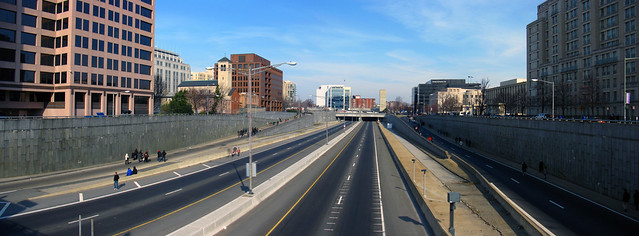
Whether I’m biking down F Street and running headlong into it, or dodging its construction equipment on the infrequent occasions when I have to drive through the I-395 tunnel, it’s hard to miss Capitol Crossing — now the largest development underway within downtown Washington, DC. I knew that this was an unusual project, but it turns out that it’s incredibly unusual: the only instance of a privately financed freeway deck anywhere in the country.

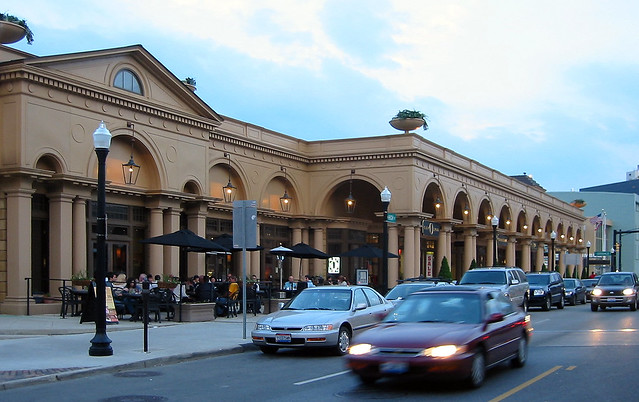
The “Ponte Vecchio” example that everyone points to is The Cap at Union Station: two narrow retail buildings alongside the principal spine of Columbus, Ohio, all built on a bridge over a freeway. It is a marvelous example of a place connector, one that seamlessly unites two emerging neighborhoods to one another.

However, these caps aren’t exactly something that can be replicated everywhere, since it’s an incredibly expensive way to fix a place. The Columbus example was funded by the federal government, as a mitigation measure for widening the freeway below. Most other recent cap proposals resulted from similar mitigation measures — and thus most are parks, both because that’s what the government builds and because their relatively light weight keeps the cost of building a deck down. Klyde Warren Park in Dallas is one example; 70% of the money came from the federal and state governments.

Three things to keep in mind when evaluating a freeway cap:

2009 01 20 - 0573-0575 - Washington DC - I-395

The future site of Capitol Crossing, on a rare car-free day (Inauguration Day 2009). Photo by Bossi, via Flickr.

1. The price of the structure is only justifiable if you’re surrounded by very high-value land — namely, a high-rise, high-rent CBD of a high-cost city. This limits the situations where these caps make economic sense to premier sites. For instance, a few blocks of air rights over the Massachusetts Turnpike in Boston’s Back Bay are currently in the planning/proposal phase, having seen prior plans fall apart during the Great Recession.

Capitol Crossing’s developers paid the District $60 million for air rights and are sinking another $400 million into constructing a platform over I-395 just east of Union Station, yielding a cost per “FAR-foot” (square foot of potential development) of around $150-200. That’s substantially higher than the $75 per FAR-foot seen in recent transactions for development sites at the periphery of downtown — but comparable to the $190 per FAR-foot paid for “dirt” within downtown DC, which is pretty much extinct. The net result of this scarcity and high prices is that only the very highest value land uses, namely office and retail, are economically feasible at this development — residential just doesn’t pay enough.

(Calculation based on pre-construction cost figures and final buildout of 2.2 million square feet. Post building calculation doesn’t include demolition costs.)

The economic feasibility line might also be teased out from the RFI responses that Virginia DOT received regarding two sites over I-66 in Arlington — one at the edge of Rosslyn’s high-rise core, and another in low-rise East Falls Church (actually within Arlington County). Almost none of the responses deemed the EFC parcel economically feasible, but many of the responses indicated that the effective “land cost” for the Rosslyn parcels, including cost of construction, at nearly $100 per square foot of FAR.

Unlike private development, a park’s feasible land value is set off-market and is thus completely subjective. In a neighborhood in dire need of a park, or on an irreplaceable waterfront site, the value of a new park may indeed justify the cost of construction.

2. It’ll be much easier, and cheaper, to build a cap if the freeway is completely closed for a while — say, for a major reconstruction. Staging construction over an operating freeway is risky, dangerous, and ultimately costly. Hence, many existing freeway-lid projects, like the Prudential Center and Copley Place in Boston, were constructed before the road underneath them opened to the public. Columbus’ lid was built during an 18-month closure of I-670, for example.

Even at Capitol Crossing, the developer realized the folly of trying to keep the freeway open during construction, and proposed to close 395 entirely for 15-18 months. The closure eventually came to naught due to politics, but would have “cut in half the construction time,” according to the Post: “Building the deck requires installing about 150 caissons along the median to support a network of steel girders… installing the caissons while the highway is in use would be hazardous and disturb nearby residents.”

3. A more entrepreneurial approach that governments can take to such a project is suggested by Matthew Kiefer, who worked on an earlier iteration of the MassPike deal:

MassDOT should adjust its expectations about the revenue potential of these difficult sites to reflect economic reality. It should rely more on rent derived from the net profit of a stabilized real estate asset – percentage rent or a share of proceeds of future sales or refinancings – and less on initial land value, which can be illusory. The Commonwealth will be around for a long time to realize patient returns.

In this PPP structure, the state “speculatively” builds the platform, then executes a “ground lease” for the air rights while keeping the property under state control. This may require a more entrepreneurial attitude towards monetization than most state DOTs are willing to take, but well-located center-city land is a great long term investment. If you really believe in the quality and long-term value of the place that you’re creating, a percentage-rent ground lease is a great way to discount the rent up front but to participate in the long-term gains.

Interestingly, Brandywine Realty Trust also suggested the same net-lease arrangement in its response to VDOT.

4. There are lower-cost alternative to a full bridging project while minimizing the freeway’s footprint and impact. In many cases, the most expensive bit will be bridging the through-traffic lanes — but even sunken urban freeways usually have lots of other spaces. Embankments are usually excessive, and building platforms can be cantilevered out over their edges. Lower-traffic ramps and shoulders are easier to close temporarily for construction. Skybridges can be assembled off-site rather than in-situ, providing more connectivity across the site while minimizing closures of through lanes.

ULI sponsored a governors’ advisory panel study about another downtown Boston air rights parcel in 2012; it recommended a lighter approach than a full-on deck, with buildings surrounding the interchange and bridges over it. (Ironically, the parcel was created through the Big Dig project!)

5. Railroad air rights have also seen active development in recent years, e.g., Hudson Yards in NYC, River Point in Chicago, and 30th Street Yards in Philadelphia. However, the costs aren’t truly comparable to freeway decks: the column spacing can be much closer for railroads than for freeways, and the vehicle movements are rather more predictable.

Oops, NPS accidentally fixed the Peters Point trail crossing

Rock Creek trail crossing at Peters Point

Peters Point, which I earlier called the worst trail junction in town, was miraculously fixed for a few days.

All it took was a resurfacing project that sent cars around the useless little loop. Since the drivers were forced to slow down and pay attention, they were much more likely to notice the crosswalk and yield to pedestrians. That’s even though the temporary crosswalk was more difficult to see, and a set of warning signs were taken away.

Now that the main roadway resurfacing is complete, though, everything’s back to “normal” now. The really sharply angled ramp has been regraded, and perhaps the crosswalk will be restriped with a ladder rather than two thin lines, but I don’t expect to see compliance to ever again be quite as high.

Not that the deadly and criminal behavior by car drivers stopped, of course. This guy illegally blew through the crosswalk without stopping, slowing, or even bothering to look for the cross traffic that was inches away.

Rock Creek trail crossing at Peters Point

“Build all the new housing in downtown’s backyard” isn’t working out well for DC

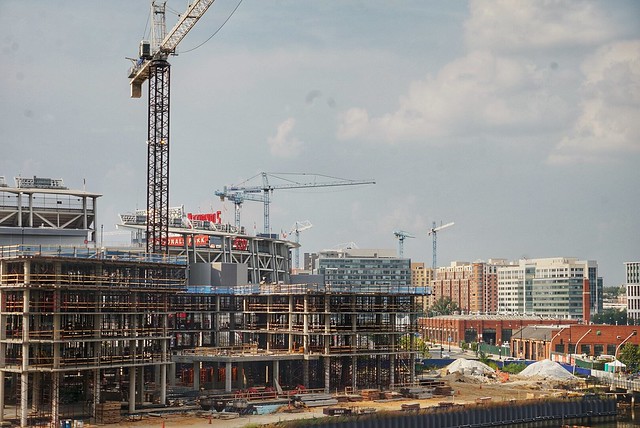
Construction around Navy Yard Metro

Part three of my multi-part series about housing production in DC went live on GGWash this week. Further installments will examine the impact of so much new housing construction on how central-city neighborhood planning — and begin to examine alternative forms that new housing besides central-city high-rises.

Part 1 – DC built 13% less housing over the past decade than its own citywide plan calls for: In 2006, DC adopted a Comprehensive Plan to guide its development efforts. At the time, the District’s population had just started to perk up after six decades of decline, and the plan reasonably foresaw that growth could continue into the future. The District’s population has indeed grown substantially, but its housing stock isn’t keeping pace.

Part 2 – The lion’s share of DC’s new housing is only going in one part of the city: Over the last decade, DC has built 13% less housing than its Comprehensive Plan calls for. Of the new housing that is going up, most of it is confined to the central city even though the plan recommends only 30% go there. Meanwhile, most parts of the District are building little or no new housing.

Part 3 – Most of DC’s new housing is in high-rises, which most people can’t afford to live in
At first glance, the District’s central-city housing boom might seem to be completely benign: as long as new housing is being built, does it matter where it is? But by funneling almost all new residences into central-city high-rises, the District is all but requiring that new housing be built with only the most expensive construction techniques, on the most expensive land. Potential residents need more choices.

A few possible bike + train itineraries via Amtrak’s Capitol Limited

Harper's Ferry in October

The Capitol Limited rolls into Harpers Ferry, W.V.

The launch of roll-on/roll-off bicycle service on Amtrak’s Capitol Limited makes it much easier for bicyclists to travel the Great Allegheny Passage and C&O canal towpath. Although the train’s mileage is very similar to the trail’s, a look at the mileage charts will still come in handy when planning an expedition.

For instance, one could complete the trip over two (slightly ambitious) or three (light) weekends, rather than blocking off an entire workweek and hoping for no rain. Starting from DC, this might look like:

Capitol Limited schedule

Capitol Limited, 2015 schedule

C&O Friday
4 PM: Amtrak from DC to Cumberland; overnight. (The late departure makes it possible to get most of a workday in.)
C&O Saturday
Bike 85 miles from Cumberland to Williamsport
C&O Sunday
Bike 68 miles from Williamsport to Reston; Silver Line back

GAP Thursday
4 PM: Amtrak from DC to Pittsburgh; overnight
GAP Friday
Bike 76 miles from Pittsburgh to Ohiopyle
GAP Saturday
Bike 75 miles from Ohiopyle to Cumberland
GAP Sunday
9 AM: Amtrak from Cumberland to DC

The trip’s even easier starting from Pittsburgh, since you can roll off the early-morning Capitol Limited and have a full day of bicycling ahead. Here’s an easy-pace three-weekend schedule, involving just one weekday:

GAP (Part 1) Saturday
5 AM: Amtrak from Pittsburgh to Connellsville
Bike back to Pittsburgh (downhill)

GAP (Part 2) Saturday
5 AM: Amtrak from Pittsburgh to Connellsville
Bike 44 miles to Rockwood
GAP (Part 2) Sunday
Bike 45 miles from Rockwood to Cumberland (mostly a fantastic downhill)
7 PM: Amtrak from Cumberland to Pittsburgh

C&O Friday
5 AM: Amtrak from Pittsburgh to Cumberland, arrive 9:31 AM
Bike 60 miles to Hancock
C&O Saturday
Bike 65 miles to Harpers Ferry
C&O Sunday
Bike 59 miles to Washington DC
4 PM: Amtrak from DC to Pittsburgh

For Washingtonians, Harpers Ferry is also a gateway to a great many weekend road rides in the western hills. Begin with the 4PM ride out on a Friday, and an overnight in the old town. The next day, choose between several loop routes near Harpers Ferry, like around Antietam or South Mountain. After one more overnight (no need to carry everything), take the train back the following morning.

Or take the train out on a Friday evening and begin riding back east along the C&O, perhaps spending a night at a trailside campsite or a cabin (Lockhouse 28 and the Bald Eagle Island campsite are 10 miles downriver, bikeable before sundown during DST). Then, head up out of the valley to explore northern Loudoun or western Montgomery counties. Ultimately, either the W&OD or C&O (or even RideOn on Monday morning from Poolesville) offer a return trip into town.

Another, less complete trail links two other cities along the Capitol Limited — Pittsburgh and Cleveland. Here’s how that trip would work as a one-way.

Friday photo: Georgetown Park, in memoriam

Remnant of Georgetown Park mall

The Shops at Georgetown Park opened in 1981 with one of the most exuberant postmodern interiors in DC. Its fantastical neo-Victorian atrium, accented with the requisite brass railings and stamped ironwork, was meant as an elegant escape from the busy streets outside, filled with specialty shops catering to the carriage trade. It’s strange that its loss raised not a peep in such a preservation-obsessed neighborhood, just as postmodernism is starting to gain attention from the preservation community.

This little scrap of the old atrium railing is within a tiny elevator lobby off M Street, next to Forever 21. The elevator is apparently used for Anthropologie’s loading and for its offices, but also has stops on floors that have been abandoned. One of the mall’s skylights is also intact, above the cash/wrap at H&M.

Friday photo: Globalization and the architecture of “triple echo McMansions”

Zilicun fields

Teardowns have recently been making the news in Arcadia, the suburb of Los Angeles where my aunt and uncle have lived for many years. Chris Hawthorne, the architectural critic for the LA Times, wrote that the new mansions are a curious simulacrum of grandiose European houses, carrying on a tradition as old as Southern California itself:

Yet to dismiss [the mansions] as mere eyesores would be to miss a larger story about immigration and architecture in Southern California in an age of globalization. The houses Tong and Chan design represent a triple echo. First, European architectural styles were widely copied in American suburbia, producing thousands of so-called McMansions. Then those styles began appearing in Chinese subdivisions, many of them designed and built by American firms… Their architecture is reassuring to Chinese buyers not just because it suggests American suburban plenty. It also reminds them of newly built and highly sought-after residential architecture on the outskirts of Shanghai, Beijing and Guangzhou…

In the late 1870s, Elias “Lucky” Baldwin, the city’s founder and one of Southern California’s great land barons, hired architect Arthur A. Bennett to design a guest cottage for his sprawling ranch. Bennett’s eclectic design mixed the English Queen Anne and American “stick” styles with elements of Swiss chalet architecture and references to Moorish landmarks and Chinese pagodas. The budget for the house, now part of the Los Angeles County Arboretum, was vast, making it a cottage in name only. With its high ceilings and exterior dripping with filigree, it is as much the product of eclectic architectural influence — and showy new money —- as even the flashiest Arcadia houses by Tong and Chan.

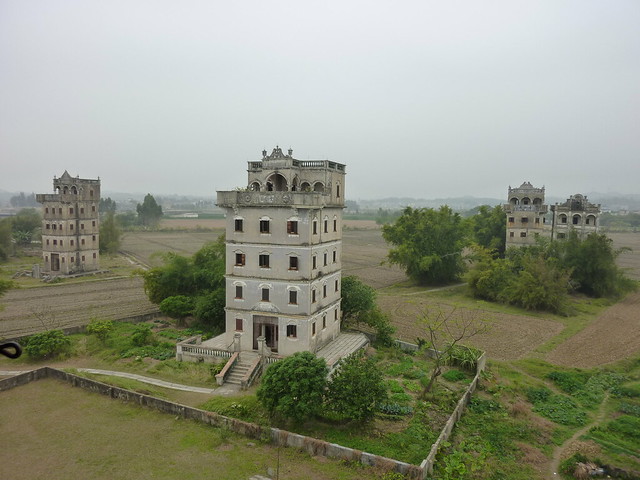
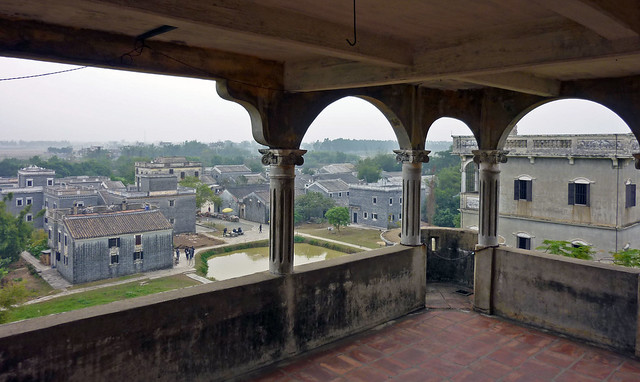
This description brought to mind the most curious buildings that I saw in China, the “diaolou” of Kaiping — the county my father (and his cousin in Arcadia) hails from. Like Arcadia’s new mansions, they look fantastically out of scale, and their mish-mash of architectural revivals certainly don’t match any classical notions of Good Architecture. But sometimes, globetrotting capital manifests itself in less-than-serious ways, and today the diaolou are considered global treasures. From their UNESCO World Heritage Site designation:

covered porch

The main towers, with their settings and through their flamboyant display of wealth, are a type of building that reflects the significant role played by émigré Kaiping people in the development of several countries in South Asia, Australasia, and North America, during the late 19th and early 20th centuries, and the continuing links between the Kaiping community and Chinese communities in these parts of the world.

The big difference between fin-de-siecle Kaiping and 21st-century Arcadia, though, is zoning. America might be “a free country” in many respects, but not when it comes to building houses, as a recent LA Times article by Frank Shyong reveals.

In yet another display of what Mike Davis called “slow-growth Know-Nothingism,” Anglos are using their superior access to the machinery of zoning and local elections to write into law their feelings about “those” people — in particular, changing the zoning code to severely restrict new houses. The people who vote today get to write laws affecting the people who will live there tomorrow, without even knowing or caring who they’ll be.

I used to live in another American neighborhood that’s filled with ostentatious mansions built by immigrants who earned their keep in questionable trades. These days, of course, those buildings are considered local treasures. I’m glad that the Yankee settlers who lived lived there in the 1870s and 1880s, farming and building simple cottages, didn’t have zoning — and thus couldn’t legislate into the built environment their sublimated panic about immigration and social change.

Friday photo: Build in town, not edge towns, to cut carbon

edge town

The results are definitively in: when it comes to cutting carbon pollution from new development, location is far and away the most important factor. Even bad infill development will easily beat even the best greenfield design in terms of avoiding car trips — the single most climate-damaging activity in most Americans’ daily lives.

Kaid Benfield illustrates the point by contrasting the VMT per capita within some of the best suburban and urban neighborhood designs of recent years. Grounding his analysis in research, he writes:

[L]ocation is by far the most significant indicator of how much driving typically takes place to and from a given neighborhood. This is because of something called “destination accessibility”: outlying locations have fewer jobs, shopping opportunities, schools and other typical trip destinations within easy reach than do more central locations, causing average driving distances to be longer. (It is also generally easier in more central locations to substitute transit and walking for what would otherwise be driving trips, but such “mode shifts” are statistically less significant to vehicle miles traveled than are driving trip distances.) As a result, carbon emissions from outlying locations, per person and per household, tend to be higher – typically a lot higher – than those from closer-in locations.

It takes a lot of effort to create new “connected, complete communities” from scratch, since a “complete community” depends upon a myriad of services. When the first household arrives in an incomplete “edge town” (like Kitts Creek, shown above), they may be able to walk to other houses and some services. New services won’t arrive until there’s sufficient population to support them — and in many cases, rely upon people living even further out. Contrast that with a new house within an existing “complete community,” which already has all of that community’s services at their doorstep, from day one.

I’ll note that mode shift is less statistically significant because, outside of a few urban cores where destinations are so close by that walking is enjoyable and driving a pain, driving accounts for a substantial majority of Americans’ trips. That makes development within those few urban cores that much more important, in the scheme of shifting Americans away from automobility.

Thus, the most effective land use tool that urban planners have to address the global warming crisis — and at minimal public cost, to boot — is to make infill development easier.

Applied on a global scale (or even at a citywide scale), the potential is vast: 2014’s New Climate Economy report estimated that “compact, transit-oriented cities” could keep 1.8 billion tons (CO2 equivalent) of global warming pollution out of the air annually by 2050. That’s equivalent to decarbonizing the entire US transportation sector, or the economies of Russia or India.