Friday photo: Bonsai, artificial limits to growth, and humility

Phipps: bonsai since 1960

Cities are living things that require supporting infrastructure: physical infrastructure, social infrastructure, green infrastructure. They also need room to grow and change.

The exception that proves the rule are bonsai, “the most unnatural nature that exists,” and “like a verb…. not a noun — it’s doing.” Trees can survive when confined to tiny boxes that constrain their growth. This 55-year-old Scotch Pine at the Phipps Conservatory would, on a managed plantation, have a trunk one foot wide — wider than the magazine at right, about half the diameter of the planter this tree lives in — and be 60-80′ tall.

However, bonsai require a lot of care and feeding just to survive, including extensive pruning to thwart natural growth instincts. Without that pruning, the tree gradually consumes all of the soil’s nutrients and starves. All this intervention turns what should be a robust, independent tree into a fragile hothouse flower, subsisting on life support. At this juncture, even if it was freed from its constraints, this tree could never match the size of its wild counterpart. It’s a neat inversion of the usual relationship between man and nature, but like seeing a bored tiger at a zoo, it’s also a bit sad to see.

Natural systems also impose limits on their own sustainable growth, of course. Cycles see growth culminating in decline and death, then renewal and evolution. But nothing that’s alive stands perfectly still.

Those who propose to stop growth should have the humility to acknowledge that doing so will change the very nature of growing things. By giving themselves free rein to change the city, they are placing a tremendous burden on the resources of future generations.

“Missing Middle Housing”: missing in action for 30 years

Housing completions by # of units in building

Missing Middle Housing” refers to a broad spectrum of smaller-scale multifamily building types that occupy the middle ground between single-family detached and large apartment buildings. At its edges, the term can cover rowhouses and 5+ unit apartments, but in my mind, the core of the “missing middle” are “plexes” — two, three, or four flats on a single city lot. Small apartment buildings like these line the side streets of most of America’s walkable urban neighborhoods: two- and three-flats in Chicago, Polish flats in Milwaukee, three-deckers in Boston, or brownstones in New York.

Census data show that 2-4 unit buildings have almost evaporated over the past generation. As recently as the early 1970s, over 1/4 of multifamily units built were in small buildings. Now, it’s only about 4%.

Despite the steep mid-1970s recession, over 10X as many units were built in small multifamily buildings as today. In boom years, 14X as many were built. It was during the Reagan era that these buildings broadly fell out of favor.

2-4 unit buildings have been a relatively small share of all multifamily construction in the postwar era. Since the 2008 recession, they’ve practically disappeared — with only a few thousand units built nationwide every year:

Housing completions by # of units in building

Next up: Wait, you mean today’s apartment boom isn’t actually that big?

Friday photo: Be careful what your zoning asks for

In the Penn Quarter neighborhood, as Mark Jenkins wrote in the Washington Post, “arts spaces are mandated by zoning, yet the arts scene is hard to find. Nearly a dozen exhibition spaces populate the area… most don’t have access to the street and aren’t clearly identifiable from outside. They are in lobbies or tucked away in office building interiors.” Here’s one, Terrell Place at the prime corner of 7th & F, that’s not entirely hidden — but also not exactly shouting its noble story to the public. Yet it’s somewhat striking in that it wastes what could be prime retail space across from the National Portrait Gallery and the Verizon Center arena.

The “arts” designation for the “Gallery Place” neighborhood was intended to foster a vibrant community of commercial art galleries alongside working artists, all in the shadow of the Portrait Gallery. Yet instead, there are scarcely any commercial galleries, which require considerable staff investment, and instead many pointlessly large office building lobbies which feature above-average displays of plop art. Perhaps some lawyers and lobbyists have their lives slightly enriched by walking past these paintings, but the general public now derives scant benefit.

The designation is so broadly written that at least two suspiciously spacious bars on E Street — Penn Social and Hill Country Barbecue — both owe their existence to the “arts” requirement. I’m glad that Penn Social has room to spare; it’s a reliable go-to for large events that might not otherwise fit into such a convenient downtown location. But was that really the intent of the zoning?

The situation illustrates the difficulty of trying to define great places, which depend upon a lot of “we know it when we see it” subjectivity, through legal means like zoning. Now that quality retail has emerged as the prime placemaking amenity — anywhere can have open space, but retail’s a lot more difficult — it’s also become something worth subsidizing for its placemaking value. Yet before you can subsidize something, you have to define it.

Doing so will be fiendishly difficult for public entities like municipalities, which will also run into arguments about whether retail is a public good or a private good. However, it should be easier for private entities seeking to cross-subsidize across revenue streams.

CNU conversations: Introducing the Place Corp

west block

Findlay Market in Cincinnati, where a nonprofit market manager and CDC are working alongside private developers to create a mixed-use destination based around small, local shops.

Our earlier lunchtime conversation in Dallas quickly morphed into some constructive criticism of the community development field. We’re doers, so we delved into some of the mechanics of how a community could control its destiny, and ensure affordability over longer time scales.

In theory, Community Development Corporations have tremendous capacity to manage community change, but even where good CDCs exist — as in Boston and Chicago — their efforts are often quickly overwhelmed by the monstrous quantities of capital involved in gentrification. CDFIs were started to help leverage greater sums of capital, but never quite seemed to move beyond a little niche.

The work that community development organizations do is so labor-intensive that it doesn’t end up being very scalable. Some of that is good — community organizing and small-scale development in disinvested neighborhoods is tough. Some of that is bad — there’s so much bureaucracy involved in securing grants or tax-credit financing (or securing property for a Community Land Trust), and in complying with restrictions on spending that money, that staff capacity gets stretched thin.

(As a side note, why don’t we at CNU talk more often with the community development sphere? Sure, there’s some buy-in when individuals from CDCs get invited to present, but otherwise there’s scarcely any overlap. Perhaps siloization is to blame: CDCs/CDFIs have their own conferences, their own language, their own processes.)

Yet surely there are other vehicles that can provide a middle ground of financing for community development. In a gardening analogy, LIHTC-funded, CDC-built subsidized housing is like a trickle of water from a hand-carried watering can, and Wall Street money is like turning a fire hose onto your flowerbeds. Surely there’s some happy medium: a way to use local capital within a neighborhood, to fund incremental, community-positive projects that make a solid but uneventful return, over the long run.

There’s recently been a lot of renewed buzz about low-profit corporations and B-corps. Richard Plunz’s magisterial history of New York City housing shows us that many of the most innovative efforts at community-building there stemmed from just such endeavors, many underwritten by philanthropists or unions who sought investments with steady returns.

We discussed some of the innovation going on with cooperatives — the most established of low-profit, broadly-owned corporations. I talked up some experiments in the Upper Midwest, like the River West Investment Cooperative in Milwaukee, the considerable excitement around the Northeast Investment Cooperative in Minneapolis, and efforts to minimize business displacement along the Central Corridor light rail. In both cities, local capital is fostering communities of cooperative businesses in “emerging” neighborhoods. And unlike the Mondragon cooperatives, these coops are focusing on serving neighborhood needs, rather than exporting. Nationwide, a few credit unions (like Self-Help in North Carolina) have built substantial commercial-lending businesses, even in real estate.

But as much as we liked the idea of cooperatives, not everywhere has the fertile legal or cultural setting of Minnesota or Wisconsin. While cooperatives are great for certain kinds of businesses, they’re not for everyone: They can raise modest sums of capital, but struggle with large sums; their structures aren’t always flexible enough to accommodate multiple capital classes; their plodding, consensus-based nature makes them resistant to entrepreneurs’ bold ideas. Big-money equity investors (aka venture capital) are critically important to getting small businesses going, and are rewarded with high returns and an outsized say in governance — neither of which can be accomplished with a co-op’s flat structure.

dscf0099

The history of Minneapolis’ West Bank neighborhood is an instructive example of co-ops’ promise and limitations. Uniquely among the ’60s hippie havens, federal urban renewal was leveraged to place most of the neighborhood’s housing stock within limited equity co-ops or Section 8. Alas, idealism and local control proved unable to adapt to either obsolescence or succession [PDF]. Photo: Michael Hicks, via Flickr.

Co-ops are a proven success within steady markets that provide community necessities, like workforce housing or groceries or child care or bike repair or bakeries — but perhaps aren’t the best vehicle for more colorful businesses. In many ways, commercial real estate development is just such a business.

Which brought us to the big small-business finance innovation of recent years: crowdfunding. Numerous “community investing” vehicles have been floated, like direct/P2P lending, lending through community financial institutions, conventional Kickstarter-style rewards (perhaps with interest paid in-kind), equity investments, etc. Crowdfunding has become almost de rigeur in certain popular, high-growth businesses. It first swept thin markets for trinkets that would typically be distributed online — e.g., board games. As the dollar amounts have grown, and as regulators have gradually warmed to the idea, platforms specializing in more capital-intensive bricks and mortar projects have sprouted for sectors like breweries and restaurants. Business models that defy categorization, like the McMenamin’s brand of alcohol theme parks, might be particularly well-suited to crowdfunded equity.

Several new platforms have emerged within this space. I’m most familiar with Fundrise. It’s evolved its primary offering away from common equity investments and towards what it calls “project payment dependent notes,” a hybrid of mezzanine debt (it’s debt, with a promissory note) and preferred equity (even though there’s a pre-determined target return, dividends are only paid when there’s adequate cash flow). For small developers, crowdfunding — even in the currently half-baked, accredited-investors-only form — holds significant advantages, namely cheaper, slower money, plus broader community buy-in.

Interestingly for our purposes, at least one nonprofit community development institution has begun to use Fundrise as part of its capital stack, and in particular in an attempt to save a for-profit community institution. The San Francisco Community Land Trust used Fundrise to raise its 38% equity stake (a local nonprofit offered the other 62% as equity) in an attempt to buy a mixed-use building housing the nation’s oldest African American bookstore, in a neighborhood otherwise ravaged by urban renewal. (Alas, the attempt foundered when the landlord changed the offering price.) All that the city could do was to landmark the building, perhaps in an attempt to reduce its market value, and to offer the business inclusion on a “legacy business” roster.

Mezzanine debt seems to also be the sweet spot for small business-oriented lenders like ZipCap. Their business model mirrors the built-in customer base of a cooperative, “recruiting an ‘Inner Circle’ of customers who pledge to spend a set amount of money in a fixed period of time.” Instead of relying upon just that circle for funds [as a co-op would do with equity memberships, or Member Loans], ZipCap uses those pledges as collateral for outside loans.

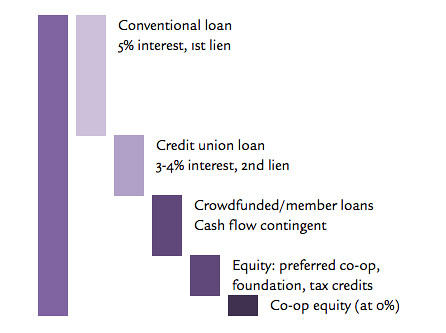
Combining all of the above vehicles — not-for-profits, low-profit cooperatives, and crowd funded for-profits — into interrelated entities might solve the scalability problem by allowing each entity to contribute its own strengths to a capital stack:

investment co-op waterfall

We called this entity a Place Corp, which has the ability to construct a capital stack from various tranches of capital, while keeping control within the community. (Outside investors and developers can help to build pieces, with the Place Corp hopefully maintaining some control via equity, but are treated merely as means towards an end.) Investors can choose from a wide variety of risk/return combinations, and can invest either time or money, choosing negative returns (gifts, grants), zero return (co-op equity), or modest returns. The Place Corp is diversified across property types, but not in location — like the family firms or community banks of yore. The durable, long-term returns of placemaking will create financial rewards for some investors — but for most, the place itself will be the return.

Next in the series: Where? And what sort of services might a Place Corp provide beyond just financing?

Thanks to some of those who contributed to this series of conversations: Karja Hansen, Matt Lambert, Russell Preston, George Proakis, Padriac Steinschneider, Seth Zeren

Friday photo: DMU in Trenton

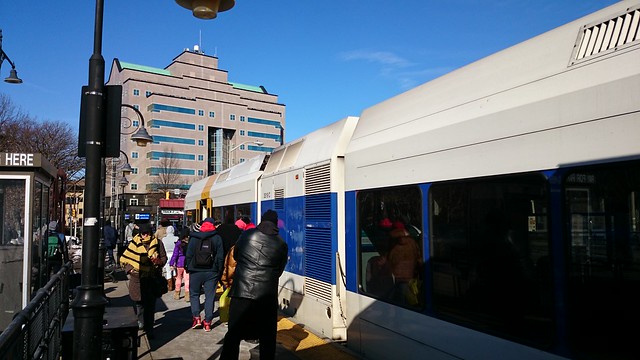
Hello DMU - NJ River Line

Look, an LRV with no catenary! The diesel powerplant in the middle (note the stained exhaust vents) produces its characteristic vibration and noise, and unlike a commuter train, the passenger compartments are all subjected to it. It’s also definitely slower; by one calculation, an electric LRV could do the same route 18% faster. It seemed out of place in the urban centers on either end, but more appropriate in the suburban villages in between.

These might be appropriate for other “interurban” lines with wide stop spacing and relatively low station-area densities. Given that most suburban areas are already arrayed along roads rather than rails, and that the train isn’t much faster than a bus, perhaps this isn’t the panacea for suburban transit.

CNU conversations: If CBAs are broken, should they be turned upside down?

Demolition

Redevelopment of Alexandria public housing near Braddock Metro in 2013. The slightly taller buildings with gables in the back include replacement units.

A subsequent conversation at CNU bemoaned how “tollbooth zoning” (as Ben Ross calls it) has turned everyone into their worst nightmare of a money-grubbing Chicago machine pol, rasping “ubi est mea?” over a cigar.

Ross’ description: “payment, in cash or in kind, is exacted from developers as the price of passage… The most common technique for forcing developers through the tollbooth is to zone for much less density than anyone really wants… When someone wants to build, they either apply for rezoning or seek approval of an ‘alternate’ use of the land” — and thereby pulls up to the tollbooth. It seems cost-less, but only because it’s a way current voters/residents can extract payments (tolls, ransoms) from future residents.

In Chicago, the racketeering operation was simple — you paid, you played. You want to build something? Fine, pay up and we’ll talk. (This indictment was a classic.) In many cities today, it’s pretty much the same. We’re systematically under-zoning (and over-planning) everything to maximize the possible value granted through zoning relief, and demanding the difference back through legalized bribes we call community benefits agreements.

Because the contents of the CBA or PUD are up for negotiation at one point in time, communities end up with whatever’s convenient then, not what’s actually needed. The results can be baffling. One local municipality has a surfeit of tiny “black-box” theaters that don’t get used, since theaters can only be purchased in increments of one, and the cheapest performing-arts giveaway is a black-box theater. (Someday, I’ll pull together a tour of the laughable “arts spaces” that zoning’s required around Penn Quarter.)

The most obvious solution would be to buy upzones using cold, hard cash on a per-foot basis, but that’s not allowed — if it’s a tax (or impact fee), it requires a legal nexus. [Update: Of course, Chicago has since devised a cash-for-upzoning scheme. Don’t try this at home.] So instead, communities get whatever the developer feels generous enough to give. Not to mention that the entire process, since it’s all boils down to political power, favors those who already have political power — large, well-connected developers vs. squeaky-wheel communities. Small developers get shut out of any opportunity to build, and disempowered communities (the homeless, for instance) never get a chance.

Now, since we’ve established that the zoning is entirely arbitrary anyways, why not flip the equation and start with the community benefits? The quantity of stuff permitted on the site ultimately doesn’t matter as much as the quality of what goes there.

This “upside down pro forma” is already being done in several instances, notably in situations where municipalities are seeking to maximize affordable housing output. For instance, cities that have committed to 1:1 public housing replacement — as HUD’s Choice Neighborhoods program does — have long had to work backwards to find enough market-rate units to make the pro forma pencil out. Alexandria has operated under a 1:1 public housing replacement policy since 1972 (“Resolution 830,” PDF), and the results are very impressive — seamlessly integrated urban fabric, both socially and physically.

Canada never had HOPE VI as federal policy, and its municipalities have a firmer hand in land use control. (For instance, Ontario’s Section 37 permits cash payments within a negotiated CBA. Sounds filthy, but actually cash is nice in that it’s easily measured.) So, working backwards from the benefits to the proposal isn’t unusual.

Woodward's

The art inside the Woodward’s enclosed retail court shows a police riot that took place nearby.

In Vancouver, the mind-bogglingly complex Woodward’s redevelopment used a public RFP process to stack a vertical mixed-use community with just about everything onto an abandoned department-store block right on Skid Row.

In Toronto, zoning bonuses paid for a 68-unit artist live/work space. Regent Park’s redevelopment has created 1:1 replacement units, plus 15% so far. As part of the development agreement, space for social infrastructure was built early on; the Daniels Spectrum “includes several state-of-the-art performance spaces, a locally run café, a green roof, and two floors for various educational, arts and community groups that have long operated in and around Regent Park. Many relied on informal or rented space, and some had been uprooted when the demolition began. The need for this kind of social infrastructure remained.”

Regent Park redevelopment continues

Regent Park in Toronto, where a commitment to better than 1:1 replacement housing (and additional retail and social services) is resulting in much higher densities.

That’s certainly one approach for maximizing the community benefits, but it introduces a few huge risks. It still only works for huge projects, it still relies on political power, and it still subjects the CBA to the fads of the moment. And what happens if the approach fails? The developer might just decide there’s nothing in it and walk away. (Another argument for good phasing.)

Even though the “tollbooth” system is the one we’re used to, it’s in large part to blame for making development complicated and costly — thus shutting out smaller producers, resulting in under-production and higher costs for everyone. Those higher costs go into landlords’ pockets. A rational system would instead make it easier to build, lower housing prices, and instead steer the same dollars to higher taxes and better services for all needy people, regardless of whether they live near a CBA-extracted theater or not.

To finish off the analogy: instead of fighting over who gets to sit inside the tollbooth, maybe it’s time to replace tolls with VMT charges and carbon taxes.

(Updated 4/2018)

One (faraway) city sees its authentic retail as “basic infrastructure,” even amidst gentrification

Singapore Hawker Center

A case study (quite literally) about the struggle to maintain authenticity through small-scale retail operations is profiled in this week’s Economist. In Singapore, the government somewhat inadvertently nurtured one of the world’s most exciting food cultures through its “hawker centers.” Anthony Bourdain explained their history in “The Layover“:

The hawker centers of Singapore were a shrewd strategy to incorporate and control what was once a chaotic but pervasive culture of street carts. To control the health, safety, and traffic aspects, vendors were brought inside these covered structures still open to the air, but in stalls with regulated running water, refrigeration, and strict rules of food handling.

In short, they’re food courts with one key twist — they’re government-owned, often located within HDB public housing estates. Today, rising rents and rising living standards both threaten the culinary treasures that are so integral to Singaporean culture:

The main problem is that Singaporeans have grown used to paying prices that the market can no longer bear… The government, says Dr [Leslie] Tay, “has committed to providing cheap food for the masses”. With tiny flats and cramped kitchens, and with the number of two-working-parent families steadily rising, plenty of Singaporeans count on hawker markets for their sustenance. But with the first generation of hawkers retiring and their replacements paying market rents, food prices will certainly rise.

And as the masses change, so will the food. Some Singaporeans lament that a recent influx of immigrants from northern China has made their traditional Teochew or Hokkien [ethnic groups from southeastern China] favourites harder to find.

The article arose from a blog post by Dr Tay where he recommended instituting non-market mechanisms for allocating space in the government-owned markets: “Wouldn’t it be great if the officers can just recognize his status as a Heritage Hawker and help him get a stall at pioneer hawker prices?” (Pioneering stalls were subsidized in an attempt to entice hawkers off the streets, and today those rents are 90% below market rate, according to the 2015 case study by Tan Shin Bin for NUS’ Lee School.)

Indeed, but would you necessarily trust a government to make good decisions about what constitutes “good food”? Perhaps not, but plenty of America’s most successful public markets (like those in Milwaukee and Seattle) are run by nonprofits. An early effort at a nonprofit hawker centre in Singapore failed, but the government has signed new management agreements with cooperatives and “social enterprises,” as recommended by a 2012 panel.

A prior experiment in renting out a hawker center to a for-profit operator failed, and won’t be repeated; Minister Vivian Balakrishnan, whose ministry runs most centers, maintains that “Hawker centres are social infrastructure – and not an opportunity for property speculation or rent seeking by commercial entities.” Instead, nonprofit managers will get the opportunity to reinvest surpluses into social development and entrepreneurship, and prioritize operators that provide affordable food and heritage cuisines.

“Social infrastructure,” as Minister Balakrishnan put it, provides a useful frame for talking about “authenticity.” Cities are living things that require supporting infrastructure: physical infrastructure, social infrastructure, green infrastructure. They also need room to grow and change.

How can cities simultaneously build physical infrastructure (transportation, housing, workplaces) while also supporting and fostering social infrastructure, and regenerating ecological infrastructure? The answer might seem simple, but unlike physical infrastructure, social infrastructure is itself also living — and a somewhat fickle, slow-growing, and slow-rooting species at that. These make them tremendously resilient, but also slower to adapt than other forms of infrastructure.

As Singapore’s experience indicates, the answer probably lies with the social enterprise sector. How could those be structured? One potential answer’s coming up.

Friday photo: a minimalist memorial

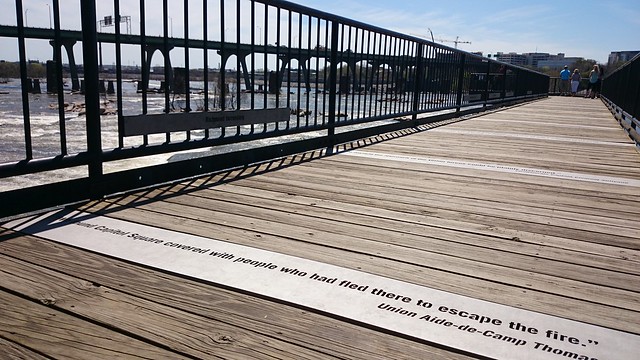
Richmond riverfront

The 1865 Exhibit,” a surprisingly moving exhibit (full text) comprises of a terse timeline (pictured here: “Richmond surrenders”), plus primary-source quotes from the three-day liberation of Richmond. Obviously, the surroundings help: swirling waters, road and rail traffic on bridges old and new, the city skyline and the woods.

A soldier with the 11th Connecticut, quoted in James Loewen’s Lies Across America in its chapter about the curious then-omission of Richmond’s liberation from the city’s landscape:

Our reception was grander and more exultant than even a Roman emperor, leading back his victorious legions with the spoils of conquest, could ever know… The slaves seemed to think that their day of jubilee had fully come. How they danced, shouted, waved their rag banners, shook our hands, bowed, scraped, laughed all over, and thanked God, too, for our coming.

Sometime soon, the walkway (built over a dam that fed an adjacent canal) will again cross the river.

CNU conversations: Can we build authentic, small-scale communities that subtly adapt to change?

A few thoughts on a CNU 23 presentation by Russell Preston and Matt Lambert about their ongoing work on defining and fostering authenticity within New Urbanist places. Other thoughts will be forthcoming, as I write them up.

Once and forevermore

Do design and development really disrupt enduring neighborhoods? This block in Guangzhou, China, changed tremendously, but in some ways didn’t change at all.

1. Role of design
Flexible, adaptable buildings allow uses to change in their natural cycles. Crucially, notoriously fickle uses like production and retail must be given room to adapt. Not only do shop concepts and merchandise change, but the volume of these uses needed rises and falls with economic cycles. Tactical urbanism has shown us that design details may not be quite as important as broader questions of scale and program. Such a “stage set” approach may be especially appropriate in an era where programs frequently change.

2. Small scale
To the extent that smaller, more “honest” enterprises can be designed around, perhaps the best physical model relies on creating adaptable space along many smaller frontages — a fractal approach, as it were. More marginal businesses have long turned to side streets and passages to be near, but not in the middle of, the retail action.

Since these frontages are inherently not as valuable, they can remain affordable even amidst higher rents for premier locations nearby. Just as coach houses are “naturally affordable housing,” consider the value of alleys, passages, and even enclosed arcades as “naturally affordable retail.”

Another CNU 23 session, ostensibly about pedestrian malls, featured examples of pedestrian-only ancillary passages where smaller retailers thrive just off Main Street. Beth Anne Macdonald spoke about Division Street in Somerville, N.J., where commerce has thrived after the street was turned into a pedestrian mall in 2012. Division (like Bethesda Lane, which Tim Zork presented at the same session) was intended as shared space but ended up being car-free 24/7 — a testament to that type’s tremendous flexibility. Despite its Spartan design of concrete and streetlamps, Division is thoroughly programmed year-round.
Downtown in the distance

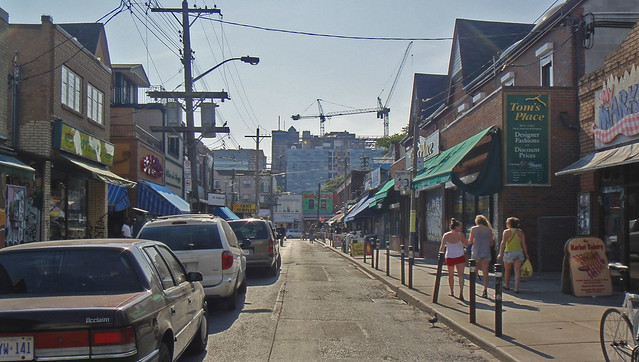
Kensington Market in Toronto has a built environment that’s a terrible jumble of everything, but it gets the scale — and thus the feel — just right. It’s car-free on summer Sundays, thanks to gates that cost just $180,000.

Similarly, I’m setting up a walking tour in October of how retail is thriving away from the main streets in Georgetown, along its alleys, side streets, and the pedestrian-only C&O trail. The neighborhood’s historic scale — its small blocks and small spaces — and relatively flexible zoning permits this natural shift between uses. That these processes can work illustrates two chapters in “Death and Life”: small blocks and aged buildings.

Of course, financing these spaces can be a challenge. Yet this country is plagued with throwaway retail space, much of it ancillary to upstairs office and residential. Whether the ground floor of an apartment complex is given over to “amenity space,” or to small retailers who may or may not reliably pay rent, shouldn’t be of much interest to the bankers — and, arguably, many of the apartment tenants might well prefer the latter! Designing the public and private spaces with the flexibility to accommodate whatever uses might be demanded could prove a greater challenge.

At the Louisville NextGen meeting, the one example of a new-construction informal street market that I could think of was a set of buildings in Downtown LA’s Fashion District. They appeared to have been built largely as paid parking garages, for which there are many local comparables, but had clear-span ground floors to accommodate small wholesale clothing retailers. It was awesome.

3. Policy and non-market structures
Market prices for prime space in gateway cities have — due to high outside-investor interest — reached heights that stifle innovation and organizations that evaluate their impact in primarily non-market means. Furthermore, not all institutions are lucky enough to have purchased their property “back when it was cheap.”

The 5M model (final program & renderings) has promise — identifying “community anchors” more broadly than just non-profits, offering free or discounted space to these community serving entities, and profiting by selling ancillary services. The other innovation is that this project’s pro forma has been turned on its head: the community space is accepted as a given at the starting point, and the market-rate buildings sized accordingly. (Since every development in San Francisco is discretionary, you might as well ask for the moon.)

But what about the next community that comes along? Will tomorrow’s fresh ideas and institutions have similarly protected spaces? Is this model flexible enough to accommodate new institutions, or shifting missions among the existing institutions? Rather like rent control, this approach privileges those who showed up at the right time, excludes newcomers — and leaves the question of capital renewal unanswered. Could a similar space, like [innovation] District Hall, be continually refreshed with new concepts and competitions on a regular basis?

(We had a detailed conversation about a potential corporate structure to ensure long-term community affordability on the following day. Notes about that conversation are forthcoming.)

4. Chinatowns, new
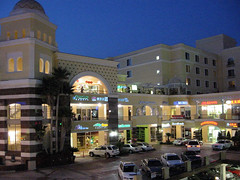
At least some suburban communities have successfully retrofitted smaller scale uses into strip-mall suburbia: the “ethnoburbs” that Asian immigrants have settled across North America. Even shiny, new buildings still foster small businesses, due in part to high density, tiny footprints (see above), management that understands the business models, and perhaps other factors that could be identified.
Meanwhile in ethnoburbia

San Gabriel, Calif.

These retail centers can be built in a more transit-oriented manner; the vertical malls cropping up around Flushing have a mind-boggling spatial complexity. The vertiginous skyscrapers of Hong Kong, clustered around mass transit, have organically evolved 3-D pedestrian networks so intricate that they defy description, but which host all sorts of authentic communities.

5. Chinatowns, old
These neighborhoods appear to maintain a remarkably stable level of economic diversity — of activities, of economic groups — and appear, from the outside, to have stable populations. Yes, some of this stability is real, and partially results from capital that gets locally recycled, through local institutions.

But what looks like stability from the outside also hides considerable turbulence under the surface. There’s constant upheaval among the community’s participants, as high in-migration balances out community members “lost” to assimilation. By and large, assimilation (as institutional racism declines/morphs) has undermined most of American cities’ other mixed-income ethnic enclaves, but since Han Chinese easily outnumber every other ethnic group in the world, there will always be a inflow of migrants — or will there?

Another less-than-replicable factor behind Chinatown’s staying power is a lack of effective enforcement (“It’s Chinatown, Jake”). Thus, things don’t quite happen to code; it’s cheaper, but somebody might get hurt. Whether that trade-off is worthwhile is your judgment call, but it does illustrate that over-regulation might be a factor in driving high costs.

6. Community change and the word “authentic”
It’s worth thinking through a bit more about how “authenticity” (see this discussion by Sharon Zukin) like any other aspect of community character, will move in cycles. Every community changes its participants, and is changed by its participants. The people who come after us have different experiences, and what we do shapes how they understand the world around them. This feedback loop can either result in a virtuous, or a vicious, cycle.

The pace of change also matters. Change is literally a fact of life, but violent upheaval is rarely welcomed. Many communities today are upset by the roller-coaster ride that property markets have put them on, with prices rising much faster than social infrastructure can adapt.

What appears authentic and novel to us will seem workaday and fake to someone else: If I cooked one of my grandfather’s recipes for you, you’d see it as “authentic” and he’d see the exact same dish as “fake.” It’s exactly that interplay, exchange, and evolution that makes cities — and especially American cities — such interesting and exciting places. It’s a tough edge to surf on, to simultaneously embrace and resist change, to honor established practices while inventing new ways, but it’s a worthwhile endeavor.

High rises’ high costs, part 3: Maintenance costs

Earlier, I’ve written about how high-rises face higher up-front costs, stemming from both lower efficiency and higher construction costs. But the high-rise cost penalty doesn’t just apply to upfront construction costs — their ongoing maintenance expenses are typically higher than for low-rise buildings.

Eastgate Village & Mercy Hospital

Even within this one development, condo fees for 1-bedroom units are 30% higher in the renovated mid-rise than in the new low-rises.

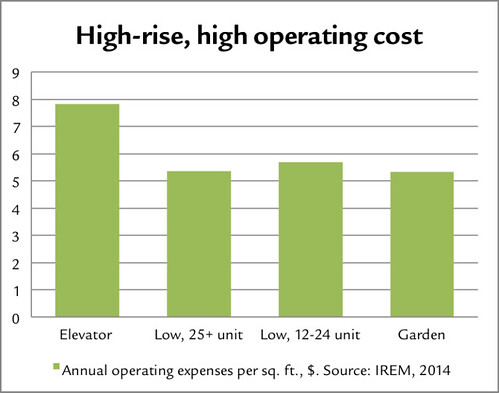
The Institute of Real Estate Management publishes an annual benchmarking report for property managers, showing average operating expenses for 717,000 apartments nationwide. IREM’s 2014 report found that “elevator” buildings (both mid- and high-rise) have operating costs that are 43% higher per square foot.

IREM apt ops data

Frank Schliewinsky, writing in Strategics Vancouver Condo Report, analyzed MLS data to find that “Monthly strata [condo] fees for low-rise projects tend to be less than those for high-rise projects.” Fees averaged 22-25% higher per unit in high-rise buildings across metro Vancouver, both in low- and high-cost markets, and both for new construction and older buildings.

(Factors that may explain the discrepancy between the two figures may relate to definitions — many low-rise buildings still have costly elevators — and/or the smaller unit sizes typical in high-rises.)

Some of these increased costs stems from the upfront construction: high-rises have more materials and bigger systems to maintain, and their less efficient floor plans mean more common areas have to be maintained.

Another curious factor is at work, though. The higher costs for high rises creates a vicious cycle: Higher costs (per square foot, and per unit) mean higher rents are needed to justify high-rise construction. Those higher rents can only be achieved by aiming for that segment of the market which wants to pay higher rents — by definition, the luxury segment, who can be enticed to pay higher costs by adding ever more amenities. Those amenities further increase costs, both up front and in the long run.

None of this is to disparage high-rises, of course: I live in a high rise, after all, and enjoy its sunlight, views, sound attenuation, and proximity to services. (And, frankly, don’t really use the high-cost swimming pool very often.) When I was younger, though, I lived in lower-cost low-rise apartments and aspired to someday live in the sky.

The intrinsically high costs of building and maintaining high-rises makes it dangerous to recommend that high-rises will absorb a large share of housing growth — particularly in metro areas that already suffer from high housing costs, which don’t need even more housing that’s inherently costly.

(Again, to be continued.)

High rises’ high costs, part 2: Land-efficient, but not floorspace-efficient

clearing

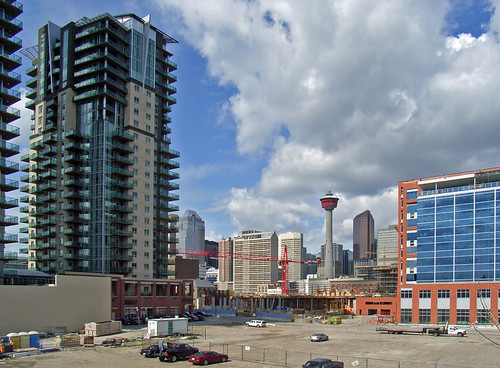
High-rises, like these in Calgary, may be land-efficient, but aren’t really floorspace-efficient.

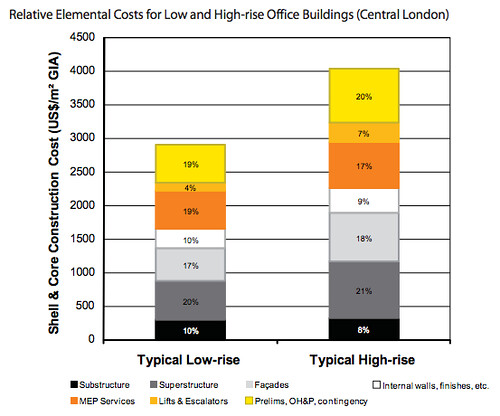
I wrote earlier about how higher per-square-foot construction costs make high-rise housing considerably more expensive to build than low-rise housing. Those higher prices don’t stem from any one factor; costs for everything increase as buildings get taller (courtesy James Barton and Steve Watts of Davis Langdon/AECOM, in a CTBUH Technical Paper):

Elements of higher cost for high-rises

Increasing building heights doesn’t linearly decrease the cost of land per unit, as economic theory suggests, since taller buildings cost more (and in non-linear ways): they cost more to build, and they inherently waste more of their floor space.

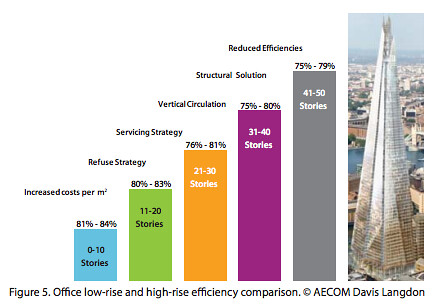
The “efficiency” of high-rise (and mid-rise) buildings is typically lower than for low-rise buildings, and as Tom Steidl points out, especially so under American building codes. “Efficiency” in this context is an architectural term describing the “net to gross” ratio, of “rentable” or net internal area to gross internal area. As Steve Watts of Davis Langdon/AECOM points out in CTBUH Journal:

Tall buildings are less efficient than low-rise schemes because:
– Structural frames and core walls are larger and thicker
– More area is taken by plant and risers
– Smaller floor plates result in relatively high space-taken by lifts, stairs, circulation, etc.

Floorplate efficiencies of high-rises at various heights

Essentially, connecting all of the stuff above down to the ground requires taking space away from all the floors below. Every additional floor requires a tiny slice of every single floor below. The result is that 15%-25% of a high-rise’s floor area is typically wasted space. Steidl helpfully shaded these diagrams of towers in Vancouver (88.8% efficient) and Los Angeles (80.9% efficient), with net square feet in orange:

Ground-related housing types minimize this efficiency loss by eliminating interior hallways and vertical circulation. A typical Chicago three-flat achieves almost 90% net-to-gross efficiency, and every additional flat makes the design even more efficient — six flats can be accommodated with the same circulation area, yielding almost 95% efficiency. Alternate designs, like Montreal’s exterior-stair triplexes or the “Charleston triplex” (a Torti Gallas invention at King Farm that gives three flats their own internal staircases) can yield even higher efficiencies, approaching 100% — while achieving densities exceeding 30 dwelling units per acre.

Putting the two together, a high-rise unit faces a 15% efficiency penalty, and a 40% (or higher) cost penalty per square foot. The compound penalty of these two factors amounts to a 60% (or higher) construction cost premium per high-rise unit. Plus, ground-related housing can often be “self-parked,” i.e., can meet parking requirements with surface lots rather than costly multi-story parking.

What’s more, interior common areas don’t just have to be built today; they have to be maintained tomorrow — a subject for another post.